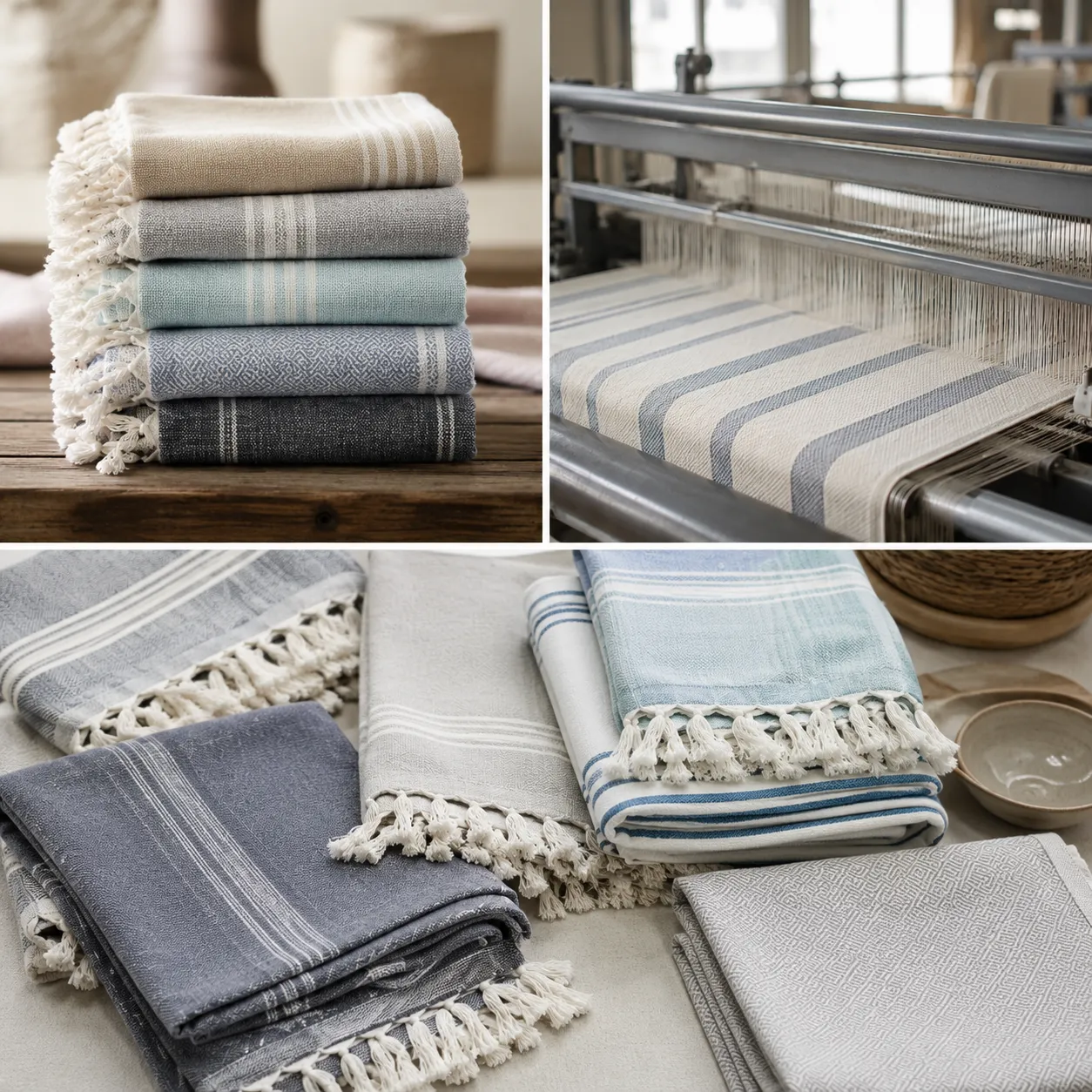
What This Pricing Model Actually Includes
Peshtemal pricing is easy to misunderstand because the towel looks simple: flat weave, light handfeel, fringe at both ends. In the mill, it is not priced like a terry bath towel. Terry cost is driven heavily by pile yarn weight; peshtemal cost is driven by warp setup, weft density, yarn quality, shrinkage after finishing, and fringe handling time.
For our factory, a realistic Turkish peshtemal towel bulk pricing model starts with the finished size, not the greige size. A 100×180 cm towel may need to be woven around 108×194 cm before washing if the construction shrinks 6–8% in width and 7–10% in length. Buyers who compare only finished GSM miss the fabric loss that sits before packing.
- Finished size: common resort sizes are 90×170 cm, 95×180 cm, and 100×180 cm.
- Construction: flat weave, honeycomb, twill stripe, or mixed terry-back panels change loom speed.
- Yarn route: ring-spun cotton, combed cotton, cotton-bamboo blend, or recycled cotton blend.
- Fringe method: machine-tied fringe is cheaper; hand-knotted fringe adds labor and more rejection risk.
- Decoration: woven stripe, jacquard logo band, embroidery, screen print, and paper belly band are costed separately.
Our MOQ remains 500 pcs per design per color. We can sometimes combine neutral stripe colors in one yarn-dyed warp plan, but we will push back if the order requests 12 colors at 500 pcs each with different warp layouts. That creates setup waste and makes the unit price look worse than it should.
| Line item | Typical range | How it affects FOB cost |
|---|---|---|
| Finished GSM | 220–420 GSM | Every 40 GSM step usually adds USD 0.22–0.46 on 95×180 cm sizes, depending on yarn count. |
| Yarn count | 16s, 21s, 32s cotton | Finer yarn gives smoother drape but increases spinning and breakage cost. |
| Weft density | 14–24 picks/cm | Higher picks/cm improves body and stripe clarity but slows loom output. |
| Fringe length | 6–12 cm | Longer fringe increases yarn waste and tying time. |
| Finishing loss | 5–11% | Washed softness and shrinkage control must be priced into greige fabric width and length. |
| Packing | OPP bag, kraft band, carton | Retail belly band plus barcode label can add USD 0.10–0.28 per pc. |
Turkish Peshtemal Towel Bulk Pricing Model by Volume
Below is the kind of FOB Ningbo/Shanghai pricing band we would use for first-pass RFQ discussions. These are not shelf prices. They assume export-grade cotton flat weave towels, OEKO-TEX 100 Class I compliant dyeing auxiliaries, ISO 9001 process control, and standard carton packing.
For a hammam towel bulk order, the price gap between 1,000 pcs and 10,000 pcs is real but not unlimited. Yarn and dyeing do not become half price just because the PO is larger. The bigger savings come from warp planning, lower setup waste, fewer lab dips per unit, and carton consolidation.
| Spec example | 500–999 pcs | 1,000–2,999 pcs | 3,000–7,999 pcs | 8,000+ pcs |
|---|---|---|---|---|
| 90×170 cm, 240–270 GSM, yarn-dyed stripe, machine fringe | USD 3.05–3.55 | USD 2.72–3.18 | USD 2.48–2.92 | USD 2.30–2.70 |
| 95×180 cm, 300–330 GSM, combed cotton, washed finish | USD 4.15–4.90 | USD 3.78–4.42 | USD 3.46–4.05 | USD 3.24–3.78 |
| 100×180 cm, 360–400 GSM, honeycomb weave, long fringe | USD 5.35–6.45 | USD 4.86–5.88 | USD 4.45–5.36 | USD 4.18–5.05 |
| 95×180 cm, jacquard border logo plus stripe | USD 5.10–6.20 | USD 4.62–5.58 | USD 4.24–5.05 | USD 3.96–4.72 |
These bands assume one approved colorway per 500 pcs. If the buyer asks for 500 pcs split into five stripe colors of 100 pcs each, the quote will not hold. The loom still needs warp preparation, yarn dyeing, and inspection by color. For small color splits, a better route is to keep the base towel natural or ivory and change only the belly band, hangtag, or embroidery thread.
For peshtemal, the cheapest quote is often a low-density fabric with under-controlled shrinkage. It can look acceptable in a sample photo and fail after the third hotel laundry cycle.
Yarn, Weave Density, and the Cost of Drape
Peshtemal buyers often describe the target handfeel as soft, dry, and compact. That does not automatically mean low GSM. A 230 GSM towel can feel harsh if the yarn is coarse and the finishing is rushed. A 310 GSM towel can still pack tightly if the weave is balanced and the yarn has enough twist stability.
We normally build flat weave Turkish-style towels in 21s or 32s cotton. For a more rustic hospitality look, 16s yarn can work, especially in wide stripe designs. For a cleaner retail handfeel, combed 32s cotton gives fewer neps and a smoother face, but it raises raw material cost and demands tighter loom tension control. If tension is uneven, the finished towel can skew after washing, especially with border stripes.
- Flat weave: lowest weight and fastest drying, useful for beach clubs, hammam retail sets, and luggage-friendly resort gifts.
- Honeycomb weave: more surface texture and perceived body, but slower on the loom and more sensitive to shrinkage variation.
- Twill stripe: good for bold visual bands; edge bowing must be checked after finishing.
- Terry insert panel: possible for absorbency zones, but it changes the article from a true flat peshtemal into a hybrid construction.
One construction quirk matters: the selvedge edge of a peshtemal carries more visual responsibility than the side seam of a terry towel. If warp tension is uneven, the stripe line may curve near the selvedge. We check bow and skew after ISO 6330 washing, not just on the loom. For export orders, we usually hold dimensional tolerance at ±3% after washing for flat weave peshtemal and tighter only when the buyer accepts a higher reject allowance.
| Construction choice | Best use case | Risk if under-specified | Cost impact |
|---|---|---|---|
| 240–270 GSM flat weave | Promotional resort gift or retail bundle | Can feel too thin if yarn is low grade | Lowest cost base |
| 300–330 GSM combed cotton flat weave | Hotel spa, beach club, boutique retail | Shrinkage must be tested before bulk | Mid-range cost |
| 340–390 GSM honeycomb | Spa lounge, elevated hammam program | Texture can pucker if finishing is uneven | Adds roughly 12–18% over plain flat weave |
| Jacquard border logo | Private label and club branding | Logo distortion if border repeat is not engineered | Adds setup cost plus slower weaving |
Fringe Is Not a Free Detail
The fringe is where many peshtemal cost disputes start. In a product photo, machine-tied fringe and hand-knotted fringe can look similar. In production, the labor time and defect risk are different. Machine fringe is more consistent and suitable for hotel laundry. Hand knotting gives a craft look, but the knots must be checked for pull strength and symmetry.
For bulk pricing, we separate fringe into length, knot type, and trimming standard. A 7 cm fringe on both ends is efficient. A 12 cm twisted fringe with tassel grouping uses more yarn and adds manual correction time after washing. If a buyer requests long fringe for a pool program, we ask about laundry equipment first. Industrial tunnel washers can tangle long fringe and create return complaints that have nothing to do with cotton quality.
- Set the finished fringe length in centimeters, measured after wash and tumble dry.
- Confirm machine-tied, hand-knotted, or twisted tassel construction before sample approval.
- Run a 10-piece wash trial to check knot loosening, yarn shedding, and edge curling.
- Define trimming tolerance, usually ±1 cm for standard fringe and ±1.5 cm for hand tassel styles.
One defect we watch for is fringe slippage at the last weft insertion. If the lock yarn is too loose, the towel body may remain stable while the fringe begins to open after laundering. We use a simple internal pull check on fringe bundles, and for stricter hotel programs we can align testing with ISO 13934-1 fabric tensile principles on retained samples. It is not a decorative issue; it is a service-life issue.
Decoration Costs: Stripe, Jacquard, Embroidery, Label
A peshtemal already has a strong woven identity, so not every logo needs embroidery. For many resort and spa buyers, a yarn-dyed stripe plus woven label gives a cleaner result than a large stitched logo. If the towel is thin and loosely woven, embroidery can pucker the flat fabric unless we add backing and reduce stitch density.
For buyers comparing peshtemal towel wholesale pricing, decoration should be quoted as a separate line. Otherwise, a supplier may hide a lower fabric grade behind a bundled logo price. We prefer to price the base towel, then add the decoration route. This lets the buyer see whether the cost is being spent on cotton and weaving or on branding.
| Branding method | Typical MOQ | Approx. add-on cost | Factory note |
|---|---|---|---|
| Yarn-dyed stripe pattern | 500 pcs/color | Included in base if stripe yarns are planned together | Best for repeat resort programs. |
| Woven label on hem | 500 pcs/design | USD 0.07–0.18/pc | Low risk and laundry-stable. |
| Embroidery up to 6,000 stitches | 500 pcs/design | USD 0.20–0.46/pc | Needs backing test on 240–300 GSM fabrics. |
| Jacquard border logo | 800–1,000 pcs/design | USD 0.42–0.95/pc plus setup | Good for subtle branding but requires repeat engineering. |
| Kraft belly band with barcode | 500 pcs/design | USD 0.11–0.24/pc | Useful for DTC and resort retail shelves. |
If the logo is central to the order, review embroidery vs sublimation vs jacquard before locking artwork. For tech pack setup, our team usually asks buyers to include Pantone TCX or TPX references, logo vector files, finished size, and carton packout in one document. The process is faster when the first RFQ resembles the structure in build a towel tech pack that mills can quote.
Color, Washing, and Lab Test Costs Buyers Forget
Peshtemal towels are often yarn-dyed. That means stripe color is built into dyed yarn before weaving, not printed on top afterward. Yarn dyeing gives better stripe clarity and wash durability, but it creates minimum dye-lot logic. If the order uses six stripe colors, each color must be matched, dyed, dried, and checked before weaving starts.
For color approval, we use D65 light source review and buyer-approved Pantone standards where provided. For wash performance, the two tests we quote most often are ISO 105-C06 for colorfastness to domestic and commercial laundering and ISO 105-X12 for rubbing fastness. For dimensional stability, we use ISO 6330 washing procedure references, then measure shrinkage after drying. These are not paperwork extras; they determine whether the towel still fits the brand spec after real use.
- Natural and ivory: lowest dye risk, suitable for spa and wellness programs, but must be protected from warehouse staining.
- Navy and black: higher risk of lint visibility and rubbing complaints if dyeing is rushed.
- Red and saturated orange: often require extra lab dip rounds to hit shade and fastness together.
- Yarn-dyed multi-stripe: attractive for retail, but each added yarn color increases setup complexity.
- Garment-washed finish: softer handfeel, with more shrinkage allowance and slightly higher processing cost.
Our standard bulk approval route includes one lab dip or yarn color card round, one pre-production sample, and bulk cutting from approved greige or finished fabric. Extra lab dips are not expensive alone, often USD 35–70 per color, but they add days. For seasonal resort launches, late color changes are more damaging than the lab dip fee because loom time has already been planned.
MOQ, Color Splits, and Cost-Per-Use Reality
Our factory MOQ is 500 pcs per design per color, and this matters more for peshtemal than for plain white terry towels. A plain hotel towel can often share yarn and dyeing across multiple clients. A striped peshtemal with custom warp layout belongs to one buyer’s program. The setup cost has fewer places to hide.
Here is a practical cost-per-use example. A beach club chooses between a 250 GSM 90×170 cm towel at USD 2.62 FOB and a 320 GSM 95×180 cm combed cotton version at USD 3.88 FOB. After local freight, duty, and handling, landed costs may be around USD 3.18 and USD 4.66. If the lighter towel survives 28 commercial wash cycles before edge curl and fringe loosening cause removal, cost per use is USD 0.114. If the heavier towel reaches 64 cycles, cost per use is USD 0.073. The second towel costs more on the PO but less in operation.
This is why we push back when buyers ask us to remove weight from a towel that will enter hotel or beach club laundry. A thin peshtemal can be correct for retail gifting or airline amenity use. It is usually the wrong choice for a property that washes the same towels three times per week.
- Use 500 pcs as the minimum for one colorway, not as a target for five colorways.
- Keep stripe layouts shared across colors when possible to reduce warp change cost.
- Choose packaging variation instead of fabric variation for small boutique runs.
- Approve one base construction first, then develop seasonal colors after laundry testing.
- Ask for retained bulk reference samples so reorders can be matched against the original shipment.
For broader MOQ strategy, negotiate towel MOQ without killing margin explains where mills have flexibility and where they do not. If the program is for pool or beach operations, beach club resort towel program is also useful for planning loss rates and reorder timing.
Production Timeline from RFQ to Vessel
A realistic peshtemal schedule is 38–58 days after all artwork, color standards, and deposit are confirmed. The low end applies to natural or simple yarn-dyed stripes with existing yarn routes. The high end applies to custom jacquard border, multiple yarn colors, special retail packing, or repeated lab dip rounds.
| Stage | Typical days | What can delay it |
|---|---|---|
| RFQ clarification and costing | 1–3 days | Missing finished size, GSM, fringe, or packing details |
| Lab dip or yarn color approval | 5–9 days | Saturated colors, unclear Pantone reference, buyer review delay |
| Proto or pre-production sample | 7–12 days | New jacquard border, hand fringe, revised label placement |
| Bulk yarn dyeing and warp preparation | 6–10 days | Too many color splits or late shade correction |
| Weaving and fringe processing | 10–18 days | Long tassels, honeycomb construction, loom queue |
| Washing, finishing, inspection | 5–8 days | Shrinkage outside tolerance or colorfastness retest |
| Packing and export booking | 4–7 days | Barcode changes, carton mark revisions, vessel space |
For air freight, peshtemal has an advantage over terry because it packs flat and dense. But air freight still damages the economics of a bulky textile order. For most resort programs, sea freight is the better plan unless the first opening inventory is late. The trade-off is covered in more detail in container vs air freight towel orders.
Carton planning should be set before production finishes. A 95×180 cm towel at 310 GSM usually packs around 40–50 pcs per export carton depending on folding method, belly band, and moisture control target. We keep carton gross weight practical for warehouse handling, usually under 18–21 kg. Over-packed cartons can compress fringe and create uneven shelf presentation after unpacking.
What We Need to Quote Without Padding
A clean RFQ helps us quote tighter. If a buyer sends only a photo and target price, we have to protect against unknowns. If the buyer sends a spec sheet, we can separate base towel cost from decoration and packing. That is where the Turkish peshtemal towel bulk pricing model becomes useful rather than theoretical.
- Finished size, GSM target, and acceptable shrinkage after wash.
- Yarn preference: carded cotton, combed cotton, organic cotton, or blend.
- Weave type: flat, honeycomb, twill stripe, jacquard border, or hybrid terry panel.
- Stripe artwork with color references and repeat direction.
- Fringe length and knot method after washing.
- Decoration files, label artwork, barcode needs, and carton mark requirements.
- Order quantity by color and expected reorder calendar.
We manufacture under ISO 9001 quality management, BSCI social compliance, and OEKO-TEX Standard 100 Class I material control where specified. For baby, spa, or sensitive-skin programs, buyers should request the relevant certificate number and scope rather than accepting a logo screenshot. Our guide how to read OEKO-TEX certificate explains how to check product class, validity date, and covered materials.
Related reads: for material trade-offs, see combed vs zero twist cotton explained and towel GSM decision framework. For size planning across resort and bath programs, use towel sizes dimensions complete guide.
Factory Recommendation for Resort and Retail Buyers
For a first private-label peshtemal program, we usually recommend one core construction before expanding colors. A safe starting point is 95×180 cm, 300–330 GSM, combed cotton flat weave, 7–8 cm machine-tied fringe, yarn-dyed border stripe, woven label, and kraft belly band if retail display is needed. This gives enough body for resort use while staying compact for shipping and shelf storage.
For a lower-cost promotional version, move to 90×170 cm and 240–270 GSM, but keep the fringe controlled and avoid too many stripe colors. For a higher-end spa or boutique retail version, choose honeycomb texture or jacquard border branding, but allow more sample time and a larger first order. The wrong move is asking for luxury handfeel, six custom colors, hand tassels, retail packing, and the lowest promotional price in one PO.
We can produce peshtemal orders from 500 pcs per design per color, with more stable pricing from 3,000 pcs upward. For current FOB bands, sample timing, or construction feedback, contact us on WhatsApp at +86 13205717266 or email [email protected]. We will quote the base towel, decoration, packing, and testing assumptions separately so your team can see where the money goes.
Price a Peshtemal Program Clearly
Send finished size, GSM, stripe artwork, fringe detail, quantity by color, and packing needs. We will return a line-by-line FOB quote with MOQ and timing.
Request a Peshtemal Quote →