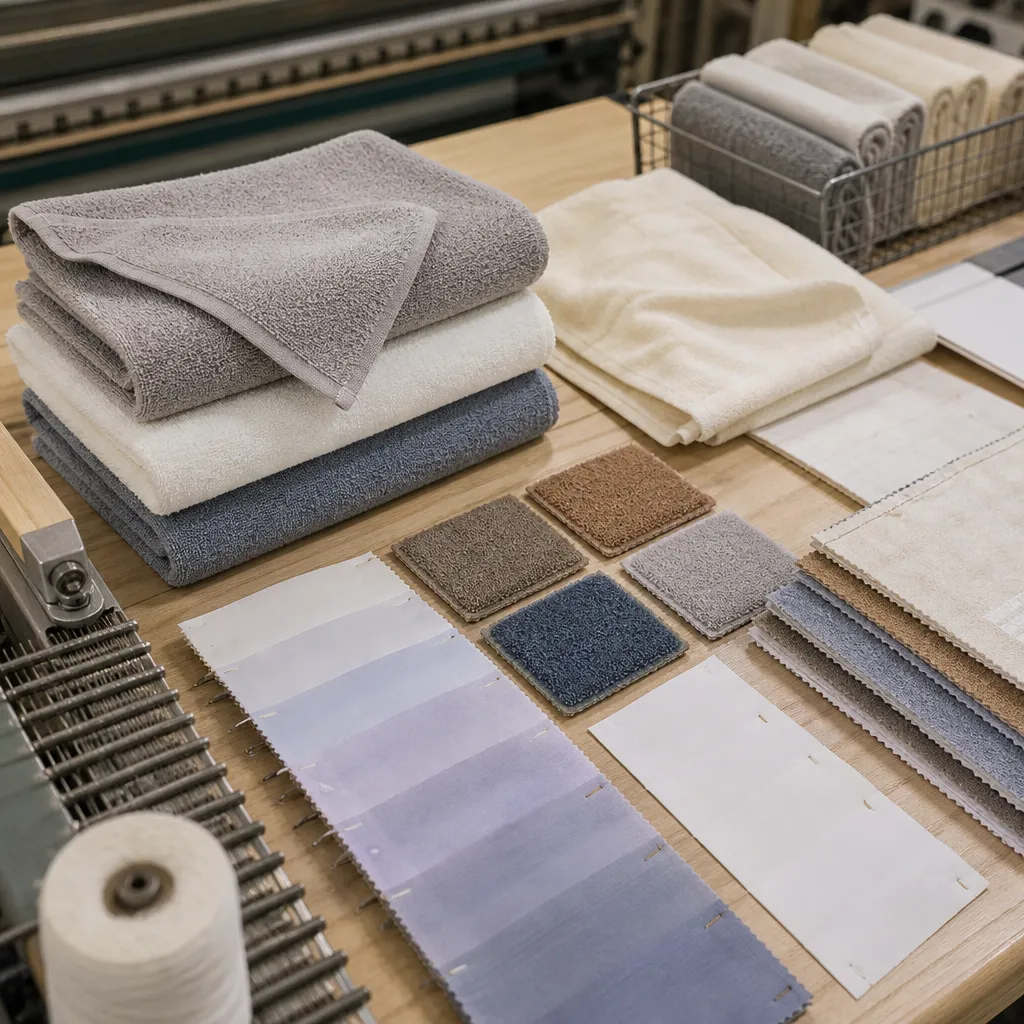
Start with the spec that changes the quote fastest
For this category, the biggest pricing swings usually come from five lines on the RFQ: size, GSM, blend, edge construction, and pack method. A 300 GSM coral fleece cloth and a 380 GSM warp-knit glass cloth can share the same finished size on paper, yet they do not run on the same yarn consumption, cutting loss, or inspection standard. If you ask three suppliers for "microfiber towels for cleaning MOQ and pricing" without freezing those details, the cheapest quote often hides a different construction rather than a genuine cost advantage.
- State finished size after hemming or ultrasonic cut, not greige width.
- Name the blend ratio: 80/20 polyester-polyamide is standard for general cleaning; 70/30 is softer and more absorbent but costs more and can tighten MOQ because mills buy lower-volume yarn.
- Specify the surface: terry, coral fleece, suede, waffle, or warp knit for glass.
- Call out the edge: overlock, hidden edge, silk band, edgeless ultrasonic, or covered edge.
- Separate bulk pack from retail-ready pack because barcode labels, belly bands, insert cards, and resealable polybags change labor minutes more than many buyers expect.
| Construction | Typical use | Common MOQ behavior | Cost effect |
|---|---|---|---|
| 300-320 GSM terry, 80/20, overlock edge | General household and janitorial | Usually easiest at low MOQ | Lowest baseline among custom options |
| 340-360 GSM coral fleece, 80/20, overlock or covered edge | Dusting, polishing, retail multipacks | MOQ depends on dye lot per color | Moderate uplift from higher pile |
| 360-400 GSM edgeless ultrasonic cut | Auto/detailing crossover, scratch-sensitive use | Higher MOQ because cutting setup and waste control matter | Noticeable uplift from process and rejection risk |
| 260-300 GSM warp knit glass cloth | Glass and mirror | Often needs dedicated run by color | Higher than basic terry despite lower GSM |
| 420+ GSM 70/30 plush | Higher-end retail cleaning kits | MOQ rises because yarn is less standard | Highest among common cleaning cloth specs |
Microfiber towels for cleaning MOQ and pricing: where minimums really come from
MOQ in this segment is rarely one single number. Buyers hear "500 pieces" and assume that applies to any color, any blend, any packaging, but the mill usually means one design and one color under a simple production path. In practice, the minimum is tied to dyeing efficiency, knitting or weaving allocation, cutting yield, and whether packaging is manual or line-fed.
Our standard towel MOQ is 500 pcs per design per color, but microfiber cleaning programs often become more complicated because a single PO may include four colors and two edge styles. If each color only represents 125 pieces, the real issue is not sewing capacity; it is the dye lot and downstream handling. On dark shades, especially black, navy, and saturated red, smaller lots tend to show wider shade deviation roll to roll. That is why some suppliers push buyers toward color consolidation rather than purely higher order volume.
- Below roughly 1,000 pcs per color, suppliers may quote a small-lot dyeing surcharge or switch to stock-dyed fabric if shade tolerance allows.
- If the order uses custom printed insert cards or multilingual labeling, the packaging vendor can become the real MOQ bottleneck.
- Edgeless ultrasonic programs often require full-case planning by color because mixed-color cut lots create more handling error.
- If you request a 70/30 blend in a non-stock yarn count, the yarn booking itself can raise the practical MOQ beyond the sewing minimum.
| Order shape | What usually limits MOQ | What buyers can do |
|---|---|---|
| 1 SKU, 1 color, bulk pack | Fabric efficiency | Keep one standard size and one edge finish |
| 1 SKU, 4 colors, bulk pack | Dye lot size | Use lighter color palette or accept shade tolerance window |
| 1 SKU, 4 colors, retail sleeve | Packaging material MOQ | Use one generic insert card with color sticker |
| 2 constructions in one PO | Separate production routing | Split shipment or keep one construction for launch |
| Private-label e-commerce set | Barcode, pack collation, final inspection time | Use master carton assortments that match sales packs |
FOB ranges by spec, not just by volume
Unsupported price tables create trouble later, so here is the context behind the numbers. These ranges assume FOB China, custom production, standard export carton, and no unusual compliance testing beyond normal internal quality checks. They also assume June 2026 raw material conditions, with stable polyester pricing and average polyamide movement. Port trucking, inland fuel swings, and retail-ready accessories are not included unless noted.
| Spec | 1,000-2,999 pcs | 3,000-9,999 pcs | 10,000+ pcs |
|---|---|---|---|
| 40x40 cm, 300 GSM terry, 80/20, overlock edge, bulk pack | USD 0.27-0.35 | USD 0.22-0.29 | USD 0.19-0.25 |
| 40x40 cm, 350 GSM coral fleece, 80/20, covered edge, bulk pack | USD 0.33-0.42 | USD 0.27-0.35 | USD 0.24-0.31 |
| 40x40 cm, 380 GSM edgeless ultrasonic, 80/20, bulk pack | USD 0.39-0.50 | USD 0.32-0.41 | USD 0.28-0.36 |
| 30x30 cm, 280 GSM warp knit glass cloth, 80/20, bulk pack | USD 0.21-0.29 | USD 0.18-0.24 | USD 0.15-0.21 |
| 40x60 cm, 420 GSM plush, 70/30, covered edge, bulk pack | USD 0.74-0.92 | USD 0.63-0.80 | USD 0.56-0.72 |
Those ranges widen when the order uses very dark shades, recycled-content claims, low-friction retail packaging, or carton assortments that slow final packing. They can also tighten downward when the buyer accepts stock colors and one-language care labels. For brands comparing FOB quotes, we suggest asking each supplier whether the quote assumes fabric weight tolerance of plus or minus 5 percent or plus or minus 8 percent; that small line explains many "too good" prices.
Why a cheap cloth can become expensive after 3 months
Cleaning towels are bought on repeat, so replacement rate matters more than opening cost. A lower quote sometimes comes from a reduced polyamide percentage, lighter actual GSM than declared, or shorter pile that loses dust pickup after washing. We see this often in promotional multipacks where the approved sample is acceptable, but bulk production drifts because the buyer approved by handfeel only.
A practical example: one distributor compared a 40x40 cm cloth at USD 0.23 against another at USD 0.31. The lower-cost version tested at 287 GSM on incoming check against a declared 320 GSM, had overlock thread breaks after about a dozen wash cycles in a commercial tunnel washer, and left more lint on black piano-finish panels during use trials. The higher-cost version held weight closer to target and passed internal wipe tests longer, so the reorder interval was roughly 30 percent longer. That is not a universal rule, but it is a normal sourcing pattern.
- Watch for actual GSM drift between sample and bulk.
- Check whether the cloth has been split properly; poorly split microfiber feels slick and cleans worse.
- Look at edge seam density on overlocked products; loose SPI can open after repeated wringing.
- For glass cloths, verify the surface does not produce cross-direction streaking after 5 wash cycles.
The retail pack can add more than the logo
For B2B importers serving supermarkets, hardware chains, or DTC kits, packout often moves the quote more than decoration. Most cleaning towels in this segment do not need expensive branding methods, but they do need accurate pack collation and scan-ready labeling. A plain master-carton export pack is straightforward. A three-pack with belly band, suffocation-warning polybag, EAN sticker, lot code, and inner carton divider is not.
| Packaging format | Typical added cost per unit | Common hidden issue |
|---|---|---|
| Bulk pack, 50 or 100 pcs per PE bag | USD 0.00-0.02 | Loose count errors if final audit is rushed |
| Single polybag with barcode sticker | USD 0.03-0.06 | Sticker placement inconsistency |
| Printed belly band around folded cloth | USD 0.05-0.09 | Fold variance makes front panel look messy at retail |
| Resealable retail pouch with insert card | USD 0.09-0.16 | Accessory MOQ and manual packing time |
| Gift-box multipack | USD 0.22-0.48 | Carton cube rises fast and freight efficiency falls |
If your program is price sensitive, one useful compromise is a generic printed sleeve shared across colors, then a small color dot label added during packing. That reduces packaging MOQ exposure without making the shelf look unfinished.
Lead time is mostly a color and finishing question
For a straightforward custom run, our normal production timing is about 25 to 35 days after sample approval and deposit, but microfiber cloths can move outside that range depending on dyeing queue and whether the edge finish is standard sewing or ultrasonic. During peak season before Q4 retail launches, booking fabric inspection and packaging collation can add a week.
- RFQ review and quote alignment: 1-3 days
- Color confirmation or lab dip if needed: 3-6 days
- Pre-production sample: 5-8 days
- Bulk fabric knitting/dyeing and cutting: 10-16 days
- Sewing or ultrasonic finish, packing, final inspection: 7-11 days
Air freight can save launch deadlines for a small first batch, but cleaning towels are light only by unit, not by volume. Carton cube builds quickly, so the landed cost gap between sea and air can become larger than the manufacturing savings from a low FOB. For shipment planning, container-vs-air-freight-towel-orders is useful when your sales team asks for a split shipment just before season start.
The QC checks that matter on cleaning microfiber
This is the part buyers often ask for after they receive a bad lot. A microfiber cloth should not be approved on color and softness alone. For cleaning use, we focus on a few defect modes that directly affect end use: poor splitting, inconsistent GSM, edge failure, shade variation, and contamination. Contamination sounds minor until a white glass cloth ships with dark fly fibers trapped in the pile.
- GSM verification: weigh conditioned samples from multiple cartons and compare against agreed tolerance. We prefer checking at least 10 pieces across early, middle, and late production lots.
- Size after finishing: measure after folding is relaxed. Ultrasonic-cut edgeless cloths can shrink slightly more on one axis if cutting speed and heat are not stable.
- Split-fiber performance: use a simple water pick-up and drag test, then confirm under magnification if the yarn opening looks incomplete on suspect lots.
- Edge integrity: perform a seam pull check on overlock or covered-edge towels. Look for skipped stitches, loose thread tails, and corner unraveling after manual tension.
- Colorfastness: for dark shades, run ISO 105-C06 wash fastness and ISO 105-X12 rubbing where relevant to downstream use.
- Lint and foreign fiber control: inspect white or light cloths under strong light for black contamination, hard filament, oil marks, and needle grease.
Two construction quirks deserve specific attention. First, warp-knit glass cloths can show diagonal tracking lines if tension was uneven during knitting; these lines are easy to miss in folded cartons but visible on mirrors. Second, ultrasonic-cut edgeless towels can fuse too hard at the perimeter, creating a stiff edge that drags on sensitive surfaces. We reject that condition even when the piece count is correct, because the complaint comes back later as scratch risk.
If the sample approval file does not record actual weight, actual size, blend, edge method, and pack format, the bulk inspection will turn into argument instead of control.
A workable RFQ for distributors and private-label buyers
The fastest way to clean up pricing noise is a tighter RFQ. We recommend that buyers avoid broad requests such as "best price for microfiber cleaning towel" and instead send a practical spec bundle. This shortens the quoting cycle and also makes supplier comparisons usable.
- Finished size in centimeters, with tolerance
- Target GSM and tolerance band
- Blend ratio such as 80/20 or 70/30
- Construction name: terry, coral fleece, warp knit, waffle, suede
- Edge finish and thread color requirement
- Color list or Pantone references if brand-controlled
- Unit pack and master carton requirement
- Testing needs such as ISO 105-C06 or buyer-specific wash trial
- Forecast split by SKU for first PO and 90-day reorder estimate
If you need a cleaner handoff to suppliers, build-towel-tech-pack-that-mills-can-quote covers the fields that stop rework later. Buyers also tend to benefit from negotiate-towel-moq-without-killing-margin when the sales team wants too many opening colors for a small launch.
Where to push, and where not to push, during negotiation
Some concessions are easy for a mill to make; others only hide cost until the claim shows up in bulk. Buyers usually get better results by negotiating around production efficiency instead of pressing blindly on unit price.
- Push for fewer opening colors rather than unrealistic piece counts per shade.
- Ask whether stock colors can be used for the first run if exact shade is not critical.
- Combine nearby sizes only if the carton plan still works; mixed dimensions can increase packing errors.
- Use one common packaging platform across SKUs and vary only stickers or insert text.
- Do not push suppliers to erase the cost of 70/30 blend or edgeless finishing if your product promise depends on it.
For more background on material trade-offs, microfiber-vs-cotton-towel-comparison and custom-microfiber-towels-wholesale-guide are helpful references. If your program crosses into auto care, auto-detailing-microfiber-towel-program is relevant because the tolerance expectations are usually tighter than general household cleaning.
Certifications and compliance buyers still ask for
Even in an everyday cleaning category, importers increasingly ask for social and chemical compliance documentation. We hold OEKO-TEX Standard 100 Class I, BSCI, and ISO 9001. For microfiber towels, OEKO-TEX is usually the most visible buyer request because the cloth is handled repeatedly and sometimes sold for household use near skin-contact categories. ISO 9001 matters more on process consistency, especially if your retailer wants traceable inspection records.
If the certificate itself is part of supplier onboarding, how-to-read-oeko-tex-certificate gives a more practical reading than most buyer checklists. We also suggest aligning any test claims before sample approval instead of after deposit; this saves re-dyeing arguments.
Related reads
If you are building a broader sourcing file, towel-gsm-decision-framework, pantone-color-matching-custom-towels, and private-label-vs-white-label-towel-programs help tighten the commercial side of the brief.
For adjacent product planning, custom-microfiber-towels-wholesale-guide and the industry page for auto detailing towels are useful if your cleaning assortment includes higher-pile or scratch-sensitive cloths. Buyers sourcing general utility lines can also review /products.html#promo for simpler pack structures.
Quote your cleaning microfiber program with the real spec
Send size, GSM, blend, edge, colors, and pack format. We will reply with a usable MOQ and FOB range, plus timing and QC notes. WhatsApp: +86 13205717266 | [email protected]
Request a quote →