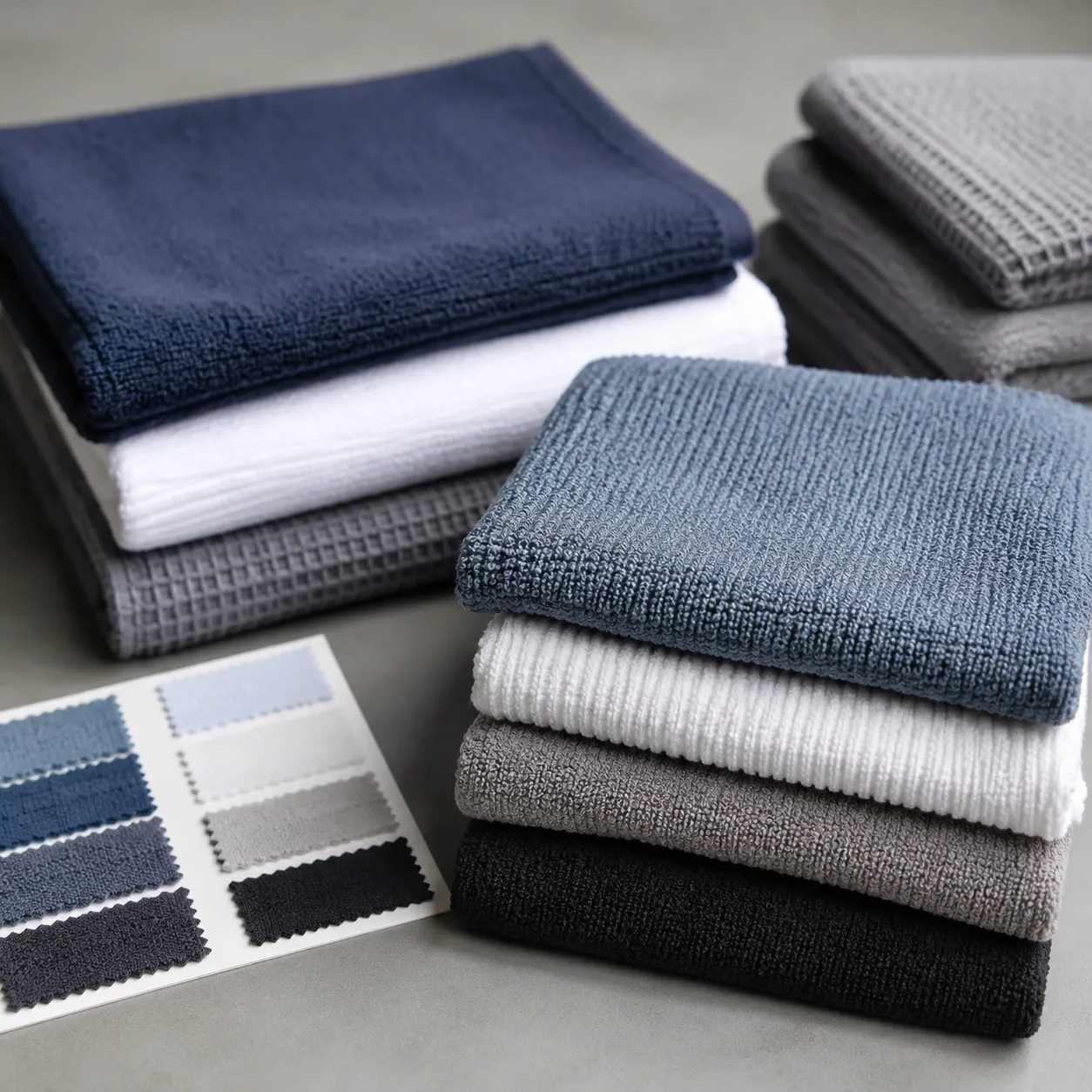
Start with the use case, not the hangtag claim
For this category, we do not begin by asking for the lightest possible cloth. We ask where the towel will be used and how often it will be rinsed, wrung, packed, and reused within the same day. A hostel amenity towel, a backpacking towel, a yoga-and-travel crossover item, and a branded giveaway all need different balances between dry time, handfeel, opacity, and pack size.
That is why a usable quick dry travel towel gsm and yarn spec guide has to connect fabric numbers to actual field use. If the product is meant for trekking, buyers usually accept a flatter hand and lower pile because packed volume matters. If it is sold DTC as a body towel, the complaint rate rises quickly when the fabric feels too glassy on skin after the first wash. We see that especially in very low-weight suede constructions below 180 GSM.
| End use | Typical size | Working GSM | Construction we quote most | Common failure if mis-specified |
|---|---|---|---|---|
| Ultralight backpacking | 40×80 cm to 60×120 cm | 170-210 | warp knit suede microfiber | poor absorbency feel, transparency when wet |
| General travel / hostel | 50×100 cm to 70×140 cm | 200-260 | double-sided brushed microfiber | bulky pack size if GSM drifts too high |
| Beach + travel crossover | 70×140 cm to 80×160 cm | 240-320 | waffle or brushed microfiber | slow line-dry if cell depth is too dense |
| Promotional travel set | 30×80 cm to 50×100 cm | 180-230 | suede microfiber printed | edge curling after sublimation heat |
The GSM range that usually works
Buyers often ask for a single recommended weight. We would rather give a working band. For most microfiber travel towels, 190-250 GSM is where the spec is easiest to control at scale while keeping decent absorbency and compact packing. Below that, the towel folds very small but starts to feel undersized in performance unless the yarn split is done well. Above that, softness improves, yet the product begins to behave less like a travel item and more like a general-purpose gym or beach towel.
- At 170-190 GSM, packed size is excellent, but seam grin and print read-through become more visible.
- At 200-230 GSM, we usually get the best balance for all-purpose travel SKUs.
- At 240-260 GSM, handfeel improves and opacity is better, though drying time in still-air room tests stretches noticeably.
- Above 280 GSM, we normally ask buyers to confirm whether they still want a travel towel or are moving into beach / fitness positioning.
For drying claims, we avoid broad statements without a protocol. In our internal comparison room, we test drying under 24-26°C ambient temperature and 50-60% relative humidity after standardized water pickup and a controlled wring step. Under those conditions in Q2 2026, a 205 GSM suede microfiber body towel usually reaches near-dry handling state faster than a 255 GSM brushed version of the same size, but the gap narrows if the heavier cloth uses a more open waffle geometry. The point is that drying speed is construction-dependent, not just weight-dependent.
Yarn specification matters more than many RFQs show
The travel towel category is dominated by polyester-polyamide microfiber, usually 80/20 or 85/15 blends. On paper, both can look acceptable. In practice, how fine the filament is, whether the microfiber is well split, and whether the blend is stable from lot to lot will shape absorbency more than the blend line alone.
| Yarn element | Typical spec | What it changes | What we watch in QC |
|---|---|---|---|
| Blend ratio | 80/20 or 85/15 PES/PA | water pickup, softness, cost | actual lab composition tolerance vs declared spec |
| Filament fineness | 0.2-0.5 dpf equivalent | surface area and touch | slippery hand if coarse lots are mixed in |
| Split quality | mechanically/chemically split microfiber | wicking and drying behavior | slow wet-out if split is incomplete |
| Ground yarn stability | fine denier warp-knit base | shape retention after wringing | diagonal distortion and edge torque |
One topic-specific issue here is split consistency. In travel towels, poor splitting often hides during first visual inspection because the cloth still looks smooth and clean. It shows up later when the towel pushes water around instead of taking it in on the first wipe. We check that by a sink-style wet-out observation before formal lab testing. Another issue is heat-set imbalance in warp knit fabric. If heat setting is rushed, the panel may twist slightly after sublimation or after the first wash, which makes folding and pouch packing look messy at retail.
Choose construction before decoration
Most travel towels are one of three constructions: suede microfiber, brushed microfiber, or waffle microfiber. Each responds differently to moisture, printing, and edge finishing. Buyers sometimes lock in full-bleed artwork first and only then ask whether waffle is possible. That sequence creates avoidable compromises.
| Construction | Best use | Drying behavior in our room test | Decoration fit | Factory caution |
|---|---|---|---|---|
| Suede microfiber | lightweight travel, promo | fast surface release after wring | excellent for sublimation | can feel less absorbent on first touch |
| Brushed microfiber | consumer retail travel towel | moderate, with softer hand | good for print and embroidery patch add-on | bulkier pack size |
| Waffle microfiber | travel + beach crossover | good airflow if cell depth is open | pattern can interrupt fine print detail | snag risk at raised cells |
- Suede gives the cleanest printed detail and the smallest fold pack.
- Brushed face gives a more familiar towel hand, especially for body use.
- Waffle improves perceived drying because air channels stay open, but artwork must be simplified.
If the program includes a carry pouch, construction choice also affects sewing yield. Waffle edges are less forgiving on narrow hem widths, while very light suede panels can ripple if the overfeed is not tuned correctly at the binder. These are small production details, but they show up immediately in final presentation.
How we test absorbency and dry time before bulk approval
This is where many claims become vague, so we pin the method down. For absorbency, we commonly reference AATCC 79 for wettability as a quick comparative indicator, then pair it with gravimetric water pickup in-house by weighing dry fabric, immersing, draining for a fixed interval, and reweighing. For drying comparison, we record retained moisture loss over time under controlled room conditions rather than promising a universal number like "dries in half the time".
- Condition the samples for 24 hours in a stable room.
- Cut panels from body area, not near selvedge or hem.
- Measure dry mass and dimensions before wetting.
- Immerse for fixed seconds, then hang or wring per agreed method.
- Reweigh at timed intervals until handling-dry threshold is reached.
The boundary conditions matter. A wrung towel dries far faster than a non-wrung towel. A 50×100 cm sample behaves differently from a 70×140 cm body size even at the same GSM because water load per unit is different in use. For that reason, our quote notes should state whether dry-time comparisons were based on cut swatches or finished-size towels, and whether the sample was line-hung flat, folded once over a rod, or laid on mesh.
If a supplier gives you a drying-speed claim without test temperature, humidity, wet pickup method, and towel size, treat it as a slogan, not a specification.
Spec lines that reduce complaints after launch
A clean spec sheet for this category should do more than list GSM and size. It should remove the gray areas that create first-batch disputes. We recommend including the fabric weight tolerance, finished size tolerance after wash, blend ratio, knit type, print method, hem construction, pouch fabric if included, and the exact pass/fail standard for colorfastness and dimensional stability.
- GSM tolerance: keep bulk control within ±5% where possible for stable pack-size consistency.
- Finished size tolerance: typically ±3% after finishing; confirm whether measured pre-wash or post-one-wash.
- Colorfastness to washing: define grade target and test standard before artwork approval.
- Edge finish: narrow hem, overlock plus turn-back, or binding; each changes curl behavior.
- Logo method: sublimation all-over, woven label, or silicone patch, depending on retail position.
One source of returns in printed travel towels is not color bleed but edge wave after press and wash. Lightweight microfiber can distort if print heat, panel tension, and hem shrinkage are not balanced. Another is low-opacity dark wet show-through, where the towel looks acceptable dry but turns semi-transparent when fully soaked. If your brand sells the item for body use, ask for a soaked-opacity check during sample review.
Related reads: If you are still narrowing material direction, compare microfiber and cotton trade-offs and our GSM decision framework. For RFQ prep, the fastest way to avoid vague quotes is to use a tighter tech pack structure.
FOB price bands for 2026 orders
Prices in this category move with microfiber raw material, print coverage, pouch inclusion, and carton efficiency. The bands below reflect our China FOB quoting range in June 2026 for OEKO-TEX Standard 100 Class I compliant production, based on standard export packing and no unusual retail trim. They are not valid for air freight, branded gift boxes, or very complex accessory kits.
| Spec basis | MOQ | FOB China unit price | Notes |
|---|---|---|---|
| 40×80 cm, 185-200 GSM suede microfiber, full print, no pouch | 3,000 pcs | USD 0.88-1.12 | best for promo or event travel kits |
| 50×100 cm, 200-220 GSM suede microfiber, pouch included | 2,000 pcs | USD 1.28-1.63 | most common general travel program |
| 60×120 cm, 220-240 GSM brushed microfiber, elastic loop + pouch | 1,500 pcs | USD 2.06-2.58 | retail-oriented set with softer hand |
| 70×140 cm, 245-280 GSM waffle microfiber, custom pouch | 1,000 pcs | USD 3.18-4.06 | larger crossover item with lower carton efficiency |
For lower quantities, our standard MOQ remains 500 pcs per design per color, but travel towel economics improve substantially once printing, cutting, and pouch sewing can run in steadier batches. A buyer trying to save USD 0.14 by dropping from 215 GSM to 185 GSM may create a much bigger cost later if review scores fall because the towel feels too thin after one wash. We would rather trim accessory complexity first than underbuild the cloth.
Lead time depends on printing path and pouch complexity
Microfiber travel towels are usually not slowed by weaving; they are slowed by artwork approval, print scheduling, and sewing coordination with the pouch. For an order that is technically straightforward, our normal path is shorter than many cotton towel programs, but only if approvals are disciplined.
- 1-3 days for RFQ review and construction recommendation
- 3-6 days for strike-off or digital print color check
- 5-8 days for pre-production sample with pouch and labeling
- 18-28 days for bulk after sample signoff
- 3-5 days for final inspection, packing, and booking readiness
If the order includes matched carabiners, mesh bags in custom colors, or retail belly bands with barcode sequencing, add a few extra days because accessory arrival can become the gating step. For shipment planning, our logistics team usually advises clients to review container versus air freight timing before promising launch dates.
Related reads: For decoration decisions, see embroidery vs sublimation vs jacquard. If your order is small and color-heavy, our article on MOQ negotiation without margin damage helps frame realistic splits.
A practical RFQ template for this category
If you want comparable quotes from different mills, keep the request tight. A good RFQ for a travel towel should state target end use, finished size, GSM band, microfiber blend, construction, print coverage, hem style, pouch requirement, label pack, compliance needs, and test standards. Without those, suppliers will each assume a different cloth and price range, and your quote sheet will not be comparing like for like.
- State whether the towel is for face, hair, body, or multi-use travel.
- Give one acceptable GSM band, not a spread like 180-300.
- Specify suede, brushed, or waffle microfiber.
- Confirm if dry-time comparison must be tested on finished-size towels.
- List required standards such as OEKO-TEX Standard 100 Class I, BSCI, and ISO 9001 supplier expectations.
That is the shortest route to a usable quick dry travel towel gsm and yarn spec guide in sourcing practice: define the end use, select a construction family, lock the test method, and only then optimize cost. Once those points are clear, the rest of the program becomes much easier to scale without surprise quality debates.
What we would spec for three common buyer briefs
To make this less abstract, here are three setups we would quote today. They are not universal templates, but they show how the numbers move with the use case.
| Buyer brief | Recommended build | Why this build | Indicative MOQ |
|---|---|---|---|
| Outdoor brand pack towel | 45×90 cm, 195 GSM suede microfiber, 80/20 blend, narrow hem, mesh pouch | lowest pack bulk with clean print surface | 2,000 pcs |
| DTC travel body towel | 60×120 cm, 225 GSM brushed microfiber, hanging loop, drawstring pouch | better skin hand and fewer thin-feel complaints | 1,500 pcs |
| Resort retail travel souvenir | 70×140 cm, 250 GSM waffle microfiber, simplified artwork, elastic band | display value and perceived performance at larger size | 1,000 pcs |
None of these should be approved from catalog photos alone. We still recommend hand sample review, wash test, and pouch fit check with the actual folded towel. Travel products live or die on packability, and that is hard to judge from a swatch.
Need a travel towel spec reviewed?
Send your target size, GSM range, artwork coverage, and pouch requirement. We will mark up the spec, flag risk points, and quote realistic MOQ, price, and lead time. WhatsApp: +86 13205717266 | Email: [email protected]
Request a Quote →