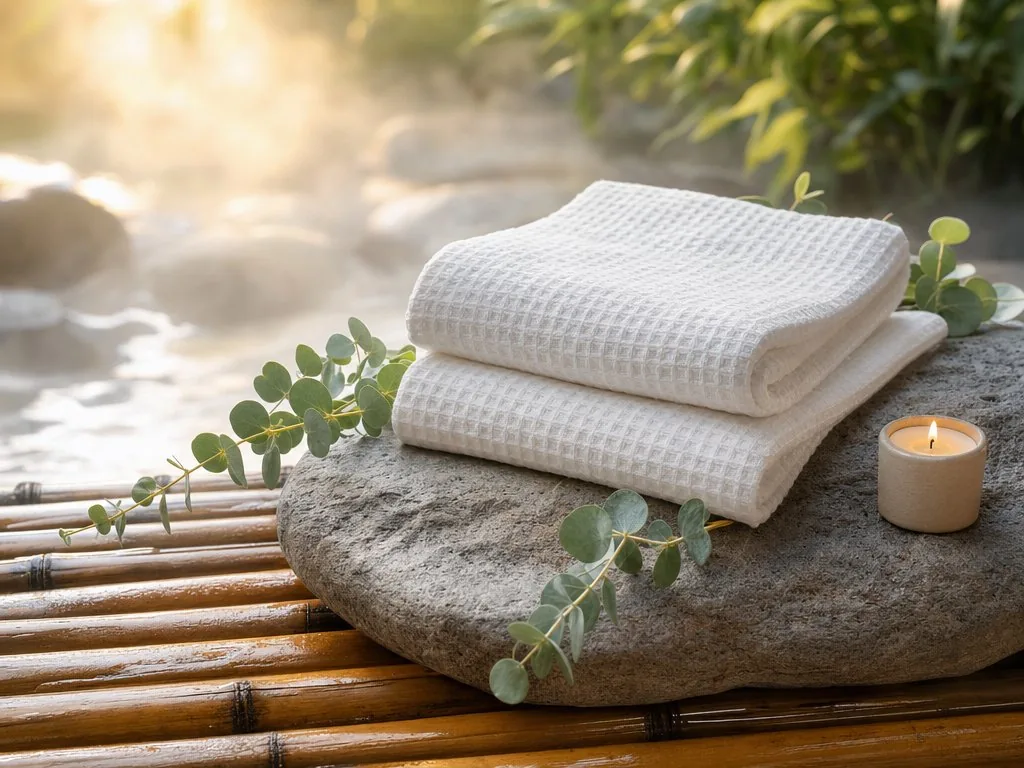
Why waffle towels mislead buyers on weight
Waffle fabric is not a lighter version of terry. It is a grid structure, usually called honeycomb weave towels in some buying briefs, where raised squares and recessed channels create surface area without loop pile. On the factory floor, that changes how we calculate absorbency, shrinkage allowance, hand feel, carton cube, and laundering risk.
For terry bath towels, a buyer may start with GSM and size, then adjust yarn. For waffle bath towels, we start with the cell depth and yarn balance. A 360 GSM waffle towel can feel fuller than expected after the first wash because the cells tighten and become three-dimensional. A 520 GSM waffle towel can become bulky, slow to dry, and unstable at the hem if the yarn is too soft or the border is poorly controlled.
Our MOQ is 500 pcs per design per color. For waffle development, we normally ask buyers to approve one washed reference sample, not only a flat pre-wash sample, because the visual grid changes after relaxation. Our mill in Zhejiang has produced cotton, cotton-bamboo, and cotton-polyester waffle programs for spas, hotel retail corners, and DTC bath brands, but we reject some requested specs when the use case is wrong. For example, a high-chlorine hotel laundry should not copy a boutique retail waffle towel without changing the yarn twist and dye standard.
| Use case | Typical waffle GSM | Common size | Factory comment |
|---|---|---|---|
| Spa treatment towel | 300-360 GSM | 70 x 140 cm | Fast drying, compact carton, lighter hand |
| Hotel bath towel | 380-460 GSM | 70 x 140 cm or 76 x 152 cm | Better coverage and guest perception |
| Retail bath towel | 420-520 GSM | 75 x 150 cm | Fuller cell height, higher shrinkage control needed |
| Travel or gym bath towel | 260-330 GSM | 65 x 130 cm | Lowest cube, but less plush after repeated wash |
| Bath sheet | 430-560 GSM | 90 x 160 cm | Needs reinforced hem and longer drying test |
waffle weave bath towel gsm and yarn spec guide: the spec lines that matter
A useful spec sheet for this fabric should not say only “100% cotton waffle towel, 400 GSM.” That line is too loose for OEM quoting. Two suppliers can quote the same GSM and deliver towels with different cell height, shrinkage, absorbency, and edge stability.
For a real waffle weave bath towel gsm and yarn spec guide, we want the buyer to define the finished size after wash, fiber blend, yarn count, warp and weft construction, dye method, border design, hem width, and allowed shrinkage. If the towel will carry embroidery, woven label, or paper band packaging, those details also affect the cost and sample route.
- Finished size after washing: Quote against the size the customer receives after relaxation, not only loom-state dimensions.
- GSM tolerance: For waffle bath towels, we normally control bulk at ±5% for solid cotton programs and ±7% for blended or piece-dyed small lots.
- Yarn count: The count should match cell depth; fine yarn in a deep waffle can snag, while coarse yarn in a shallow waffle can feel boardy.
- Shrinkage direction: Waffle usually shrinks more in length than width unless the structure is balanced and pre-relaxed.
- Border and hem: Flat border zones need separate control because they shrink differently from the honeycomb body.
For related foundation specs, buyers can compare our broader towel GSM decision framework and towel sizes dimensions complete guide. Those articles are terry-inclusive, while this article focuses on the waffle construction problem.
GSM bands we actually quote for waffle bath programs
GSM is still important, but not as a direct comfort score. We use it as one part of a performance triangle: absorbency, dry time, and cell recovery after wash. A lower GSM waffle towel may perform better in a spa because it releases moisture quickly between treatment-room cycles. A higher GSM waffle towel may sell better at retail because the customer judges it by hand weight on the shelf.
For quick dry cotton towels, we often recommend 340-410 GSM. That range gives a clear waffle texture, avoids a thin kitchen-towel look, and keeps drying time reasonable. For hotel rooms, where the towel must survive commercial laundry and still look neat on a shelf, 400-470 GSM is more stable. Above 500 GSM, we treat the article as a heavier retail or villa program and add more testing before bulk.
| GSM band | Hand feel after 3 washes | Drying behavior | Best buyer fit | Risk to watch |
|---|---|---|---|---|
| 260-320 GSM | Light, slightly crisp | Fast; good for humid locations | Travel, gym, promotional spa kits | Can look too flat if cell depth is shallow |
| 330-390 GSM | Balanced, textured | Fast to medium | Spa, boutique hotel, wellness retail | Length shrinkage must be controlled |
| 400-470 GSM | Fuller, more bath-towel-like | Medium | Hotel room, resort villa, DTC bath | Hem waving if border tension is wrong |
| 480-560 GSM | Heavy and dimensional | Slower | Retail bath sheet, gift set | High carton cube and longer tumble dry time |
A specific example from our costing desk: a 75 x 150 cm waffle towel at 430 GSM uses about 484 g of fabric before trims and packaging. If we move the same size to 520 GSM, the fabric mass becomes about 585 g. That extra 101 g is not only cotton cost; it also changes dye liquor loading, drying time, carton weight, and sometimes the needle selection for hem sewing.
Yarn count, twist, and cell depth
The yarn spec is where many low-price waffle towels fail. For cotton waffle bath towels, common yarn counts include 21s/2, 16s/1, 20s/1, 32s/2, or mixed warp-weft combinations depending on the loom setup and target texture. We avoid giving one universal count because the right count depends on the cell repeat and final GSM.
A deeper honeycomb cell needs enough yarn body to stand up after wash. If the yarn is too fine and soft, the cell wall collapses after tumble drying, giving a wrinkled, old look even when the towel is new. If the yarn is too coarse for the repeat, the fabric can become stiff and the recessed channels lose absorbency because the structure cannot open.
| Target construction | Possible yarn direction | Resulting character | Factory caution |
|---|---|---|---|
| Light spa waffle | 20s/1 warp with 16s/1 weft | Open, fast drying, moderate texture | Needs controlled finishing to avoid skew |
| Balanced hotel waffle | 21s/2 or 32s/2 warp with 16s/1 weft | Stable grid, cleaner folding | Higher yarn cost but better dimensional control |
| Soft retail waffle | Combed cotton 20s/1 with lower twist weft | Softer hand and higher loft | More lint in early washes if not pre-washed well |
| Heavy bath sheet waffle | Ply yarn warp and heavier weft | Strong cell wall, full hand | May dry slowly and increase freight cube |
Combed cotton is usually worth the premium for retail and hotel programs because shorter fibers are removed before spinning. For economy spa towels, carded cotton can be acceptable if the buyer accepts more lint and a slightly rougher hand. Zero-twist yarn is rarely our first suggestion for waffle bath towels because the structure already has volume; very low twist can reduce cell recovery and increase snagging. Buyers comparing cotton options may find our combed vs zero twist cotton explained article useful.
- For a clean hotel fold, choose a balanced warp-weft yarn plan and avoid an over-deep cell.
- For a soft retail touch, use combed cotton and consider garment washing, but add lint testing.
- For a low-cost spa towel, reduce GSM before reducing yarn quality too far.
- For a bath sheet, reinforce the hem because the waffle body and flat hem shrink at different rates.
Shrinkage is the main hidden defect
Waffle towels move more than buyers expect. The grid relaxes in the first wash, and the recessed channels pull the fabric inward. If a PO states 70 x 140 cm but does not say whether that is before or after washing, the factory and buyer may be measuring different products.
In our sample room, we check shrinkage using a controlled domestic or commercial laundering method depending on the end market. For retail and boutique programs we often use ISO 6330 as a reference method for washing and drying. For North American buyers, AATCC TM135 is also common for dimensional change. We record width and length at marked points, then compare the waffle body and the flat border separately.
A typical cotton waffle bath towel may shrink 4-7% in width and 7-11% in length after three wash and tumble cycles if it has not been pre-relaxed. With better yarn balance and controlled finishing, we target 3-5% width and 5-8% length. For hotel laundries with high heat, we do not promise unrealistic 2% shrinkage unless the construction has been engineered and tested for it.
- Measure the sample before washing at three width points and three length points.
- Wash using the agreed method, detergent, temperature, and drying condition.
- Rest the towel flat for at least four hours before final measuring.
- Record waffle-body shrinkage separately from border distortion.
- Approve the bulk tolerance only after the buyer signs the washed sample.
For waffle towels, the approved washed sample is more important than the first beautiful unwashed sample. The towel the guest uses is the relaxed towel.
Absorbency and dry time testing for honeycomb fabric
Waffle towels often feel dry to the hand because the surface has less pile contact than terry. That does not mean absorbency is poor. The honeycomb channels hold moisture across the surface, but the towel can release that moisture faster during drying. For spas and humid coastal hotels, that can reduce musty odor risk if laundering and storage are handled correctly.
For development, we use simple mill checks and buyer-facing lab references. AATCC TM79 can be used for absorbency speed, measuring how quickly a water drop is absorbed. For capacity, we weigh the towel dry, saturate it, extract under controlled conditions, and weigh again to compare water retention. For colorfastness, ISO 105-C06 for washing and ISO 105-X12 for rubbing are common references, especially on dark navy, charcoal, and earth-tone waffle programs.
One defect specific to waffle fabric is cell shadowing after dyeing. Because raised cell walls and recessed valleys take light differently, a poorly leveled dye lot can show uneven tone under hotel bathroom lighting. This is not the same as terry barre. It usually comes from uneven fabric tension, poor scouring, or aggressive softener application that pools in the recesses.
- Ask for absorbency speed after softener finishing, not only before finishing.
- Check cell recovery after tumble drying; the grid should lift again, not flatten permanently.
- Inspect dark colors under both D65 light and warm indoor light to catch cell shadowing.
- Limit silicone softener if the towel needs fast water uptake in spa use.
- Require wash colorfastness reports for dark shades and contrast binding.
FOB pricing and what changes the quote
For OEM buyers, waffle towel pricing changes quickly with yarn, GSM, dye method, size, and packing. Our standard MOQ remains 500 pcs per design per color, but the most efficient price usually starts at 1,500-3,000 pcs per color because loom setup, dyeing, and finishing loss spread better across the order.
As a realistic FOB China reference in 2026, a 70 x 140 cm cotton waffle bath towel in 360-400 GSM usually quotes around USD 4.10-5.60 at 500-999 pcs, USD 3.55-4.85 at 1,000-2,999 pcs, and USD 3.05-4.35 at 3,000-8,000 pcs. A heavier 75 x 150 cm retail waffle towel in 450-520 GSM often sits around USD 5.35-7.40 at 500-999 pcs, USD 4.75-6.50 at 1,000-2,999 pcs, and USD 4.10-5.85 at 3,000-8,000 pcs. Embroidery, woven labels, paper bands, individual polybags, FSC cartons, and barcode stickers add cost.
| Cost driver | Typical impact | When it matters most |
|---|---|---|
| Combed cotton instead of carded | Adds about USD 0.18-0.45 per bath towel depending on weight | Retail, hotel room, gift sets |
| Garment wash or pre-wash | Adds about USD 0.22-0.55 per piece | Shrinkage control and softer hand |
| Dark reactive dye shade | Adds about USD 0.10-0.35 per piece | Navy, black, forest, terracotta |
| Embroidery logo | Adds about USD 0.12-0.60 per piece | Monograms, spa branding, retail personalization |
| Paper band plus barcode | Adds about USD 0.08-0.22 per piece | Retail shelves and DTC fulfillment |
Cheap construction is not always cheap in use. If a spa buys a 300 GSM carded cotton waffle towel at USD 2.75 and replaces it after 55 treatment cycles, the towel costs USD 0.050 per use before laundry. If the same spa buys a 390 GSM combed version at USD 4.05 and uses it for 105 cycles, the towel cost drops to USD 0.039 per use. The higher first invoice can still be the lower operating cost.
Certification and compliance lines buyers should not skip
For towel programs touching skin, certifications are not decoration on a supplier profile. They decide which dye auxiliaries, softeners, labels, and packaging inks can be used. LUMA & CO. TEXTILE holds OEKO-TEX Standard 100 Class I, BSCI, and ISO 9001 certification. Class I is the strictest OEKO-TEX product class, originally intended for babies and toddlers, so it gives adult bath and spa buyers a stronger chemical safety baseline.
We still ask buyers to specify the intended sales market. EU, US, Gulf, and Asia retail requirements differ in labeling, fiber declaration, and packaging warnings. If a buyer asks for bamboo-cotton waffle towels, we need the exact fiber naming rules for the market because viscose from bamboo and bamboo fiber are not labeled the same way in every jurisdiction.
- Request the current OEKO-TEX certificate number and verify it against the issuing institute database.
- Ask whether trims are included: sewing thread, labels, embroidery thread, and printed packaging may need separate control.
- For hotel tenders, include BSCI or social audit expectations before deposit, not after bulk production starts.
- Keep ISO 9001 process control documents tied to inspection records and nonconformance handling.
- If importing retail sets, confirm fiber content label wording before care labels are woven or printed.
If your procurement team is new to certificate review, use our how to read OEKO-TEX certificate guide before approving a supplier. For broader OEM documentation, our build towel tech pack that mills can quote article shows the lines that reduce quote gaps.
Sampling and bulk lead time from our mill
Waffle development is not the slowest towel category, but buyers should allow enough time for washed approval. A yarn-dyed stripe or custom jacquard waffle will take longer than a solid piece-dyed towel. For solid cotton waffle bath towels, our normal sample timing is 7-12 days if greige fabric or similar yarn is available. If we need a new yarn count or new weave trial, plan 14-21 days.
Bulk production usually takes 25-38 days after deposit, lab dip approval, and final sample signoff for 500-5,000 pcs per color. For larger hotel or retail programs above 10,000 pcs, we plan 40-55 days depending on dyehouse capacity and packaging complexity. Sea freight to North America or Europe usually adds 25-40 days port to port, while air freight is possible but expensive because towels are heavy and bulky. Our container vs air freight towel orders article gives more detail on that decision.
- Send target size after wash, GSM band, color, fiber, and expected use case.
- We quote based on MOQ 500 pcs per design per color and propose one or two construction routes.
- Lab dip and strike-off are prepared; custom color usually needs 5-7 days after Pantone or physical swatch receipt.
- We make a pre-production sample and wash it under the agreed method.
- Buyer signs the washed sample, packaging layout, care label, and carton mark before bulk starts.
- Inline inspection checks GSM, width, skew, hem, color, and cell recovery.
- Final inspection uses AQL sampling unless the buyer has a stricter protocol.
How to brief us without over-specifying the wrong things
Some buyers send a long brief with every possible test but no use case. That creates cost without improving the towel. A hotel laundry towel, a spa wrap companion, and a retail gift towel should not share the same waffle spec. We prefer a shorter brief that tells us the business problem: dry faster in humid rooms, reduce carton cube, create a textured retail look, or replace terry in a villa program.
The best RFQs include a target retail price or landed cost, expected wash method, annual volume, color palette, and packaging style. If the buyer has a benchmark towel, sending a physical sample is better than sending a photo. We can measure GSM, count approximate yarn, inspect cell repeat, and run a wash comparison. For size planning, check towel sizes dimensions complete guide. For spa-specific towel planning, spa towels need different cotton than hotel is also relevant.
A good waffle weave bath towel gsm and yarn spec guide should help buyers avoid both extremes: a thin towel that collapses after laundry and a heavy towel that misses the quick-dry reason for choosing waffle in the first place. If you are building a program, give us the use case first; we can then translate it into yarn, GSM, shrinkage allowance, and testing.
Build a Waffle Towel Spec We Can Quote
Send size after wash, GSM target, fiber, color, packaging, and expected laundry method. We will review the construction, MOQ, FOB range, and sample timing. WhatsApp: +86 13205717266. Email: [email protected].
Request a waffle towel quote →