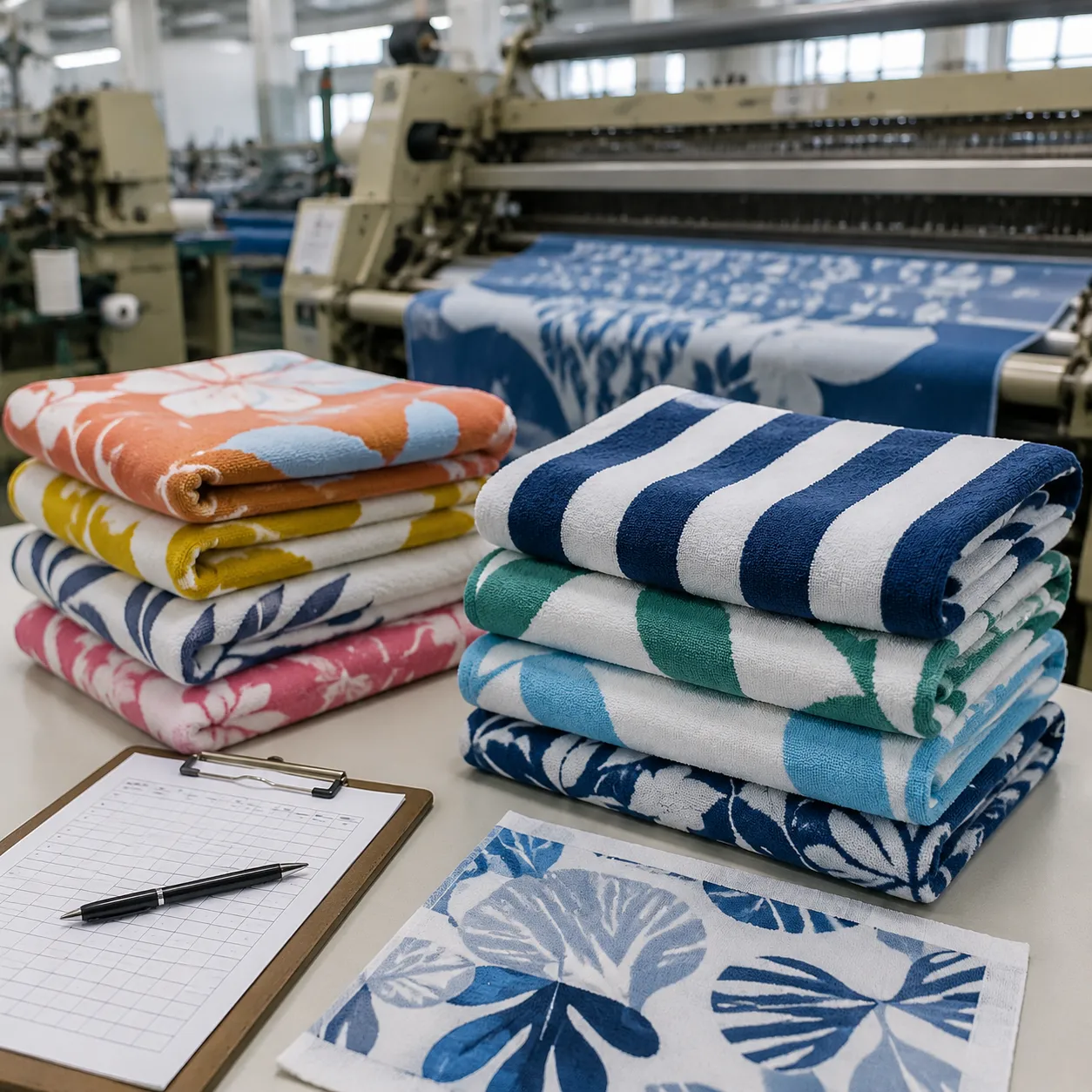
The Spec Sheet Is The Commercial Contract
For cotton bath towels, buyers often start with pile height and yarn count. For microfiber bath towels, the first risk is more basic: two suppliers can quote the same size and GSM while using different yarn split, knit density, edge sewing and finishing chemistry. The towel may look similar in a PDF photo, then behave differently after ten laundry cycles.
We treat the microfiber bath towels specification sheet as the working contract between merchandising, weaving or knitting, dyeing, printing, sewing, QC and packing. If a line is missing, the factory will fill the gap with the cheapest workable default. Sometimes that default is fine. Sometimes it causes lint transfer, weak edge seams, slow absorbency or carton compression marks.
Our standard MOQ is 500 pcs per design / per color. Below that, lab dyeing, cutting loss and packing setup usually cost more than buyers expect. We can sample smaller quantities for approval, but bulk costing becomes stable from 1,000 pcs upward, especially for printed microfiber bath towels.
| Spec line | Buyer decision | Factory risk if left open |
|---|---|---|
| Fabric face | Suede, waffle, terry microfiber or two-sided construction | Supplier quotes cheaper face with lower water pickup |
| Blend | Commonly 80/20 or 85/15 polyester/polyamide | Handfeel changes and absorbency drops |
| GSM | 220-420 GSM depending use case | Weight tolerance becomes a dispute after shipment |
| Edge | Overlock, bound edge, or hemmed edge | Curling, seam puckering or weak corner strength |
| Test method | ISO/AATCC method and pass value | QC becomes visual opinion instead of measurable approval |
Microfiber Bath Towels Specification Sheet: Core Lines
A usable microfiber bath towels specification sheet does not need fifty fields, but the first fifteen must be clear. We ask buyers to separate the product identity from the performance requirement. Size and logo belong to identity. GSM, blend, absorbency and wash change belong to performance.
For bath use, microfiber is usually selected because it dries faster and packs smaller than cotton. It is not a like-for-like substitute for a 600 GSM cotton hotel towel. If the buyer wants thick handfeel and spa-style drape, cotton or cotton-bamboo is usually the better route. If the buyer wants compact travel, gym shower, camper van, quick-dry retail or beach-to-bath crossover use, microfiber is the stronger material.
- Product type: bath towel, shower towel, travel bath towel or bath sheet.
- Finished size: common sizes are 70 x 140 cm, 75 x 150 cm, 80 x 160 cm and 90 x 180 cm.
- Finished weight: specify GSM and finished piece weight tolerance, not GSM alone.
- Composition: polyester/polyamide ratio, normally 80/20 for better absorption or 85/15 for tighter cost control.
- Fabric structure: suede microfiber for print clarity, terry microfiber for loft, waffle for quick dry texture.
- Logo method: sublimation print, heat transfer label, woven label, embroidery patch or silicone label.
- Compliance: OEKO-TEX Standard 100 Class I for skin contact, plus BSCI and ISO 9001 factory documentation when requested.
One practical point: size tolerance and weight tolerance should both be stated after washing, not only before washing. A 75 x 150 cm towel at 320 GSM should finish close to 360 g before packing. If the same towel arrives at 315 g average, the buyer may still be inside size tolerance but outside absorbency expectation.
Fabric Face Decisions Come Before Artwork
Microfiber bath towels are not one fabric. The wrong face can make the artwork sharp but the towel unpleasant, or make the towel soft but the logo muddy. We decide the face before we finalize print artwork because the surface controls ink spread, shade depth and touch.
Suede microfiber is the cleanest for full-surface sublimation. It holds fine lines, photo prints and retail graphics well. The downside is that it can feel flatter against the skin unless the finishing is controlled. Terry microfiber gives more towel-like texture and higher perceived loft, but it does not carry detailed print as sharply. Waffle microfiber dries fast and folds small, but the raised grid can distort thin logo lines.
| Fabric face | Recommended GSM | Best use | Watch point |
|---|---|---|---|
| Suede microfiber | 220-300 GSM | Travel bath towels, printed retail towels, promo bath kits | Can feel thin if buyer expects cotton-like plushness |
| Terry microfiber | 300-420 GSM | Gym shower towels, private label bath towels, camper towels | Loop snag and lint level must be tested |
| Waffle microfiber | 240-340 GSM | Quick dry bath towels, spa travel sets, outdoor programs | Logo lines can break across grid texture |
| Dual face suede/terry | 320-450 GSM | Higher-end retail bath sheets | Higher cutting waste and slower drying than single face |
For sublimation artwork, we usually ask for 300 DPI files at full size, CMYK reference plus Pantone target for key brand colors. Deep black and saturated red need bulk cloth confirmation because sublimation shade shifts with fabric density and heat dwell time. On a 280 GSM suede towel, 195-205 C for 35-45 seconds is a normal production window, but exact settings must be confirmed on the buyer's approved base cloth.
GSM, Weight And Absorbency Values
GSM is only useful when paired with construction and absorbency. A 260 GSM suede towel and a 260 GSM waffle towel will not pick up water the same way. A 360 GSM terry microfiber towel can feel strong in hand but still perform poorly if the yarn split is weak or softener residue blocks capillary action.
For OEM approval, we use AATCC 79 as a simple water drop absorbency reference, plus an internal pickup test by weighing a conditioned towel before soaking, after drip time and after spin extraction. Buyers do not need to copy our internal method exactly, but they should demand one repeatable method with a pass value. Without a number, “quick dry” and “absorbent” are just adjectives.
| Use case | Suggested GSM | Target absorbency | Drying expectation |
|---|---|---|---|
| Budget travel bath towel | 220-250 GSM | At least 2.3 x dry weight water pickup | Air dry in 120-170 min at 23 C / 50% RH |
| Retail quick dry towel | 260-320 GSM | 2.6-3.2 x dry weight water pickup | Air dry in 150-210 min |
| Gym shower towel | 300-360 GSM | 3.0-3.7 x dry weight water pickup | Air dry in 180-260 min |
| Large bath sheet | 340-420 GSM | 3.4-4.1 x dry weight water pickup | Air dry in 220-320 min |
We normally set GSM tolerance at +/-5% for bulk microfiber bath towels. For a 75 x 150 cm towel at 300 GSM, the calculated piece weight is about 337.5 g before labels and packaging. A realistic finished tolerance is 321-354 g. Tighter than that is possible, but it increases sorting work and can raise FOB cost by USD 0.06-0.12 per piece on mid-volume orders.
Colorfastness, Shrinkage And Laundry Testing
Microfiber towels fail differently from cotton towels. Cotton complaints often involve lint, pile pull or slow drying after heavy softener use. Microfiber complaints more often involve shade migration, edge wave, heat damage, hard handfeel after over-drying or reduced water pickup after finishing chemistry is not rinsed correctly.
For colorfastness, we use ISO 105-C06 for domestic and commercial laundering reference, ISO 105-X12 for rubbing, and ISO 105-E04 when perspiration exposure matters for gym or travel programs. For dimensional change, ISO 5077 after washing and drying gives a cleaner basis than measuring random shop-floor samples.
- Dimensional change: keep length and width change within +/-4% after 3 wash cycles for most retail programs.
- Colorfastness to washing: target grade 4 or above for shade change and staining on multifiber adjacent fabric.
- Crocking: dry rubbing grade 4 or above, wet rubbing grade 3-4 or above for deep shades.
- Absorbency after wash: water drop should wet out within 5 seconds after 3 washes if no special coating is specified.
- Edge seam strength: corner and long-edge seams should pass handling pull checks without skipped stitches or seam opening.
A topic-specific defect we watch closely is heat glazing on sublimated microfiber. If press temperature or dwell is too high, the face becomes shiny and less absorbent in printed areas. It may pass a first visual inspection, then customers complain that the towel smears water instead of picking it up. We check printed and unprinted zones separately during sample approval.
Price Bands By Volume And Spec
FOB China pricing depends on GSM, size, fabric face, logo method, packing and test package. The table below is a working range for 2026 orders from our mill, assuming OEKO-TEX Standard 100 Class I material control, standard export carton, and buyer-ready QC records. It is not a quote for every artwork file, but it is close enough for budgeting.
| Order quantity | Basic 260 GSM suede 70 x 140 cm | 320 GSM waffle 75 x 150 cm | 380 GSM terry 80 x 160 cm |
|---|---|---|---|
| 500 pcs / color | USD 3.10-3.85 | USD 4.20-5.15 | USD 5.55-6.80 |
| 1,000-2,999 pcs | USD 2.55-3.25 | USD 3.55-4.45 | USD 4.75-5.90 |
| 3,000-7,999 pcs | USD 2.18-2.85 | USD 3.05-3.88 | USD 4.15-5.25 |
| 8,000+ pcs | USD 1.96-2.55 | USD 2.72-3.48 | USD 3.72-4.82 |
A cheap microfiber bath towel can be a poor buy if it loses absorbency early. For example, a 70 x 140 cm 240 GSM towel at USD 2.05 may survive 35 usable wash cycles in a rental program before edge curl and odor retention cause removal. That is USD 0.059 per use before laundry. A 310 GSM towel at USD 2.88 that remains acceptable for 75 cycles costs USD 0.038 per use. The higher FOB price is not the higher operating cost.
Cost also moves when buyers request individual polybags, belly bands, barcode stickers, hangtags or compression packing. Retail packout can add USD 0.12-0.45 per piece. Recycled polyester yarn, GRS chain-of-custody documentation or extra third-party testing can add more, so those requirements should be declared before sample quotation.
Approval Path From RFQ To Bulk
A complete microfiber bath towels specification sheet shortens the approval path because sample room, dyeing and QC are working from the same document. For a new construction, we do not recommend jumping from artwork to bulk PO without a base cloth approval. The buyer should approve fabric handfeel first, then print or label execution, then packed pre-production sample.
- Send RFQ with size, GSM target, fabric face, blend, logo method, quantity by color and packing requirement.
- Approve quotation range and confirm whether OEKO-TEX, BSCI, ISO 9001 records or third-party testing are required.
- Make base cloth or strike-off sample in 5-9 days when greige fabric is available, or 12-18 days for new dyed fabric.
- Approve artwork layout, Pantone target, label placement and edge construction.
- Produce pre-production sample in 7-12 days and measure weight, size, absorbency and wash change.
- Release bulk PO, deposit and final signed TDS before cutting.
- Run bulk production, inline QC and final AQL inspection before shipment.
Normal production timing is 22-35 days after sample approval for 500-5,000 pcs. Larger programs or multiple artwork SKUs usually need 32-48 days. Sea freight to North America commonly needs 24-38 days port-to-port, while air freight can move in 5-9 days but often costs more than the towel on low-GSM bulky cartons. For freight planning, container vs air freight towel orders gives a useful decision frame.
QC Sampling And AQL Values
For bulk inspection we normally apply ANSI/ASQ Z1.4 or ISO 2859-1 sampling logic, with critical defects at 0, major defects at AQL 2.5 and minor defects at AQL 4.0 unless the buyer specifies otherwise. For microfiber bath towels, we add zone checks because defects near the face center or logo area are more visible than a small thread tail near a care label.
- Critical defects: wrong fiber content, sharp foreign object, mold, severe dye contamination, missing compliance label where required.
- Major defects: wrong size beyond tolerance, visible print shift, open seam, color shade outside approved range, absorbency failure.
- Minor defects: loose thread under 15 mm, slight carton rub mark, small edge waviness within agreed tolerance.
- Measurement plan: check size after relaxation, piece weight, label position, carton count and barcode scan where applicable.
- Wash check: retain bulk samples for 3-cycle wash comparison against the signed pre-production sample.
One construction quirk: microfiber edges can tunnel after washing if the binding tape has a different shrinkage behavior from the towel body. We test bound-edge samples after wash before confirming bulk. A clean-looking edge on an unwashed sample does not prove it will stay flat.
Packaging, Cartons And Compliance Records
Microfiber bath towels compress well, but over-compression can leave fold memory and carton edge marks, especially on suede face fabric. For export cartons we usually target 12-18 kg gross weight per carton depending destination handling rules. A 75 x 150 cm 320 GSM towel often packs 40-50 pcs per carton without retail packaging, but only 24-36 pcs with individual printed sleeves or hangcards.
Carton specification should include ply, burst strength or edge crush target, inner polybag requirement, desiccant use and shipping marks. For humid routes or long storage, we keep final moisture below an agreed level and avoid sealing warm towels immediately after finishing. Trapped heat and moisture are a real cause of odor complaints in microfiber shipments.
- OEKO-TEX Standard 100 Class I certificate number and scope should match towel fabric or finished article claim.
- BSCI audit record supports social compliance review but does not replace product testing.
- ISO 9001 certificate confirms management system coverage, not automatic product conformity.
- Care label should state wash temperature, no chlorine bleach, low tumble heat and no fabric softener when absorbency is critical.
- Carton marks should match PO, SKU, color, quantity, gross weight, net weight and carton sequence.
For buyers building a broader towel program, the spec logic is similar to microfiber vs cotton towel comparison, but the test values and failure modes differ. If your team is still building a full RFQ pack, build towel tech pack that mills can quote is worth using before you send supplier emails.
Related Reads And Buyer Notes
Related reads: for fabric weight decisions, see towel GSM decision framework and towel sizes dimensions complete guide. For compliance review, how to read OEKO-TEX certificate explains how buyers should check scope and validity instead of accepting a cropped PDF.
If your program includes gym, travel or car-care towels alongside bath towels, compare the performance expectations in custom microfiber towels wholesale guide, sweat towels for gym spec guide and auto detailing microfiber towel program. The same fiber family behaves differently when the towel is used on skin, glass, paint or fitness equipment.
Our practical advice is to keep the first PO narrow. Start with one fabric face, two colors and one packout. Once wash data and customer feedback are stable, add new prints or sizes. A microfiber bath towels specification sheet can support many SKUs, but every new construction adds sampling, shade control and inspection work.
Send Us Your Microfiber TDS
For OEM microfiber bath towels, send size, GSM, artwork, quantity and test requirements. We will return a spec check, MOQ view and FOB range. WhatsApp: +86 13205717266. Email: [email protected].
Request a Quote →