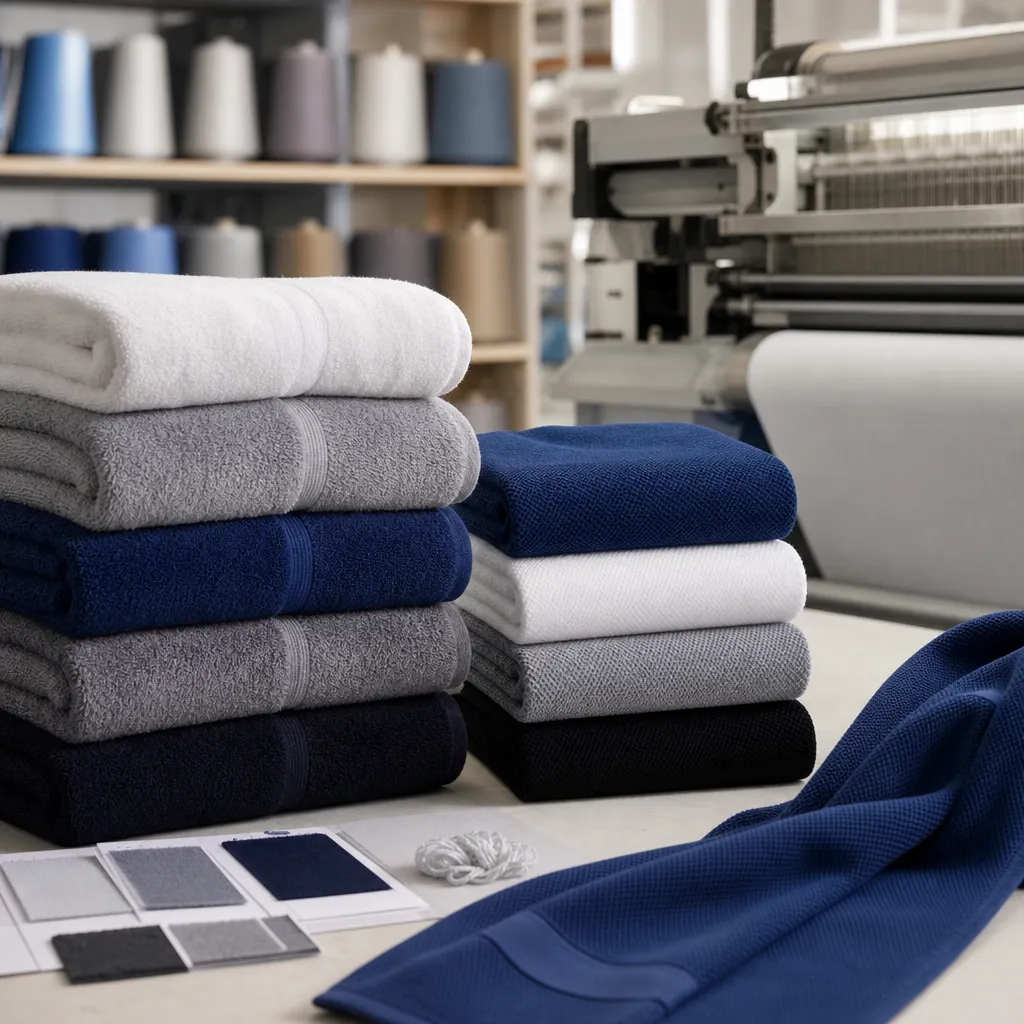
The Usage Scene Decides the Fabric
We quote team, gym, tournament, and retail athletic programs from the same factory floor, but the towel constructions are not interchangeable. A 30 x 50 cm towel clipped to a golf bag has different risks than a 40 x 80 cm towel issued at a boxing studio. A stadium giveaway towel can be lighter because it may be used ten times; a training towel in a commercial gym can see 140 to 220 wash cycles in one year.
For sports towels, we start by mapping three points before yarn or GSM: where the towel sits during use, how it is laundered, and what surface touches the logo. Clip-on towels need reinforced corners. Bench towels need a softer hand but must not shed lint onto black uniforms. Retail athletic towels need packaging discipline because shelf creases and uneven folding make the product look cheaper than the fabric really is.
| Use case | Common size | Construction we quote first | Main failure risk |
|---|---|---|---|
| Gym sweat towel | 30 x 90 cm or 35 x 75 cm | Cotton terry 360-430 GSM or microfiber 260-320 GSM | Odor retention, edge curling, color bleed |
| Team sideline towel | 40 x 80 cm or 40 x 100 cm | Cotton terry 420-500 GSM with dobby or jacquard logo zone | Loop pulls from tape, helmets, and hooks |
| Golf or club towel | 40 x 50 cm or 45 x 60 cm | Terry or waffle microfiber with grommet corner | Corner tearing, metal staining, snagging |
| Retail cooling towel | 30 x 100 cm | Polyamide/polyester microfiber 180-240 GSM | Print distortion after stretch and wash |
| Event or race towel | 30 x 50 cm or 35 x 70 cm | Cotton terry 300-380 GSM or velour front | Low absorbency if pile is too short |
The cheapest mistake is visible at sampling; the expensive one appears after the towel has already entered the locker room. A team towel with open-loop terry can look full at 470 GSM, then pick up thread pulls from hook-and-loop straps by the third week. For that environment, we may shift to shorter pile, tighter reed density, or a microfiber waffle face even if the handfeel is less plush on day one.
Sports Towels Need a Narrower GSM Window
Sports towels sit in a tighter performance window than bath towels. Too light, and the towel feels disposable after sweat and detergent. Too heavy, and it dries slowly in equipment bags, which creates odor complaints and freight weight that does not add much value. The practical range for most athletic programs is 300-500 GSM for cotton terry and 180-340 GSM for microfiber.
A 35 x 75 cm cotton towel at 400 GSM carries about 105 g of fabric before hem allowance and decoration. After hems, woven label, and carton moisture variation, packed unit weight lands closer to 118-126 g. That difference matters when a brand moves 18,000 pieces by air for a tournament deadline; freight can overtake the towel cost if the size and GSM are chosen casually.
| Fabric target | Best fit | GSM range | Factory note |
|---|---|---|---|
| Light cotton terry | Race kits, promo packs, youth team issue | 300-360 GSM | Lower cost, faster drying, less body after 50 washes |
| Standard cotton terry | Gyms, schools, training centers | 370-430 GSM | Best balance for absorption and laundering cost |
| Heavy cotton terry | Pro team, club retail, hospitality fitness rooms | 450-520 GSM | Stronger handfeel, slower drying, higher carton weight |
| Flat microfiber | Cooling, travel, compact retail towels | 180-240 GSM | Low bulk, good print area, not bath-towel absorbency |
| Waffle microfiber | Golf, court sports, equipment wipe-down | 260-340 GSM | Better grip and dirt pick-up, needs stable edge binding |
- For cotton terry, keep pile height controlled when the towel will contact Velcro, wrap tape, or textured gym flooring.
- For microfiber, specify the blend and filament feel; a 80/20 polyester-polyamide towel wipes better than a low-polyamide promotional cloth, but costs more.
- For dark team colors, confirm reactive dye or disperse dye route by fiber type before approving logo artwork.
- For shared gym laundry, avoid oversized towels unless the operator has drying capacity; overloaded dryers cause hard handfeel and musty returns.
A useful cost-per-use calculation needs honest laundry assumptions. One 40 x 80 cm towel at 390 GSM might quote at USD 1.46 at 10,000 pcs and survive about 85 commercial washes in a fitness studio, or 1.7 cents per use before laundry. A 460 GSM version may quote at USD 1.82 and survive around 125 washes under the same detergent and dryer settings, or 1.5 cents per use. The heavier towel is not automatically better, but the cheaper towel is not automatically cheaper over the season.
Cotton, Microfiber, or Blended Construction
Cotton terry remains the safest choice for sweat absorption and skin comfort. Ring-spun 21s or 32s cotton yarn gives better handfeel than open-end yarn, while combed cotton reduces short-fiber lint. For a school or gym program, we often build the towel with cotton pile and cotton or polyester ground yarn depending on the durability target. Polyester in the ground can improve dimensional stability, but it changes burn testing and labeling requirements for some markets.
Microfiber is not a lower-cost substitute for every towel. It is strong for compact packing, quick drying, cooling formats, golf cleaning, and full-surface sublimation. It is weaker when the customer expects the familiar bite of cotton terry against sweat. A microfiber sports towel also needs edge control: overlock thread that is too loose will ripple after wash, while a stiff bound edge can feel sharp during face use.
| Material choice | What it does well | What to watch | Typical May 2026 ex-factory band |
|---|---|---|---|
| Cotton terry, 360-430 GSM | Absorbs sweat quickly and feels familiar | Lint in first washes, loop pulls | USD 1.18-1.72 at 10,000 pcs for 35 x 75 cm |
| Cotton terry, 450-520 GSM | Better body for retail and team issue | Drying time and freight weight | USD 1.65-2.38 at 10,000 pcs for 40 x 80 cm |
| Polyamide/polyester microfiber, 220-300 GSM | Compact, quick dry, printable | Can feel slick if blend is too cheap | USD 0.96-1.58 at 10,000 pcs for 30 x 90 cm |
| Waffle microfiber, 280-340 GSM | Good equipment wiping and golf use | Edge binding and shrink balance | USD 1.22-1.86 at 10,000 pcs for 40 x 50 cm |
| Cotton velour front, terry back | Clearer screen print surface | Lower front-side absorption | USD 1.40-2.05 at 10,000 pcs for 35 x 75 cm |
For a broader fabric decision, our comparison of microfiber vs cotton towels explains the absorption and drying trade-offs in more detail. For gym-specific laundering problems, why gym towels fail after 50 washes is the closer read.
Logo Method Is a Durability Choice
A logo on a towel is not just decoration. It changes the surface, the washing behavior, and sometimes the absorbency. Embroidery looks strong on club and team towels, but dense stitching can stiffen a small sweat towel. Sublimation is excellent on polyester microfiber, yet it cannot be applied to cotton terry with the same color result. Jacquard is durable because the design is woven into the towel, but it requires more discipline in line thickness and yarn colors.
For athletic towels with player numbers, gym logos, or sponsor marks, we check artwork against the fabric before giving a decoration quote. A 2 mm serif may survive on a paper proof and disappear in terry pile. A logo with a 12-color gradient may look natural in sublimation and become expensive or muddy in jacquard. For cotton, we prefer bolder marks, fewer fine outlines, and logo placement away from the main face-wiping zone when embroidery is used.
| Decoration method | Best towel base | MOQ reality | Durability note |
|---|---|---|---|
| Embroidery | Cotton terry, velour border, golf towel corner | 500 pcs per design/color | Use backing that tears cleanly; dense fills can pucker after tumble drying |
| Jacquard weave | Cotton team towels, retail athletic towels | 500 pcs per design/color, but cleaner above 1,000 pcs | Logo edges depend on weave grid; avoid tiny lettering |
| Sublimation | Polyester or poly-rich microfiber | 500 pcs per design/color | Excellent color range; confirm stretch distortion on cooling towels |
| Screen print | Cotton velour face, event towels | 500 pcs per design/color | Handfeel and crocking depend on ink and curing temperature |
| Woven label or patch | Gym issue towels, private label retail | 500 pcs per design/color | Low impact on absorbency; label corners need wash testing |
- Embroidery thread should be tested against the towel dye, especially white thread on navy or black reactive-dyed cotton.
- Jacquard logos need minimum line widths; we prefer 4-5 mm for readable small letters on terry.
- Sublimation artwork should include bleed because microfiber panels can move 3-5 mm during heat pressing.
- Metal grommets need a fabric patch or denser corner weave; punching directly through loose terry shortens service life.
For decoration selection, embroidery vs sublimation vs jacquard gives a useful method-by-method breakdown. If the brand color is strict, pair it with Pantone color matching for custom towels before locking the artwork.
Wash Testing Before the Team Order
We do not treat a first sample as proof of durability. A sample proves the direction; a pre-production sample proves the order can be made repeatedly. For sports programs, we check shrinkage, colorfastness, lint, logo stability, and edge behavior because the towel will meet sweat, detergent, sunscreen, resin, grass, court dust, and sometimes disinfectant.
Our internal check is built around recognized methods rather than vague handling claims. For wash colorfastness, the reference is ISO 105-C06. For perspiration colorfastness, ISO 105-E04 is more relevant to athletic use than a simple water soak. For dimensional change, ISO 5077 gives the measurement framework after washing and drying. If the customer sells into infant, school, or skin-sensitive channels, OEKO-TEX Standard 100 Class I is the certificate we keep ready for qualified materials.
- Lab dip or strike-off is approved for color and logo direction.
- Pre-production sample is made on bulk yarn or bulk fabric, not only showroom stock.
- We run 3 home-wash cycles for quick screening and 10 cycles for higher-risk dark colors or dense decoration.
- Measurements are taken before wash, after wash, and after tumble dry; shrinkage above the agreed tolerance is corrected before bulk cutting.
- Packed sample is checked for barcode, carton mark, moisture feel, and folding consistency before final release.
A real defect we see in athletic towels is not dramatic tearing; it is small distortion that makes the product look tired. The long side twists, the label corner curls, or the embroidery field becomes wavy. These issues come from yarn torque, unbalanced border tension, or decoration density. They are fixable, but only before bulk production.
Pricing Bands That Match Actual Specs
A serious quote needs size, GSM, material, logo method, packaging, inspection level, and delivery term. The bands below are May 2026 ex-factory reference ranges from our towel lines in Zhejiang. They are not a promise for every artwork, but they show the cost shape behind branded sweat towels and team towels. Cotton price, exchange rate, carton requirement, and decoration density can move the final number.
| Order volume | Spec example | Simple logo | More complex logo | Notes |
|---|---|---|---|---|
| 500 pcs | 35 x 75 cm cotton terry, 390 GSM | USD 2.05-2.65 | USD 2.55-3.40 | MOQ level; dyeing and setup costs carry more weight |
| 2,000 pcs | 35 x 75 cm cotton terry, 390 GSM | USD 1.58-2.08 | USD 1.95-2.72 | Good level for school teams and boutique gyms |
| 10,000 pcs | 40 x 80 cm cotton terry, 430 GSM | USD 1.62-2.18 | USD 2.10-2.95 | Better yarn, dyeing, and carton efficiency |
| 25,000 pcs | 30 x 90 cm microfiber, 260 GSM | USD 0.78-1.20 | USD 1.05-1.68 | Sublimation setup spreads well at this volume |
| 50,000 pcs | 30 x 50 cm event towel, 330 GSM | USD 0.54-0.88 | USD 0.72-1.16 | Best for race, league, and sponsor campaigns |
Cheap construction can still make sense for a one-day event. It becomes risky for a gym membership gift, pro shop item, or team-issued towel. A 500-piece order with individual polybags, woven labels, and embroidery will not land near a mass promo price because the handling time is real. If the budget is fixed, we reduce complexity first: fewer logo colors, simpler fold, standard carton, or a stock yarn shade close to the brand color.
Our MOQ is 500 pcs per design and per color. For mixed player numbers or multiple team colorways, count each design/color separately unless the base towel is identical and only a removable label changes. The article on negotiating towel MOQ without killing margin explains which compromises help and which ones only move cost into defects.
Production Timing and Capacity Planning
A tournament date or season opener gives less room for correction than a normal retail reorder. We ask for artwork, Pantone targets, size, GSM, packaging, and delivery address before sample work begins. A vague brief can lose more calendar time than weaving itself.
| Stage | Typical days | What can slow it |
|---|---|---|
| Spec confirmation and quote | 1-3 days | Missing GSM, unclear logo method, no packing brief |
| Lab dip or artwork strike-off | 4-7 days | Multiple Pantone targets on dark fabric |
| Sample making | 6-10 days | Jacquard loom setup, grommet sourcing, unusual label |
| Buyer approval window | 2-7 days | Internal brand review or sponsor sign-off |
| Bulk production | 18-32 days | Yarn dyeing, embroidery capacity, microfiber printing load |
| Final inspection and packing | 2-4 days | Carton mark changes, failed metal detection if accessories are used |
| Sea freight booking | 7-14 days before sailing | Peak season space and destination port congestion |
For a clean repeat order, 25-35 production days after approval can work. For a new custom sports towel with dyed yarn, jacquard, packaging, and third-party inspection, a 45-60 day calendar is more realistic before vessel transit. Air freight can rescue a missed event date, but towel weight makes it expensive; splitting 10-20 percent by air and the balance by sea is usually a better fix than flying the full order.
- Approve one golden sample and keep it sealed for inspection reference.
- Freeze carton quantity early; changing from 100 pcs to 60 pcs per carton affects carton dimensions and freight quotes.
- Confirm whether towels are packed damp-free after finishing; excess moisture can create odor during long transit.
- For metal grommets or clips, specify nickel-free requirements if the destination retailer asks for them.
For freight decisions, we link sourcing teams to container vs air freight for towel orders. For the upfront brief, how to build a towel tech pack that mills can quote will save several rounds of email.
Compliance Is Part of the Spec
Athletic products touch skin during heat and sweat, so certification cannot be an afterthought. LUMA & CO. TEXTILE operates with ISO 9001 quality management, BSCI social compliance, and OEKO-TEX Standard 100 Class I qualified material routes when the order requires that level. Certification scope must match the material and process; a certificate for a white cotton base does not automatically cover a new black dye, metallic print, or sourced accessory.
For team and school orders, formaldehyde, banned azo dyes, nickel release from metal trims, and colorfastness to perspiration are the usual review points. For fitness brands selling online, label accuracy also matters. A microfiber towel should not be marketed as cotton because the handfeel is soft. A cotton-rich towel with polyester ground yarn should be labeled according to the destination market rules.
- Ask for certificate number, issuing body, article scope, and expiry date instead of accepting a screenshot.
- Match the certificate to fiber, dye route, and decoration method used in bulk production.
- Keep one packed production sample for claims handling after delivery.
- For marketplace sales, confirm fiber content, care label language, country of origin, and polybag warning text before packing.
Our guide on how to read an OEKO-TEX certificate is useful when a retailer asks for documents but does not explain what they expect. Hospitality buyers comparing locker-room towels with guest-room towels may also want the hotel towel sourcing guide, because the laundering assumptions are different.
What to Send Us for a Clean Quote
A complete RFQ prevents loose pricing and protects the calendar. We need the towel role, size, target GSM, fabric preference, logo file, Pantone references, packaging, order quantity by color, destination, and required compliance documents. If any of those points are unknown, we can recommend a starting spec, but the quote will carry assumptions.
For a first custom sports towel program, our practical starting point is 35 x 75 cm at 390-420 GSM cotton terry for gym and team use, or 30 x 90 cm at 240-280 GSM microfiber for compact retail and cooling formats. From there, the real decision becomes decoration and wash target. A towel expected to last one summer camp does not need the same construction as a towel issued daily in a training facility.
- Send vector artwork in AI, PDF, or SVG, plus any sponsor placement rules.
- State whether the towel is sold, gifted, rented, or laundered in-house.
- Give the target landed price or ex-factory budget band so we can adjust fabric and decoration honestly.
- List required standards such as OEKO-TEX Standard 100, BSCI, ISO 9001 factory documentation, or retailer chemical limits.
- Confirm the delivery date and whether partial air shipment is acceptable if timing becomes tight.
Related reads: for size decisions, use the towel sizes and dimensions guide; for GSM trade-offs, see the towel GSM decision framework. Product teams building broader athletic assortments can also review our gym towel product range and golf towel program guide.
Quote a Sports Towel Program
Send size, GSM target, artwork, quantity by color, and delivery market. MOQ starts at 500 pcs per design/color. WhatsApp: +86 13205717266. Email: [email protected].
Request a Quote →