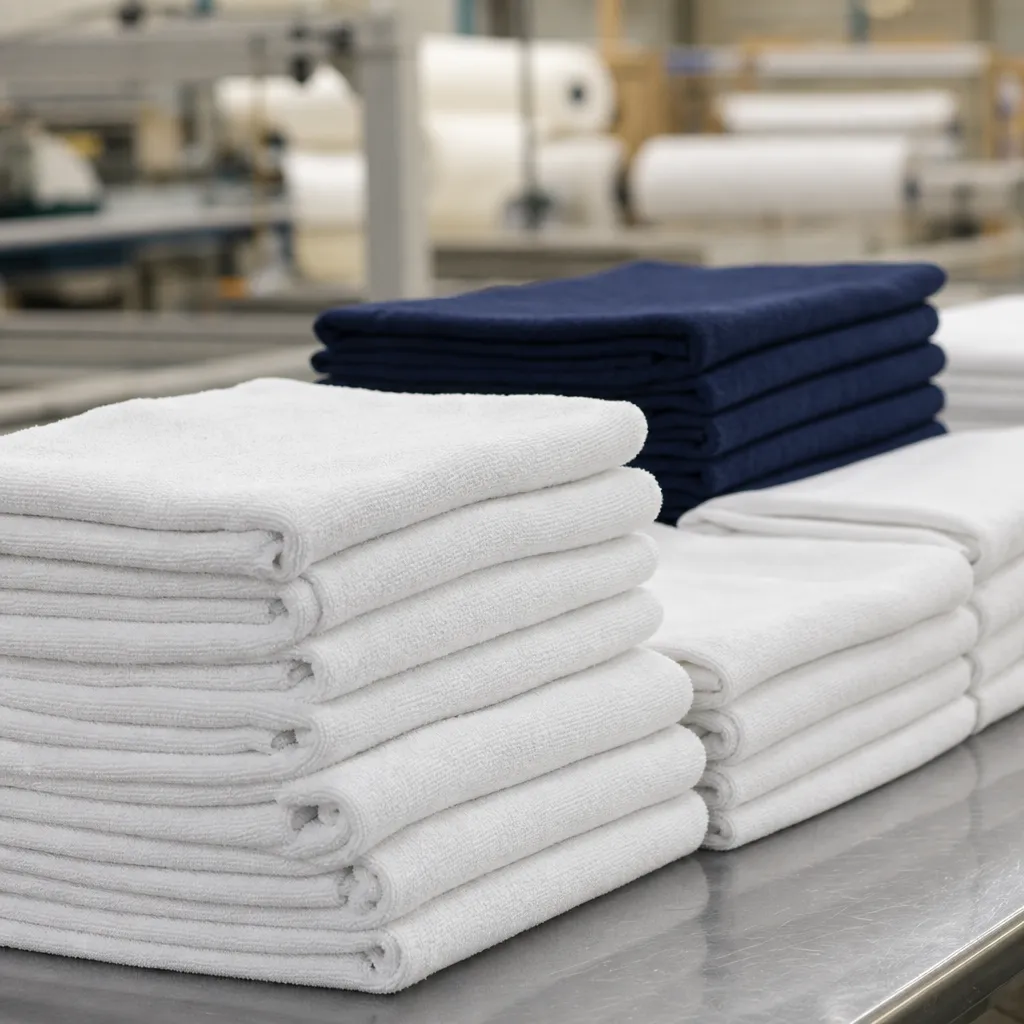
Start with the base towel, not the monogram
Buyers often evaluate the embroidery first because it is the visible brand element. In production, the opposite sequence is safer. If the ground towel is unstable, the monogram will tunnel, pucker, or drift after wash. For bath towels, we usually see the cleanest embroidery result on combed cotton terry in the 500-680 GSM range, with a tight enough ground to support stitch density but enough pile recovery to keep the hand feel acceptable.
Before you compare suppliers, lock five towel lines in the RFQ: finished size, tolerance after wash, GSM tolerance, yarn type, and border construction. A 76 x 142 cm towel with 580 GSM and a dobby border behaves very differently under embroidery than a 70 x 140 cm zero-twist item with a soft, open pile. We normally caution buyers against placing a monogram too close to a highly raised border because the presser foot can ride unevenly and the satin stitch edge becomes inconsistent.
| Base towel field | What to request from supplier | Why it matters for monogram |
|---|---|---|
| Finished size | Example: 76 x 142 cm ±3% | Logo placement shifts if shrinkage is not controlled |
| Weight | 500-680 GSM, bulk avg tolerance ±5% | Low GSM body can ripple under embroidery |
| Yarn | 16s ring-spun or combed cotton pile | Finer, more even surface gives cleaner stitch edge |
| Border | Flat dobby or cam border drawing | Need stable area for hooping and placement |
| Shrinkage | Wash result after 3 cycles | Placement and monogram proportions must stay balanced |
A supplier checklist should include embroidery capability by towel construction
Not every towel mill that can weave terry can embroider it well in-house. Some outsource decoration, which is not automatically a problem, but it changes lead time control and defect accountability. Ask whether the embroidery line is internal, dedicated, or subcontracted. Then ask what hoop size, backing, and thread system they use for dense terry towels.
- Ask for the maximum embroidery field they recommend on bath towels without visible puckering. We usually keep monograms in a restrained area, often under 110 x 110 mm for hotel programs.
- Ask what backing material they use on terry. Cut-away backing is common for stability; water-soluble topping can help keep stitches from sinking into high pile.
- Ask whether they adjust stitch density for 500 GSM and 650 GSM towels differently. A single embroidery file should not be run unchanged across every pile height.
- Ask how they prevent hoop burn and pile crush on light shades such as white, ivory, and stone.
Two topic-specific checks matter here. First, ask whether the supplier runs a pull-compensation adjustment on block letters with satin columns; otherwise vertical initials can look narrow after wash because the pile rebounds around the stitches. Second, ask whether they trim jump threads manually on the towel back before final folding. On hospitality programs, we still see rejection claims caused by loose back threads snagging during laundry handling.
Request a sample set that exposes failure, not just beauty shots
A single showroom sample is not enough. The better test is a controlled sample pack. We recommend asking each supplier for three pieces from the same run: one unwashed counter sample, one piece washed 5 cycles at 60°C, and one piece washed 10 cycles if the towel is going into a commercial laundry environment. If the buyer is in hospitality, add a requirement for chlorine tolerance comments if your wash formula includes bleaching chemistry.
- Review the monogram front view for edge sharpness, fill coverage, and pile show-through.
- Turn the towel over and inspect bobbin tension, trimmed thread ends, and backing feel.
- Measure placement from hem and side seam after washing; record movement in millimeters, not comments like "looks okay".
- Check the hand around the logo zone. Overstiff areas often signal excessive density or too much backing.
- Photograph all three samples side by side under the same light.
| Sample check | Acceptable range | Common failure mode |
|---|---|---|
| Logo placement deviation | Within ±6 mm from approved spec | Off-center monogram in folded presentation |
| Shrinkage after 5 washes | Usually under 5% on length, under 4% on width | Logo appears too close to border after wash |
| Thread coverage | No exposed ground in main strokes | Pile peeking through serif details |
| Back thread trimming | No loose tails over 8 mm | Snagging in commercial laundry |
| Color change | Grade 4 minimum where specified | Ivory thread dulling after bleach contact |
Check whether the supplier can control placement repeatability in bulk
Bulk embroidery problems are usually not dramatic technical failures. They are repeatability failures. Piece 1 and piece 1,200 both pass independently, but they do not match when laid in a spa suite or hotel room. This is why your checklist should ask how the factory sets placement guides before a run and how often operators verify them.
Our usual control method is simple: a hard placement template for the first-off approval, an in-line check every 50 pieces, and a carton-end audit before final sealing. On bath towels with thick hems, even a small folding difference before hooping can move a monogram by 7-10 mm. That amount is visible when towels are stacked at reception or folded on open shelving.
- Require a placement diagram with dimensions from hem and side edge.
- Require a first-off approval photo with ruler visible.
- Ask for the factory's in-line inspection frequency during embroidery.
- Ask whether they segregate shade lots before decoration; embroidering across mixed white shades creates visible mismatch.
If the supplier cannot show this process clearly, you are not buying a controlled monogram program. You are buying a decorated towel batch.
Audit the color and thread specification like you would audit fabric
Monogram buyers sometimes treat thread as an accessory line item. It is not. Thread sheen, thickness, dye stability, and bleach response all affect claim rates. For white hotel towels with navy or charcoal initials, we normally suggest polyester embroidery thread for wash stability and abrasion resistance. For softer retail bath sets, rayon may look richer, but it is less forgiving in aggressive laundering.
If brand color is important, ask how the supplier handles thread shade approval. Pantone matching in thread is not the same as lab-dipping cotton yarn. There are practical limits. A good supplier will tell you whether they will source an existing thread cone, make a nearest match, or require MOQ for special thread dyeing.
| Thread question | Preferred answer from supplier | Risk if unclear |
|---|---|---|
| Thread material | Polyester for laundry-heavy hospitality programs | Premature fading or fuzzing |
| Shade approval method | Cone card or sewn strike-off against reference | Approved color drifts in bulk |
| Wash test | Internal wash check plus buyer-approved standard | No evidence of durability |
| Bleach exposure comment | Declared suitability or limitations | Unexpected thread tone shift |
| Needle and density adjustment | Different setup by pile height and letter size | Thread sinks or puckers |
Use certifications correctly: they qualify the program, but they do not replace QC
A reliable supplier should be able to show OEKO-TEX Standard 100 Class I, BSCI, and ISO 9001 documentation for the program environment. Those certificates matter, especially for hotel groups and retail brands with compliance requirements. They do not prove that the monogram is placed correctly or that the towel will stay flat around the embroidered zone after laundering.
For buyer files, we suggest collecting three documents at onboarding: the current OEKO-TEX certificate scope, the internal quality SOP for embroidery inspection, and the wash test record used on the approved style. If the vendor hesitates on the last two, that is usually more informative than the certificate itself.
Related reads: if your team needs to verify compliance paperwork, start with how-to-read-oeko-tex-certificate.html. If you are still building the underlying hotel towel spec, hotel-towel-sourcing-guide-2026.html and build-towel-tech-pack-that-mills-can-quote.html are the right foundation.
Price the monogram program by run logic, not only by piece price
The cheapest quote on a monogram towel often hides setup inefficiency. Ask how the supplier builds cost: base towel FOB price, embroidery stitch count or size band, backing, thread color count, folding requirement, polybag or insert, and carton assortment. For a straightforward bath towel program, we usually see the embroidery adder quoted by logo size bracket rather than exact stitch count because hospitality initials are often simple serif or script marks.
As a realistic 2026 FOB China range, a 550-600 GSM combed cotton bath towel in white with a single-position monogram may land around USD 4.25-5.40 per piece at 1,000-3,000 pcs, depending on size, cotton market, and embroidery area. At 5,000-10,000 pcs on one ground shade and one thread shade, a comparable setup may move into roughly USD 3.85-4.90. A denser towel at 650+ GSM with gift-ready fold, belly band, and tighter placement tolerance will sit higher.
- Ask for pricing by volume tier and logo size tier.
- Ask whether there is a digitizing charge for the monogram file and whether repeat orders waive it.
- Ask how much cost changes if you split one order into multiple initials or room-category variants.
- Ask what happens if the buyer requests piece-by-piece personalization instead of one standard mark.
| Order scenario | Typical MOQ logic | Indicative FOB range |
|---|---|---|
| Hotel opening order, one monogram | 1,000 pcs per style/color | USD 4.25-5.40 |
| Group reorder, one monogram, stable spec | 3,000 pcs and up | USD 3.95-4.95 |
| Luxury retail set, heavier towel and branded pack | 500 pcs per design/color minimum | USD 5.10-6.80 |
| Multi-initial personalization | Quoted case by case | Higher due to handling and setup complexity |
If someone quotes far below this band, examine what is missing. Common omissions are lower actual GSM, outsourced decoration, reduced trimming labor, or weaker QC at the back side of embroidery. The cost claim usually appears later as rework, replacement, or slower replenishment.
Lead time depends on sample discipline more than machine speed
Bath towel embroidery is not slow by itself. Revisions are what extend calendars. A practical sourcing plan is 3-5 days for quote and artwork review, 5-7 days for digitizing and strike-off, 7-12 days for towel sampling if weaving or dyeing is involved, and 18-30 days for bulk once approvals and deposit are in place. During peak season or before major hotel openings, embroidery capacity can become the bottleneck rather than terry weaving.
- Buyer sends tech pack with towel spec, logo file, placement drawing, and target wash standard.
- Supplier issues quote, confirms MOQ, and flags any density or border-placement risk.
- Strike-off approval is signed before bulk towel body is reserved.
- Bulk towel production and embroidery scheduling are locked together, not separately.
- Final inspection checks both towel spec and monogram placement before shipment.
For reorders on an approved setup, we often ship within 22-28 days for standard white hospitality grounds, while custom-dyed retail colors can extend to 30-40 days. If freight timing is tight, review container-vs-air-freight-towel-orders.html before you split shipment too late.
Questions that quickly expose a weak supplier
A good checklist is useful because weak vendors answer certain questions vaguely. We would treat the following responses as caution signals during supplier comparison.
- "We can embroider anything on any towel" without asking about GSM, pile, border, or wash use.
- "Placement is by sample" with no millimeter measurement or control template.
- "Color is similar" without a strike-off approval process.
- "Commercial wash is no problem" without showing any wash record or internal standard.
- "MOQ is flexible" but no explanation of how style, color, and monogram variants affect setup.
One more technical question works well: ask what they do when the towel pile swallows fine script detail. Experienced teams will mention underlay choice, topping film, reducing density, or enlarging thin strokes. Inexperienced teams will simply say they make the logo sharper in software.
Build your final supplier checklist around approval evidence
By the time you issue a PO, your checklist should produce documents, not opinions. We recommend keeping one approval file for each monogram style and towel base. That file should include the towel spec sheet, embroidery artwork version, strike-off signoff, wash result notes, placement drawing, packaging standard, and inspection criteria. This shortens reorders and limits disputes if a property team complains months later.
Related reads: for monogram design choices, see monogrammed-bath-towels-luxury-brand-guide.html. For decoration trade-offs across methods, embroidery-vs-sublimation-vs-jacquard.html is useful. If MOQ is the sticking point, negotiate-towel-moq-without-killing-margin.html covers practical ways to structure the order.
The best monogram towel supplier is usually not the one with the nicest sample photo. It is the one that can explain, measure, and repeat the same result at bulk scale.
For buyers sourcing bath towels from China, our own operating baseline is MOQ 500 pcs per design and per color, with OEKO-TEX Standard 100 Class I, BSCI, and ISO 9001 certification support. We run production planning around bulk repeatability because that is what hotel and retail replenishment programs depend on.
Need a monogram bath towel quote with real QC points?
Send your towel spec, logo file, target quantity, and wash-use scenario. We will quote the base towel, embroidery setup, MOQ, and lead time clearly. WhatsApp +86 13205717266 or email [email protected].
Request a quote →