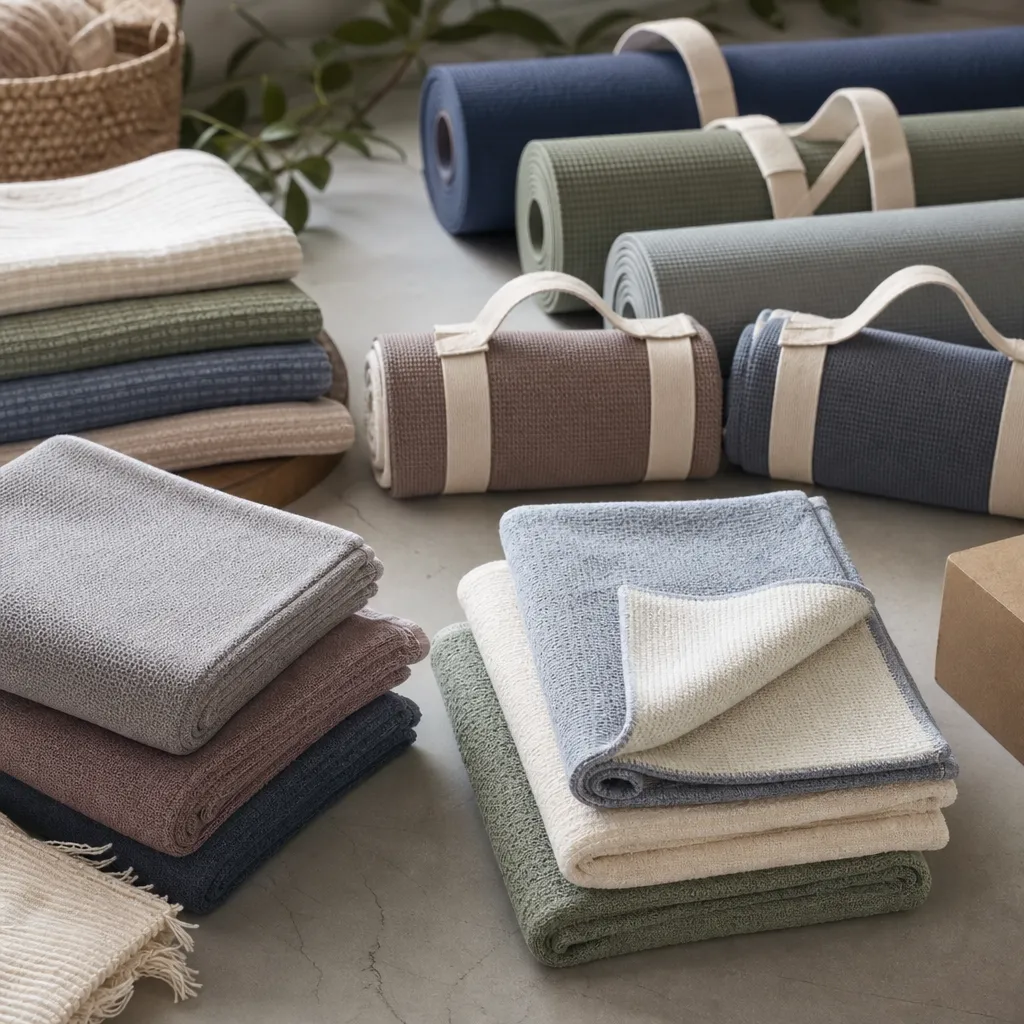
Why branded yoga mats need a towel spec
We are a towel mill, not a rubber compounding plant, so we look at branded yoga mats through the part that touches sweat, dye, laundry, and daily studio operations. A mat can carry the logo, but the towel decides grip under moisture, odor control after repeated classes, and how quickly staff can reset a room between sessions.
For most studio, retreat, and fitness brand programs we see, the commercial decision is not mat only versus towel only. It is whether the buyer wants a retail-feeling kit, a class rental system, or a promotional giveaway. Each one needs a different GSM, size, backing, packaging, and QC plan.
- Retail kits: usually one mat plus one full-size yoga mat towel, packed in a drawstring bag or kraft box for DTC sale.
- Studio rental: towel durability matters more than gift packaging because each piece may see 80-140 wash cycles per year.
- Retreat merchandise: lower total quantity, stronger color story, and more visible branding on belly bands or woven labels.
- Corporate wellness: tighter budget control, simpler logo placement, and carton packing that can survive parcel distribution.
Our standard OEM towel MOQ is 500 pcs per design / per color. If the program includes a matching mat, we normally align the mat MOQ to the towel MOQ so the buyer does not receive unmatched leftovers. For 500-1,000 kits, we recommend keeping mat color to one base shade and moving the design work onto the towel, label, or band.
Start with use case, not logo size
Logo size is usually the first request on a tech pack, but it should come after use case. A hot yoga towel needs wet-grip behavior. A Pilates towel needs soft handfeel and edge stability. A wellness gift towel can be lighter, but it still cannot bleed dye onto a pale rubber mat.
| Program type | Common size | Recommended towel GSM | Main risk if underspecified |
|---|---|---|---|
| Hot yoga studio kit | 61 x 183 cm towel over 61 x 183 cm mat | 300-380 GSM microfiber suede or 360-420 GSM cotton-blend jacquard | Slipping when sweat pools near hands |
| Pilates or barre studio | 50 x 100 cm hand towel plus 61 x 183 cm mat | 360-450 GSM cotton terry or 280-340 GSM microfiber | Corners curling after repeated washing |
| Retreat retail set | 70 x 180 cm flat towel or mat towel | 260-330 GSM quick-dry microfiber or flat cotton | Too bulky for luggage or guest welcome bags |
| Corporate wellness gift | 40 x 80 cm towel plus 4-6 mm mat | 280-350 GSM microfiber or 400-500 GSM cotton hand towel | Decoration looks cheap after five washes |
For a yoga mat towel, the size tolerance is more important than many buyers expect. If the towel is 2 cm narrower than the mat, users feel the rubber edge under their palms. If it is too long, the end folds under the foot during Warrior poses. We usually hold cut size tolerance within ±1.5 cm after washing for microfiber mat towels and ±2.0 cm for cotton terry, depending on construction.
Related reads: if your team is still deciding between towel materials, compare absorbency and drying behavior in microfiber vs cotton towel comparison. For general sizing logic, our complete towel dimensions guide is useful before building the kit BOM.
Material choices for mat-and-towel kits
Most branded yoga mats use PVC, TPE, NBR, natural rubber, PU-top rubber, cork, or jute-blend surfaces. The towel specification changes depending on that surface. Natural rubber has good floor grip but can mark if packed against unstable disperse dyes. PU-top mats feel dry and smooth, but a loose towel can slide over them unless the towel has silicone dots or pocket corners.
On the towel side, we normally quote four constructions. Microfiber suede is the most common for hot yoga because it is printable and folds small. Cotton terry feels more familiar for spa-style studios but dries slower. Cotton-poly jacquard gives woven branding without ink, though the design must be simplified. Waffle microfiber is lighter and dries quickly, but it is less plush under knees.
| Towel construction | Typical GSM | Best use | Factory note |
|---|---|---|---|
| Microfiber suede, 80/20 polyester-polyamide | 260-340 GSM | Printed full-mat towel for hot yoga and travel kits | Needs disperse print fixation and colorfastness wash test before bulk |
| Microfiber with silicone grip dots | 300-380 GSM | Non slip yoga towel for humid studios | Dots must be cured evenly; under-cured dots peel after tumble drying |
| Cotton terry, combed yarn | 420-560 GSM | Spa-yoga hybrids, Pilates, locker room towel sets | Higher lint during first washes; pre-wash sample is recommended |
| Cotton-poly jacquard | 360-480 GSM | Subtle studio branding with repeated pattern | Artwork should avoid fine lines below 2.5 mm in weave |
Two topic-specific defects show up often in yoga kit sampling. The first is corner memory on microfiber towels: if heat setting is rushed, the towel corners lift after laundering and the user feels the edge under the wrist. The second is silicone dot shadowing: too much pressure in packing can leave dot impressions on PU or light-colored rubber mats during ocean transit. We avoid this with interleaving paper and a 24-hour packed sample check before approving export cartons.
Grip testing we use before bulk approval
Grip is not a single number because dry grip, damp grip, and sweat grip behave differently. For a non slip yoga towel, we test dry hand drag first, then dampen the contact area with a measured spray. A towel that feels stable dry can become unstable once the pile is saturated.
- Cut a production-size towel sample and wash it once at 40°C with neutral detergent, no softener.
- Place it over the buyer-approved mat surface and condition both pieces for at least 4 hours at 20-24°C.
- Apply 8-10 ml water over a 30 x 30 cm hand zone to simulate sweat accumulation.
- Run a basic inclined-plane slip check and record the angle where movement starts.
- Inspect silicone dots, pocket seams, or backing texture after one wash and again after five wash cycles.
For lab references, we use ISO 6330 for domestic washing procedures when evaluating dimensional change and appearance after laundering. For colorfastness, we use ISO 105-C06 for washing and ISO 105-X12 for rubbing. If the towel will be sold for infants, family wellness, or skin-sensitive programs, we recommend OEKO-TEX Standard 100 Class I yarns and dyes. LUMA & CO. TEXTILE is OEKO-TEX 100 Class I, BSCI, and ISO 9001 certified.
We do not promise that every branded towel will grip every mat. A microfiber towel on a textured PVC mat behaves differently from the same towel on cork or PU. For bulk programs, we ask buyers to send the final mat sample or approve a matched mat surface before we lock towel backing.
Branding placement that survives practice and washing
Branding on yoga accessories has to survive sweat, friction from hands and feet, and repeated washing. A large print across the towel face can look good in photos, but it may reduce perceived grip if the ink layer is heavy. For studio rental towels, we usually keep the usable hand and foot zones cleaner and move branding to the ends, side border, woven label, or packaging band.
| Branding method | Works best on | MOQ impact | Risk to control |
|---|---|---|---|
| Sublimation print | Polyester microfiber suede towel | No extra MOQ beyond 500 pcs/design/color | Color shift after heat press if artwork is not profiled |
| Embroidery | Cotton hand towel or carry pouch | Adds stitch file and thread approval | Raised stitches can irritate if placed in palm zone |
| Jacquard weave | Cotton-poly towel or cotton terry | Better above 800-1,000 pcs for cost efficiency | Small lettering can close up in pile |
| Woven label or belly band | Any towel or kit packaging | Low decoration risk at 500 pcs | Label position must not scratch mat surface |
For custom yoga mats, logos are often screen printed, laser engraved on cork, or embossed into rubber. If the towel is the main decoration carrier, the mat can stay plain, which reduces cost and shortens sampling. If the mat has the same logo, we check Pantone matching across different materials because ink on microfiber usually looks brighter than ink on rubber.
- Keep printed towel artwork in CMYK plus Pantone reference, not only RGB screen files.
- Avoid large dark solid print zones on white microfiber if the buyer expects very soft handfeel.
- Use embroidery mainly on carry straps, pouches, and hand towels, not the main mat contact area.
- For jacquard, convert gradients into two or three yarn colors before quotation.
- Add a woven care label with wash temperature, no-softener warning, and country-of-origin wording.
Related reads: for decoration trade-offs, see embroidery vs sublimation vs jacquard. If your artwork depends on exact studio colors, our Pantone color matching guide explains why fabric, pile direction, and lighting change the result.
Specs we ask buyers to confirm
A quote for branded yoga mats with towels is only accurate when the kit components are clear. If the buyer says “standard mat and towel,” suppliers may quote very different thicknesses, fiber blends, and pack methods. One quote may include a 4 mm TPE mat and 280 GSM towel; another may include a 5 mm natural rubber mat and 360 GSM grip-dot towel. The landed price difference is not a supplier margin trick; the products are not the same.
- Mat material: TPE, PVC, NBR, natural rubber, PU-rubber, cork, or other surface.
- Mat size and thickness: common sizes are 61 x 173 cm, 61 x 183 cm, and 66 x 183 cm; thickness is usually 3-6 mm.
- Towel size after washing, not only cut size before sewing.
- Towel GSM and fiber blend, including whether silicone dots, corner pockets, or elastic straps are needed.
- Decoration method on towel, mat, pouch, label, and packaging.
- Wash standard, colorfastness target, and any certification requirement such as OEKO-TEX Standard 100.
- Packing style: individual polybag, paper belly band, drawstring pouch, retail box, or master carton only.
For a private label yoga accessories launch, we recommend building a one-page BOM before sampling. It should show mat, towel, strap, bag, label, insert card, carton mark, and barcode requirements. This saves time because decoration, sewing, and packing departments can check the same document instead of reading separate email threads.
Pricing bands by volume and construction
Prices move with cotton, polyester yarn, rubber compound, exchange rate, carton size, and decoration coverage. The bands below are typical FOB China ranges we would use for early planning in 2026. They are not final quotes, but they help buyers see why a low-cost promotional kit cannot use the same materials as a retail hot yoga kit.
| Volume | Towel-only OEM range | Mat + towel kit range | Typical specification |
|---|---|---|---|
| 500-999 pcs | USD 3.10-5.40/pc | USD 10.80-18.60/kit | 300-340 GSM printed microfiber towel, 4-5 mm TPE or PVC mat |
| 1,000-2,999 pcs | USD 2.65-4.70/pc | USD 9.40-16.20/kit | Microfiber towel with print or silicone grip, matched mat color, basic pouch |
| 3,000-5,999 pcs | USD 2.30-4.15/pc | USD 8.70-14.80/kit | Better carton efficiency, custom band, lower decoration setup per unit |
| 6,000+ pcs | USD 2.05-3.80/pc | USD 7.90-13.60/kit | Stable repeat program, optimized cutting, bulk accessory purchasing |
A cheaper towel can look attractive on the first purchase order. The problem appears after use. In one recent studio projection, a 290 GSM microfiber towel without grip backing cost USD 2.48 at 1,200 pcs and lasted about 45 hot-yoga wash cycles before edge distortion became visible. A 350 GSM towel with cured silicone dots cost USD 3.36 and reached around 85 wash cycles in the buyer’s laundering setup. The second towel cost 35% more at purchase, but the towel cost per class dropped from about USD 0.055 to USD 0.040.
That calculation changes if the towel is for a one-week retreat or corporate gift, so we do not force every buyer into the heaviest specification. We do push back when the requested price requires a towel that will slip, bleed, or curl in normal use.
Sampling, bulk timing, and QC gates
For a new yoga kit, sampling takes longer than a normal towel order because two product categories must be matched. The towel can be developed in our mill; mat confirmation may involve compound color, surface texture, and odor checks. Natural rubber especially needs airing time before packing, or the kit can smell too strong when opened by the customer.
| Stage | Typical timing | What we check |
|---|---|---|
| Tech pack review and quote | 2-4 days | BOM, artwork, MOQ, price tier, carton estimate |
| Lab dip or print strike-off | 5-8 days | Pantone direction, handfeel, colorfastness risk |
| Prototype towel sample | 7-12 days | Size after wash, edge sewing, grip dots, label position |
| Matched mat or kit sample | 10-18 days | Mat odor, logo, packing pressure, towel-mat fit |
| Bulk production | 25-35 days after approval | Weaving/knitting, printing, sewing, inspection, packing |
| Final inspection and export booking | 3-7 days | AQL check, carton marks, documents, vessel or air schedule |
For inspection we normally use an AQL approach based on ISO 2859-1, with defect categories agreed before production. Critical defects include needle fragments, severe dye transfer, wrong care label, and packaging contamination. Major defects include incorrect size beyond tolerance, loose seam, print misregistration, silicone dot peeling, or logo placement outside the approved position. Minor defects include small thread tails that can be trimmed without affecting use.
- Approve the pre-production sample with actual towel wash result, not only unwashed appearance.
- Confirm care instructions: machine wash cold or 40°C, no chlorine bleach, no fabric softener, tumble low or line dry depending on backing.
- Run carton drop or compression check if kits ship by parcel after import.
- Keep one sealed golden sample at the buyer side and one at our factory for bulk comparison.
Our factory capacity is about 2.4M towels per year with 220 employees. For seasonal launches, we advise booking production 45-60 days before the required ship date, and longer if the program uses custom rubber color, retail boxes, or multiple SKUs.
Packing and freight details buyers miss
Yoga kits are not heavy like bath towel cartons, but they take space. A mat rolled with a towel inside may look efficient, yet it can create pressure marks, trap rubber odor, or wrinkle the towel if packed too tight. For retail sets, we usually roll the mat separately and fold or roll the towel with a paper wrap. For studio bulk supply, towels can ship flat or half-folded while mats ship in separate cartons.
Carton dimensions affect freight more than many first-time buyers expect. A 5 mm mat roll increases cubic volume quickly. For a 1,000-kit order, changing from a thick retail box to a paper belly band can reduce total CBM by roughly 18-25%, depending on roll diameter and master carton count. That saving can be larger than the printing cost difference.
- For Amazon or DTC fulfillment, confirm barcode, suffocation warning, carton weight limits, and inner pack count before production.
- For studio direct supply, mark cartons by color and SKU so staff do not open every box during receiving.
- For humid destinations, use silica gel and avoid packing damp towels after finishing.
- For natural rubber, allow airing time and avoid sealing samples immediately after production.
- For air freight, keep individual kit packaging compact; dimensional weight may exceed actual weight.
For logistics planning, compare container vs air freight for towel orders. If you are still shaping the first purchase order, how to negotiate towel MOQ without killing margin explains why too many colors at 500 pcs each can make the program expensive.
How we would spec three practical programs
A studio chain, an online fitness brand, and a retreat operator should not buy the same kit. Below are practical starting specifications we would quote before sampling. They can be adjusted, but they show where cost and performance usually balance.
- Hot yoga studio launch: 61 x 183 cm 340 GSM microfiber towel with silicone grip dots, 5 mm TPE mat, woven label at towel corner, one-color logo on mat, packed separately for studio storage.
- DTC wellness retail set: 61 x 183 cm 310 GSM sublimated microfiber towel, 4 mm natural rubber or PU-rubber mat, cotton drawstring pouch, paper belly band, care card, carton packed by SKU.
- Retreat welcome kit: 70 x 180 cm 280 GSM quick-dry towel, lightweight travel mat or no mat depending on luggage plan, woven label, kraft band, 500-800 pcs per color story.
For branded yoga mats, we normally recommend placing the strongest visual branding on the towel or packaging unless the mat surface is central to the brand story. Towels are easier to recolor, easier to print in complex artwork, and easier to reorder in seasonal designs. Mats are better kept stable in material and color once the buyer finds a compound that users like.
If your product is closer to a gym sweat towel than a full yoga kit, see sweat towels for gym spec guide. For building the document we need to quote accurately, use our towel tech pack guide.
What to send us for a reliable quote
For custom yoga mats and towel kits, the fastest quotation comes from a simple but complete request. We can estimate from a concept, but accurate pricing needs size, material, decoration, packaging, and volume. If the buyer already has a target retail price, tell us early; we can adjust construction before sampling instead of after the sample disappoints the finance team.
- Send target quantity by SKU, with color count and expected reorder pattern.
- Confirm whether the order is towel only, mat only coordination, or full mat-and-towel kit.
- Provide artwork files in AI, PDF, or high-resolution format with Pantone references.
- List certification needs: OEKO-TEX Standard 100 Class I, BSCI audit support, ISO 9001 production control, or retailer-specific testing.
- Tell us destination port, packing requirement, and whether shipment is by sea, air, or courier sample first.
LUMA & CO. TEXTILE has operated since 2007 and supplies 80+ brand clients across 47 countries. Our towel MOQ is 500 pcs per design / per color. Standard new development timing is 2-4 days for quote review, 7-18 days for sampling depending on decoration and kit complexity, and 25-35 days for bulk production after sample approval.
For a direct specification review, contact us by WhatsApp at +86 13205717266 or email [email protected]. Send the mat surface if it is already chosen; that one sample can prevent grip and dye-transfer problems that only appear after the kit is assembled.
Build a yoga kit that works in use
Send your size, GSM target, artwork, mat material, and quantity. We will review the towel construction, decoration route, MOQ, FOB pricing, and production timing before sampling.
Request a quote →