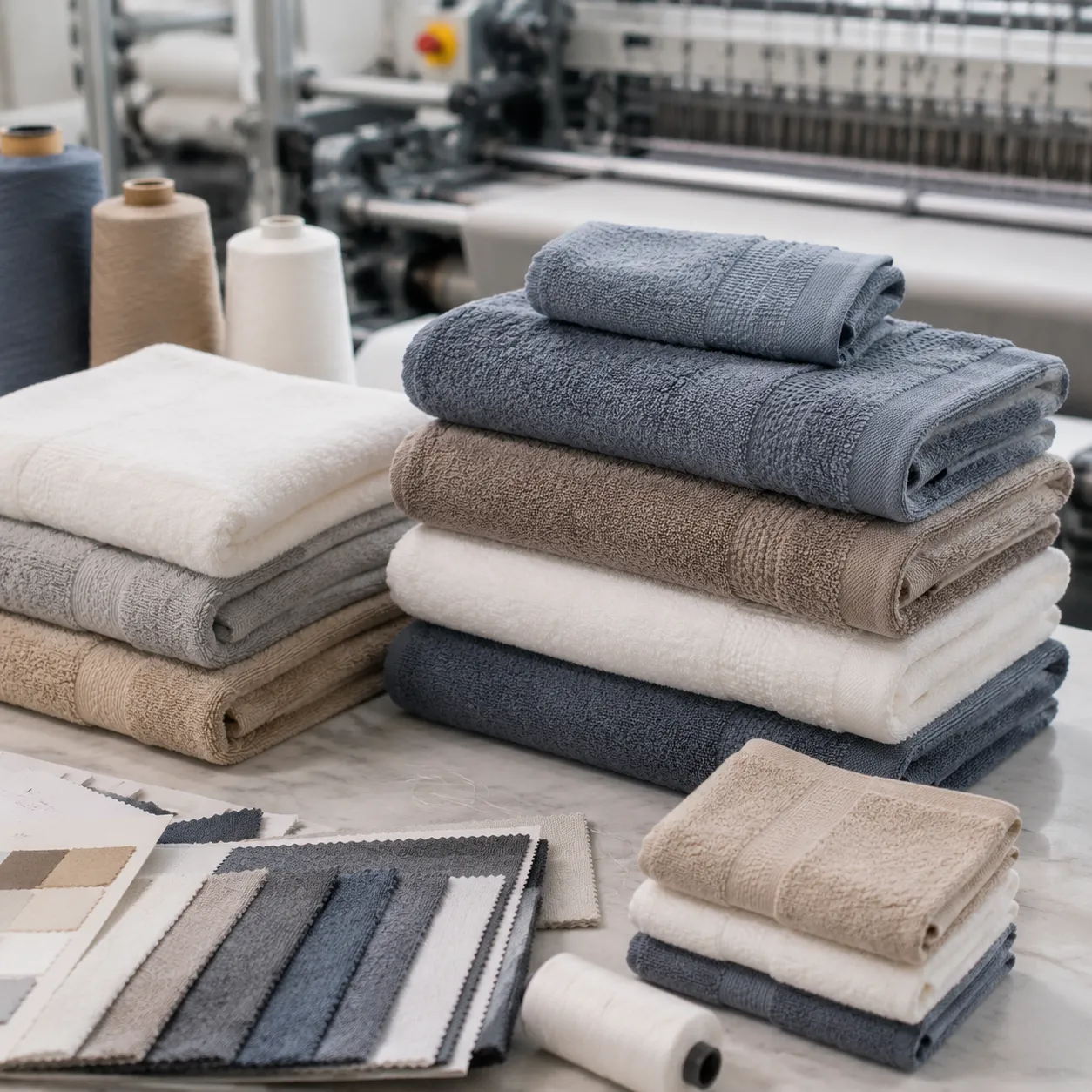
Start With the Set, Not the Single Towel
For private label programs, the set composition drives the factory workflow more than one towel spec alone. A bath towel, hand towel, and washcloth may share the same yarn and color, but they do not share the same loom width, hemming rhythm, packing labor, or QC sampling path. That is why we quote sets differently from loose bulk towels.
At our mill, a typical private label bath set starts at MOQ 500 sets per design per color. If the buyer wants one bath towel color, one hand towel color, and one washcloth color inside the same set, we treat those as three color lots unless the yarn-dyed or piece-dyed plan can be consolidated. Small color splits are where buyers often lose the FOB efficiency they expected.
| Common set format | Typical size spec | Normal GSM range | Where cost pressure appears |
|---|---|---|---|
| 3-piece bath set | 70×135 cm bath, 40×70 cm hand, 30×30 cm washcloth | 500-650 GSM | Bath towel yarn weight and set packing labor |
| 4-piece hospitality set | 2 bath towels, 1 hand towel, 1 washcloth | 520-700 GSM | Carton cube, terry pile height, laundry durability |
| 6-piece retail set | 2 bath, 2 hand, 2 washcloth | 450-600 GSM | Barcode packing, inner carton count, shade consistency |
| Spa starter set | Bath sheet, hand towel, face towel | 420-580 GSM | Low linting requirement and softener control |
The first costing question we ask is not only size and GSM. We ask how the buyer plans to sell, store, and replenish the set. A retail DTC brand may care more about shelf presentation and barcode accuracy. A hotel group usually cares more about laundering performance, replacement cost, and shade continuity between reorders.
Private Label Towel Set FOB China Cost Breakdown: What We Quote
A private label towel set FOB China cost breakdown has six main layers: fabric weight, yarn and dyeing, weaving and finishing, decoration, private-label packing, and export handling. FOB means we include the cost up to loading at the China port, usually Ningbo or Shanghai for our towel exports. It does not include ocean freight, destination duty, customs clearance, or local delivery.
Below is a realistic build for a mid-weight 3-piece set using combed cotton terry, piece dyed, with a woven brand label and printed belly band. These figures change with cotton price, exchange rate, and carton plan, but the proportions are useful when reviewing supplier quotes.
| Cost layer | What is included | Typical FOB impact per set |
|---|---|---|
| Base terry fabric | Yarn, weaving, terry pile, ground yarn, basic hemming | USD 4.85-6.90 |
| Dyeing and finishing | Reactive dyeing, washing, softening, tumble drying, shade approval | USD 0.42-0.86 |
| Decoration | Woven label, embroidery, jacquard border, or printed insert | USD 0.12-0.75 |
| Set assembly | Size sorting, set matching, folding, packing-line labor | USD 0.18-0.46 |
| Private-label packaging | Belly band, hangtag, care label, polybag, master carton | USD 0.20-0.68 |
| Export handling | Final inspection support, carton marking, pallet option, FOB documents | USD 0.09-0.21 |
For a 3-piece set at 500-650 GSM, most serious FOB China quotes we see from real mills fall between USD 5.85 and USD 9.85 per set at practical order volumes. A very low quote can be real if the set is light, white, unpacked, and plain. It becomes risky when the quote claims heavy GSM, dark reactive color, embroidery, retail packing, and a very low MOQ at the same time.
Fabric Weight Is the Biggest Line Item
Terry towels are priced heavily by grams because cotton yarn is the largest material input. GSM alone is not enough; the buyer also needs size tolerance and construction. A 600 GSM towel with a loose pile and weak ground can feel bulky at first but lose stability after repeated wash cycles. We normally control finished towel weight at about ±5% after conditioning, then confirm absorbency and dimensional change during wash testing.
For towel sets, the bath towel usually carries 65-75% of the total cotton weight. If a buyer wants to reduce FOB cost without damaging user experience, we often adjust the washcloth first, then the hand towel, and protect the bath towel specification. Dropping the bath towel from 620 GSM to 500 GSM can save money, but it changes perceived value immediately when the customer opens the pack.
- 450-500 GSM: workable for promotional or light retail sets, faster drying, lower carton weight, less luxury handfeel.
- 520-580 GSM: common for private label home and hotel starter programs because it balances cost and laundry life.
- 600-680 GSM: stronger shelf impression and better drape, but slower drying and higher freight cube.
- 700 GSM and above: useful for selective luxury ranges, but needs careful pile twist and drying guidance to avoid customer complaints.
One construction detail matters here: border shrinkage. If the decorative dobby border is too dense compared with the terry field, the towel can bow after washing. For set programs, bowing is worse because the bath and hand towel may distort at different rates. We check this in the sample room by measuring skew after a 40°C wash and tumble dry cycle before bulk approval.
Yarn, Dyeing, and Shade Risk Add Quiet Costs
Combed cotton, carded cotton, zero-twist yarn, bamboo-cotton blends, and microfiber blends do not cost the same, and they also behave differently in dyeing. For private label towel sets, we usually recommend combed cotton for mainstream bath programs because it gives cleaner pile, acceptable lint control, and stable reorders. Carded cotton can reduce FOB, but linting and uneven pile appearance are more visible in darker shades.
Dark navy, charcoal, forest green, and saturated terracotta shades cost more to dye than white or pale beige. They also need more disciplined washing-off to prevent crocking. For colorfastness, we commonly reference ISO 105-C06 for domestic laundering and ISO 105-X12 for rubbing. For baby, spa, or facial-use sets, OEKO-TEX Standard 100 Class I or Class II requirements should be agreed before lab dips are approved.
| Material choice | FOB effect versus basic carded cotton | Best use case | Factory caution |
|---|---|---|---|
| Carded cotton | Baseline | Budget retail or low-frequency use | Higher lint and less smooth pile |
| Combed cotton | +USD 0.28-0.62 per 3-piece set | Hotel, DTC, gift set programs | Requires yarn booking before dyeing |
| Zero-twist cotton | +USD 0.55-1.10 per 3-piece set | Soft handfeel retail sets | More snag risk and lower abrasion resistance |
| Bamboo-cotton blend | +USD 0.48-0.95 per 3-piece set | Spa or wellness positioning | Longer absorbency stabilization after finishing |
Shade continuity has a cost that is not always visible on the first PO. If a buyer orders 700 sets now and 700 sets three months later, the second lot may not match unless the lab dip, dye recipe, and approved bulk shade card are controlled. We keep retained swatches from approved lots, but the buyer should also keep a signed approval set. For more detail on approvals, see Pantone color matching for custom towels and how to build a towel tech pack that mills can quote.
Decoration Changes Both Unit Cost and Defect Risk
Private label does not always mean a large visible logo. The cheapest identification is a woven care label or brand label sewn into the hem. Embroidery gives a stronger branded look but adds thread, backing, machine time, trimming, and a different inspection standard. Jacquard branding must be planned at the weaving stage and is not a late-stage add-on.
Embroidery on towel sets has two common defect modes. First, dense stitches can crush the terry pile and create a hard patch. Second, poor backing removal can leave scratchy residue, especially on hand towels and washcloths. We normally keep embroidery density below about 8,000-10,500 stitches for small chest-style logos on bath towels unless the artwork is simplified.
- Woven label: usually USD 0.035-0.09 per towel depending on size, fold, and yarn colors.
- Care label plus size tab: often USD 0.025-0.06 per towel when printed satin is used.
- Embroidery: commonly USD 0.18-0.55 per towel for moderate logo sizes, higher for metallic thread or large filled areas.
- Jacquard border: cost depends on loom setup and yarn plan; it is efficient only when the design repeats across enough quantity.
- Printed belly band: usually USD 0.08-0.22 per set depending on paper weight, color coverage, and barcode requirements.
For decoration decisions, a buyer should compare artwork durability with the towel’s intended wash cycle. A hotel towel washed 120 times needs a different logo plan than a retail gift set washed 20-40 times in a home machine. We covered the method comparison in embroidery vs sublimation vs jacquard and the bath-specific details in monogrammed bath towels for luxury brands.
Private-Label Packing Is Not a Small Afterthought
Packing is where many FOB reviews go wrong. A loose bulk carton and a retail-ready private label set are different products on our packing floor. Retail packaging requires barcode placement, folded presentation, label orientation, carton assortment, and sometimes drop-test discipline. These tasks add labor and slow the line because operators must match multiple towel sizes into the correct set.
We usually ask buyers to provide the packing hierarchy early: towel label, individual fold, set wrap, inner carton if any, master carton, carton mark, and pallet preference. If the packing instruction arrives after bulk towels are finished, the team may need to re-fold or re-sort, which adds days and cost.
| Packing option | Typical cost per set | Lead-time effect | Best fit |
|---|---|---|---|
| Bulk folded set in export carton | USD 0.06-0.14 | +0-1 day | Hotel opening orders and back-of-house stock |
| OPP bag with size sticker | USD 0.10-0.24 | +1-2 days | E-commerce fulfillment or warehouse sorting |
| Printed belly band | USD 0.16-0.34 | +3-5 days after artwork approval | Retail shelves and gift sets |
| Kraft box with insert card | USD 0.42-0.95 | +7-12 days after dieline approval | High-value DTC sets |
| FSC paper wrap plus hangtag | USD 0.24-0.58 | +5-8 days after material confirmation | Sustainability-positioned retail programs |
One practical issue is carton compression. A high-pile towel packed too tightly can arrive with flattened edges or band marks. For heavy 600-680 GSM sets, we prefer a slightly larger carton and controlled compression rather than forcing more sets per carton to reduce freight. A damaged retail presentation costs more than the few cents saved on carton cube.
MOQ and Volume Bands Change the FOB Answer
Our standard MOQ is 500 pieces per design per color. For towel sets, we normally calculate this as 500 sets if all components share one set design and one colorway. The lower the volume, the more setup cost is carried by each set: lab dips, loom preparation, label ordering, carton printing, packing-line setup, and inspection documentation.
The private label towel set FOB China cost breakdown below assumes a 3-piece combed cotton set at 520-600 GSM with one color, sewn labels, printed care labels, and standard export carton packing. It excludes ocean freight and destination charges.
| Order volume | Likely FOB China band | What changes at this level | Common buyer mistake |
|---|---|---|---|
| 500-799 sets | USD 7.40-10.20 per set | Setup and packing labor weigh heavily | Requesting many colors inside the same small PO |
| 800-1,499 sets | USD 6.85-9.45 per set | Label and dyeing cost spreads better | Approving packaging too late |
| 1,500-2,999 sets | USD 6.25-8.70 per set | More efficient weaving and carton planning | Underestimating warehouse space |
| 3,000-5,999 sets | USD 5.80-8.10 per set | Better yarn booking and packing-line rhythm | Changing shade after lab dip approval |
| 6,000+ sets | USD 5.45-7.65 per set | Strongest material leverage and fewer line resets | Not reserving reorder shade standards |
Here is a fresh cost-per-use view from a recent style discussion. A 540 GSM 3-piece set at USD 6.35 FOB was expected to survive about 65 home wash cycles before the bath towel looked tired. A 610 GSM combed cotton version with better hem thread and stricter dye washing was USD 7.58 FOB, but we estimated about 92 wash cycles. Before freight, that is roughly USD 0.098 per wash set use versus USD 0.082. The higher FOB option was not cheaper on the PO, but it was cheaper over use life.
Lead Time: Where the Days Go
A clean towel set order is not slow, but every approval gate must be placed in the right sequence. We can usually make a plain dyed sample faster than a full retail-packed set sample because packaging vendors need artwork, dielines, and sometimes barcode files. For first orders, buyers should plan 35-55 days after deposit and final approval. Repeat orders with stable yarn and packaging can often run in 25-40 days.
- Confirm tech pack with size, GSM, yarn, color standard, label position, packaging, and carton marks.
- Make lab dips or strike-off towels, usually 5-8 days for standard reactive colors.
- Produce pre-production sample set, typically 7-12 days depending on decoration and packaging.
- Approve PP sample, barcode placement, care label language, and folded set presentation.
- Run bulk weaving, dyeing, finishing, sewing, and set assembly, usually 18-30 days.
- Conduct internal QC and buyer inspection, then book vessel space and prepare FOB documents.
For QC, we normally use an AQL inspection plan based on ISO 2859-1. Critical defects are not accepted. Major defects often include wrong size beyond tolerance, visible oil stain, wrong label, broken hem, shade paneling, and mixed component sets. Minor defects may include small loose threads or slight fold variation if they do not affect use.
Documents and Certifications That Affect Cost
Certification is not a decoration line, but it affects sourcing discipline. LUMA & CO. TEXTILE operates with OEKO-TEX Standard 100, BSCI, and ISO 9001 systems. If a buyer needs the finished towel set covered under a specific OEKO-TEX scope, we should verify material, dye, thread, label, and packaging contact requirements before production. Adding an uncertified trim after approval can create a compliance gap.
- OEKO-TEX Standard 100 Class I: relevant for baby or sensitive skin products, with stricter chemical limits.
- OEKO-TEX Standard 100 Class II: common for direct-skin adult towel products.
- BSCI audit status: useful for brand compliance teams reviewing social responsibility requirements.
- ISO 9001: supports controlled production records, corrective actions, and document traceability.
- ISO 2859-1 AQL: practical inspection framework for final random checking before shipment.
Buyers should ask whether the quoted FOB includes third-party lab testing or only mill internal checks. Lab testing for absorbency, dimensional change, colorfastness, and fiber content can add USD 180-650 per style depending on test scope and country standard. For certificate review basics, read how to read an OEKO-TEX certificate.
A Quote Checklist Before You Compare Suppliers
Two FOB quotes are comparable only when the same assumptions are written down. A one-line quote such as “3-piece towel set, 600 GSM, private label” leaves too much room for later adjustment. We prefer a buyer sends a compact RFQ sheet so our merchandising team can cost the same product that the buyer intends to approve.
- Set components, finished sizes, GSM per component, and allowed size or weight tolerance.
- Fiber and yarn requirement: carded, combed, zero-twist, bamboo blend, or microfiber.
- Color standard: Pantone TCX, physical swatch, white level, or existing towel sample.
- Decoration files: label artwork, embroidery DST if available, jacquard repeat, or printed belly band dieline.
- Packing hierarchy: individual towel fold, set wrap, barcode, inner carton, master carton, and pallet need.
- Compliance scope: OEKO-TEX class, BSCI requirement, ISO 9001 documentation, and lab test list.
- Target delivery window, destination country, and whether FOB Ningbo, FOB Shanghai, or another port is required.
Related reads: for sizing decisions, see towel sizes and dimensions complete guide. For MOQ trade-offs, see negotiate towel MOQ without killing margin. For freight after FOB, see container vs air freight towel orders.
If a supplier refuses to separate fabric, decoration, packing, and export assumptions, the FOB number may still be usable, but it is harder to manage during revisions. A clear private label towel set FOB China cost breakdown protects both sides: the buyer sees what each change costs, and the mill avoids reworking approved goods after production starts.
Need a Set Costed From Your Actual Spec?
Send the towel set composition, GSM, color standard, decoration plan, and packing requirement to [email protected] or WhatsApp +86 13205717266. We quote from MOQ 500 pcs per design per color with FOB China timing and cost assumptions shown clearly.
Request a towel set quote →