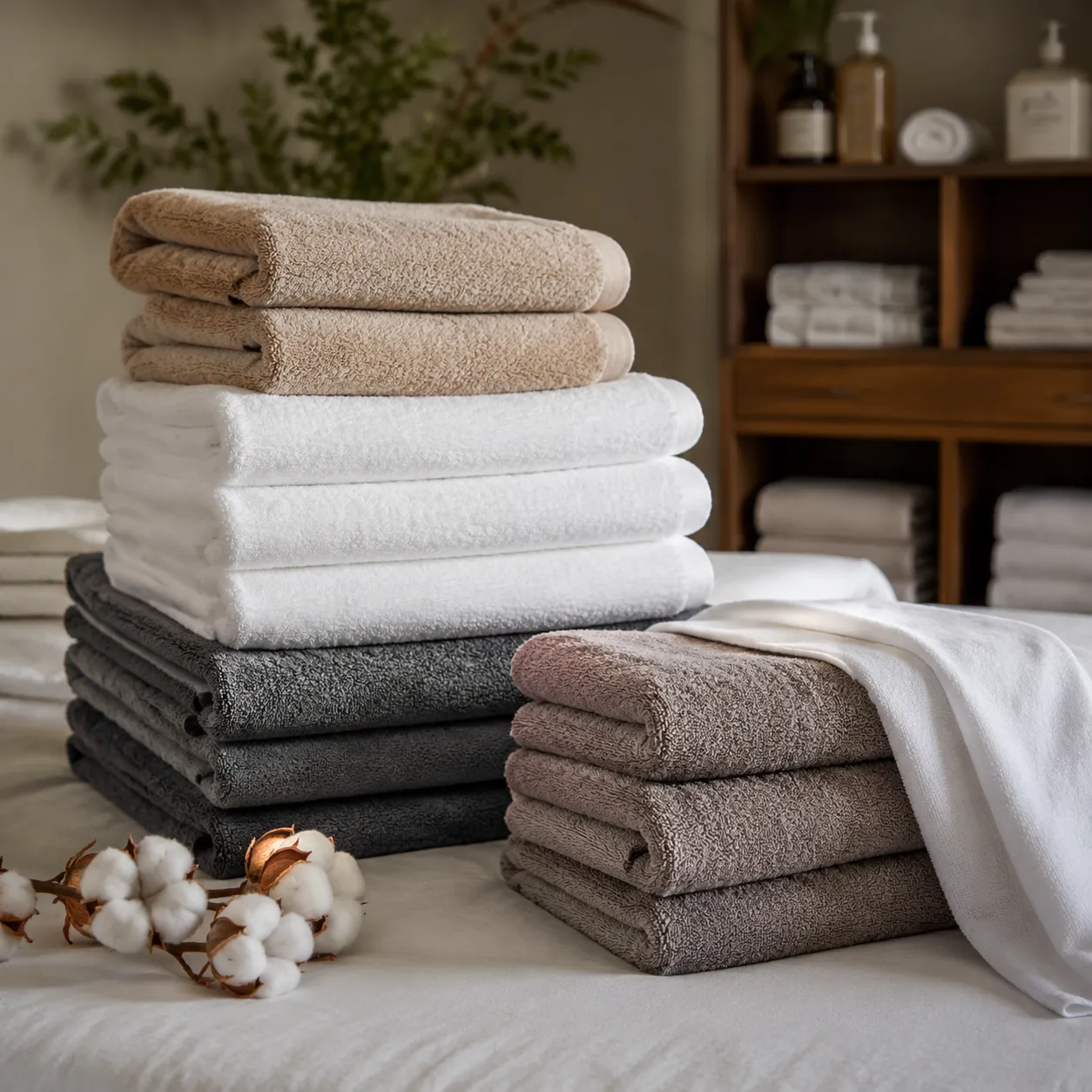
Why Treatment-Room Towels Price Differently
Treatment-room towels are not just smaller hotel towels. They sit under facial steam, touch massage oil, get rolled into warmers, and often wash with peroxide-based detergents. A towel that looks acceptable at delivery can harden, grey out, or smell sour after 35 spa laundry cycles if the yarn, dyeing, and finishing are chosen only for first-touch softness.
For a useful spa treatment towel bulk pricing model, we start with the service path: facial towel, massage table towel, hair-wrap towel, pedicure towel, or hot compress towel. Each path has a different failure risk. Facial towels need low lint. Massage towels need oil-release behavior. Warmer towels need stable hems because folded wet towels expand under heat and pressure.
- Facial cabins: 28×28 cm or 30×30 cm towels, usually 430-520 GSM, low-lint cotton terry.
- Massage rooms: 35×75 cm, 40×80 cm, or 70×140 cm pieces, often 450-600 GSM depending on table coverage.
- Hot towel service: 30×30 cm and 32×70 cm sizes, with tighter hemming to prevent edge curl inside towel warmers.
- Pedicure and salon crossover: darker shades or bleach-resistant vat dye when peroxide spotting is common.
- Retail add-on sets: softer hand feel and private-label packaging, but lower laundering intensity than back-of-house stock.
Spa Treatment Towel Bulk Pricing Model: The Base Formula
At our mill, the base price comes from fabric weight, yarn grade, dyeing route, finishing, decoration, packing, and order volume. Cotton cost is the largest variable, but not the only one. For treatment room towels, we also price for oil handling and dimensional stability, because a towel that shrinks 8% can stop fitting a warmer basket or massage-table fold pattern.
We usually quote MOQ at 500 pcs per design / per color. Small spa groups can mix sizes in one PO, but each dyed color and each logo setup still has its own production cost. If a buyer wants 300 pcs in sage green, 300 pcs in sand, and 300 pcs in charcoal, the mill sees three small dye lots, not one 900-piece program.
| Cost driver | Typical range | Pricing effect |
|---|---|---|
| GSM | 380-650 GSM | Higher GSM increases yarn consumption and carton weight |
| Cotton yarn | Carded, combed, ring-spun, zero-twist blend | Combed and zero-twist improve hand feel but cost more |
| Dye route | Reactive dye, vat dye for dark/bleach-risk colors | Vat dye can add 8-18% depending on shade and lot size |
| Decoration | Woven label, embroidery, jacquard border, tonal logo | Setup and run speed affect unit price |
| Packing | Bulk carton, bundle wrap, retail belly band, barcode | Private-label packing adds labor and material cost |
| Testing | ISO 6330 wash, ISO 5077 shrinkage, ISO 105-C06 colorfastness | Adds sample time and lab cost, but reduces claim risk |
Current FOB Price Bands by Volume
The following FOB China bands are realistic for cotton spa towels produced in a certified factory, not stock liquidation pricing. They assume OEKO-TEX Standard 100 Class I compliant materials, BSCI social audit alignment, ISO 9001 process control, bulk carton packing, and no oversized embroidery. Freight, duty, and destination handling are excluded.
| Item | Spec assumption | 500-999 pcs | 1,000-2,999 pcs | 3,000-7,999 pcs | 8,000+ pcs |
|---|---|---|---|---|---|
| Facial towel | 30×30 cm, 480 GSM combed cotton | USD 0.58-0.82 | USD 0.47-0.68 | USD 0.41-0.59 | USD 0.36-0.52 |
| Hot compress towel | 32×70 cm, 500 GSM ring-spun cotton | USD 1.25-1.72 | USD 1.05-1.48 | USD 0.94-1.31 | USD 0.86-1.20 |
| Treatment hand towel | 40×80 cm, 520 GSM combed cotton | USD 1.78-2.45 | USD 1.55-2.12 | USD 1.38-1.91 | USD 1.27-1.76 |
| Massage bath towel | 70×135 cm, 560 GSM cotton terry | USD 5.85-7.45 | USD 5.18-6.62 | USD 4.78-6.05 | USD 4.42-5.68 |
| Spa sheet towel | 90×180 cm, 450 GSM flat-terry hybrid | USD 7.90-10.40 | USD 7.10-9.35 | USD 6.55-8.70 | USD 6.08-8.15 |
This is where spa towel wholesale pricing can look confusing. A 30×30 cm towel may vary by only USD 0.20 per piece, while a sheet towel can move by more than USD 2.00 because the fabric weight and carton cube are much larger. For a 1,200-piece order of mixed treatment room towels, we often see a blended FOB value between USD 2,200 and USD 5,800 depending on size mix.
The GSM Trap in Spa Linen Cost
Spa teams often ask for a heavier towel because they associate weight with comfort. That is partly true, but a heavier towel also holds more water, dries slower, and can overload a washer-extractor before the textile is actually clean. For treatment-room operations, cost-per-use depends on laundry energy and replacement rate as much as the FOB price.
A 40×80 cm towel at 480 GSM uses about 154 g of fabric before hem and process loss. At 600 GSM, the same size uses about 192 g before loss. That 38 g difference sounds small, but across 4,000 pieces it adds roughly 152 kg of textile weight to buy, ship, wash, dry, and store. In a spa laundry running two turns per day, the heavier towel may also need 6-10 more minutes in the dryer.
| Use case | Recommended GSM | Why we quote it |
|---|---|---|
| Facial cleansing towel | 430-500 GSM | Soft enough for skin contact, lower lint after pre-wash |
| Hot towel warmer roll | 460-540 GSM | Rolls tightly without staying wet in the core |
| Massage hand towel | 500-580 GSM | Absorbs oil and water without becoming bulky |
| Treatment table layer | 420-500 GSM | Faster drying and easier folding than bath-grade terry |
| Luxury guest drape towel | 560-650 GSM | Better hand feel, but higher laundry and freight cost |
For spa buyers, a towel that dries one cycle faster often saves more money over six months than a towel that is USD 0.30 cheaper at purchase.
Oil, Bleach, and Warmer Heat Change the Spec
Massage oil is the defect maker we watch first. If oil is not removed fully, cotton loops can feel waxy and towels develop a stale odor even after washing. We ask buyers whether they use mineral oil, coconut oil, essential-oil blends, or water-based lotion. Mineral oil and heavy aromatherapy blends require stronger laundry chemistry and more robust colorfastness.
The second issue is towel warmer behavior. Wet rolled towels expand as they heat. If the hem is too thick or the stitch tension is loose, the edges twist and the roll no longer presents neatly. For warmer towels, we prefer a balanced 2.0-2.5 cm hem, polyester core sewing thread, and a pre-shrink finish. We check dimensional change after ISO 6330 washing and calculate shrinkage under ISO 5077.
- Oil retention: caused by dense loops, under-dosed detergent, or softener buildup; specify no heavy silicone softener for back-of-house towels.
- Greying: common on white treatment room towels when oil and skin product residue redeposit in low-temperature wash.
- Peroxide spotting: affects reactive-dyed dark colors; vat dye is safer for bleach-risk programs but costs more.
- Hem roping: appears after repeated wet rolling in warmers; tighter stitch balance reduces twisting.
- Lint transfer: a problem for facial cabins; combed cotton and pre-wash testing help reduce loose fiber.
Decoration Adds Cost Only If It Slows Production
For cotton spa towels OEM programs, decoration is usually quiet: a woven label, a small embroidery, a jacquard border, or a tonal logo. Spa buyers rarely need the large, high-contrast marks used on beach or golf towels. That helps cost, because small branding has lower stitch counts and less risk of stiff hand feel.
A 55 mm wide woven side label may add USD 0.05-0.11 per towel at 2,000 pcs. A simple embroidery under 3,500 stitches may add USD 0.18-0.42 depending on placement and thread color. Jacquard border branding is efficient above 1,500-2,000 pcs per size because the loom setup is spread across more pieces, but it is expensive for a 500-piece trial.
| Branding method | Best for | Added cost range | Factory note |
|---|---|---|---|
| Woven label | Back-of-house identification | USD 0.04-0.13/pc | Lowest risk for towel hand feel |
| Small embroidery | VIP spa suites and retail sets | USD 0.16-0.55/pc | Avoid dense stitching on facial towels |
| Jacquard border | Signature treatment towel programs | USD 0.22-0.70/pc | Better above 1,500 pcs per size |
| Tone-on-tone dobby | Subtle hospitality branding | USD 0.12-0.35/pc | Works well on hand and bath sizes |
| Retail belly band | Giftable spa towel bundles | USD 0.09-0.28/pc | Requires barcode and carton sorting discipline |
If the towel will be heated, we also check label placement. A label trapped inside a tight wet roll can wrinkle or curl. For hot towel service, side seam placement is usually cleaner than a wide center-fold label.
MOQ, Sampling, and Production Calendar
Our standard MOQ is 500 pcs per design / per color. For plain white or ecru massage towels bulk orders, we can sometimes combine greige fabric planning across sizes, but we still need enough volume to dye, cut, sew, inspect, and pack without pushing labor cost too high. For dyed spa palettes, the practical MOQ is stricter because shade approval and dye bath setup are not free.
- RFQ review: 1-2 days to confirm size, GSM, yarn, color, packing, and testing needs.
- Lab dip or yarn shade approval: 4-7 days for dyed colors; white usually skips this step.
- Proto sample: 7-12 days for existing construction, 12-18 days for new border or embroidery.
- Bulk production: 25-38 days after sample and deposit approval for most spa towel programs.
- Inspection and packing: 3-5 days including AQL check, carton marking, and moisture review.
- Ocean freight planning: 18-35 days on water depending on destination port; air freight is usually only justified for urgent opening stock.
For a new spa opening, we prefer a 60-75 day sourcing calendar from confirmed tech pack to warehouse arrival by sea. If the program includes retail packaging, barcodes, or multiple colorways, give the carton plan another week. Buyers setting up a larger hospitality linen program can compare the planning logic in setting up a hotel linen program, even though spa turns and sizes differ.
A Realistic Cost-per-Use Comparison
A lower unit price can still be a poor spa linen cost decision. Here is one practical scenario. A 38-room day spa buys 2,400 white 40×80 cm towels. Option A is a 430 GSM carded cotton towel at USD 1.18 FOB with a projected 55 usable wash cycles before roughness and edge distortion. Option B is a 520 GSM combed cotton towel at USD 1.64 FOB with a projected 92 usable wash cycles after ISO 6330 wash simulation and in-house tumble testing.
Option A costs about USD 0.0215 per wash before freight and laundry. Option B costs about USD 0.0178 per wash. Even though Option B costs USD 1,104 more at purchase for 2,400 pcs, the longer replacement interval usually wins if the spa launders in-house and wants consistent guest feel. If the towels are frequently stained by tint, clay mask, or oil spills, the answer may change; we then spec darker colors or separate towel grades by treatment type.
- Choose lower GSM when towels are used as single-service wipe towels and replaced often.
- Choose combed cotton when facial contact and low lint matter more than lowest landed cost.
- Choose vat dye for dark towels exposed to peroxide or bleach-risk salon chemistry.
- Choose bulk packing for back-of-house replenishment; retail packaging belongs only on guest-facing kits.
- Choose separate SKUs for oily massage service and facial service to avoid over-specifying every towel.
What We Need to Quote Accurately
The fastest quotes come from a simple spec sheet, not a mood board. For a spa treatment towel bulk pricing model, the missing detail is often laundering. A towel washed by a commercial laundry at 75°C behaves differently from one washed in a boutique spa machine at 40°C with fragrance detergent. We need that information before we recommend yarn and dyeing route.
- Exact size in cm and acceptable tolerance, usually ±2% after washing for most spa towels.
- Target GSM and whether the buyer prioritizes hand feel, dry speed, or laundry life.
- Color standard such as Pantone TCX, physical swatch, or approved lab dip requirement.
- Use environment: facial, massage oil, hot towel warmer, pedicure, sauna, or retail kit.
- Branding method, logo size, thread colors, label position, and whether skin contact must remain smooth.
- Packing plan: pieces per polybag, carton quantity, barcode label, inner bundle, and pallet requirement.
- Compliance documents needed, including OEKO-TEX Standard 100 Class I, BSCI, and ISO 9001 records.
Related reads: for size decisions, use our towel sizes and dimensions guide. For cotton selection, compare combed vs zero-twist cotton. If your spa also operates treatment rooms in a hotel, the hotel towel sourcing guide helps align bath stock with spa stock.
Related reads: decoration teams can review embroidery vs sublimation vs jacquard, while compliance teams should check how to read an OEKO-TEX certificate. For freight planning on bulky towel orders, see container vs air freight towel orders.
Our Practical Recommendation for Spa Buyers
For most treatment-room towel programs, we recommend starting with 480-540 GSM combed or ring-spun cotton for hot and facial towels, 500-580 GSM for massage hand towels, and 420-500 GSM for table-layer towels where drying speed matters. White is the safest operational color, but it must be paired with oil-aware laundering. Dark colors can look cleaner longer, yet they need stronger colorfastness planning when peroxide is present.
If the brief is only “soft and cheap,” we will push back. The better buying question is how many turns per day the towel must survive without odor, edge curl, lint, or shade change. A clear spec lets us build a spa treatment towel bulk pricing model that matches real use instead of only the first invoice.
Build a Spa Towel Cost Sheet
Send your size mix, GSM target, color plan, decoration artwork, and laundry method. We will quote MOQ from 500 pcs per design/color with realistic FOB bands and production timing. WhatsApp: +86 13205717266. Email: [email protected].
Request a spa towel quote →