Start with the fabric face, not the quotation
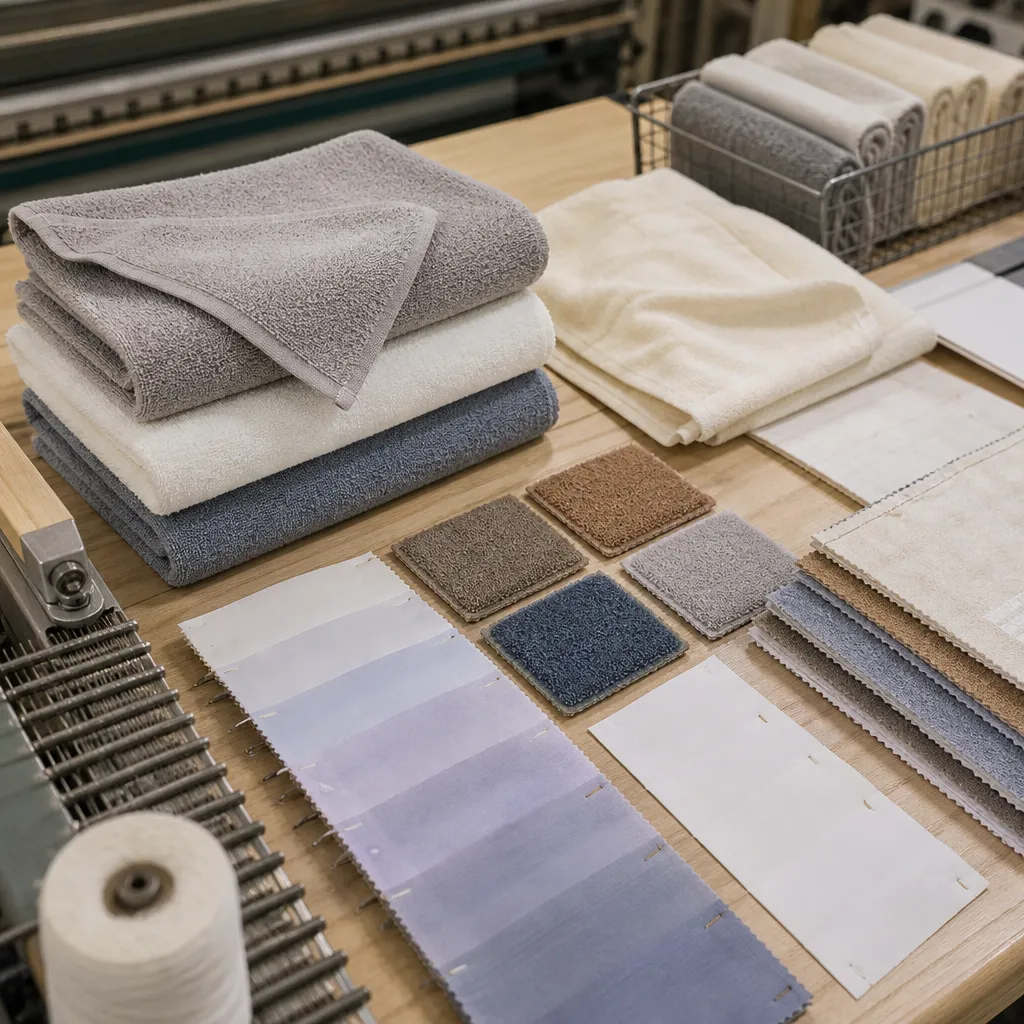
For this product, the first audit point is not price. It is whether the factory understands what the towel actually does on hair: absorb surface water quickly, reduce rubbing, stay light enough for wrapping, and avoid rough friction on wet cuticles. We usually see workable retail and salon programs in the 240-360 GSM band. Below 230 GSM, many pieces feel thin and lose body after repeated laundering. Above 380 GSM, wraps often become bulky at the button loop area and dry too slowly between uses.
Construction matters more than a generic GSM claim. Most reliable programs use warp knit microfiber rather than loosely controlled weft constructions, because warp knit gives better dimensional stability and less edge torque after washing. If a supplier cannot state whether the fabric is warp knit coral fleece, short-pile brushed microfiber, or waffle microfiber, the quote is still too early.
| Use case | Typical construction | Workable GSM | Common risk if mis-specified |
|---|---|---|---|
| Salon backbar hair towel | Warp knit short pile | 250-290 GSM | Feels too flat if pile is over-sheared |
| DTC hair wrap with button | Warp knit brushed microfiber | 280-330 GSM | Loop area becomes bulky if fabric is too heavy |
| Value retail promo hair wrap | Basic microfiber knit | 230-260 GSM | Lower absorbency and faster shape drift |
| Spa or gift set hair wrap | Soft brushed microfiber | 300-360 GSM | Longer drying time in humid climates |
A useful microfiber hair towels supplier checklist asks for blend, denier, and pile control
This is where broad claims usually collapse. Buyers often receive "microfiber" as if that were the whole material spec. It is not. For hair towels, we ask suppliers to declare the polyester/polyamide ratio, the pile style, and whether the fabric face is single-sided or double-sided. The most common commercial blend is 80/20, but some budget programs are pushed to 85/15 or even higher polyester content. Those cheaper blends can still work for low-use kits, yet they usually show a drier handfeel and weaker water pickup.
- Ask for the actual blend tolerance, not just the nominal blend. A mill should be able to state something like 80/20 ±3%.
- Ask whether the surface is cut pile or terry-like raised pile. Cut pile often feels cleaner; raised pile may trap more lint if finishing is poor.
- Ask whether the face has been aggressively softened. Over-softening can improve first-touch feel but reduce absorbency in early washes.
- Ask for the fabric weight report from the same production lot used for sample sewing, not from an unrelated archive roll.
On the mill floor, one of the easiest ways to spot an inexperienced vendor is inconsistency across the roll width. A fabric may average 300 GSM overall, but if the left edge runs lighter and the center runs denser, the sewn wraps twist differently after laundering. That issue rarely shows in a studio sample unless you pull pieces from different positions on the roll.
Watch the two failure modes buyers miss most: snagging and edge roping
Hair towels are handled with wet hands, rings, nails, clips, and salon tools. A soft face that photographs well can still be a problem if loops catch easily. We see two repeat defects in weak supply chains. First is surface snagging, where the pile pulls into visible tracks. Second is edge roping, where the perimeter curls and tightens after wash, making the wrap sit crooked on the head.
These defects come from different causes. Snagging is often tied to loose raising control or unstable pile finishing. Edge roping is usually linked to sewing tension imbalance, binding shrinkage mismatch, or poor heat-setting before cutting. A vendor that only talks about fabric softness and ignores sewing tension control is not ready for repeatable bulk.
| Defect mode | What usually causes it | How we check it | Commercial impact |
|---|---|---|---|
| Surface snagging | Loose pile structure or rough finishing | Manual hook test and 5-wash review | Higher returns in DTC orders |
| Edge roping | Binding shrinkage mismatch | Flat-lay measurement after wash | Wrap loses fit and shelf appearance |
| Button pull-off | Low stitch density at closure point | Seam pull test on closure area | Immediate use failure |
| Shape skew | Uneven relaxation or cutting off grain | Diagonal measurement after laundering | Inconsistent wrap fit |
The closure area deserves its own review
For a hair wrap, the button and elastic loop are not trim details. They are the highest-stress point in the whole product. We have seen decent fabric paired with weak closure assembly that fails during in-store sampling, especially when customers stretch the loop too hard. A supplier should specify the button diameter, loop material, and reinforcement stitch pattern before bulk approval.
- For adult wraps, button diameters commonly sit around 16-22 mm depending on the loop length and fabric bulk.
- Elastic loops should be tested after laundering because some low-cost elastics harden or shorten noticeably after heat exposure.
- If the button is resin or coconut-look, confirm edge smoothness; rough button rims can abrade microfiber loops over time.
- We prefer seeing a boxed reinforcement or bar-tack support where the loop joins the body panel.
If the supplier offers only a front-face photo and not a close-up of the closure stitching, we would treat that as an incomplete sample package. For buyers building a custom hair towel wholesale program, closure consistency is one of the first things that separates a sewing workshop from an actual managed production line.
Testing should match hair-towel use, not generic home textile claims
A broad promise like "good for 100 washes" is not useful unless the method is named. For microfiber wraps, we typically want a wash sequence tied to ISO 6330 for domestic laundering procedure, then dimensional checks and appearance review after multiple cycles. For color performance on dark shades, we commonly reference ISO 105-C06 for colorfastness to washing. If white or pastel wraps will contact tinted hair products, rub and stain review should be added during sample evaluation.
Absorbency is another area where vendors overstate performance. Rather than vague copy, ask for a simple retained-water or pickup comparison done on matched specimen sizes. The exact internal method may vary by mill, but the protocol should be repeatable. A real supplier can explain specimen conditioning, immersion time, drain time, and how many readings were averaged.
| Test area | Reference method | What to record | Reason it matters |
|---|---|---|---|
| Dimensional stability | ISO 6330 wash procedure | Length and width change % | Wrap fit after laundering |
| Colorfastness to washing | ISO 105-C06 | Grade after wash | Dark shades and private label programs |
| Seam performance | Internal seam pull method | Failure point and stitch opening | Closure durability |
| Substance compliance | OEKO-TEX Standard 100 Class I | Valid certificate scope | Retail and family-use claims |
Certificates matter, but only if they match the item you are buying
For this category, buyers frequently see a certificate PDF and stop there. We would not. The supplier should be able to show a current OEKO-TEX Standard 100 Class I certificate if the brand wants the broadest consumer-safety positioning, along with factory-level BSCI and ISO 9001 documentation. But the important point is scope: the certificate should cover the relevant product group or material family, not just an unrelated textile article.
The same caution applies to recycled claims. If a microfiber hair wrap is sold as recycled polyester-based, ask which component is recycled and whether the trim matches that claim. It is common for the shell fabric to carry one claim while the elastic loop and button do not. That may be acceptable, but it should be disclosed clearly in the tech pack.
Related reads: if your team is checking paperwork quality, how-to-read-oeko-tex-certificate.html helps with scope and expiry review. For spec discipline before quoting, we also suggest build-towel-tech-pack-that-mills-can-quote.html and microfiber-vs-cotton-towel-comparison.html.
Price moves with fabric yield, sewing minutes, and packing format
We would not treat hair-wrap pricing like a flat commodity line. The cost swing between two similar-looking wraps often comes from three places: actual fabric consumption, closure assembly time, and retail packing. A tapered twist-wrap shape wastes more fabric than a straight rectangle with a loop. A hidden neat seam finish takes more sewing time than an exposed overlock. A printed belly band with barcode sticker is not the same cost profile as a polybag with suffocation warning.
| Order volume | Typical spec band | FOB China USD/pc | Notes |
|---|---|---|---|
| 500-1,000 pcs | 250-280 GSM basic wrap | 1.18-1.62 | Limited color split; simple packing |
| 1,000-3,000 pcs | 280-320 GSM branded wrap | 1.36-1.94 | Custom button or woven label possible |
| 3,000-8,000 pcs | 300-340 GSM retail-ready wrap | 1.72-2.38 | Printed insert card and barcode common |
| 8,000+ pcs | 330-360 GSM higher-touch set item | 2.05-2.96 | Better spread of trim and packing overhead |
Those ranges assume standard custom OEM conditions, not air freight, not unusually complex gift boxes, and not sub-MOQ color fragmentation. Our own MOQ is 500 pcs per design per color. If a buyer wants four colors at 200 pieces each, the order may still be possible, but the cost per piece usually rises because dye lot, cutting spread, and trim setup stop scaling efficiently. For tactics on splitting quantities without wrecking the economics, negotiate-towel-moq-without-killing-margin.html is worth a read.
Bulk timing usually breaks at approval speed, not at knitting
A realistic calendar for microfiber hair wraps is shorter than dense cotton towel programs, but not instant. For a custom color and branded closure setup, we normally budget 3-5 days for quote confirmation, 5-7 days for sample making if fabric is in greige or stock base, 3-6 days for buyer comments, then around 18-28 days for bulk after approval and deposit. If a new dye shade, custom card insert, or special button mold is involved, add time.
- Tech pack and artwork review
- Fabric and trim confirmation
- Sample sewing and closure check
- Color and measurement approval
- Bulk cutting, sewing, finishing
- Final inspection and packout
The production bottleneck is often not the fabric knitting itself. It is waiting on trim signoff, revised loop length, or packaging barcode confirmation. That is why a hands-on microfiber hair towels supplier checklist should include who approves each milestone and how comments are recorded. Buyers that manage this cleanly usually avoid the last-week scramble.
The sample you approve should be pulled apart, measured, and washed
A nice-looking pre-production sample is not enough for this category. We encourage buyers to review one piece for aesthetics and one piece for destructive checking. Measure body length, front width, loop length, and post-wash recovery. Turn the seam allowance out. Check whether the binding edge tunnels. Count whether the closure stitches are dense enough to resist repeated stretch.
- Wash at least 3 cycles before bulk approval; 5 cycles is better for dark or saturated shades.
- Photograph the wrap flat before and after laundering to catch edge torque and silhouette drift.
- Check lint transfer onto a light surface if the wrap will be paired with white packaging or pale robes.
- Review packed dimensions if the item goes into a gift box or travel kit cavity.
This is also where brand-side teams can align retail expectations with reality. If the item is meant for a beauty subscription box, compact fold and visual neatness may matter more than maximum plushness. If it is for salon repeat laundering, stable absorbency and closure durability should carry more weight than extra-soft finishing.
What we would want in the RFQ, line by line
A vendor audit gets easier when the RFQ is specific. For a microfiber hair wrap supplier program, the cleanest quote requests usually define the shape, finished size tolerance, fabric construction, target GSM, blend, closure details, branding method, and packout. That prevents the common situation where three suppliers quote three different products under one product name.
- Finished size with tolerance, such as body length and widest panel width
- Fabric construction and blend, not just the word microfiber
- Target GSM range and whether tolerance is allowed
- Closure spec: button size, loop material, reinforcement style
- Branding method: woven label, embroidery, heat transfer, or printed pack insert
- Packing format: bulk pack, polybag, belly band, insert card, master carton count
Related reads: for decoration trade-offs on this product family, see embroidery-vs-sublimation-vs-jacquard.html. If you are comparing material behavior more broadly, custom-microfiber-towels-wholesale-guide.html and towel-gsm-decision-framework.html help frame the spec conversation.
Need a microfiber hair towels supplier checklist tied to your SKU?
Send us your target size, GSM, closure style, and packout. We can review the spec, flag production risks, and quote from our OEM line. MOQ 500 pcs per design per color. WhatsApp: +86 13205717266 | Email: [email protected]
Request a Quote →