What actually gets a logo through spa laundry
The first decision is not color or artwork. It is whether the towel will survive repeated wash cycles in a spa laundry without the logo turning stiff, puckering, or losing contrast. For cotton terry, we look at pile height, ground stability, and where the operator grips the towel during folding and service.
A robe-side logo and a treatment-room towel logo do not age the same way. Robes are handled dry and shown to guests; treatment towels are soaked, wrung, and often pressed hot. That is why the same artwork can work on a 520 GSM hand towel and fail on a 380 GSM facial towel if the stitch density is too heavy.
| Placement | Typical risk | What we check |
|---|---|---|
| Bottom corner | Twisting after wash | Fiber balance and edge stability |
| Center top border | Visual crowding | Distance from dobby or hem |
| Side edge | Service abrasion | Grip points and folding line |
| All-over repeat | Heavy hand feel | Stitch coverage versus pile crush |
For spa buyers, the best result is often subtle. Guests notice alignment, thread tone, and hand feel long before they count stitches.
Decoration methods that work on cotton terry
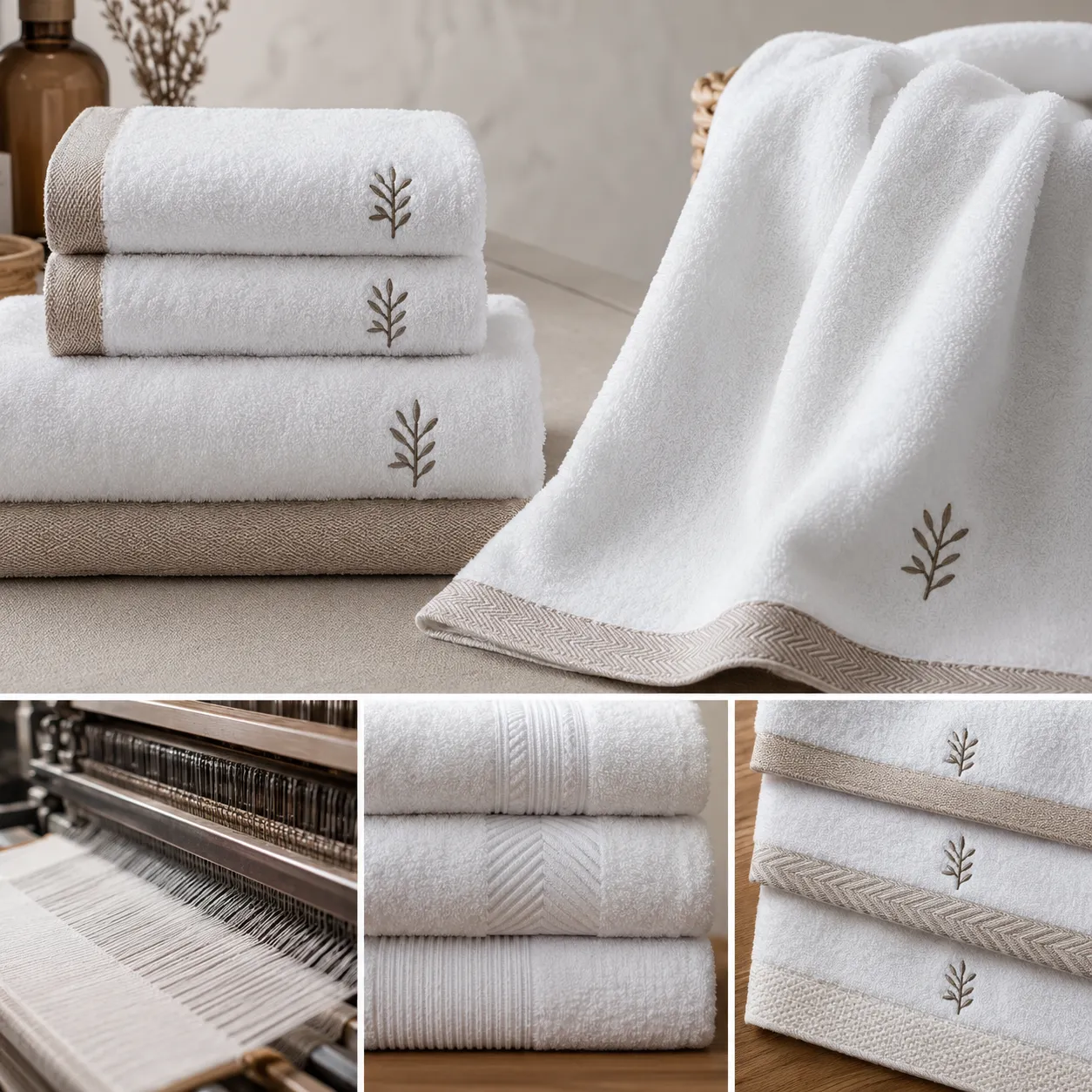
We use three main decoration paths on spa cotton towels: direct embroidery, woven border branding, and jacquard patterning. Each one affects the towel differently, and each one creates a different production risk. If the logo is simple, embroidery is usually the cleanest route. If the brand wants a quieter, hotel-like look, border branding often reads better from a distance.
| Method | Best towel body | Typical setup note |
|---|---|---|
| Embroidery | 400-600 GSM terry | Needs stabilizer and trim control |
| Dobby or woven border | 450-650 GSM terry | Best when logo can live in the border zone |
| Jacquard weave | Spa sets and premium programs | Artwork must be simplified for loom limits |
| Printed label patch | Short runs and promos | Avoids stitch bulk but looks less integrated |
- Embroidery gives the most recognizable brand mark, but dense fills can harden the fabric if the logo is oversized.
- Woven borders keep the pile softer in the main field, which matters on treatment towels and face cloths.
- Jacquard is useful when the brand wants pattern identity more than a literal logo.
- For very small initials, a left-corner monogram can look cleaner than a full wordmark because the stitch path stays short.
A common mistake is to ask for a stitched logo in the same tone as the towel and then expect it to show clearly under warm spa lighting. In that situation, a slightly darker thread or a textured border gives better visibility without looking loud.
Spa towel cotton logo decoration guide by towel type
The towel body changes the decoration rules. A 100% cotton loop terry towel has more surface drag than a flat weave, so the embroidery backing matters more. On a velour face or sheared surface, we can place smaller marks because the pile is shorter and the stitches sit higher. On loop terry, the logo must be sized to bridge the texture rather than fight it.
| Towel type | Usual GSM | Decoration note |
|---|---|---|
| Hand towel | 450-550 GSM | Best balance of visibility and hand feel |
| Facial towel | 320-420 GSM | Keep artwork small and low-density |
| Bath towel | 550-650 GSM | Can carry a larger mark without distortion |
| Spa wrap or sheet | 380-500 GSM | Border branding often beats center embroidery |
If the spa uses towels in hot cabinets or tumbler dryers, we avoid very thick thread counts on smaller towels. Heat plus repeated folding can create a raised logo edge that feels fine at first sample but becomes noticeable after a few months in service.
- Use a smaller satin column width when the towel pile is deep and loose.
- Keep the logo away from the hem if the hem is already reinforced with dense stitching.
- On treatment towels, avoid oversized fill stitches that trap lint and slow drying.
- If the towel will be folded into a display cube, check that the logo lands on the visible face after folding.
Thread count, stitch density, and wash-life limits
Decoration is not free weight. Every thread adds density, and density changes how the towel dries. We usually test a logo sample after three wash and dry cycles, then recheck edge lift, thread breakage, and shrink distortion after ten cycles. That is enough to catch most bad placement decisions before bulk.
| Logo size | Typical stitch range | Practical note |
|---|---|---|
| 40-50 mm mark | 2,500-3,800 stitches | Good for initials or icon marks |
| 60-80 mm wordmark | 4,000-6,500 stitches | Most common for spa towels |
| 90 mm+ badge | 7,000+ stitches | Needs careful placement on thicker cotton |
We prefer to keep logo density under control because spa towels are washed often, sometimes with alkaline detergent and high extraction speed. A dense fill on a small area can shrink unevenly relative to the surrounding terry, especially after the first hot wash. That is one reason we push buyers toward cleaner outlines or split-fill art when the logo is large.
- Ask for a sew-out on the actual towel GSM, not on a random sample fabric.
- Check the reverse side; backing material can feel rough if it is too heavy.
- Look for needle heat marks on lighter colors, especially ivory and sand.
- If the logo is near a border, inspect whether the border pucker appears after steaming.
Color, contrast, and spa interior lighting
Spa interiors are often warm, indirect, and low glare. That means a logo that looks sharp in daylight can disappear under amber lamps. Thread color should be chosen against the towel color and the room lighting, not only the Pantone chip. We compare the sample under both 2700K and 4000K light because reception and treatment rooms rarely share the same brightness.
- On white towels, soft charcoal, taupe, or deep green usually reads cleaner than pure black.
- On beige and oatmeal towels, a tone-on-tone thread can work if the logo shape is bold enough.
- On dark towels, avoid ultra-thin lettering; the pile swallows narrow strokes.
- When the brand uses multiple spa zones, keep thread colors consistent across the same collection to avoid a mismatched look at shelf level.
If the client wants a subtle brand cue, we sometimes recommend a woven label plus a small stitched icon instead of a large wordmark. It gives the room a tidier finish and reduces thread consumption.
Sampling rules before bulk approval
For spa decoration, sample approval is less about approving a pretty image and more about confirming repeatability. We need the exact towel body, the same stitch path, and the same thread lot that will go into production. If any of those change, the sample is no longer a valid reference.
- Approve the artwork at actual size with placement coordinates.
- Run a sew-out on the finished towel, not on cut fabric only.
- Wash the sample with the spa's intended detergent if the buyer can share it.
- Confirm folding orientation, because a logo that looks correct unfolded may disappear when merchandised.
- Sign off on thread shade under warm and neutral lighting.
We ask for approval notes in writing when the logo is close to a hem, border, or seam. That reduces disputes later if the decoration has to move by a few millimeters to avoid the lockstitch line.
Pricing, MOQ, and lead time buyers can plan around
Decoration cost depends on stitch count, placement complexity, thread color changes, and whether the towel needs a custom border. For a spa towel cotton logo decoration guide, the range is usually driven more by labor than by raw cotton. On current order mixes, plain cotton spa towels with a simple one-color logo often land at about USD 2.10-3.40 per piece at 500-1,000 pcs, while multi-element branding with border work or multiple logo positions can move to roughly USD 3.60-5.80 per piece. Larger orders reduce the stitched-unit cost, but only if the artwork is stable and the color count stays low.
| Order size | Simple logo | Complex logo + border |
|---|---|---|
| 500-1,000 pcs | USD 2.10-3.40 | USD 3.60-5.80 |
| 1,000-3,000 pcs | USD 1.85-3.00 | USD 3.20-5.10 |
| 3,000+ pcs | USD 1.60-2.70 | USD 2.90-4.60 |
MOQ for our factory is 500 pcs per design per color. If the artwork needs multiple thread colors, the effective MOQ can rise because each setup consumes machine time and approval time. A standard sample-and-bulk path takes about 12-18 days for sampling and 28-40 days for bulk after approval, depending on yarn availability and the decoration load.
These numbers are realistic for spa programs that use cotton terry and one decoration method. If a buyer wants mixed sizes, mixed colors, and mixed logo placements in one shipment, the price and timeline both move upward because the line has to be reset more often.
What goes wrong in production
Most decoration defects are avoidable, but they show up quickly when the spec is vague. We see four recurring problems: logo drift from the hem, bobbin show-through on light towels, thread tension imbalance, and border draw-in after embroidery. None of these is dramatic on day one; all of them become obvious after a few wash cycles.
- Logo drift: the mark sits too close to the seam and gets pulled off-center during hemming.
- Bobbin show-through: backing thread ghosts through thin or pale fabric.
- Puckering: embroidery density is too high for the towel construction.
- Border wave: a woven border is too tight relative to the terry field and curls after finishing.
To avoid rework, we check needle path, underlay, and the actual finished towel dimensions before the machine runs bulk. A spa towel can lose a few millimeters in width after finishing, which is enough to push a centered logo slightly off balance if the layout was drawn on pre-shrink measurements.
How we tie decoration to compliance and traceability
Brand buyers often ask about decoration first, but we still treat compliance as part of the same package. Our spa towel programs are produced under OEKO-TEX Standard 100 Class I certification for skin-contact safety, BSCI social compliance, and ISO 9001 quality management. If a buyer needs document packs, we can provide test references and lot traceability with the shipment.
For color and stitch stability, we also pay attention to dye lot separation and thread lot consistency. If a brand has a strict PMS or Pantone target, we test the logo thread against the towel body before bulk, not after. That matters because a logo that is technically correct can still look wrong if it sits too cool or too warm against the towel base.
| Control point | Why it matters | Factory check |
|---|---|---|
| Thread lot | Keeps logo shade stable | Lot matching and swatch approval |
| Finished size | Protects placement | Post-wash measurement |
| Backing material | Affects hand feel | Reverse-side inspection |
| Carton packout | Prevents creasing on embroidered areas | Fold direction and pack density |
Related reads: spa towel cotton sample approval workflow, pantone color matching custom towels, and how to read OEKO-TEX certificate.
A practical spec we would quote without rework
If a buyer asks us for a clean spa program, we usually start with a 500-550 GSM ring-spun cotton hand towel, a one-color embroidered icon at the lower corner, and a thread shade that stays readable under warm lighting. That combination is simple enough to produce consistently and subtle enough for treatment rooms. If the concept needs more presence, a woven border gives the brand a stronger identity without loading too much thread into the towel body.
- Keep one decoration method per SKU whenever possible.
- Use the same placement on all sizes in the set unless the fold pattern changes.
- Request a wash-tested strike-off before bulk approval.
- If the brand wants a luxe feel, spend the budget on towel hand and border finish before increasing logo complexity.
For spa buyers comparing options across multiple vendors, the useful question is whether the factory can hold the same placement after finishing, not whether the first sample looks sharp. A good decoration program is one that still looks intentional after steam, detergent, folding, and shelf display.
Related reads: embroidery vs sublimation vs jacquard, waffle weave towels spa buyer specs, and spa towel program treatment room specs.
Need a spa towel decoration quote?
Send us the towel size, GSM, logo file, and target quantity. We will confirm decoration method, stitch count, pricing, and lead time for your program.
Request a Quote →