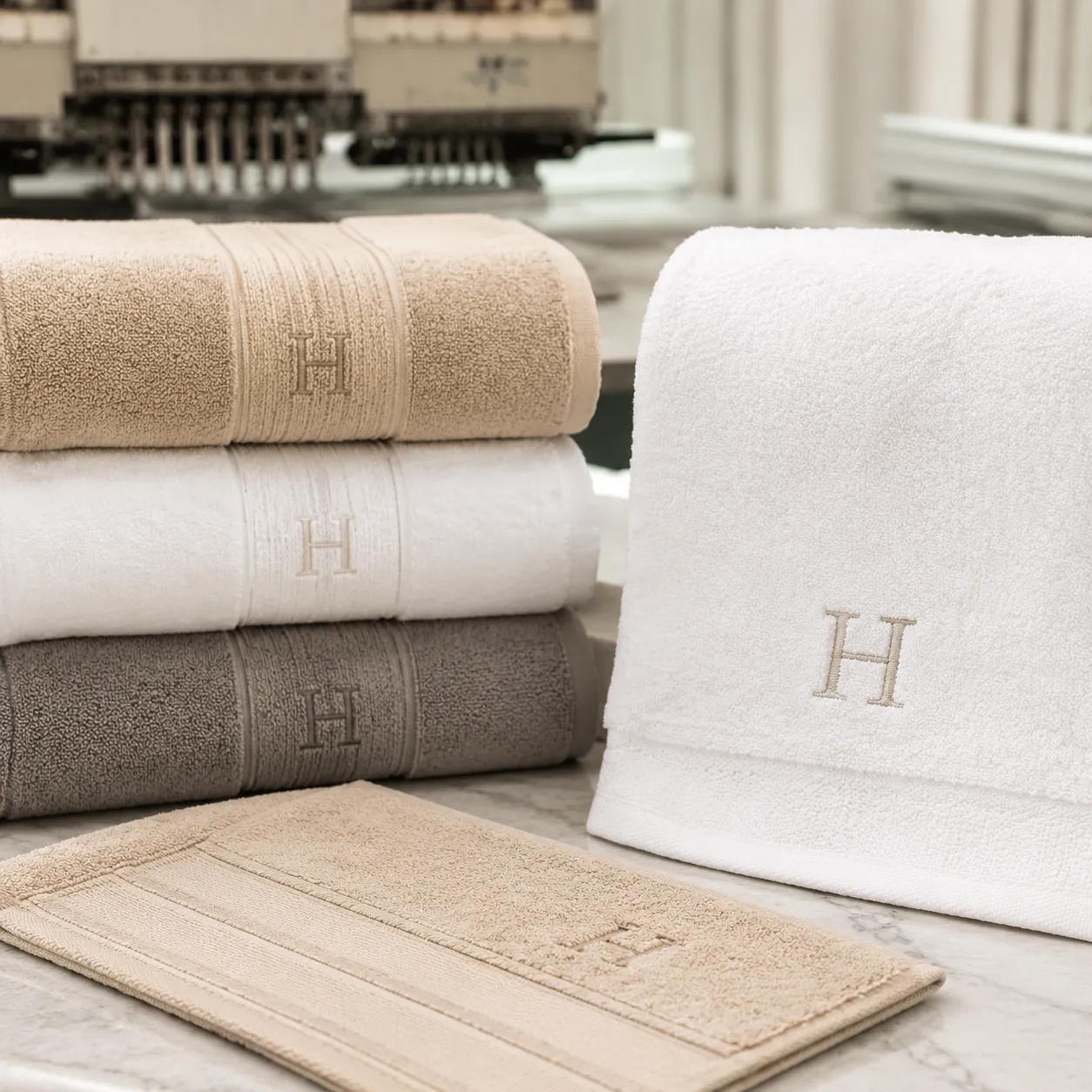
Why monogramming fails on terry loops
Bath towels are not flat fabric. A 550-700 GSM terry towel has raised pile, loose loop movement, and shrinkage after laundering. A logo that works on a cotton shirt can look heavy, buried, or distorted on a towel because the embroidery needle is passing through uneven loops rather than a woven plain surface.
In our decoration room, most rejected embroidered bath towels trace back to three decisions made too early: the buyer locks the artwork before checking minimum line thickness, chooses the towel GSM without considering stitch weight, or places the monogram where users fold or hang the towel. We can solve these issues, but not after 3,000 pieces are already embroidered.
- Loop interference: high pile can swallow thin satin stitches under 1.2 mm after the first wash.
- Needle drag: dense logos can pull terry loops inward and create a puckered square around the embroidery.
- Backside irritation: large stitch blocks near the face-contact zone feel rough if backing is not trimmed correctly.
- Color bleeding risk: dark embroidery thread on white cotton still needs ISO 105-C06 wash testing before approval.
- Wrong fold logic: a logo placed for flat display may disappear when the towel is stacked on a hotel shelf.
Monogrammed bath towels logo decoration guide: first choices
Before we quote custom monogram towels, we ask for the towel size, GSM, logo size, thread color count, and intended folding method. These five details decide whether embroidery is clean and economical or expensive and unstable. For a hotel bath towel monogram, we usually start with a 70 x 140 cm or 76 x 152 cm towel, 520-650 GSM, combed cotton or ring-spun cotton, and a logo area between 55 x 55 mm and 90 x 120 mm.
A crest with tiny text may need simplification. We often convert hairline borders into satin columns, remove interior gaps smaller than 0.8 mm, and increase letter height to at least 6 mm for block fonts or 8 mm for script fonts. These are not design preferences. They are mechanical limits caused by pile height, thread thickness, and repeat washing.
| Decision | Factory recommendation | Why it matters |
|---|---|---|
| Towel GSM | 500-600 GSM for most embroidered bath programs | Enough body for hospitality use without making the logo area too bulky |
| Pile height | Medium pile, not extra-high spa pile | High pile makes small letters disappear unless we use topping film |
| Logo width | 60-110 mm for bath towels | Visible on shelf and in-room use without excessive stitch count |
| Thread type | 120D/2 polyester embroidery thread | Better chlorine and laundry resistance than rayon in hotel washing |
| Backing | Tear-away plus water-soluble topping when needed | Stabilizes terry loops and prevents stitches from sinking |
Placement is a laundry and folding decision
Towel embroidery placement should be agreed after the buyer shows us how the towel will be folded. A logo placed 90 mm above the bottom hem may look right when the towel is flat, but it can land on a fold crease in a tri-fold hotel presentation. For retail gift sets, we may move the monogram toward the lower right corner. For hotels, we often center it above the dobby border or use a corner placement that remains visible in stacked storage.
We mark placement from finished towel edges, not greige fabric edges. Cotton terry can shrink 4-8% depending on construction and washing. If we embroider before final finishing or fail to compensate for shrinkage, the logo may drift from the approved position. Our normal process is weaving, dyeing, washing, tumble drying, cutting inspection, then embroidery on finished-size towels unless the construction requires another sequence.
| Placement option | Typical measurement | Best use | Risk to check |
|---|---|---|---|
| Centered above dobby | 35-55 mm above border top | Hotel and spa bath towels | Logo may be hidden if towel is rolled |
| Lower right corner | 70-100 mm from side and bottom edge | Retail monogrammed gifts | Corner can twist after tumble drying |
| Vertical side monogram | 80-120 mm from side hem | Resort and boutique displays | Needs fold mockup before approval |
| Large center logo | 180-260 mm wide | Promotional or robe-style towel display | High stitch count can stiffen the towel face |
- Ask your housekeeping or retail team for the exact fold photo before sampling.
- Confirm whether the towel hangs on a rail, sits in a stack, or is rolled in a basket.
- Avoid embroidery directly on thick dobby borders unless the border is designed for stitching.
- Keep monograms away from zones that touch the face or neck during use.
- Approve placement using washed sample towels, not only fresh production pieces.
Digitizing for towels is different from apparel
Logo digitizing for towels starts with underlay. On terry, we use edge-walk and zigzag underlay to hold loops down before the top satin stitch. For filled areas, we reduce the jump distance where possible and avoid very long satin spans that can snag in commercial laundry. A 75 mm crest may run 7,500-12,000 stitches, while a dense 110 mm shield with text can exceed 18,000 stitches. That difference changes cost, production speed, and hand feel.
We also use water-soluble topping film for logos with fine text or open loops. The film sits over the towel surface while stitching, preventing terry loops from poking through the embroidery. After production, the film is removed by steam or light washing. If a supplier skips topping on high-pile cotton, the first sample may look acceptable from one meter away, but close inspection shows broken letter edges and loop shadows inside the design.
- Review artwork in vector format, preferably AI, PDF, EPS, or high-resolution SVG.
- Convert small gradients, shadows, and thin outlines into stitch-friendly solid shapes.
- Run a digitized stitch simulation and estimate stitch count before quoting bulk.
- Embroider one strike-off on the actual towel GSM and color, not spare flat fabric.
- Wash the sample three to five cycles before final approval if the order is for hotel laundry.
GSM, cotton, and logo size must work together
For monogrammed bath towels logo decoration guide decisions, GSM is not only about absorbency. It controls pile height, towel weight, drying time, and how much the embroidery sits above or sinks into the surface. A 480 GSM bath towel can take a small monogram cleanly but may feel too light for a five-star room. A 700 GSM towel feels substantial, yet a 45 mm script initial may need topping and thicker satin columns to remain visible.
We usually guide brand buyers toward 540-620 GSM when embroidery is part of the program. Combed cotton gives a smoother pile and fewer fly fibers around the logo. Zero-twist cotton can feel soft, but the loose fiber structure may fuzz around dense embroidery after repeated tumble drying. For more detail on yarn selection, see combed vs zero-twist cotton explained and our broader towel GSM decision framework.
| Towel spec | Logo suitability | Typical FOB price at 500 pcs | Typical FOB price at 3,000 pcs |
|---|---|---|---|
| 500-540 GSM ring-spun cotton | Good for small initials and simple wordmarks | USD 4.35-5.10 / pc | USD 3.55-4.25 / pc |
| 560-620 GSM combed cotton | Best balance for hotel crest embroidery | USD 5.20-6.40 / pc | USD 4.35-5.45 / pc |
| 640-700 GSM combed cotton | Suitable for large monograms, needs topping | USD 6.75-8.20 / pc | USD 5.80-6.95 / pc |
| 450-500 GSM economy cotton | Works for promotional programs, lighter hand | USD 3.70-4.50 / pc | USD 3.05-3.75 / pc |
These bands assume one embroidery position, up to two thread colors, normal export carton packing, and our MOQ of 500 pcs per design per color. Metallic thread, appliqué patches, individual name personalization, or oversized logos can add USD 0.18-0.95 per towel depending on stitch count and handling time.
Thread, backing, and wash testing standards
For hotel and spa programs, we prefer polyester embroidery thread because it holds color better against peroxide detergents and repeated tumble drying. Rayon has a softer shine, but it is less stable under industrial laundry chemistry. For white or pale towels, we also check whether dark thread leaves any shadow during wet pressing or after storage in humid cartons.
Our standard internal tests include dimensional change after washing using ISO 6330 procedures, color fastness to domestic and commercial laundering aligned with ISO 105-C06, and rubbing fastness checks based on ISO 105-X12 where dark embroidery sits on light towel grounds. For baby, facial, or skin-contact programs, OEKO-TEX Standard 100 Class I is the safer certificate level. Our mill also operates under BSCI audit controls and ISO 9001 quality management.
- For white hotel towels, request thread shade approval under D65 light before bulk production.
- For dark towels, test lint visibility around the logo after tumble drying.
- For chlorine exposure, tell us the laundry chemistry before sampling, not after shipment.
- For retail gift towels, check backing softness because the buyer may use the towel directly after purchase.
- For spa use, avoid oversized dense logos that reduce the soft hand expected in treatment rooms.
Cost-per-use: cheap embroidery can become expensive
A buyer once asked us to reduce a 95 mm crest from 13,400 stitches to 8,200 stitches to save cost. The sample looked acceptable before washing, but after eight ISO 6330-style wash cycles, the thin fill opened near the crown detail and the terry pile showed through. The saving was about USD 0.16 per towel on a 1,200-piece order. If the towel is used 85 times in a hotel room, that saving equals less than USD 0.002 per use.
Compare that with replacement cost. If poor digitizing causes only 9% of a 1,200-piece batch to be retired early, and the landed replacement cost is USD 6.90 per towel including freight and duty, the loss is roughly USD 745 before labor. This is why we push back when buyers ask us to remove backing, skip topping, or stitch fine lettering below workable limits. A lower unit price is not useful if the logo looks tired before the towel body is worn out.
| Volume | Recommended order type | Sample and production timing | Indicative FOB decoration cost |
|---|---|---|---|
| 500-799 pcs | Small hotel or boutique retail drop | 7-10 days sampling, 24-30 days bulk | USD 0.48-1.20 / towel |
| 800-2,999 pcs | Standard hotel or DTC batch | 7-12 days sampling, 28-35 days bulk | USD 0.36-0.95 / towel |
| 3,000-7,999 pcs | Chain hotel or resort program | 9-13 days sampling, 32-42 days bulk | USD 0.28-0.78 / towel |
| 8,000+ pcs | Annual replenishment or multi-property rollout | 10-15 days sampling, 38-50 days bulk | USD 0.22-0.62 / towel |
Sample approval workflow we use at the mill
The sample stage should prove three things: the towel base is correct, the logo is readable, and the decoration survives the wash conditions expected by the buyer. We do not recommend approving a monogram from a photo alone. Camera angle hides pile compression and thread shine. A physical sample lets the buyer feel the backing, inspect the reverse side, and test how the towel folds on shelf.
- Buyer sends towel size, GSM target, Pantone references, logo file, and fold photo.
- We review artwork for stitch limits and return a decoration risk note within 1-2 working days.
- Lab dip or yarn-dyed color approval runs 5-7 days when custom towel colors are required.
- Embroidery strike-off on actual towel fabric takes 4-6 days after digitizing approval.
- Washed sample review adds 3-5 days depending on the requested cycle count.
- Bulk production starts after written approval of towel, logo, placement, packing, and carton marks.
For a new program, plan 12-18 days for full sample approval and 28-45 days for bulk production after deposit and approved sample. Air freight can shorten delivery but rarely helps if the sample decision is rushed. For larger towel programs, our build a towel tech pack that mills can quote guide explains the information we need before accurate costing.
Packing, cartons, and quality inspection
Embroidery quality can be damaged after sewing if packing is careless. Dense logos should not be crushed under carton compression while still warm from finishing. For white towels, we avoid direct contact between dark embroidery and loose printed carton surfaces. We normally pack bath towels in PE bags or belly bands, then export cartons with moisture control when shipping to humid routes.
Our inline inspection checks stitch breaks, loose threads, trimming, backing residue, logo position tolerance, and shade consistency. For logo position, a practical tolerance is usually +/- 8 mm on bath towels because terry fabric relaxes after sewing and folding. For luxury retail presentation, we can tighten the tolerance, but the production line slows and inspection cost rises.
- MOQ is 500 pcs per design per color for OEM monogrammed bath towel orders.
- Standard carton weight target is usually 14-19 kg to protect towel loft and warehouse handling.
- Needle detection can be added for baby, airline, or strict retail compliance programs.
- Private label packaging needs 6-10 extra days if woven labels, belly bands, or barcode stickers are custom made.
- Final AQL inspection commonly follows general ISO 2859-1 sampling principles unless the buyer specifies another plan.
Related reads: for decoration method trade-offs, compare embroidery vs sublimation vs jacquard. For logo color control, review Pantone color matching custom towels. If the order is hospitality-focused, our hotel towel sourcing guide 2026 covers towel body specs beyond embroidery.
Related reads: buyers planning luxury initials can also check monogrammed bath towels luxury brand guide. For certificate review, see how to read an OEKO-TEX certificate. For freight decisions after production, use container vs air freight towel orders.
Send Us Your Monogram Artwork
Email the towel size, GSM target, logo file, fold photo, quantity, and delivery country. We will check stitch feasibility, MOQ, pricing, and timing from the mill side. WhatsApp: +86 13205717266. Email: [email protected].
Request OEM Quote →