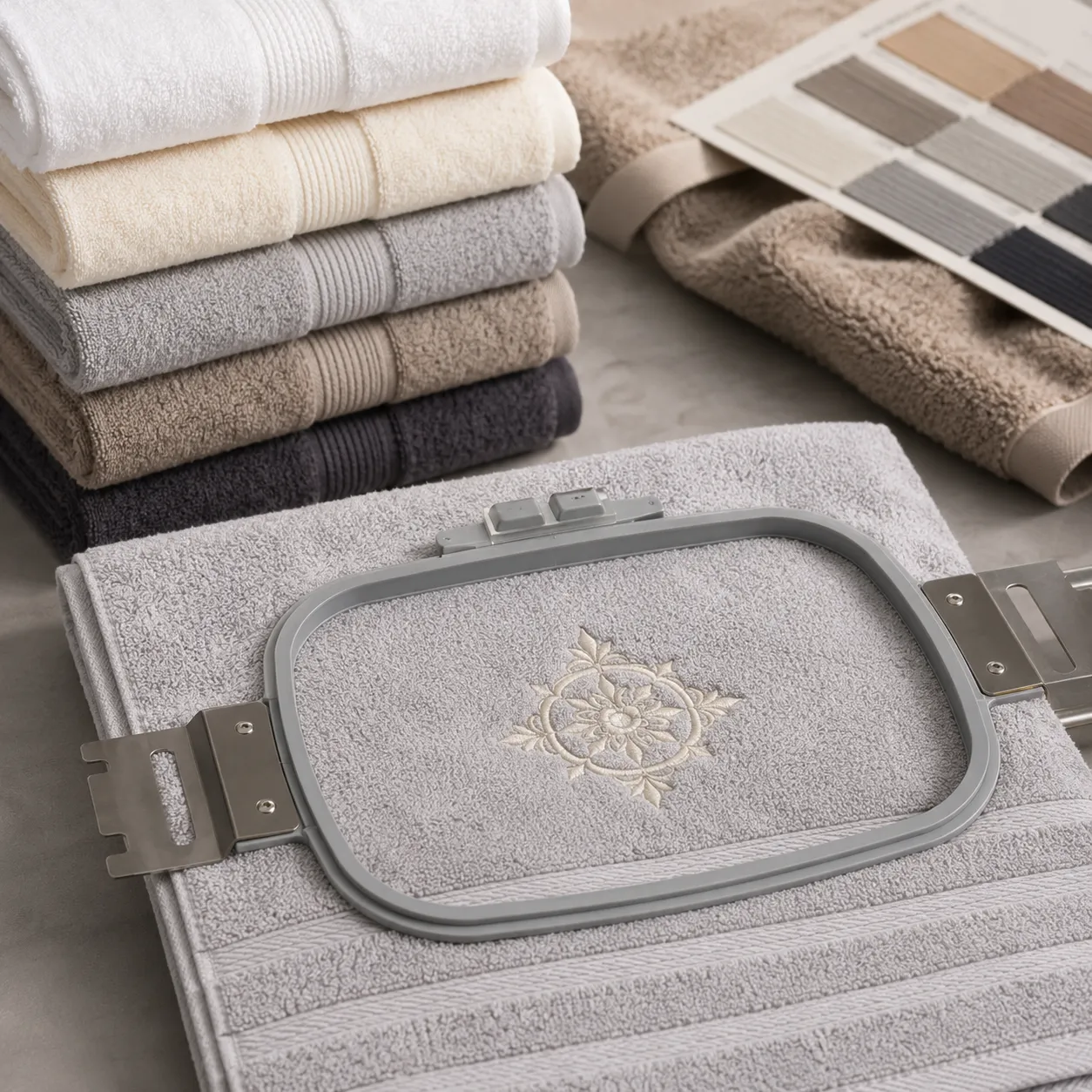
Start with the towel body, not the letterform
Embroidery is only as stable as the ground fabric under it. We see buyers approve artwork first and then ask us to fit that monogram onto whatever bath base is cheapest that month. In practice, the order runs better when the towel is selected first. For 2026 programs, the bath formats we most often embroider successfully are 27×54 in at 520-580 GSM and 30×58 in at 560-680 GSM, usually in ring spun or combed cotton terry. Below roughly 500 GSM, the face can look sparse around satin columns in the letter. Above about 700 GSM, the pile height starts hiding fine serif details unless the design is simplified.
Two construction details matter more than buyers expect. First, whether the embroidery sits on the dobby border, a sheared header panel, or directly into the pile. Second, whether the towel has a stable backing density at that location. A 9 cm dobby band gives cleaner edge definition than embroidering into open loops, but it also limits letter height. If the brand wants a 75 mm crest with internal lines, we usually propose a header panel or a low-pile carved zone rather than forcing too much stitch into a narrow border.
| Base towel option | Typical GSM | Best monogram zone | What usually goes wrong |
|---|---|---|---|
| Standard terry bath towel | 520-580 | Dobby border or short sheared panel | Loop show-through if underlay is too light |
| Dense combed terry | 560-680 | Header panel above border | Heavy stitch causes local stiffness if design is oversized |
| Zero-twist style bath towel | 580-650 | Only on stabilized header area | Pile pull and distortion if embroidered directly into plush face |
| Piece-dyed dark towel | 500-620 | Border with tested backing | Bleeding around light thread after wash if dye fixation is weak |
The monogram fails in four predictable ways
Most rejected monogrammed towels do not fail because the embroidery machine was inaccurate. They fail because the program was specified without accounting for wash chemistry, pile movement, and stitch density. On our floor, we watch for four defect modes early.
- Puckering around the emblem: usually from too much stitch density on a soft base, or backing that is too light for the towel loft.
- Thread abrasion after laundry: often happens when satin stitches sit proud above the pile and get rubbed in tunnel finishing or harsh extraction.
- Color migration into light embroidery: common on navy, black, bottle green, and intense red grounds if bulk fabric dyeing is not fully controlled before decoration.
- Misplaced logos across a set: not dramatic in one piece, but obvious when 300 guest rooms line up towels with different offsets from the hem.
The useful fix is not simply "better embroidery." We normally adjust pull compensation, underlay type, and backing weight together. For example, on a 600 GSM combed cotton bath towel with a 65 mm monogram, we may reduce top stitch density from 0.42 mm fill spacing to 0.46 mm and move from a simple center-walk underlay to edge-run plus zigzag underlay to keep shape without overloading the fabric. Those are small machine-level changes, but they can be the difference between a flat logo and a hard embroidered patch.
Placement is a commercial decision, not only a design decision
Buyers usually ask whether the logo should sit on the border or in the lower body. The better question is where housekeeping, retail presentation, and laundry handling will be least disruptive. In hotels, a border placement 55-80 mm above the bottom hem is still the safest because folded shelf presentation stays consistent and operators can stack pieces quickly. For retail monogram sets, center-lower placements can photograph better, but they also expose the emblem to more abrasion during repeated home tumble drying.
| Placement | Typical size window | Operational upside | Operational downside |
|---|---|---|---|
| On dobby border | 35-55 mm high | Clean alignment and lower snag risk | Limited detail; thick borders can crowd the design |
| Above border on header panel | 45-80 mm high | Best readability for initials and small crests | Needs a stable panel construction |
| Lower body in pile | 60-95 mm high | Stronger visual impact for retail gifting | Higher risk of sink-in and outline blur |
| Corner placement | 35-50 mm high | Useful for compact branding | Looks inconsistent once folded for hotel shelves |
If the order includes bath towel, hand towel, and washcloth as one family, we do not recommend scaling the exact same file blindly. The satin width that works on a bath towel often closes up on a washcloth after laundering. We usually rebuild the monogram into separate stitch files by size tier. That adds setup discipline at sampling stage but prevents uneven brand presentation later.
What we quote in 2026, and what those numbers assume
Pricing changes with cotton, energy, labor, embroidery count, and pack-out. Any FOB figure should be tied to an actual construction. The ranges below reflect 2026 ordering conditions we see for export programs from China under normal booking conditions, not distressed spot buys and not air freight replacements. They also assume OEKO-TEX Standard 100 Class I compliant production, routine in-line QC, export carton packing, and embroidery done in-house or under managed local subcontracting with our inspection sign-off.
| Program type | Spec assumption | MOQ | Indicative FOB China |
|---|---|---|---|
| Hotel bath towel with 1-color initials | 27×54 in, 540 GSM, combed cotton, border logo 45 mm | 1,500 pcs | USD 3.10-3.68/pc |
| Hotel bath towel with 2-color crest | 30×58 in, 600 GSM, ring spun cotton, header panel logo 65 mm | 2,000 pcs | USD 4.05-4.92/pc |
| Retail gift bath towel | 30×58 in, 650 GSM, combed cotton, larger monogram, belly band | 1,000 pcs | USD 4.88-6.15/pc |
| Matching 3-piece set average | Bath + hand + washcloth, mixed embroidery files, private label pack | 800 sets | USD 7.90-10.85/set |
Those bands widen for metallic thread, appliqué underlay, custom dye-to-match thread approvals, or if the logo count forces slower machine speed. A dense crest with 14,000-18,000 stitches can add noticeably more than a clean two-letter monogram below 6,500 stitches. If a buyer wants to compare factories fairly, ask each supplier to separate the quote into greige or dyed towel cost, embroidery setup, per-piece embroidery run cost, and packaging. That makes it easier to see whether a low unit price is simply hiding a weaker base towel.
Sampling timelines buyers should actually plan around
A realistic monogram bath towels 2026 buyer guide needs time ranges that reflect approvals, not just sewing time. For a new program, we usually advise buyers to budget around 6-8 days for artwork cleaning and digitizing, 4-7 days for towel base sampling if yarn or dye lot is standard, and another 5-9 days for embroidered sample output plus internal review. If custom Pantone-adjacent thread matching is involved, add a few more days because thread cards and sew-outs often go through one revision cycle.
- Artwork review and digitizing: 3-6 days for simple initials, 5-8 days for crest-style files with fine internal lines.
- Base towel confirmation: 4-10 days depending on stock yarn, custom dyeing, and whether a header panel needs loom adjustment.
- Sample embroidery and wash check: 5-9 days including one in-house wash trial.
- Bulk production: 22-38 days after final sample sign-off for most cotton monogram programs.
- Export booking and document preparation: 6-12 days depending on destination and vessel space.
Peak disruptions still happen before major holiday retail windows and ahead of high-summer resort replenishment. If the program is tied to an opening date, do not count from PO issue alone. Count from the last approved sew-out and approved towel handfeel. For planning bulk freight, container-vs-air-freight-towel-orders.html is the more useful companion read than a generic lead-time chart.
Tests worth writing into the PO
Embroidery programs drift when the PO only says "logo to match sample." We prefer buyers to state the exact acceptance checks. For white or light ground towels, colorfastness and dimensional stability on the towel body matter most. For dark grounds with pale monograms, migration control becomes the bigger issue. We commonly work with ISO 105-C06 for domestic laundering colorfastness assessment and ISO 5077 / ISO 6330 style dimensional change procedures depending on buyer protocol. For thread and seam area review, the first practical check is still a controlled wash-and-dry trial on the embroidered panel itself.
- Colorfastness to washing: specify minimum grade target after agreed cycles, especially for navy and black towels with white thread.
- Dimensional change after laundering: the embroidery zone should not torque or pucker beyond the approved sample tolerance.
- Embroidery placement tolerance: we often agree on ±6 mm from hem reference on bath towels and tighter on premium retail sets.
- Thread trimming and backside cleanliness: no long jump threads, no visible backing exposure beyond agreed limits.
One highly specific point: if the logo sits on a dobby border, ask the mill to verify needle penetration behavior through the denser woven border structure. Needle heat and friction can fuzz mercerized embroidery thread when machine speed is pushed too high on firm dobby bands. That issue will not appear in artwork proofs, only in actual run conditions.
Why cheap monogram programs often cost more by month six
A low first quote usually comes from one of four shortcuts: lighter towel basis weight than the handfeel suggests, fewer pile loops under the embroidery zone, low-grade backing, or reduced in-line inspection. The immediate saving can look attractive. The operating result is often inconsistent placement, flatter handfeel around the monogram, and more buyer time spent sorting claims. In one recent hospitality tender we reviewed, the cheaper offer was about USD 0.44 lower per bath towel at order stage, but the heavier and better stabilized option projected lower replacement volume because logo distortion was far lower after institutional laundering. That matters more in a 20,000-piece program than a small gift run.
If the emblem is part of the brand signal, the towel should be specified like decorated uniform stock, not like a plain commodity bath towel with a last-minute add-on.
This is where cost-per-use becomes real rather than theoretical. If a towel with a weak monogram has to be downgraded from guest-facing stock after 35-45 commercial washes, while a better stabilized version stays presentable for 65-80 cycles, the cheaper opening price can disappear quickly in replacement orders, freight, and housekeeping sorting labor.
The approval sample should include more than one towel
Single-piece approvals hide variation. We prefer sending a small approval pack: one untouched visual sample, one washed sample, and one cut-away or backside review sample if the buyer is technical. That lets brand teams see not only the front look but also the backing, thread density, and how the towel panel behaves after laundering. For larger hotel groups, we also suggest one sample per colorway because white, ivory, charcoal, and navy do not embroider identically even with the same file.
- Approve the logo size in millimeters, not just a visual phrase like "small tasteful monogram."
- Approve the distance from hem or border with a hard dimension on the sample card.
- Approve the thread code and sheen level; matte and rayon-look finishes read differently under bathroom lighting.
- Approve a laundered reference piece before deposit release for bulk if the program is hospitality-facing.
Related reads: if you are still finalizing the towel base, combed-vs-zero-twist-cotton-explained.html and towel-gsm-decision-framework.html are the right starting points. If the issue is spec clarity before quotation, use build-towel-tech-pack-that-mills-can-quote.html.
What we need in an RFQ to quote quickly and accurately
The fastest RFQs are not always the longest. They are the ones that remove ambiguity. For embroidered bath programs, we can usually quote within 1-3 working days when the buyer provides towel size, target GSM, fiber type, ground color, monogram size in millimeters, placement from hem, embroidery colors, estimated stitch complexity, packaging format, and target market. If the program needs compliance review, attach the latest certificate expectations up front. We routinely work with OEKO-TEX Standard 100 Class I, BSCI, and ISO 9001 requirements, but buyers should still state retailer-specific restrictions if they apply.
| RFQ field | Why it matters | If missing, what happens |
|---|---|---|
| Towel size and GSM | Determines base cost and embroidery stability | Quote comes back too wide to compare |
| Logo dimensions in mm | Sets stitch count and backing choice | Factory guesses, then sample cost shifts later |
| Placement reference point | Controls production consistency | Bulk variance rises across cartons |
| Wash use case | Home, hotel, spa, retail gift all behave differently | Wrong towel base gets selected |
| Packaging request | Affects labor and carton density | Freight model is incomplete |
Related reads: for artwork and branding methods, compare embroidery-vs-sublimation-vs-jacquard.html. For broader hospitality setup questions, setting-up-hotel-linen-program-90-day-roadmap.html and hotel-towel-sourcing-guide-2026.html are the most relevant companion pieces.
Quote your monogram bath towel program
Send us the towel spec, logo file, target quantity, and destination. We will reply with construction options, FOB ranges, lead-time windows, and any stitch-risk notes before sampling. WhatsApp: +86 13205717266 | Email: [email protected]
Request a quote →