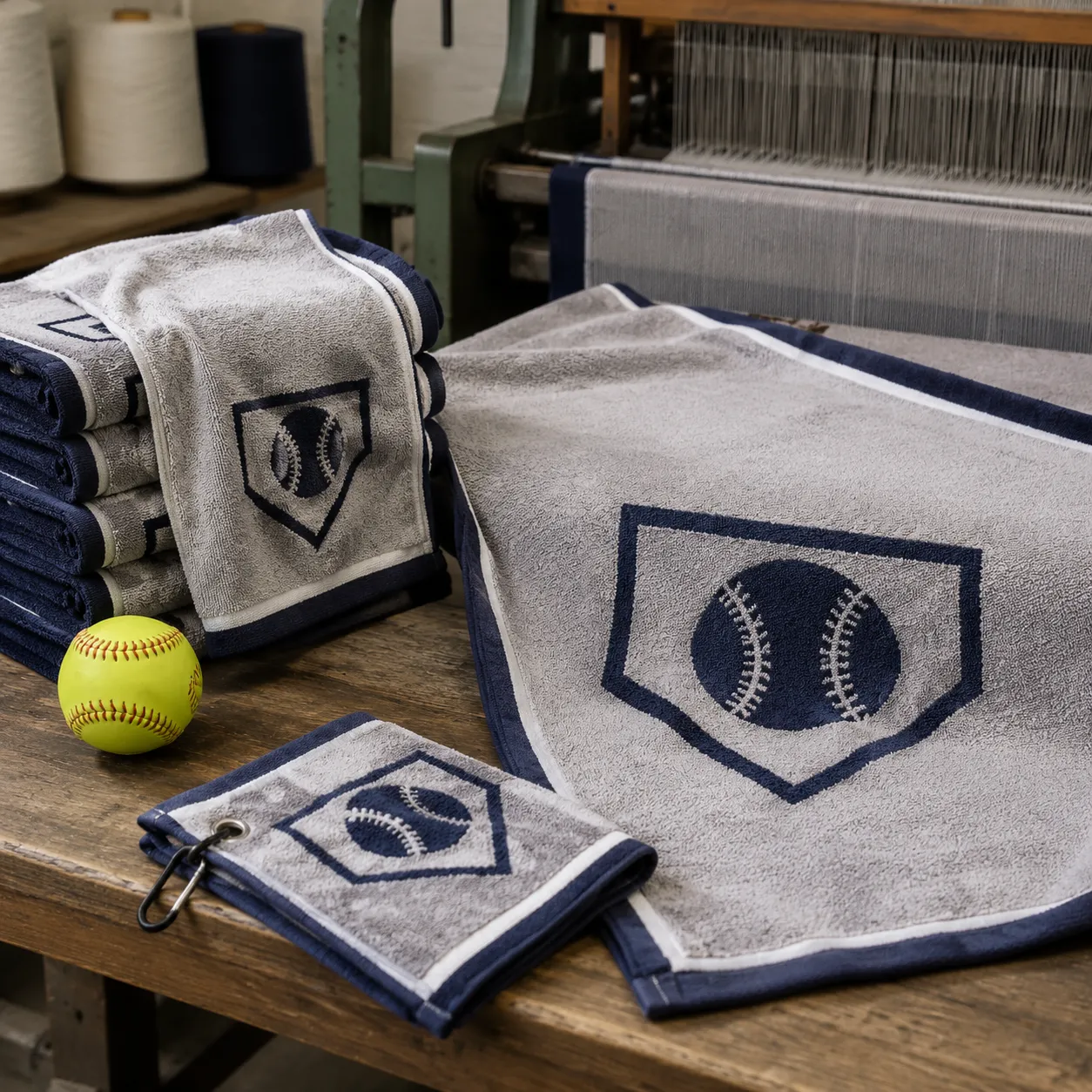
Start with the dugout handling pattern
Softball is different from a gym towel program because the towel is handled in short, repeated bursts. A player wets it, snaps or shakes it, puts it over the neck, drops it on a bench, then repeats the cycle after fielding or running bases. That handling pattern affects fabric choice more than the product photo does.
For team orders, we usually see three user groups: youth clubs ordering 500–1,200 pieces for a season, school athletic departments ordering 800–2,500 pieces across multiple sports, and tournament operators ordering 3,000–10,000 pieces as a branded giveaway. The same cooling fabric can serve all three, but the edge finish, size, and logo method should not be copied blindly between them.
- Youth team issue: lighter towel, lower unit cost, simple one-position logo, fast replenishment before tournament season.
- High school or college program: more durable edge, darker body color, name or number option, wash test before bulk approval.
- Tournament retail or giveaway: stronger packaging requirement, larger decoration area, color consistency across cartons, barcode or hangtag if sold at the venue.
Our factory MOQ is 500 pcs per design / per color. Below that level, the sampling and dye setup time often costs more than the fabric saving, especially when a team wants a custom Pantone body color instead of stock navy, black, royal blue, red, or white.
Fabric choice for softball cooling towels
Most softball cooling towels use synthetic construction because evaporative performance depends on capillary movement and surface area. Cotton feels familiar, but it holds water deeper in the yarn and becomes heavy around the neck. For softball dugout use, we normally quote three constructions: polyester microfiber knit, polyester-nylon blend knit, and PVA-style sponge sheet. Each has a different handfeel and decoration limit.
| Construction | Typical GSM | Usual size range | Best use | Factory note |
|---|---|---|---|---|
| Polyester microfiber knit | 135–185 GSM | 30×90 cm, 30×100 cm, 40×80 cm | Team issue, sponsor giveaways, school sports | Good print surface; dries faster than cotton terry after wringing |
| Polyester/nylon blend knit | 150–210 GSM | 30×100 cm, 32×110 cm | Higher-feel team towel with softer drape | Better handfeel, slightly higher cost, needs tighter shade control |
| PVA sponge cooling sheet | 220–310 GSM wet-equivalent handling | 26×66 cm, 30×80 cm | Low-cost cooling giveaway where softness is less important | Must be packed damp or sealed correctly; not suitable for embroidery |
| Cotton terry towel | 320–450 GSM | 30×60 cm, 35×75 cm | Sweat wiping, not primary cooling | Absorbent but heavier and slower to reset by wringing |
For softball orders, our most balanced spec is usually 160–175 GSM polyester microfiber knit at 30×100 cm. It is long enough to sit around the neck without sliding off during bench movement, but it does not feel bulky under a batting helmet strap or warm-up jacket collar.
A construction quirk worth checking: some cooling knits curl at the long edge after heat setting if the edge tension is uneven. During sample review, we lay the towel flat after one warm wash and measure edge roll. If the roll exceeds 8–10 mm along the long side, it can interfere with logo visibility and packing presentation.
Size and weight should match player age
The common retail cooling towel sizes are not always right for softball. A 40×120 cm towel looks generous, but it can drag into dirt when a younger player sits on a low bench. On the other side, a 25×75 cm piece may look economical but feels too short when worn around the neck during a long inning.
| Player or program | Recommended size | GSM range | Approx. piece weight | Why it fits |
|---|---|---|---|---|
| Youth softball, ages 8–12 | 28×85 cm | 145–165 GSM | 35–39 g | Light around the neck; fits small team bags |
| Travel team, ages 13–18 | 30×100 cm | 155–180 GSM | 47–54 g | Enough length for neck cooling and logo display |
| College or adult league | 32×105 cm | 165–195 GSM | 55–66 g | More coverage without becoming a bath towel |
| Tournament giveaway | 30×90 cm | 135–160 GSM | 36–43 g | Controls freight weight for 5,000+ pc runs |
The piece weight numbers above are calculated from area and GSM, then adjusted for cutting and edge loss. For example, a 30×100 cm towel at 170 GSM has a fabric area of 0.30 square meters, so the base fabric weight is about 51 g before label and packing. This matters because freight is charged on carton weight or volume, and a 10 g increase becomes 50 kg across 5,000 pcs.
If a program wants a towel for both softball and general athletic use, we suggest 30×100 cm rather than a sport-specific mini size. It works for softball, volleyball, soccer sidelines, and summer conditioning. That makes the replenishment order cleaner because the athletic department does not need separate SKUs.
How we test cooling claims without overpromising
Cooling towels are often sold with vague claims, so we prefer a defined comparison test. Evaporative sports towels cool by holding water near the surface and releasing moisture as air moves across the fabric. The effect depends on ambient temperature, humidity, airflow, how much water remains after wringing, and the athlete's skin temperature. No factory should promise one fixed temperature drop for every field condition.
For our internal comparison checks, we condition samples for 24 hours, soak them in room-temperature water, wring each piece through the same roller pressure, then place them on a flat thermal plate in a controlled room. A typical benchmark room is 32°C, 55% relative humidity, with low fan airflow. We record surface temperature change at 1, 5, 10, and 20 minutes. These readings are for comparative development, not a medical or safety certification.
| Check | Method or reference | Pass range we use for team orders | What it tells us |
|---|---|---|---|
| Initial water pickup | Gravimetric soak and wring comparison | At least 1.7× dry towel weight after hand wring | Whether the fabric can hold enough surface moisture |
| Evaporation comparison | Controlled room internal protocol with fixed airflow | Stable cooling curve through 10 minutes versus approved sample | Whether a new yarn lot performs like the signed sample |
| Colorfastness to washing | ISO 105-C06 or AATCC TM61 adapted wash check | Grade 3–4 or better for most dark shades | Risk of shade bleed in shared laundry |
| Dimensional change | ISO 6330 domestic wash procedure reference | Within ±5% after 5 cycles for microfiber knit | Whether the towel shrinks or twists before season end |
| pH of textile surface | ISO 3071 reference | Typically 4.0–7.5 for skin-contact goods | Comfort and compliance check for skin contact |
The most useful field-style test is simpler: wet the towel, wring it by hand, snap or shake it twice, then wear it for 10 minutes while walking outdoors. We ask brand-side teams to do this with the pre-production sample before approving bulk. Laboratory numbers are helpful, but the coach or athlete will judge by neck feel, smell after use, and whether the towel stays manageable when damp.
Decoration that stays readable after wet use
Team logo cooling towels can be decorated by sublimation, heat transfer, screen print, woven label, or a combination of print plus label. Embroidery is possible on some microfiber towels, but we rarely recommend it for this product because the stitched area becomes stiff when wet and can rub the neck.
For full-color softball artwork, sublimation on white or light polyester knit gives the cleanest result. The limitation is that the base fabric must be polyester-rich, and the white backside may show if the towel twists. For darker body colors, a heat transfer or silicone-style transfer can work, but the film area should stay small because large transfers block evaporation where they sit.
| Decoration method | Best logo size | MOQ impact | Durability concern | Suggested use |
|---|---|---|---|---|
| Sublimation print | Full surface or repeated pattern | 500 pcs/design/color | Artwork can blur if fabric is over-stretched during heat press | Tournament graphics, sponsor repeats, retail designs |
| Heat transfer logo | Up to 10×12 cm per position | 500 pcs/design/color | Large films reduce breathability and may crack if wash setting is too hot | School crest, chest-style logo, one-color team mark |
| Screen print | Up to 18×25 cm | 800 pcs/design/color recommended | Ink handfeel varies by chemistry and coverage | Simple bold graphics on medium runs |
| Woven label plus body color | 2.5×5 cm to 4×6 cm label | 500 pcs/design/color | Label corner can lift if stitch density is too low | Club programs wanting a subtle brand mark |
- Keep critical text at least 6 mm high for sublimation on textured knit.
- Avoid fine white outlines on navy or black transfers; they pick up lint and look uneven after team laundry.
- Place the main logo 8–12 cm from one short end if the towel will hang over a dugout rail.
- For player-name options, group names in one artwork file per colorway to reduce prepress errors.
A specific defect we watch for is ghosting on sublimated cooling towels. It happens when the fabric shifts a few millimeters during heat pressing, leaving a shadow beside letters. We prevent it with proper paper tension, adhesive transfer paper when needed, and a cooling rack step before stacking. On busy pre-season orders, that cooling rack step is easy to rush, so we include it in the line QC checklist.
For a deeper comparison of decoration choices, our team wrote about embroidery, sublimation, and jacquard. For color approval, especially school colors, Pantone matching for custom towels explains why fabric, ink, and lighting must be reviewed together.
Wash, sunscreen, and clay-dirt realities
Softball towels meet sunscreen, sweat, infield dirt, grass, and sometimes sports drink residue. A bright white towel can look sharp at delivery, then stain quickly if the team uses it on the bench. For youth and school programs, darker shades or all-over sublimation patterns hide clay marks better than plain white.
Laundry instructions should be written for the team manager, not only for a retail consumer. We recommend cold or warm wash, mild detergent, no chlorine bleach, no fabric softener, and low tumble dry or air dry. Fabric softener is a problem because it can coat the microfiber surface and reduce water movement. High dryer heat can also distort the knit or damage transfer logos.
- Approve one wet-use sample before bulk, including logo feel against the neck.
- Run at least 5 wash/dry cycles on the approved sample if the towel is for team issue.
- Check dark shades for bleed against a white cotton witness cloth.
- Rub a damp printed area with a white cloth to screen for loose dye or ink.
- Confirm packaging can handle a towel that may be slightly tacky from humidity during summer receiving.
For bulk school orders, we can add a small care label or printed care card. It adds cost, but it reduces complaints caused by bleach or high heat. If a club plans to launder all towels together, we also recommend avoiding mixed dark and white towel bodies in the same issue set.
Certification language buyers can safely use
We hold OEKO-TEX Standard 100 Class I, BSCI, and ISO 9001 certifications at factory level. For cooling towels, it is important to use this language correctly. OEKO-TEX Standard 100 is a restricted-substance certification for textile materials tested against defined chemical criteria; it is not a cooling-performance certificate. BSCI relates to social compliance auditing. ISO 9001 relates to quality management systems, not an individual towel's field performance.
If your customer is a school district, college bookstore, or event sponsor, ask what documentation they need before sampling. Some require an OEKO-TEX certificate number and scope page. Others want a factory audit summary, product composition declaration, or Prop 65 review for U.S. retail distribution. We can prepare standard document packs, but legal market claims should be reviewed by the brand or importer.
- OEKO-TEX Standard 100 Class I: useful for skin-contact textile restricted-substance assurance.
- BSCI: useful when the purchasing policy asks for social compliance audit evidence.
- ISO 9001: useful for showing documented production and corrective-action systems.
- Wash-test reports: useful for proving the approved sample and bulk output are being compared under the same conditions.
The practical point is consistency. A softball program does not benefit from a certificate if the bulk fabric lot changes without checking shade, handfeel, and water pickup. In our workflow, the signed pre-production sample becomes the control piece for cutting, printing, packing, and final inspection.
Pricing bands and where cost changes
For custom cooling towels for teams, the main cost drivers are fabric GSM, size, decoration coverage, packaging, and order quantity. A small towel with a one-position transfer can be economical. A full-surface sublimated towel with individual polybag, barcode, and hangtag costs more because the print and packing time increase.
| Order volume | Basic one-logo towel | Full sublimation towel | Retail-packed towel | Typical use |
|---|---|---|---|---|
| 500–999 pcs | USD 1.05–1.55/pc | USD 1.45–2.15/pc | USD 1.80–2.70/pc | Single club, booster store, pilot order |
| 1,000–2,999 pcs | USD 0.82–1.28/pc | USD 1.18–1.86/pc | USD 1.48–2.35/pc | School district, travel organization |
| 3,000–7,999 pcs | USD 0.66–1.05/pc | USD 0.98–1.55/pc | USD 1.26–2.05/pc | Tournament or sponsor activation |
| 8,000+ pcs | USD 0.54–0.92/pc | USD 0.82–1.38/pc | USD 1.08–1.82/pc | Multi-event program, national campaign |
These are realistic ex-factory bands for common microfiber cooling towel specs, not binding quotes. If the body is a custom-dyed polyester/nylon blend at 190 GSM, the cost can move above the table. If the order uses stock white fabric with a small one-color logo, it may sit near the lower end.
Here is a cost-per-use view from a recent style discussion, using fresh assumptions. A 30×90 cm low-GSM giveaway towel at USD 0.62 might last about 12–18 team wash cycles before the edge curls and the print looks tired. A 30×100 cm towel with better edge binding and tested transfer at USD 1.14 may reach 35–45 cycles in school laundry. If a team issues 700 towels and each one is used twice per week for a 10-week season, the stronger version can reduce replacement pressure even though the first invoice is higher.
Sampling and bulk timing before season start
Softball schedules create tight windows. Spring programs often ask for delivery after rosters are finalized, while tournament operators want goods before sponsor artwork is fully approved. The cleanest plan is to freeze the towel spec first, then add names, sponsor marks, or packaging details after the base construction is confirmed.
- Spec confirmation and quote: 1–2 working days after size, GSM, logo method, quantity, and packaging are clear.
- Lab dip or print strike-off: 5–8 days for color or artwork review.
- Physical sample: 7–12 days for standard microfiber cooling towel construction.
- Pre-production sample after artwork lock: 4–7 days if fabric is ready.
- Bulk production: 18–28 days for 500–5,000 pcs; 25–38 days for larger or multi-color orders.
- Final inspection and export packing: 2–4 days.
- Sea freight to many major ports: often 25–40 days; air freight commonly 5–9 days after handover.
For named player towels, add time for roster checking. The most common production delay is not weaving or cutting; it is receiving corrected spelling after the artwork file has already entered print layout. We ask for names in a spreadsheet with one column for name, one for number, one for team, and one for towel color. That reduces manual sorting errors.
If your program is close to the first game date, split the order. Produce a base batch of unpersonalized dugout cooling towels first, then run named or retail-packed pieces later. This is often safer than rushing every SKU through decoration and risking cartons that cannot be used because of one late logo approval.
Tech pack details that prevent rework
A cooling towel tech pack does not need to be long, but it must remove interpretation. We need dimensions, GSM target, fiber composition, body color, edge finish, decoration method, logo placement, packing, carton marks, and testing expectations. If the towel is part of a larger sports assortment, tell us whether the shade must match uniforms, caps, or a previous towel shipment.
- Finished size with tolerance, such as 30×100 cm ±2 cm after wash.
- Fabric construction and GSM target, such as polyester microfiber knit at 165–175 GSM.
- Logo artwork in vector format for transfer or high-resolution raster for sublimation.
- Pantone reference plus acceptable visual tolerance under D65 light if school color is strict.
- Edge finish: overlock, hemmed edge, or binding, with thread color specified.
- Packing: bulk pack, individual polybag, wet pouch, hangtag, barcode, or carton assortment by team.
- Testing request: wash cycles, colorfastness method, water pickup comparison, and approved sample control.
Related reads should support the sourcing decision, not distract from it. If the towel will be sold as a team-branded item, building a towel tech pack mills can quote helps your designer send usable files instead of mood boards. If the athletic department is also buying sweat towels, why gym towels fail after 50 washes is useful because the same laundry habits affect microfiber and cotton differently. For freight planning on 3,000+ pc tournament orders, container vs air freight for towel orders gives the cost logic behind the shipping choice.
For adjacent programs, we also manufacture gym towels, microfiber sports towels, and beach or pool towels for clubs. A softball cooling towel order can be combined with other seasonal textile needs if the artwork calendar is realistic and the MOQ is met per design and color.
What to send us for a quote
To quote accurately, we need more than the words softball cooling towels. Send the target size, quantity, body color, logo file, decoration preference, delivery country, packaging request, and whether the towel is for team issue, retail sale, or event giveaway. If you have an existing sample, send photos of the front, back, edge, label, and a weight measurement on a kitchen scale.
Our factory has operated since 2007 with 220 employees, annual output around 2.4 million towels, and 80+ brand clients across 47 countries. We produce under OEKO-TEX Standard 100 Class I, BSCI, and ISO 9001 systems. MOQ is 500 pcs per design / per color. For direct discussion, contact us by WhatsApp at +86 13384590853 or email [email protected].
Build a field-ready cooling towel spec
Send your size, GSM target, logo artwork, quantity, and delivery market. We will return a practical OEM quote with sampling time, bulk lead time, and packaging options.
Request a cooling towel quote →