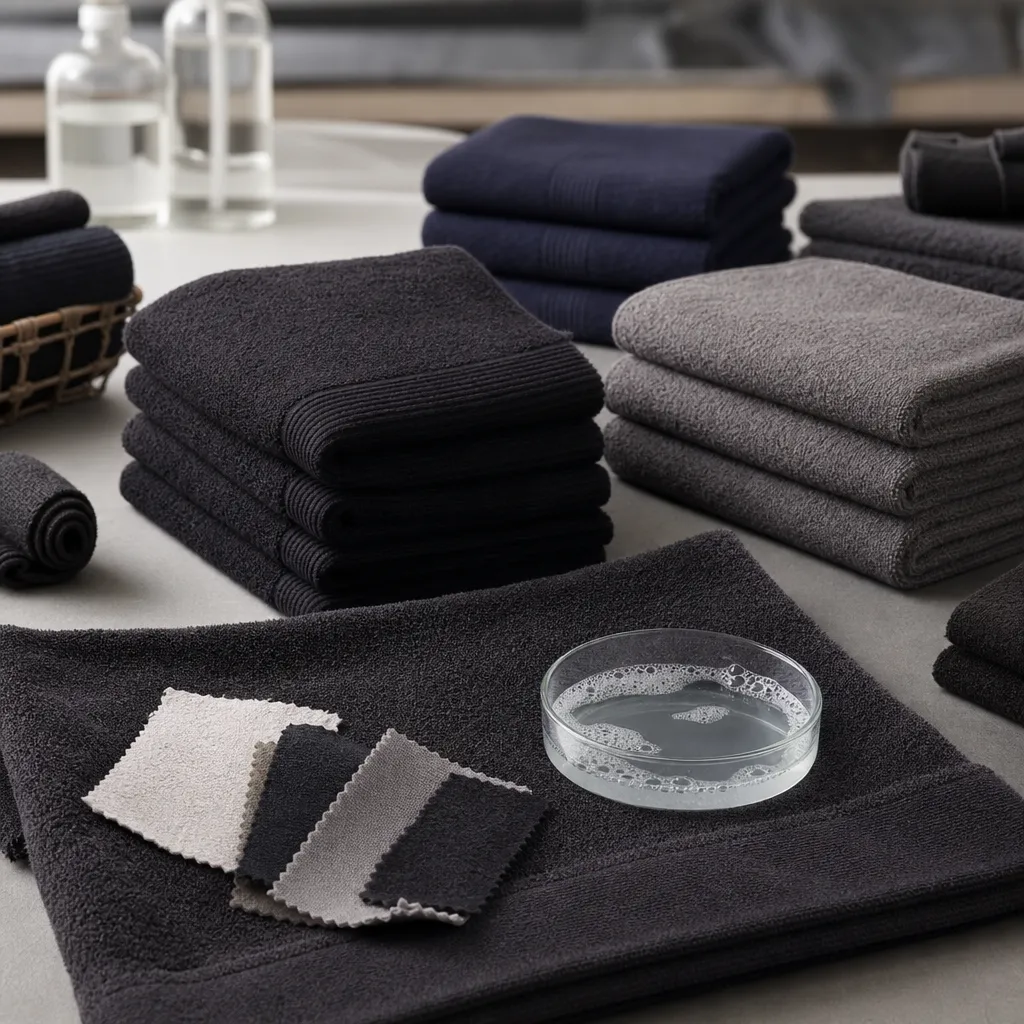
Start With the Chemical Reality
Salon towels do not fail like hotel towels. Hotel towels usually fail from guest misuse, over-drying, or chlorine in the laundry. Hair salon towels face peroxide developer, direct dye, semi-permanent color, shampoo surfactants, hair oil, and sometimes disinfectant sprays on the same day. A towel that looks fine after ISO 6330 domestic wash testing can still turn rusty brown after repeated contact with 6 percent hydrogen peroxide developer.
For salon towels bulk programs, we first ask what chemical exposure is normal in the shop. Color bars, barber hot towel service, manicure stations, and spa treatment rooms do not need the same towel. If every towel is treated as one universal item, the buyer usually overpays on some SKUs and under-specs the towels that touch bleach or color.
| Salon Use | Main Risk | Factory Spec We Usually Recommend |
|---|---|---|
| Hair coloring station | Peroxide spotting, dye transfer, black fading | 360-430 GSM ring-spun cotton or cotton-poly terry, dark reactive dye, peroxide spot test |
| Shampoo bowl | Frequent wash cycles, lint on wet hair | 400-480 GSM cotton terry, low-lint yarn, tighter hem stitching |
| Barber hot towel | Heat, steam cabinet odor, shrinkage | 300-380 GSM cotton hand towel, pre-shrink control, absorbency check |
| Spa facial room | Skin contact, softness, visible staining | 420-520 GSM cotton or bamboo-cotton, OEKO-TEX Class I yarn and trims |
Salon Towels Bulk Specs Buyers Should Lock First
The first spec is not the logo or the carton mark. It is the job the towel must do after 60 to 90 laundry cycles. For hair salon towels, our normal production range is 300-520 GSM. Below 300 GSM, the towel dries quickly but feels thin and loses shape at the hem. Above 520 GSM, it can feel more expensive, but drying time increases and commercial laundry cost rises.
Most salon towels wholesale orders land in the middle: 340-420 GSM for working towels and 450-500 GSM for client-facing spa or facial towels. We do produce lighter promotional towels, but we push back when a buyer wants a 260 GSM black towel for daily color work. The purchase price looks better on a spreadsheet, then the towel twists, sheds lint, and gets retired too early.
- Size: 30 x 70 cm for barber and manicure use, 35 x 75 cm for salon hand towels, 40 x 80 cm for shampoo and color stations, 70 x 140 cm only when the towel must wrap shoulders or body.
- GSM: 300-360 GSM for fast-dry service towels, 370-430 GSM for daily salon work, 440-520 GSM for spa-facing towels.
- Construction: 16s/1 or 21s/2 cotton yarn for balanced durability; zero-twist is soft but usually too delicate for heavy salon chemistry.
- Hem: 2-needle lockstitch or chainstitch hem with 8-10 stitches per inch; loose hem density is one of the first defects after hot wash.
- Shrinkage target: within 5 percent after ISO 6330 wash method, with a tighter 3-4 percent target for towel sets sold at retail.
Color Choice Is a Cost Decision
Black towels are popular because they hide stains, but black is not automatically safer. A low-grade black dye can bronze, redden, or lose depth after contact with peroxide developer. White towels tolerate chlorine better, but they show hair dye stains immediately. Grey looks calm in a salon, yet it can reveal patchy fading faster than deep navy or charcoal.
For black salon towels bulk orders, we normally use reactive dye on cotton and run a peroxide spotting check before approval. For cotton-poly blends, dyeing becomes more complex because cotton and polyester accept color differently. If a buyer wants very deep black and a synthetic blend, we need lab dips on the actual fabric construction, not just a Pantone callout on paper.
| Color | Strength | Watch Point |
|---|---|---|
| Black | Hides dye and oil marks well | Needs peroxide spot testing; cheap dye can turn brown |
| Charcoal | More forgiving than light grey | Shade variation is visible if lots are mixed |
| White | Can be laundered aggressively | Shows color stains and makeup immediately |
| Navy | Good client-facing alternative to black | Requires shade-band approval under D65 light |
| Burgundy or forest green | Fits branded salon interiors | Higher lab dip rejection risk; allow extra sampling days |
We check shade under D65 and TL84 light boxes because salon retail areas often use warm lighting while back rooms use cooler utility lamps. A towel that looks matched in one room can look off on a folded shelf in another. For repeat orders, we keep the approved lab dip and bulk cutting from one dye lot whenever possible.
Bleach Resistant Does Not Mean Bleach Proof
Buyers often ask for bleach proof towels. In factory terms, we prefer to say bleach resistant salon towels because no cotton towel is immune to every salon chemical at every concentration. Chlorine bleach, peroxide developer, persulfate lightener, and alcohol-based disinfectant do different kinds of damage. A towel can pass one test and fail another.
For salon programs, we usually run three practical checks. First, ISO 105-C06 for color fastness to domestic and commercial laundering. Second, ISO 105-E04 for color fastness to perspiration when towels are used around neck and face. Third, an internal peroxide spot test: we apply 6 percent and 9 percent developer drops to the dyed terry, hold for 20 minutes, rinse, then inspect after drying. This is not a replacement for a formal lab claim, but it catches the common color-bar failures before bulk production.
- Approve lab dip on the selected yarn and GSM, not on a random swatch.
- Run peroxide spotting on black, charcoal, navy, and any custom salon color.
- Wash the sample five cycles at 60 degrees C with detergent before judging lint and hand feel.
- Check shade change after tumble drying, because heat can reveal bronzing on dark towels.
- Keep the approved pre-production sample sealed for bulk comparison during inspection.
If a towel must sit beside hair color, we quote the dye performance first and the decoration second. A perfect logo on a towel that turns red-brown after developer contact is still a failed program.
Cotton, Blend, or Microfiber for Salon Use
Cotton is still the most common choice because it absorbs water, feels familiar to clients, and handles hot washing better than many lightweight synthetics. For daily hair salon towels, combed cotton is cleaner and lower lint than carded cotton, but it adds cost. Ring-spun cotton gives a good balance of durability and hand feel. Zero-twist cotton is soft, yet the open structure can snag and lose pile under heavy salon handling.
Cotton-poly blends can reduce drying time and improve dimensional stability, but they do not always feel as absorbent in the first seconds of use. Microfiber works well for hair drying and cleaning mirrors or stations, but we avoid presenting microfiber as a direct replacement for every cotton salon towel. It traps fine hair and product residue differently, so laundry sorting matters.
| Material | Typical GSM | Best Use | Trade-Off |
|---|---|---|---|
| Ring-spun cotton | 360-480 GSM | General salon and shampoo towels | Longer drying time than blends |
| Combed cotton | 380-520 GSM | Client-facing spa or facial rooms | Higher yarn cost, usually USD 0.10-0.22 more per hand towel |
| Cotton-poly terry | 320-430 GSM | High-turnover color stations | Absorbency feel needs sample approval |
| Microfiber | 220-320 GSM | Hair drying, cleaning, some retail kits | Different lint and static behavior in laundry |
For more detail on fiber trade-offs, we usually point buyers to microfiber vs cotton towel comparison and combed vs zero twist cotton explained. Those decisions affect more than softness; they change drying time, lint, and how the towel behaves after repeated hot wash.
Decoration: Keep the Logo Away From Trouble
Salon towels are functional tools, so decoration should not interrupt absorbency or create a hard patch against the client's neck. Embroidery works for retail towels, reception towels, or spa treatment rooms. For color stations, a small woven label or tonal embroidery near the hem is safer. Large embroidery in the center of a working towel traps hair and can pucker after hot wash.
Thread choice matters. Standard rayon embroidery thread has good shine, but polyester embroidery thread usually performs better against laundering and salon chemicals. On black towels, we often use tone-on-tone charcoal stitching instead of bright white, because white thread shows color transfer and product marks first.
- Embroidery area: keep under 6 x 8 cm for daily-use hand towels unless the towel is retail-facing.
- Thread: polyester thread is preferred for repeated hot wash and chemical exposure.
- Placement: hem corner or short-end border is easier to fold consistently and less likely to touch wet hair.
- Backing: use tear-away backing carefully; residue inside terry loops can feel scratchy.
- Label option: woven side label is often cleaner for black salon towels bulk orders with heavy color exposure.
If the program includes a visible brand mark, compare embroidery vs sublimation vs jacquard before choosing the method. For Pantone-controlled salon branding, Pantone color matching custom towels explains why towel pile, lighting, and dye lot tolerance all affect the final shade.
Pricing Bands We See in 2026
Bulk salon towel pricing depends on size, GSM, fiber, color, and decoration. Dark reactive dye costs more than white, and black towels require tighter shade control. Embroidery adds digitizing, thread, and slower inspection. Carton packing for chain salons can also add cost if each branch needs separate assortments.
| Order Volume | Common Spec | FOB China Price Range |
|---|---|---|
| 500-999 pcs | 35 x 75 cm, 360-400 GSM cotton, dyed color | USD 1.05-1.55 per pc |
| 1,000-2,999 pcs | 40 x 80 cm, 380-430 GSM cotton or blend | USD 1.18-1.72 per pc |
| 3,000-7,999 pcs | Mixed salon hand towels with one dark dye lot | USD 0.92-1.48 per pc |
| 8,000-20,000 pcs | Program order with carton allocation by branch | USD 0.78-1.32 per pc |
| 500-2,000 pcs with embroidery | Small logo, polyester thread, one position | Add USD 0.16-0.42 per pc |
Here is the cost-per-use math we use when a buyer is choosing between a very cheap towel and a better working spec. Suppose a 35 x 75 cm towel at 310 GSM costs USD 0.74 and lasts 38 salon washes before hem twist and thin pile make it unusable. That is about USD 0.019 per use. A 390 GSM ring-spun version at USD 1.18 that lasts 82 washes costs about USD 0.014 per use. The second towel ties up more cash at purchase, but the laundry shelf turns over more slowly and replacement orders become more predictable.
MOQ, Sampling, and Production Timing
Our standard MOQ is 500 pcs per design per color. For salon towels bulk orders, that MOQ matters because dyeing 200 pcs of black cotton terry is inefficient and shade control becomes harder. For chain salons, we often produce one approved towel spec and split cartons by branch, which keeps the factory run clean while helping the buyer manage store-level distribution.
Sampling usually takes 7-12 days for plain dyed towels and 12-18 days when lab dips, embroidery, or custom labels are involved. Bulk production normally needs 25-38 days after sample approval and deposit. If the order includes multiple dark colors, custom cartons, or third-party lab testing, plan for 35-48 days. Sea freight to Europe or North America often adds 28-40 days port to port, so launch calendars should not be built around the sewing date alone.
- Day 1-3: confirm towel size, GSM, material, color target, and packing method.
- Day 4-10: lab dip, yarn check, and first sample weaving or dyeing.
- Day 11-18: decoration sample, peroxide spot check, wash test, and buyer approval.
- Day 19-45: bulk yarn preparation, dyeing, sewing, trimming, inspection, and packing.
- Day 46 onward: vessel booking, customs documents, and shipment release.
For buyers building a first towel program, build towel tech pack that mills can quote is worth reading before sending RFQs. If you are balancing order size and cash flow, negotiate towel MOQ without killing margin explains what can and cannot be flexed in a real mill schedule.
QC Checks Before Cartons Close
LUMA & CO. TEXTILE operates under ISO 9001 quality management, BSCI social compliance, and OEKO-TEX Standard 100 Class I for qualified materials. For salon towels, certification is only the baseline. The practical QC work is in shade control, lint, hem strength, absorbency, and chemical spotting.
- Incoming yarn check: yarn count, twist, and contamination inspection before knitting or weaving.
- Dye lot control: approved lab dip matched against bulk under D65 and TL84 lighting.
- Absorbency check: water drop and sink behavior compared with approved sample after washing.
- Lint review: five-cycle wash observation, especially for black towels used around wet hair.
- Final inspection: AQL 2.5 for major defects and AQL 4.0 for minor defects unless the buyer specifies a stricter plan.
Common defects are easy to miss if the inspector only checks folded towels. We open random pieces to look for barre lines, uneven pile height, shade panels from mixed dye lots, skipped stitches at the hem, and embroidery puckering. Black towels also need side-by-side lot checks because a half-tone difference becomes obvious when shelves are stocked under salon lighting.
How We Would Spec a First Order
For an independent salon or a 5-20 location chain placing a first direct factory order, we would usually start with two SKUs rather than five. One working towel for color and shampoo areas, and one softer client-facing towel for facial, spa, or retail display. That keeps MOQ manageable while giving staff the right towel in the right room.
- Working towel: 40 x 80 cm, 380-410 GSM ring-spun cotton or cotton-poly terry, black or charcoal, no large embroidery.
- Client towel: 35 x 75 cm or 50 x 90 cm, 450-500 GSM combed cotton, navy, white, or brand color, small hem embroidery.
- Packing: 10 pcs per polybag, 100 pcs per export carton for working towels; 5 pcs per inner bag for client-facing towels.
- Compliance: OEKO-TEX Standard 100 Class I materials, ISO 9001 production control, BSCI-audited factory documentation.
- Reorder plan: keep one retained sample and one approved lab dip so repeat orders can match within commercial tolerance.
Related reads: for chemical-heavy salon operations, see salon towels wholesale bleach proof. For size planning across rooms, use towel sizes dimensions complete guide. For freight planning after approval, container vs air freight towel orders gives the timing and cost trade-offs.
We manufacture custom towel programs in Gaoyang with a 220-person team, annual output around 2.4 million towels, and experience supplying 80+ brand clients across 47 countries. For salon towels bulk projects, send the towel size, GSM target, color exposure, logo method, destination port, and expected order volume to [email protected] or WhatsApp +86 13384590853. We will reply with a realistic spec and FOB price band rather than a low number that fails in the laundry.
Build a Salon Towel Spec That Survives Wash Day
Send us your salon use case, target GSM, color plan, and quantity. We will quote a factory spec with MOQ, sampling time, bulk timing, and realistic price bands.
Request a Quote →