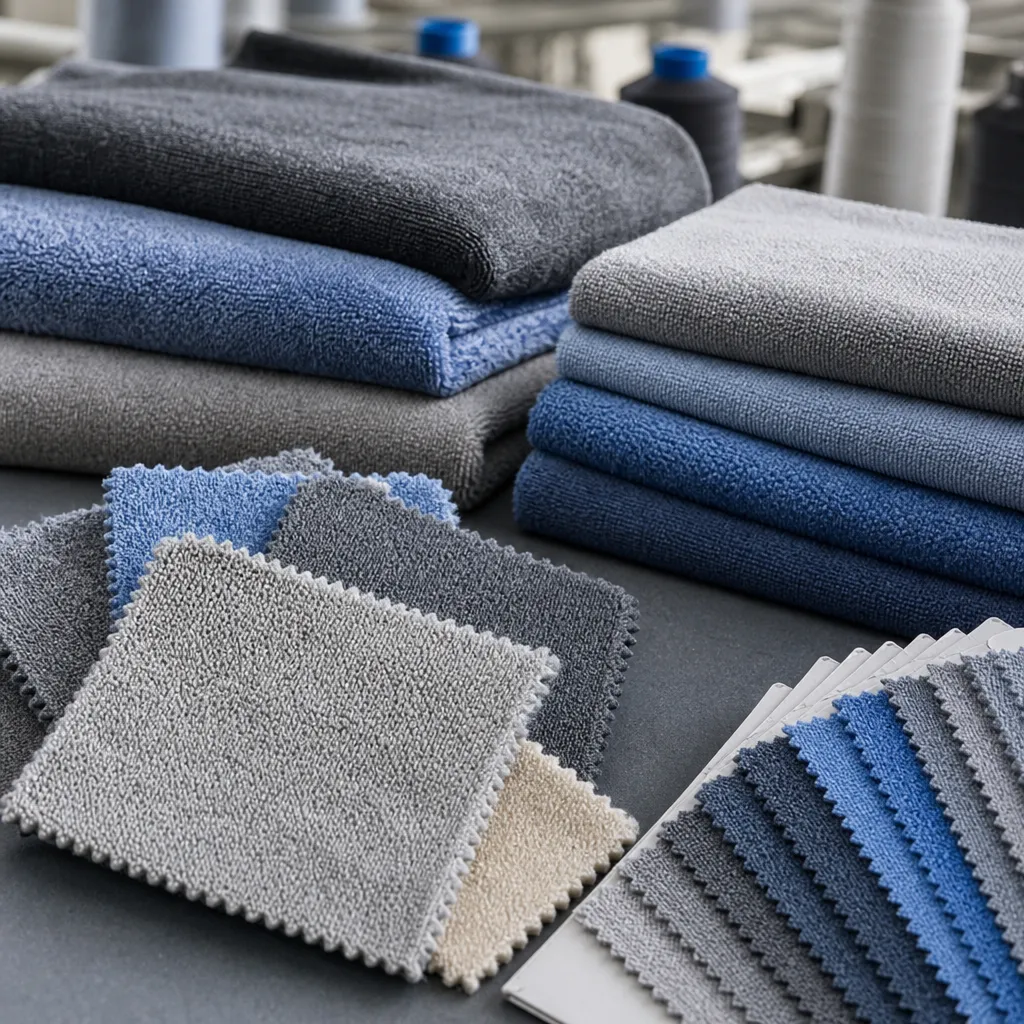
Why Buyers Benchmark AutoZone Microfiber Towels
Retail packs are useful reference samples because they show what customers already recognize: bright colors, folded bundle presentation, and a low shelf price. For OEM sourcing, however, the retail pack is only a starting point. A towel sold through an auto-parts chain may combine several functions in one pack, while a serious car wash program usually needs separate SKUs for drying, glass, wax removal, interior dusting, and dirty lower-body work.
When buyers ask us to match autozone microfiber towels, we first ask which part of the product they want to match. Is it the 30 cm x 30 cm utility size, the soft hand feel, the color coding, the retail band, or the apparent price? If that question is skipped, the factory may quote a towel that looks similar on a table but behaves differently after 25 wash cycles.
We manufacture for brand owners, detailers, gym suppliers, hotel groups, and promotional distributors. For automotive microfiber, the most important hidden variables are yarn split quality, blend ratio, edge construction, residual lint, and how the towel is packed before ocean freight. These details decide whether a towel wipes clear coat safely or leaves fine fibers on black paint.
| Retail benchmark feature | OEM sourcing question | Factory comment |
|---|---|---|
| Small multi-pack towel | Is one GSM used for all tasks? | One towel can work for light dusting, but drying and wax removal need different pile height. |
| Bright assorted colors | Are colors functional or decorative? | Color coding reduces cross-contamination between wheels, paint, glass, and interior. |
| Low shelf price | What is the cost per usable wash? | A low first price can become expensive if edge fray or lint appears early. |
| Soft touch in store | Was it tested after laundering? | We test after ISO 6330 wash cycles because new microfiber can feel better than it performs. |
Start With Function, Not Shelf Appearance
A car wash towel spec should begin with the job. A 260 GSM all-purpose microfiber cloth can wipe dashboards and door jambs, but it will not absorb like a 520 GSM twisted-loop drying towel. A plush 450 GSM buffing towel may feel safe on paint, but it can drag too much on glass and leave moisture streaks.
For OEM programs, we normally split automotive towels into at least three use groups. This avoids overbuilding every SKU and helps the buyer control margin. It also gives the end customer a clearer usage instruction, which reduces complaints.
- Utility and interior: 240-320 GSM, 80/20 polyester-polyamide, short pile, overlock or ultrasonic edge, usually 30 x 30 cm or 40 x 40 cm.
- Paint buffing and wax removal: 330-450 GSM, 70/30 or high-split 80/20 blend, edgeless or soft satin edge, commonly 40 x 40 cm.
- Drying and rinseless wash: 480-760 GSM, twisted loop or dual-pile construction, high absorption, often 40 x 60 cm, 50 x 80 cm, or 60 x 90 cm.
For car wash microfiber towels sold in retail packs, one blended utility spec may be acceptable. For a detailing brand, we recommend at least two constructions: one shorter pile for wiping and one deeper pile for paint-safe buffing. If drying is part of the line, it should be a separate towel, not just a larger version of the utility cloth.
Construction Details That Change Performance
Microfiber quality is not only a GSM number. Two 350 GSM towels can perform very differently if one uses a better split filament and a cleaner finishing process. Automotive towels are made from conjugate filaments, usually polyester with polyamide. During dyeing and finishing, the filament is split into wedge-like microfibers. Better splitting increases capillary channels, which improves water pick-up and soil capture.
The blend also matters. An 80/20 polyester-polyamide towel is cost-efficient and strong. A 70/30 blend generally feels softer and absorbs faster because polyamide holds more moisture, but it costs more and can have slightly higher color sensitivity in deep shades. We use 70/30 for paint-contact SKUs where the buyer wants a softer hand; we use 80/20 for utility cloths where durability and price are more important.
| Construction | Typical GSM | Best use | Risk if misused |
|---|---|---|---|
| Short-pile warp knit microfiber | 240-320 GSM | Interior, trim, light cleaning | Can feel too thin for paint buffing. |
| Plush dual-pile microfiber | 340-460 GSM | Wax removal, polish wipe, paint touch-up | Long pile may trap grit if washing instructions are poor. |
| Twisted-loop microfiber | 500-760 GSM | Drying towel, rinseless wash | Overpriced for basic dashboard cleaning. |
| Suede microfiber | 180-240 GSM | Glass, screens, delicate instrument panels | Low absorption for exterior drying. |
A common defect in automotive microfiber is hard-edge scratching. The fabric face may be safe, but a nylon overlock thread, rough label corner, or melted cut edge can create fine marks on soft paint. For edgeless microfiber towels, we check the cut line under light tension. If the cutter temperature is too high, the edge becomes glossy and stiff. That stiffness is small by hand feel, but it matters when the towel is used repeatedly on black panels.
Edge, Label, and Color Decisions
Edge construction looks like a minor design choice until the first warranty claim. A buyer may request the cheapest overlock edge because the towel is small, but automotive use is different from kitchen cleaning. The edge touches clear coat, mirrors, piano-black trim, and tinted surfaces.
- Overlock edge: lowest cost and durable for utility cloths, but the thread must be soft polyester and the stitch density should be even.
- Satin or suede binding: cleaner retail look, suitable for mid-range detailing towels, but adds sewing cost and can pucker if fabric shrinkage is not controlled.
- Edgeless ultrasonic cut: good for paint-contact towels, but the cut must not harden. We inspect the edge after tumble drying.
- No woven side label: preferred for paint-safe SKUs. Use printed care labels on the header card or removable sticker instead.
Color coding is also practical. We often produce blue for glass, yellow for interior, green for wax removal, and dark gray for wheels or lower panels. Dark towels hide soil but can show more dye migration risk if the dyestuff is not fixed well. For saturated black, red, or navy microfiber, we run rubbing and wash-fastness checks before bulk cutting.
For buyers building a retail line around microfiber cloths for cars, we suggest keeping one color per function rather than six random colors in a pack. Random assortments sell on shelf, but functional color coding drives repeat purchase because users learn the system.
Testing We Use Before Bulk Cutting
We do not approve automotive microfiber only by touching the sample. Hand feel is subjective and often changes after the first wash. Our sample room tests lint, absorbency, colorfastness, dimensional change, edge behavior, and packaging compression. For a new OEM program, we keep a sealed approved sample and a washed control sample beside the production card.
Topic-specific testing is especially important for detailing towels because the failure modes are visible: lint on glass, streaking after wax removal, edge fuzz after drying, and dye transfer onto light seats. These problems may not appear in a quick visual inspection at the packing table.
| Test or check | Method we reference | Target we usually set |
|---|---|---|
| Dimensional change after washing | ISO 6330 wash procedure with line or tumble dry condition agreed in spec | Within ±5% for utility cloths; tighter for packaged sets with exact fold size. |
| Colorfastness to rubbing | ISO 105-X12 dry and wet rubbing | Grade 4 dry minimum; wet grade depends on shade and use case. |
| Accelerated laundering colorfastness | AATCC 61, selected condition by shade | No obvious staining on adjacent fabric for mixed-color retail packs. |
| Lint release check | Black glass panel wipe plus tape pull inspection | No visible fiber trail after three dry passes on cleaned glass. |
| Edge abrasion observation | Internal 200-cycle edge rub on painted test panel | No hardened bead, broken thread, or sharp label corner. |
Absorbency is checked by a drop test and by weight gain after immersion and spin extraction. For a 40 x 40 cm 400 GSM plush towel, theoretical fabric weight is about 64 g before edge and label. In practice, the finished towel may be 68-74 g depending on binding and moisture regain. If a supplier quotes a 400 GSM towel but the finished piece weighs only 55 g, either the GSM, size, or cutting allowance is not what was promised.
Price Bands for OEM Car Wash Towels
Retail comparison can distort price expectations. A store pack includes importer margin, distribution, shelf space, and local retail overhead. Factory pricing is built differently: yarn, knitting, dyeing, splitting, cutting, sewing, inspection, packaging, carton volume, and inland transport to port. For microfiber, dyeing and finishing are a larger share than many buyers expect because split quality and softening affect performance.
Below are realistic FOB China bands we see for private-label microfiber car towel programs. These are not quotes for autozone microfiber towels or any specific retailer product. They are OEM reference ranges for buyers ordering from the mill with artwork, packaging, and QC requirements clearly defined.
| OEM item | 500-1,999 pcs | 2,000-9,999 pcs | 10,000+ pcs | Notes |
|---|---|---|---|---|
| 30 x 30 cm utility, 280 GSM, 80/20 | USD 0.42-0.58 | USD 0.34-0.48 | USD 0.29-0.40 | Best for interior kits and giveaway bundles. |
| 40 x 40 cm plush, 380 GSM, 80/20 or 70/30 | USD 0.86-1.18 | USD 0.72-0.98 | USD 0.62-0.84 | Edge choice changes price by 5-14 cents. |
| 40 x 60 cm dual-pile, 450 GSM, 70/30 | USD 1.45-1.95 | USD 1.24-1.66 | USD 1.08-1.42 | Good mid-range detailing towel. |
| 50 x 80 cm twisted-loop drying, 620 GSM | USD 3.35-4.45 | USD 2.86-3.72 | USD 2.48-3.18 | Higher carton volume affects freight cost. |
| 3-piece retail pack with belly band | USD 1.58-2.25 | USD 1.32-1.88 | USD 1.15-1.55 | Packaging depends on paper weight, barcode, and hang hole. |
Our MOQ is 500 pcs per design per color. For microfiber sets, we can treat a color-assorted pack as one design if the fabric, size, and decoration are the same, but dyed color minimums still affect cost. If the buyer wants five custom Pantone colors at only 500 pcs total, stock color selection is usually more realistic.
A cost-per-use example is more useful than a cheap quote. Suppose a 40 x 40 cm paint towel costs USD 0.76 FOB at 5,000 pcs and remains saleable for 45 home wash cycles. The towel cost is 1.7 cents per wash before freight and duty. If a lighter USD 0.53 towel starts shedding after 18 cycles, its towel cost is 2.9 cents per wash and the brand absorbs more complaints. That is why we push back when a buyer asks us to remove GSM and edge quality at the same time.
Packaging for Retail and Detailer Channels
The same towel can be packed for different channels. A detailer may prefer bulk polybags of 50 pcs because the towels are opened immediately. A retail pack needs a hangable header, barcode, washing icons, and a clean fold. An e-commerce bundle needs compression control so the towel does not arrive with deep fold lines and a crushed face pile.
- Confirm whether the pack is for shelf, online fulfillment, subscription kit, or professional refill.
- Decide the fold size before artwork is drawn. Changing fold after printing the belly band causes misalignment.
- Keep printed paper away from damp dyed microfiber during packing; ink transfer can happen if cartons sit in humid storage.
- Specify carton count by weight and compression, not only by piece count. High-GSM towels packed too tightly lose loft temporarily.
- Add a care card if the towel is paint-contact: no fabric softener, no bleach, wash separately by soil level, and low-heat dry.
For a three-piece 40 x 40 cm towel pack, we often use a 300-350 gsm paper belly band with matte coating, one UPC/EAN barcode, and a suffocation-warning polybag only when the sales channel requires sealed packaging. For club or detailer refills, we avoid unnecessary retail paper and use master polybags inside export cartons.
Compliance, Audit, and Lead Time
LUMA & CO. TEXTILE has operated since 2007 with about 220 employees in our towel mill. We supply more than 80 brand clients across 47 countries, with annual towel output around 2.4 million pieces. Our factory certifications include OEKO-TEX Standard 100 Class I, BSCI audit participation, and ISO 9001 quality management. For automotive towels, OEKO-TEX is not always legally required, but it is useful when the product is handled by households, packed with other consumer goods, or sold through retailers with chemical compliance rules.
A normal OEM microfiber program takes 32-48 days after sample approval and deposit. The range depends on custom dyeing, packaging artwork, and whether the towel uses stock greige fabric. Air samples can move fast, but bulk dyeing and finishing cannot be rushed without increasing shade or hand-feel variation.
- Spec confirmation: 2-4 days for size, GSM, blend, edge, packing, and target price alignment.
- Lab dip or stock color selection: 4-7 days for custom color; 1-2 days if using available colors.
- Pre-production sample: 6-10 days depending on edge, label, and retail packaging mockup.
- Bulk knitting, dyeing, finishing, and cutting: 18-28 days for most microfiber towel orders.
- Final inspection and export packing: 2-4 days, including AQL inspection and carton marking.
For quality inspection, we normally use an AQL plan based on ISO 2859-1. Automotive towel defects are classified differently from hotel towel defects. A tiny shade variation may be acceptable in a garage utility pack, while a rough edge on a paint towel is a more serious defect. We define this in the QC checklist before production, not during final inspection.
How to Send a Spec We Can Quote Accurately
If your reference is autozone microfiber towels, send the unopened retail pack plus one washed towel if possible. Photos help, but they do not show edge hardness, pile density, or lint behavior. We also ask buyers to tell us whether the product should be a retail replacement, a better-performing detailing towel, or a lower-cost promotional item.
A complete tech pack lets us quote without padding the price for unknowns. If you do not have a tech pack, start with the usage and target channel. Our merchandising team can translate that into fabric, size, edge, and packaging options.
- Size in cm or inches, with tolerance. For example, 40 x 40 cm ±1 cm after wash.
- Target GSM and construction: short pile, plush, dual-pile, suede, or twisted loop.
- Blend requirement: 80/20 or 70/30 polyester-polyamide, or open to our recommendation.
- Edge type: overlock, satin binding, suede binding, or edgeless ultrasonic cut.
- Color plan: stock color, Pantone target, or functional color coding by use.
- Packaging: bulk polybag, belly band, header card, boxed kit, or e-commerce mailer insert.
- Testing expectations: lint check, ISO 6330 wash, ISO 105-X12 rubbing, AATCC 61 colorfastness, or retailer-specific protocol.
Related reads: for construction choices beyond microfiber, see microfiber vs cotton towel comparison. If you are building a full automotive program, our auto-detailing microfiber towel program explains SKU planning. For bulk microfiber sourcing basics, review custom microfiber towels wholesale guide.
Related reads: if your team is still preparing artwork and specs, use build towel tech pack that mills can quote. For decoration choices across towel types, see embroidery vs sublimation vs jacquard. For freight planning, compare options in container vs air freight towel orders.
What We Would Not Copy Blindly
Retail packs are engineered for a shelf position and a consumer price point. That does not make them wrong, but it means the spec may not match your brand promise. If your product page says lint-free paint towel, do not copy a general-purpose cloth just because it is available in a familiar store pack. If your line targets mobile detailers, do not overpack each towel in retail paper that will be removed and discarded in the van.
We also avoid copying trademarked packaging, brand color systems, or retailer-specific claims. The safer approach is to benchmark the physical towel, define the performance you want, and build your own private-label specification. That gives you a product your team can control across repeat orders.
For buyers comparing autozone microfiber towels with OEM supply, the best outcome is rarely a perfect clone. A better spec might be a 320 GSM utility cloth with stronger wash durability, a 420 GSM edgeless paint towel with lower lint, or a 650 GSM twisted-loop dryer sold as a separate SKU. The right answer depends on how the towel will be used and how many washes your customer expects.
Build a Car Towel Spec With Us
Send your retail benchmark, target GSM, quantity, and packaging idea. We quote OEM microfiber towels from 500 pcs per design per color, with OEKO-TEX 100 Class I, BSCI, ISO 9001 controls, and production timing usually 32-48 days after approval. WhatsApp: +86 13384590853. Email: [email protected].
Request a microfiber towel quote →