Start With the Chemical Risk, Not the Logo
Salon towels fail for different reasons than hotel towels. A hotel bath towel mainly fights detergent, tumble heat, and guest misuse. A salon towel may meet sodium hypochlorite from disinfectant, hydrogen peroxide from developer, ammonium persulfate from lightener, oxidative hair dye, toner, and occasional residue from color bowls. If the base towel is not built for that chemical environment, MOQ negotiation only delays the complaint.
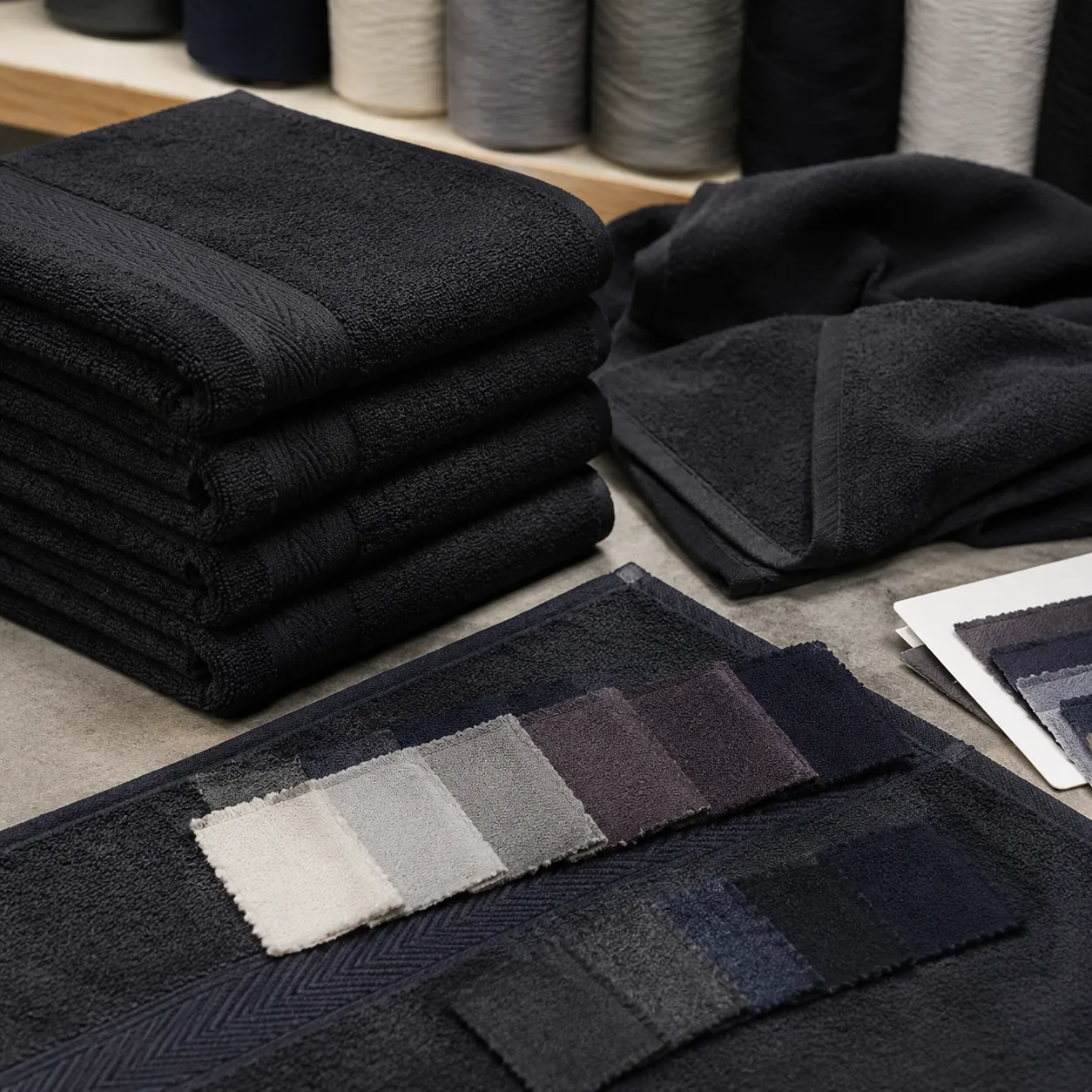
For dark salon towels, we normally separate three levels of risk. Level one is general wash durability: ISO 105-C06 or AATCC 61 accelerated laundering, usually 40°C or 50°C depending on the buyer’s laundry process. Level two is controlled chlorine contact: our internal spot test uses a 1:10 dilution of common 5% sodium hypochlorite bleach, 10 minutes contact time, then neutralizing rinse and shade check after drying. Level three is salon reality testing: peroxide developer at 6% or 9%, applied for 15 minutes on the pile face. No textile should be called fully bleach proof without defining which chemical, concentration, contact time, and pass limit are used.
| Salon exposure | Typical chemistry | What we test | Buying implication |
|---|---|---|---|
| Disinfecting splash | Diluted sodium hypochlorite | 1:10 dilution, 10 minutes, ΔE target under 2.5 on black or charcoal | Vat dye or selected bleach-resistant dye route is needed |
| Developer contact | 6% or 9% hydrogen peroxide | 15 minutes pile-face exposure, rinse, dry, compare to control swatch | Avoid bright fashion shades if towel is used near color service |
| Laundry oxidation | Oxygen bleach, alkali detergent | ISO 105-C06 wash cycle and shade change assessment | Confirm laundry recipe before approving bulk |
| Color bowl wipe | Oxidative dye plus metal salts | Manual stain and rinse check on sample towels | Black hides stains better, but lint and pile abrasion still matter |
This is why a very low MOQ request for five dark shades is risky. Each color needs its own dye validation. If a buyer wants black, charcoal, espresso, navy, and burgundy at 300 pieces each, the lab cost and dye-kettle setup become a larger share of the order than the towel itself. We can sometimes support small splits, but the chemical test plan must be simplified first.
Salon Bleach Resistant Towel MOQ Negotiation Guide
Our formal MOQ is 500 pieces per design and per color. For salon programs, the practical negotiation starts by deciding what counts as a design. If the base towel is identical and only the embroidery name changes, we can often group the greige towel planning and dyeing together. If the towel size, GSM, border, shade, or yarn route changes, it becomes a new production setup.
The easiest MOQ win is to hold the towel body constant and vary only the decoration. A 40 × 70 cm black hand towel at 430 GSM with one dobby border is much easier to split into three salon-location embroidery files than three different towel bodies. The harder request is 300 black face towels, 300 charcoal hand towels, and 300 navy shoulder towels, each with different labels and different carton marks. That is not one MOQ discussion; it is three production discussions.
- Flexible: embroidery text, thread color, carton sticker, hangtag language, polybag sticker, barcode label.
- Sometimes flexible: size split inside one color if the yarn, GSM, border, and dye bath can be planned together.
- Not very flexible: separate dark shades, separate GSMs, yarn changes, jacquard borders, and towel bodies requiring new weaving setup.
- High-risk at low quantity: black plus fashion colors marketed as bleach resistant without individual chemical testing.
A buyer can reduce cash outlay without pushing the mill into poor setup economics by ordering fewer variants instead of asking for a lower unit price on too many variants. For example, a 1,200-piece launch can be stable if it is 900 black towels and 300 white facial towels. The same 1,200 pieces spread across six dark colors usually costs more, takes longer, and creates shade-approval risk.
The MOQ Levers We Can Actually Move
We do not treat MOQ as a punishment. It reflects dye bath yield, loom setup, sewing-line changeover, label handling, and QC sampling. Our towel production is built around repeatable lots, so the best negotiation is to reduce the number of changeovers rather than ask the factory to absorb them.
| Lever | Buyer request | Factory response | Trade-off |
|---|---|---|---|
| Shared base towel | One black towel body, multiple salon names | Usually workable from 500 pcs total if embroidery files are simple | Decoration unit cost rises slightly on very small logo batches |
| Color consolidation | Replace three dark shades with black and charcoal | Improves dye-lot control and test efficiency | Less retail variety, better reorder reliability |
| Staged release | First PO covers core SKU, second PO adds accent shade | Reduces launch risk and avoids dead stock | Second shade may have separate lead time |
| Stock yarn and standard border | Use existing towel construction | Can reduce sampling days and setup cost | Less freedom on border width and pile style |
| One carton plan | Same inner pack and master carton across sites | Keeps packing line efficient | Location sorting moves to barcode or carton label |
For a multi-location salon chain, we usually recommend one master towel spec and location-specific decoration only where guests can see it. Back-of-house color towels used for dye service do not need six different logos. Put the budget into colorfastness, lint control, and reorder consistency.
Choose the Towel Body Before Negotiating Color Splits
Bleach-resistant salon towels are usually smaller and denser than hospitality bath towels. The hand feel needs to be firm enough for repeated wiping, not overly plush. If the loops are too long, the towel snags on salon carts and rough manicure edges. If the GSM is too low, the towel curls after tumble drying and looks tired on the styling station.
| Use case | Common size | Recommended GSM | Construction note |
|---|---|---|---|
| Color service towel | 40 × 70 cm | 380-460 GSM | Short-to-medium loop, darker shade, reinforced hem |
| Shampoo station towel | 35 × 75 cm or 40 × 80 cm | 420-500 GSM | Softer pile, good absorbency, avoid oversized border |
| Facial or neck towel | 30 × 30 cm or 32 × 32 cm | 360-430 GSM | Low lint, compact edge, suitable for warmer use |
| Cape shoulder towel | 50 × 90 cm | 400-480 GSM | Stable rectangular shape after wash, no heavy embroidery near neck |
Our usual salon construction is ring-spun cotton or cotton-rich pile with a tight ground weave. For black and charcoal, vat dye gives stronger chlorine resistance than normal reactive dye, but it is not magic. Undiluted bleach can still leave marks, especially if it sits under a warm towel or dries on the fabric. For buyers comparing cotton and microfiber in wet stations, the absorbency and heat feel are different; our microfiber vs cotton towel comparison explains the trade-off in more detail.
We also check hem torque after wash. A towel that passes shade testing but twists 3-4 cm out of square after five laundry cycles will cause folding problems. For salon clients, we prefer double-stitched long hems and compact end hems, because towels are handled quickly by staff and often pulled from baskets rather than folded carefully like hotel linen.
Dye Route, Shade Approval, and What “Bleach Resistant” Means
The phrase bleach resistant needs a written definition on the purchase order. We are comfortable using it when the test conditions are named and the pass limit is agreed. We are not comfortable printing it on a care label as if the towel can survive any salon chemical at any concentration.
- Approve a lab dip or yarn-dyed reference under D65 and TL84 light, not only phone photos.
- Run a wash check using the buyer’s detergent type when possible, especially if oxygen bleach is used.
- Run a controlled chlorine or peroxide spot test on the approved color before bulk dyeing.
- Confirm the acceptable shade change limit, normally visual grade 4 or better, or ΔE under 2.5 for dark service towels.
- Keep one sealed approval sample at the mill and one with the buyer for bulk comparison.
Two defect modes are common in salon orders. The first is halo fading: a pale ring around a chemical splash where the center looks less damaged than the edge. This happens when liquid wicks through the pile before reacting. The second is uneven tip fading, where the loop tips become brownish or reddish while the base remains dark. Tip fading is more visible on high-pile towels, which is one reason we avoid overly lofty constructions for color-service use.
For color matching, Pantone references are useful for branding but not enough for towel dye approval. Textile shade should be approved against a physical swatch. Buyers who need a strict brand color can use our Pantone color matching custom towels guide, but for salon chemical resistance we often steer them toward black, charcoal, warm grey, or white rather than unstable fashion tones.
Pricing Bands by Volume and Variant Count
MOQ negotiation should be tied to total landed usefulness, not only first unit price. A towel that costs USD 1.26 but is pulled from service after 28 washes costs about 4.5 cents per use before laundry. A better black salon towel at USD 1.74 lasting 72 washes costs about 2.4 cents per use. Those figures change by size and laundry process, but the pattern is consistent: very cheap towels are expensive when staff discard them early.
| Order structure | Typical FOB unit price | Best fit | Notes |
|---|---|---|---|
| 500-799 pcs, one color, one size | USD 1.48-2.05 | Pilot salon, boutique chain, sample-market launch | Decoration and testing cost carry more weight |
| 800-1,499 pcs, one or two decoration files | USD 1.32-1.86 | Regional salon group | Good balance for black towels with location embroidery |
| 1,500-3,999 pcs, one base towel | USD 1.12-1.58 | Multi-location reorder program | More efficient dye lot and carton planning |
| 4,000+ pcs, planned replenishment | USD 0.96-1.38 | Distributor or national chain | Best pricing when sizes and labels stay stable |
These bands assume common salon hand-towel sizes around 35 × 75 cm to 40 × 80 cm at 380-500 GSM, FOB China, with standard woven label or modest embroidery. Larger shoulder towels, dense 520 GSM constructions, jacquard borders, or individual retail packaging move the price upward. Our certifications include OEKO-TEX Standard 100 Class I, BSCI, and ISO 9001; if the buyer needs documentation attached to a retailer vendor file, we confirm the certificate scope before quoting.
For buyers trying to compare towel costs across product families, the towel GSM decision framework and towel sizes dimensions complete guide are useful references. Salon programs usually sit below hotel bath towel GSM but above most promotional towel constructions.
Sample Approval and Production Calendar
A rushed salon towel program often loses more time after shipment than it saved before production. If staff report fading, linting, or rough feel during the first two weeks of use, the buyer must either accept complaints or replace inventory. We prefer a front-loaded approval process with a small number of clear tests.
- Day 1-2: confirm size, GSM, towel body, shade target, logo file, label, and carton requirement.
- Day 3-7: prepare lab dip or shade reference and check decoration placement on strike-off if needed.
- Day 8-14: make pre-production sample or use close construction sample for wash and chemical checks.
- Day 15-18: buyer reviews physical sample, confirms shade under agreed lighting, and signs off test plan.
- Day 19-42: bulk yarn preparation, dyeing, weaving or greige allocation, sewing, decoration, inspection, and packing.
- Day 43-48: final AQL inspection, carton weighing, export paperwork, and vessel or air booking.
Normal production timing is 35-50 days after sample approval and deposit, depending on dye route and decoration load. Air freight is possible for urgent salon openings, but towels are heavy for their value. For a 1,500-piece hand towel order, air freight can add USD 0.38-0.72 per piece depending on destination and carton density. Sea freight is slower but normally better for planned replenishment; our container vs air freight towel orders article gives the broader logistics math.
If a buyer needs towels for a salon opening date, we recommend approving the plain towel body first and leaving decoration as a controlled second step. Embroidery can be scheduled after base towel QC, but dyeing cannot be fixed late without remaking the goods.
Decoration Choices That Do Not Break the MOQ
Salon towels are handled roughly and washed often, so decoration should be restrained. A large embroidery patch on a 40 × 70 cm towel can make the towel stiff, slow drying, and uncomfortable at the shampoo bowl. It can also trap color residue around the stitch edges.
- Small embroidery: best for front-desk or guest-facing towels, usually 6-9 cm wide on one end.
- Woven label: good for back-of-house towels because it keeps the pile surface clean and reduces stitch cost.
- Dobby border branding: possible at higher volume, but not efficient for a 500-piece trial.
- Printed care label: useful when staff need laundering rules, chemical warnings, or location codes.
- Avoid heavy metallic thread: it can feel scratchy and may react poorly to high-temperature drying.
If the order has several salon names, we ask for embroidery files in DST or high-resolution vector artwork, plus a thread color reference. MOQ becomes easier when all logos use the same stitch height and thread count. A 4,800-stitch logo and a 19,000-stitch crest should not be priced as if they are the same decoration job. For a broader comparison of decoration routes, see embroidery vs sublimation vs jacquard.
A Practical Order Split for a Salon Chain
For a first OEM order, we often propose a split that protects the chemical-service towel while still giving the brand visible identity. Assume a buyer has eight locations and wants 2,400 total towels. Instead of eight fully separate towel SKUs, we would build two functional SKUs.
- SKU A: 1,800 black 40 × 70 cm towels at 430 GSM for color and shampoo service, with woven label only.
- SKU B: 600 charcoal 35 × 75 cm towels at 460 GSM for guest-facing stations, with one shared embroidered logo.
- Pack both SKUs in standard 50-piece inner bundles and master cartons marked by barcode, not by unique printed cartons.
- Hold 60 pieces from the first bulk lot as reorder and complaint-control samples across the eight locations.
This structure keeps the dye plan simple and puts decoration where it matters. It also makes replenishment cleaner: if color-service towels wear out faster, the buyer can reorder only SKU A without reopening artwork, label, and carton discussions. That is a better MOQ strategy than forcing every branch into its own custom SKU.
Related reads: Buyers building a full salon linen program should also review salon towels wholesale bleach proof, build towel tech pack that mills can quote, and negotiate towel MOQ without killing margin. For barber or hot-towel service, hot shave towels barber shop OEM covers warmer fit, size, and heat handling.
What to Put in the RFQ
A clean RFQ lets us quote faster and push back only where the spec creates real risk. If the RFQ says “black bleach proof towels, best price,” every serious factory has to ask follow-up questions. If it names the size, GSM, dye expectation, test conditions, decoration, and packing, we can usually return a useful quote within 2-3 working days.
- Towel size and tolerance, for example 40 × 70 cm with ±3% after wash.
- Target GSM range, such as 420-460 GSM rather than one unrealistic exact number.
- Color requirement and chemical test expectation, including bleach or peroxide concentration.
- Decoration file, logo size, placement, thread color, and whether each location needs a separate name.
- Packing method, carton mark, barcode needs, and destination port or delivery country.
- Certification requirement, such as OEKO-TEX Standard 100 Class I, BSCI, or ISO 9001 documentation.
Our MOQ remains 500 pieces per design and per color, but good specification gives us room to combine work intelligently. LUMA & CO. TEXTILE has produced custom towels since 2007, with 220 employees, about 2.4 million towels per year, and brand clients across 47 countries. For salon buyers, our job is not to promise impossible chemical resistance; it is to define the service condition clearly and manufacture a towel that survives that condition at a sensible cost per use.
Build a Salon Towel MOQ Plan
Send your size, GSM target, color, chemical exposure, logo files, and expected quantity. We will advise where MOQ can be combined and where separate testing is required. WhatsApp: +86 13205717266. Email: [email protected].
Request a Quote →