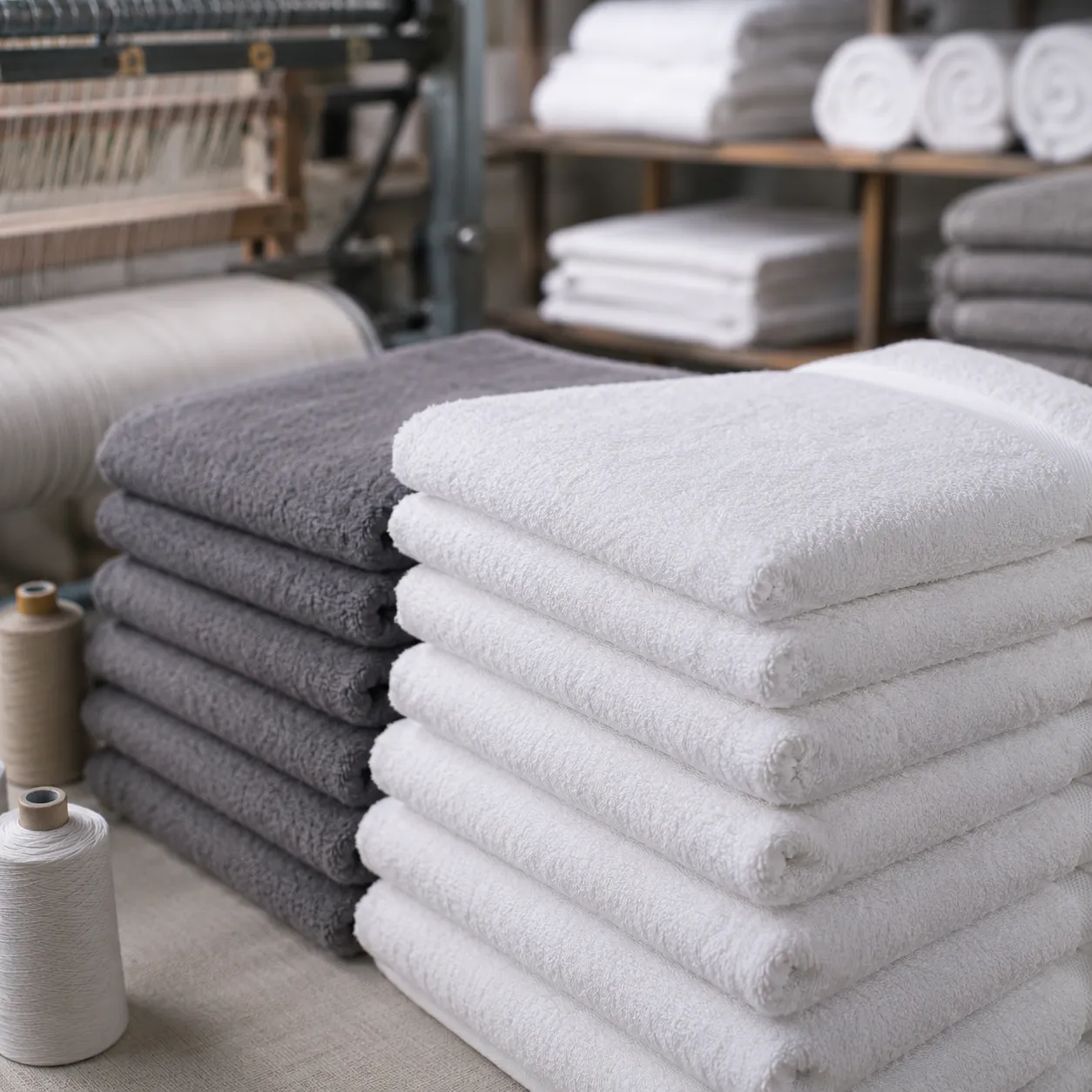
Start With the Circulation Problem, Not the Towel
Resort fitness towels move differently from bath towels. A guest may take one towel at the treadmill, another near the water station, and a third to the spa or pool deck. If the towel looks like a small hand towel, housekeeping may also use it for room touch-ups. That crossover is where most reorder plans fail.
When we quote resort fitness towels, we ask for three numbers before discussing yarn or GSM: average occupied rooms, expected gym visits per occupied room, and laundry return interval. These numbers decide whether the property needs 3.5 par or 7 par. GSM only matters after the circulation math is honest.
For a 180-room resort running 78% average occupancy, a fitness towel program can consume 190-260 towel uses per day during high season if the gym, spa reception, and pool staff all pull from the same cage. If the laundry turns product every 36 hours and a 12% buffer is kept for banquet weekends or sports groups, the starting inventory is often 900-1,250 pieces, not the 400 pieces that look sufficient on a spreadsheet.
- Count uses per day, not only room count. Fitness towels often turn faster than bath mats.
- Separate gym-only stock from spa and pool stock if shrinkage is hard to trace.
- Record damaged, missing, and downgraded towels as different causes. They require different fixes.
- Plan the first reorder before the first order ships if the resort opening date is fixed.
Gym Towel Durability Resort Reorder Plan: Practical Inputs
A gym towel durability resort reorder plan needs a simple operating model that housekeeping can update every month. We do not recommend using a fixed annual replacement percentage unless the property has stable occupancy and one controlled laundry route. Resorts rarely do.
For hotel gym towels, the reorder trigger should combine three inputs: remaining usable pieces, projected wash cycles before the next shipment lands, and real loss rate. The second input is often ignored. If a towel has already seen 95 commercial wash cycles and the next shipment takes 55 days to produce and move by sea, the property may burn through the acceptable appearance life before replenishment arrives.
| Planning input | How to measure it | Typical resort range | Why it matters |
|---|---|---|---|
| Daily towel uses | Manual count at gym return bin plus clean issue count | 0.8-1.6 uses per occupied room | Sets the true par level |
| Laundry cycle time | Hours from soiled pickup to clean shelf | 24-48 hours | Longer cycle needs more stock |
| Monthly loss rate | Missing pieces divided by opening stock | 2.5%-6.5% | Separates theft or misrouting from wear |
| Downgrade rate | Pieces removed for stains, frayed hems, gray cast | 1.0%-4.0% per month | Shows durability and laundry chemistry issues |
| Lead time cover | Days from approved PO to resort storeroom | 38-72 days by sea | Defines reorder trigger point |
The table is not meant to replace site data. It gives a resort buyer a starting frame before the first three months of usage history exists. After 90 days, the property should replace assumptions with its own issue and return counts.
What We Specify for Resort Fitness Towels
For a resort fitness room, the towel must absorb sweat quickly, dry within the laundry schedule, and survive repeated folding without the hem curling. A bath towel construction is usually too heavy. A promotional rally towel construction is usually too thin. The middle ground is a compact terry towel with enough pile to feel useful but not so much weight that drying cost climbs.
Our usual starting point is 100% cotton, ring-spun or combed ring-spun yarn, 380-480 GSM. Size depends on how the towel is used. A 30 x 70 cm piece works for treadmill consoles and face use. A 35 x 80 cm piece feels more comfortable in resort gyms and wellness studios. For yoga or stretch areas, 40 x 90 cm gives better coverage but increases laundry weight by roughly 24%-32% versus 35 x 80 cm at the same GSM.
| Use area | Recommended size | GSM range | Construction note | Common defect to watch |
|---|---|---|---|---|
| Cardio machines | 30 x 70 cm | 380-430 GSM | Short-to-medium pile terry with locked hem | Loop snags from treadmill edges |
| Resort fitness room general issue | 35 x 80 cm | 400-460 GSM | Ring-spun cotton, 16/1 or 21/2 yarn depending hand feel | Hem twist after high-heat drying |
| Spa-gym crossover | 40 x 80 cm | 430-500 GSM | Combed cotton if the towel touches face or treatment areas | Oil stains from massage rooms |
| Yoga/stretch corner | 40 x 90 cm | 420-480 GSM | Lower pile density helps faster drying | Corner curling after repeated folding |
| Pool-adjacent gym | 35 x 80 cm | 430-480 GSM | Vat-dyed dark shades or clean white with controlled chemistry | Chlorine splash marks and yellowing |
Two construction details matter more than buyers expect. First, the hem should be tight enough to stay flat but not so dense that it becomes a hard ridge after drying. We normally target 10-12 stitches per inch on gym towel hems. Second, the ground weave must hold pile yarn securely. Loose terry loops feel soft in the sample room but can pull after contact with locker hooks, zippers, or resistance band clips.
Wash-Life Testing Before You Approve Bulk
Wash-life claims need boundaries. We do not tell a resort that a towel will survive a fixed number of washes under every laundry system. Water hardness, alkali level, chlorine exposure, dryer temperature, and staff sorting all change the result. What we can do is test a defined sample against a defined method and use that data to set a realistic replacement cycle.
For resort fitness towels, we commonly run pre-production or bulk-retention checks using ISO 6330 washing procedures for dimensional stability, ISO 105-C06 for color fastness to domestic and commercial laundering conditions, and ISO 105-X12 for rubbing fastness when dark shades are used. For absorbency, we use an internal drop test alongside a simple sink-rate observation because sweat towels must take moisture quickly, not only look thick.
- Wash five sample towels for 10 cycles at the agreed temperature and chemistry profile.
- Measure length, width, weight, and appearance after drying. Record shrinkage separately from pile compression.
- Check hem waviness on a flat table. A towel can pass size tolerance but still fold poorly.
- Rub-test logo areas if embroidery or woven labels are included.
- Approve the bulk only after the buyer signs both the unwashed and washed reference sample.
A practical approval target for a 35 x 80 cm, 430 GSM white cotton gym towel is under 5% length shrinkage after controlled washing, no open hem seam, no obvious pile shedding after the first two cycles, and absorbency that stabilizes after desizing. If the towel is dyed charcoal, navy, or forest green, we add color fastness review because dark towels often hide stains but create lint and crocking complaints if dyeing is rushed.
Cost-Per-Use Without Pretending Laundry Is Free
Unit price matters, but resort buyers should not compare two towels only by FOB cost. Laundry weight, expected downgrade rate, and replacement timing can reverse the decision. A lighter towel may be cheaper to buy and dry, but if it downgrades after 70 washes instead of 115, the storeroom buys more pieces and staff spends more time sorting rejects.
Here is one realistic costing frame we use during planning. It is not a universal guarantee; it assumes a controlled commercial laundry, no heavy bleach misuse, and a resort that separates gym towels from pool towels. It also excludes local import duty and inland delivery, which vary by country.
| Spec option | Estimated FOB price at 1,500 pcs | Planning wash life | Approx. towel weight | Purchase cost per planned use | Operational comment |
|---|---|---|---|---|---|
| 30 x 70 cm, 380 GSM cotton | USD 1.42-1.78 | 75-95 cycles | 80-90 g | USD 0.015-0.024 | Good for budget cardio stations, less guest comfort |
| 35 x 80 cm, 430 GSM cotton | USD 2.05-2.58 | 105-135 cycles | 120-135 g | USD 0.015-0.025 | Balanced for resort fitness rooms |
| 40 x 90 cm, 460 GSM combed cotton | USD 3.18-3.92 | 115-145 cycles | 165-185 g | USD 0.022-0.034 | Better guest feel, higher drying load |
| 35 x 80 cm, 450 GSM dyed cotton with logo | USD 2.46-3.15 | 95-125 cycles | 125-140 g | USD 0.020-0.033 | Useful for loss control, requires color testing |
The middle option is not always the right one, but it often gives the best balance for resort fitness towels. If a property loses 5% of stock each month, decoration that identifies the resort may reduce disappearance. If the laundry runs overloaded dryers at high heat, a slightly stronger hem and controlled shrinkage become more important than a softer first touch.
Pricing, MOQ, and Production Timing From Our Mill
Our MOQ is 500 pieces per design per color. Below that level, the cutting, dyeing, labeling, carton setup, and inspection time do not scale down cleanly. For resorts opening one gym plus a small spa, we usually suggest one shared base towel and separate carton labels by department rather than two different specs under MOQ.
The pricing below is for planning only, based on typical 2026 cotton yarn and dyeing costs for OEM resort gym towels. Final quotes depend on yarn count, border design, color, logo method, packaging, exchange rate, and port. We quote in USD, usually FOB Ningbo or Shanghai.
| Order volume | Plain white cotton gym towel | Dyed cotton gym towel | Logo or label add-on | Typical production time after approval |
|---|---|---|---|---|
| 500-999 pcs | USD 2.35-3.10 | USD 2.75-3.55 | USD 0.12-0.45 | 22-30 days |
| 1,000-2,999 pcs | USD 1.95-2.70 | USD 2.32-3.15 | USD 0.09-0.38 | 25-34 days |
| 3,000-7,999 pcs | USD 1.68-2.38 | USD 2.05-2.82 | USD 0.07-0.32 | 30-42 days |
| 8,000+ pcs | USD 1.46-2.12 | USD 1.82-2.55 | USD 0.05-0.26 | 35-48 days |
Sampling normally takes 7-12 days for a plain or labeled towel and 12-18 days when custom dyeing or embroidery approval is needed. Bulk production begins after the signed sample, deposit, artwork, care label content, and carton marks are complete. Sea freight to many destinations adds 18-35 days after vessel departure; air freight can move faster but is rarely economical for heavy cotton unless a resort has an opening emergency.
Reorder Triggers That Housekeeping Can Actually Use
A reorder plan fails if it depends on one procurement manager remembering a date. The trigger should be visible in the linen room. We like a monthly towel count that separates A-grade, B-grade, repairable, and discarded stock. A-grade stays in guest-facing gym service. B-grade may move to staff fitness or back-of-house cleaning only if the resort accepts that downgrade path.
For a resort running 1,100 gym towels in circulation, a sensible trigger may be: reorder when A-grade stock falls below 720 pieces or when projected 60-day demand exceeds available A-grade plus incoming stock. That trigger uses actual service level rather than a calendar guess. If lead time is 60 days and the resort consumes 210 uses per day with a 1.2-day laundry cycle, waiting until shelves look empty is already too late.
- Set a minimum A-grade floor based on daily use, laundry cycle, and high-season buffer.
- Count loss separately from damage so security and laundry fixes are not mixed together.
- Use colored shelf tags for current stock, quarantine stock, and incoming PO quantities.
- Review the trigger every quarter because occupancy and group business change towel demand.
- Keep one approved sample and one washed reference towel in the linen office for comparison.
The phrase gym towel durability resort reorder plan sounds formal, but the working tool can be a one-page sheet. The key is discipline: count the same way each month and use the same downgrade rules. If one supervisor rejects towels for light gray cast and another keeps them in service, the data becomes noise.
Decoration Choices That Affect Loss and Wear
A logo can help reduce towel disappearance, but it can also shorten usable life if placed badly. Dense embroidery on a small gym towel creates a stiff patch, holds moisture, and may pucker after repeated drying. For fitness towels, we usually keep embroidery under 6,000 stitches and place it near one short-end border instead of in the hand-contact center.
Jacquard borders are cleaner for repeated laundering, but they require higher MOQ and more loom setup. Woven labels are cheaper and easy to identify by department, but label corners can lift if the edge sewing is weak. For dark dyed towels, a tonal woven label often performs better than white embroidery because it avoids high-contrast lint and thread discoloration.
- Use small embroidery for executive gyms or spa crossover towels, not high-loss public fitness counters.
- Use woven labels when department sorting matters more than decoration impact.
- Avoid large heat-transfer logos on cotton gym towels because cracking and edge lift can appear after hot drying.
- Choose white towels if the laundry uses strong stain treatment and has good sorting discipline.
- Choose medium dyed shades only after ISO 105-C06 and rubbing fastness review.
Related reads: for logo method trade-offs, compare embroidery, sublimation, and jacquard. For exact size planning, our towel sizes and dimensions guide helps buyers avoid ordering a towel that looks good in a sample photo but feels too small in use.
Compliance and Quality Controls to Put in the PO
For resort groups, compliance documentation should be attached to the purchase order, not chased after shipment. LUMA & CO. TEXTILE operates under ISO 9001 quality management procedures, BSCI social compliance audit systems, and OEKO-TEX Standard 100 Class I certification coverage for applicable towel materials and processes. Buyers should still request the current certificate number and scope for the exact product category.
On inspection, we use AQL sampling based on ISO 2859-1. For gym towel orders, common checkpoints include size tolerance, GSM tolerance, weight per piece, pile contamination, seam security, label placement, carton count, and shade consistency. Gym towels are small, so a 4 g weight difference can be more noticeable than it sounds. It may indicate GSM drift, moisture variation, or cutting inconsistency.
- State the approved size, GSM tolerance, yarn type, color standard, and logo placement in the PO.
- Require a retained pre-production sample and a washed reference sample before bulk release.
- Define carton packout, polybag policy, barcode label, and department mark before packing starts.
- Ask for OEKO-TEX, BSCI, and ISO 9001 documents with the quotation file.
- Reserve final inspection time before the cargo is booked, not after cartons are sealed.
A good PO also names the failure modes that matter to the resort: hem unraveling, excessive lint, shade bleeding, gray cast after laundering, hard hand feel after drying, and logo puckering. If those defects are not written, the factory and buyer may judge the same towel differently.
A 12-Month Reorder Calendar for Resorts
The first year is the hardest because the property is still learning real towel movement. We normally recommend a launch order large enough for opening plus 90 days of operations, then a smaller replenishment once loss and downgrade data are known. This avoids overbuying the wrong spec while still protecting service.
For a resort opening in October, the timeline should work backward from the guest date. Sample approval in July, bulk production in August, shipment in September, and receiving before soft opening is safer than placing the PO after the fitness equipment is installed. If the gym shares towels with spa or pool, add more buffer because internal transfer delays are common during opening weeks.
- Month 0: receive launch stock, count cartons, and photograph approved towel standards.
- Month 1: record daily issue and return counts; do not change the spec yet.
- Month 3: calculate loss, downgrade, and wash appearance trend; place first replenishment if A-grade floor is at risk.
- Month 6: review whether towel size or decoration is causing misuse or disappearance.
- Month 9: approve next high-season reorder using actual occupancy forecast.
- Month 12: update the tech pack and reorder rules before annual contract pricing.
Related reads: if your resort also manages pool inventory, see our beach club resort towel program. For gym-specific failure analysis, why gym towels fail after 50 washes explains linting, hems, and laundry chemistry in more detail. For logistics timing, compare container vs air freight for towel orders.
What We Need to Quote the Program Correctly
The fastest quote is not always the most useful quote. If a buyer sends only “white gym towel, best price,” we can give a range, but we cannot protect the resort from under-ordering or approving a towel that fails the laundry route. A tighter brief lets us price the correct construction and reorder rhythm from the start.
Send the intended size, GSM target, color, logo method, estimated opening stock, monthly occupancy pattern, laundry type, destination port, packaging requirements, and compliance documents needed. If the resort has an existing towel, send one clean piece and one laundered reject. The rejected towel tells us more than the new one: hem twist, pile loss, stains, and gray cast show what the replacement must survive.
Our mill in Gaoyang, Zhejiang has operated since 2007 with around 220 employees, supplying OEM towel programs to more than 80 brand clients across 47 countries. Annual output is about 2.4 million towels. For a gym towel durability resort reorder plan, we can support 500 pcs per design per color MOQ, sample development, bulk production, and reorder tracking documents. Contact us by WhatsApp at +86 13205717266 or email [email protected] with the resort opening date and target towel count.
Build a Resort Gym Towel Reorder File
Send your size, GSM, laundry route, occupancy estimate, and current towel problems. We will return a practical spec, MOQ plan, FOB price band, and lead-time calendar.
Request a Quote →