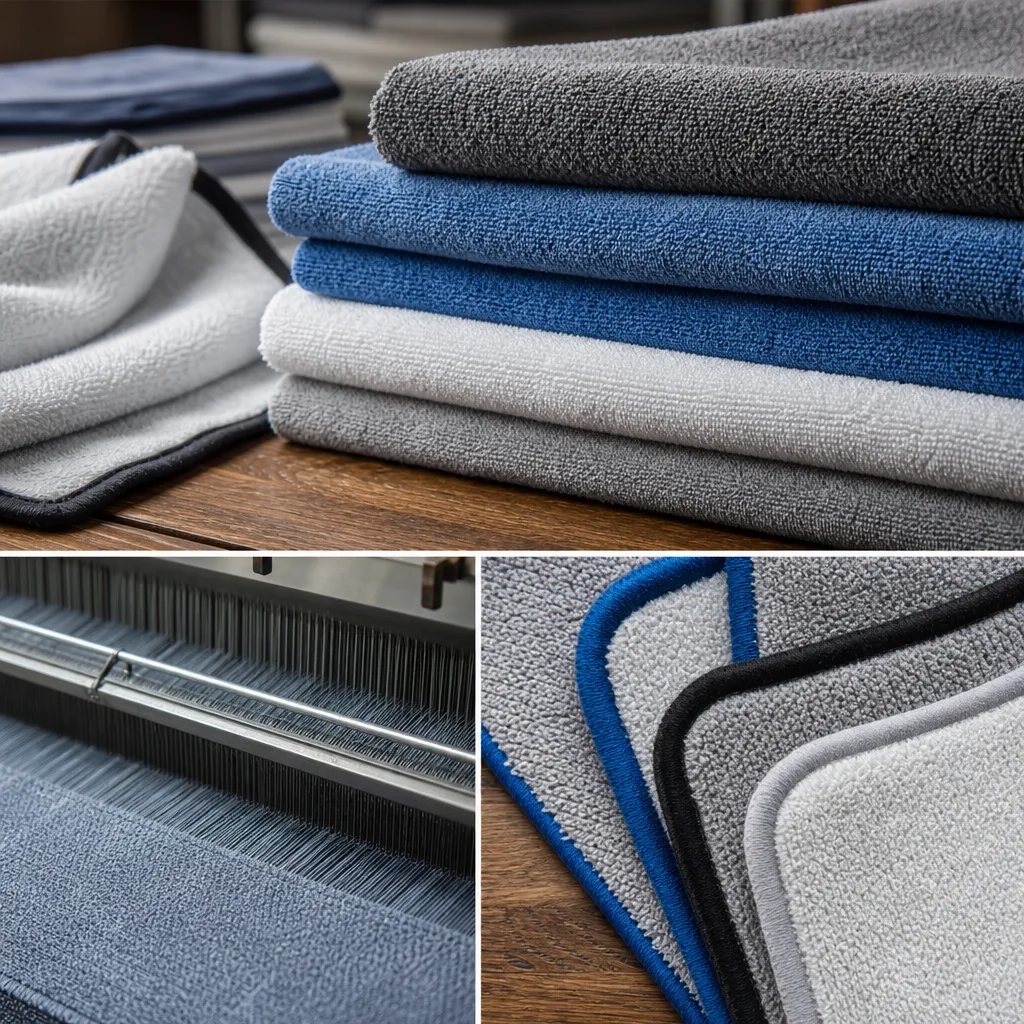
Why the MOQ problem usually starts with too many SKUs
For cleaning textiles, buyers often focus on total quantity and miss the line-level minimum. In our mill, the commercial MOQ is 500 pcs per design per color, but that does not mean every construction can be split endlessly. A 40x40 cm 320 GSM coral fleece towel with overlock edge runs on a different knitting and finishing logic than a 30x30 cm 260 GSM suede weave with laser-cut edgeless finish. If the order is fragmented across too many combinations, the microfiber towels for cleaning MOQ and pricing move in the wrong direction fast.
The main reason is production changeover. Shade matching, loom scheduling, edge finishing setup, logo method, and carton marking all create fixed costs before the first sellable piece comes off line. On microfiber items, even the nap direction check after brushing can add handling time if the buyer wants retail-grade consistency.
- A single-color bulk run at one size usually gives the cleanest FOB number
- Different GSM levels create separate greige planning and dyeing loads
- Edgeless ultrasonic or laser-cut towels cannot be costed like simple overlock items
- Private-label packout in polybag + barcode + insert often matters more than buyers expect
| Program setup | MOQ reality | Factory effect on cost |
|---|---|---|
| 1 size, 1 color, plain towel | 500 pcs | Lowest setup cost |
| 1 size, 4 colors, plain towel | 500 pcs per color | Dye lot splitting raises cost |
| 2 sizes, 4 colors, woven label | 500 pcs per size per color | Separate cutting and packout complexity |
| 3 sizes, 6 colors, 2 edge styles | Often needs MOQ rework | High changeover and slower planning |
The three spec lines that move price more than buyers expect
If we strip away branding language, most custom cleaning orders are priced from three technical choices: fabric construction, edge finish, and packout. GSM matters, but not in isolation. A 300 GSM terry microfiber with hidden-edge binding can cost more than a 340 GSM coral fleece if the sewing time is longer and defect risk is higher.
For commercial cleaning and detailing buyers, the fabric split is usually 80/20 polyester-polyamide or 85/15. The 80/20 blend is softer and absorbs better, but it is also more expensive at yarn stage. Some importers ask for 90/10 to hit a target FOB, but that tends to underperform in glass cleaning and moisture pickup. We usually push back when the end use includes polished surfaces or repeated laundering.
- Fabric construction: coral fleece, warp knit, suede, waffle, or terry microfiber
- Edge finish: overlock, hemmed, covered edge, ultrasonic cut, or edgeless laser cut
- Packout: bulk carton, OPP bag, printed belly band, barcode sticker, PDQ display, or multipack set
| Spec line | Low-cost choice | Mid-range choice | Higher-cost choice |
|---|---|---|---|
| Fabric | 85/15 250-280 GSM warp knit | 80/20 300-330 GSM terry | 80/20 360-420 GSM plush or twist pile |
| Edge | Simple overlock | Folded hem | Edgeless ultrasonic / hidden edge |
| Packout | Bulk export carton | Single polybag + barcode | Retail-ready insert + sticker + assortment |
A practical price band for microfiber towels for cleaning MOQ and pricing
The numbers below are realistic FOB China ranges for custom orders, not spot-market leftovers. We are assuming standard colors, no licensed artwork, standard carton export packing, and OEKO-TEX compliant chemistry. Prices shift with yarn market, but the structure stays fairly stable.
| Typical item | Spec example | 3,000-4,999 pcs | 5,000-9,999 pcs | 10,000+ pcs |
|---|---|---|---|---|
| Utility cleaning cloth | 30x30 cm, 250 GSM, 85/15, overlock | USD 0.31-0.39 | USD 0.27-0.34 | USD 0.23-0.30 |
| General-purpose towel | 40x40 cm, 300 GSM, 80/20, overlock | USD 0.52-0.66 | USD 0.46-0.58 | USD 0.40-0.51 |
| Glass / screen cloth | 35x35 cm, suede microfiber, printed logo | USD 0.41-0.54 | USD 0.36-0.48 | USD 0.32-0.43 |
| Auto / premium cleaning towel | 40x60 cm, 380 GSM, edgeless | USD 1.08-1.34 | USD 0.95-1.19 | USD 0.84-1.06 |
Two caution points. First, a buyer comparing quotes must confirm whether the supplier is pricing by net finished size after washing tolerance or by cut size before sewing. Second, edge finish can move the usable claim rate. On edgeless cloths, we watch fused-edge consistency because poor heat control can create brittle edges that crack after repeated laundering.
Where factories usually set the MOQ by construction
Not every microfiber cleaning program starts at the same minimum. A stock-base item with custom carton mark may be possible at the nominal MOQ. A custom dyed plush towel with embossed wash label and retail assortment may need a higher commercial floor. The honest answer is that MOQ is a capacity and complexity decision, not only a sales decision.
| Construction type | Typical MOQ | Why |
|---|---|---|
| Stock color utility cloth with custom carton mark | 500 pcs per color | Low setup, no custom trim |
| Custom dyed 40x40 cm overlock towel | 1,000 pcs per color | Dye lot and cutting efficiency |
| Printed suede cloth | 1,500 pcs per design | Print setup and registration control |
| Edgeless plush towel with private label pack | 2,000 pcs per color | Finishing yield and retail pack handling |
- If buyers need 8 colors, we often suggest reducing to 4 active colors plus 2 reorder colors
- If buyers need 3 sizes, we often align one fabric base and vary only cutting
- If buyers want low MOQ, removing custom insert cards usually saves more than shaving 20 GSM
- If launch speed matters, using a stocked Pantone-near shade can beat custom dye by a full week
The hidden cost drivers buyers miss on RFQs
An RFQ that says only "microfiber cloth, custom logo, mixed colors" is not quotable with confidence. We can still issue a budget number, but it will be broad because several hidden drivers are missing. On cleaning programs, the biggest one is whether the towel is meant for janitorial use, electronics, glass, car care, or home retail. The same dimensions do not mean the same build.
- Blend ratio changes absorbency and yarn cost
- Finished weight tolerance changes cutting yield and inspection standard
- Color assortment ratio affects dye planning and carton fill efficiency
- Logo method affects both appearance and wash life
- Retail compliance markings can require extra handwork in packout
We also ask whether the buyer wants AQL 2.5 final inspection on appearance and whether there is any wash performance threshold. For serious programs, we recommend at least one internal wash check against dimensional stability and edge integrity. For glass and electronics cloths, a lint check after three wash cycles is more useful than a generic handfeel comment.
Related reads: If your team is still building the RFQ, start with build-towel-tech-pack-that-mills-can-quote.html and custom-microfiber-towels-wholesale-guide.html. For blend trade-offs, microfiber-vs-cotton-towel-comparison.html helps non-technical stakeholders.
What lead time looks like once the PO is actually clean
Most delays in this category are not caused by sewing. They come earlier: color confirmation, logo file cleanup, lab dip approval, and packaging signoff. A buyer who approves all of that quickly can ship much sooner than a buyer who negotiates unit price for a week and then spends twelve days deciding between two barcode layouts.
| Stage | Typical days | What can delay it |
|---|---|---|
| Quote to sample confirmation | 3-6 days | Missing size, GSM, edge, or logo details |
| Counter sample / pre-production sample | 5-9 days | Artwork revision, label sourcing |
| Lab dip or color approval | 3-5 days | Pantone disagreement, dark shade correction |
| Bulk production | 18-28 days | Capacity load, multi-color split, packaging complexity |
| Final inspection and booking | 3-5 days | Carton revision, booking slot changes |
For straightforward bulk microfiber cleaning towels, total production time is commonly 26-38 days after approvals. Retail assortments with inserts, multilingual warnings, or mixed-size displays can move closer to 35-45 days. Air freight is possible for urgent replenishment, but on low-value cloths the freight can exceed the manufacturing delta you fought over.
The failure modes that make a cheap quote expensive later
We see five repeat problems in low-end offers. These are not theoretical. They show up in claims, returns, and disappointing repeat orders.
- Underweight finished towels: supplier quotes 300 GSM target but ships lots averaging closer to 276 GSM
- Hard edge feel: overlock thread and tension too tight, causing scratching risk on sensitive surfaces
- Lint after washing: weak splitting or unstable brushing leaves debris on glass and screens
- Color bleed: dark shades not washed down enough after dyeing, especially black and royal blue
- Carton compression issues: overpacked export cartons flatten pile and distort retail presentation
Two specific checkpoints matter here. First is the split-fiber performance in use; if the fiber opening is weak, the towel loses the capillary pickup buyers expect from microfiber. Second is edge consistency on ultrasonic or laser-cut items; if the energy setting is too aggressive, you get a sealed edge that looks neat in carton but turns stiff after laundering.
For branded programs, we usually suggest a simple wash verification: 5 home-laundry cycles at 40°C, then check weight drift, edge deformation, and visible linting on a black-gloss test surface. It is not a laboratory prestige exercise. It prevents ordinary claims.
How we would restructure a buyer request to hit budget
Suppose a brand wants 7,200 pieces total across six colors, two sizes, and private-label belly bands. If we leave that request untouched, the line count is too fragmented. We would usually rebuild it around one fabric base, fewer color splits, and one standard edge.
- Hold one construction for all SKUs: for example 80/20, 300 GSM, overlock
- Limit launch colors to the three best-selling shades plus black
- Choose one core size for 80% of the order and one secondary size only where needed
- Pack bulk for commercial accounts, retail band only for DTC or shelf accounts
- Reserve custom printed master carton only if warehouse scanning needs it
That kind of restructuring often lowers the FOB more effectively than asking the mill to "sharpen price" without changing the spec. In one recent janitorial program, reducing from nine active SKUs to four saved more than switching from 80/20 to 85/15 would have saved, and it protected performance.
MOQ negotiation: where flexibility is real and where it is not
There are workable ways to reduce MOQ, but they depend on what part of the order is truly flexible. We can sometimes combine dye lots, share greige with another run, or use stock accessories. What we cannot do indefinitely is absorb setup loss on a highly customized order and pretend the unit price should stay flat.
- Most flexible: carton mark, care label language, master pack quantity
- Moderately flexible: color count, assortment ratio, plain woven label
- Less flexible: custom dye on low volume, specialty edge finish, individual retail insert packs
- Usually not flexible: unique printed artwork with very small run and fixed delivery window
Related reads: Buyers negotiating line splits should also review negotiate-towel-moq-without-killing-margin.html, container-vs-air-freight-towel-orders.html, and why-gym-towels-fail-after-50-washes.html because the same cost-per-use logic applies to repeat cleaning textiles.
What to send before asking for a final quote
If you want a tight quote instead of a wide estimate, send the spec in one message. For microfiber towels for cleaning MOQ and pricing, the minimum useful RFQ should cover end use, size, GSM, blend, edge, color count, logo method, packing, test expectations, and target ship window.
- End use: kitchen, janitorial, glass, automotive, electronics, or home retail
- Finished size in cm with tolerance
- Target GSM and acceptable variance
- Blend ratio, preferably 80/20 or 85/15 stated clearly
- Edge type and whether scratch-sensitive use is expected
- Logo application: printed, woven label, embossed, or none
- Packaging format and barcode requirement
- Forecast quantity by color and by delivery month
If you already have a competitor sample, we can benchmark it. That is often faster than three rounds of verbal description. We can also flag whether the sample is really warp knit, coral fleece, or a brushed terry variant, because those are frequently mislabeled by trading companies.
Need a microfiber cleaning towel quote that matches the real spec?
Send size, GSM, blend, edge, color split, packout, and target volume. We will quote workable MOQ and realistic FOB bands, not a placeholder number. WhatsApp +86 13205717266 or email [email protected].
Request Quote →