Start with the line item buyers usually miss
On monogrammed hand towels, embroidery is rarely the biggest cost on its own. What changes the quote is how the decoration interacts with the base towel construction. A dense monogram on a low-pile 430 GSM dobby-border towel behaves differently from the same artwork on a lofty 560 GSM piece with a soft zero-twist face. The backing, needle penetration, registration drift, and reject rate all change. That is why we do not quote from logo size alone.
For B2B orders, we usually build the price in five buckets: greige and dyeing, sewing and finishing, embroidery setup and run time, quality allowance, and packaging. Freight sits outside that unless the buyer asks for landed comparisons. If you are comparing vendors, ask them to show where they place embroidery wastage. Some mills bury it inside a broad FOB number, which makes the towel look cheaper until repeat orders start showing inconsistent placement.
| Cost bucket | What moves it most | Typical share of FOB |
|---|---|---|
| Towel body | GSM, yarn type, size, border style | 58%–72% |
| Embroidery run cost | Stitch count, hoop time, thread colors | 9%–18% |
| Sampling and setup | Digitizing, strike-off revisions, special backing | 2%–6% |
| QC and reject allowance | Placement tolerance, puckering risk, shade matching | 4%–8% |
| Packaging | Band, polybag, barcode, gift box, set assembly | 6%–14% |
The base towel decides more of the quote than the monogram
For hand towels, the most common B2B sizes we quote are 30×30 cm, 35×35 cm, 40×60 cm, and 50×90 cm. Hospitality programs usually stay with simple dobby borders because they give a clean decoration zone and better repeatability. Retail gift or private-label programs ask more often for fuller piles, satin borders, or hanger loops, and those additions affect both cost and embroidery behavior.
If the buyer wants a sharp monogram with low distortion, we normally steer them toward ring-spun combed cotton in the mid-weight range rather than very fluffy constructions. A towel that feels softer in hand is not always easier to decorate. Zero-twist or very open pile can shift under the hoop and create edge wobble around serif letters. We can stabilize it, but that adds backing and machine time.
| Base spec | Typical use | FOB range at 3,000 pcs | Comment |
|---|---|---|---|
| 30×30 cm, 400–430 GSM, 16s single yarn | Guest washcloth/amenity hand use | USD 0.54–0.76 | Best for simple initials, limited loft |
| 35×35 cm, 430–470 GSM, combed ring-spun | Spa, boutique hotel, gift set | USD 0.72–0.98 | Balanced body for small monograms |
| 40×60 cm, 450–520 GSM, dobby border | Hotel hand towel | USD 1.18–1.58 | Most stable embroidery zone |
| 50×90 cm, 500–560 GSM, softer face yarn | Retail hand towel / vanity set | USD 1.94–2.62 | Decoration cost rises with reject risk |
- A dobby border can reduce puckering because the stitch area is flatter than a deep pile field.
- Reactive dyed white or light shades are easier to keep visually clean around embroidery than heavily saturated dark grounds.
- Tight hem sewing helps placement repeatability because the towel feeds flatter in finishing and inspection.
Embroidery cost is really a stitch-density and handling question
Buyers often ask for a monogram quote using only width and height. We need the artwork because two 45 mm logos can have very different stitch counts. A block initial with open spacing may run below 5,500 stitches. An ornate crest with underlay, satin columns, and two thread changes can push past 11,000. That difference affects machine minutes, thread usage, and inspection time.
For hand towels, the most cost-efficient zone is usually the lower center above the border, not too close to the hem turn-in. If the logo sits within a thick pile area, we often add water-soluble topping during embroidery to stop the stitches from sinking. That is a normal control step, but it increases handling and leaves one more variable to check in wash testing.
| Embroidery profile | Stitch count guide | Added FOB at 3,000 pcs | Risk note |
|---|---|---|---|
| Single initial | 3,800–5,500 | USD 0.16–0.24 | Low distortion if placed on border zone |
| Two-letter monogram | 5,500–7,200 | USD 0.22–0.31 | Watch overlap on plush faces |
| Three-letter monogram | 6,800–9,000 | USD 0.27–0.39 | Most common retail request |
| Small crest or emblem | 9,500–12,500 | USD 0.41–0.58 | Higher reject rate on soft piles |
- We digitize the artwork for towel pile, not for flat woven fabric.
- We run a strike-off on the real towel base, because embroidery on paper or twill does not show sinkage accurately.
- We check stitch pull and edge cleanliness after one wash and tumble cycle before bulk approval.
MOQ and color split change the real unit price fast
Our MOQ is 500 pieces per design per color, but buyers should read that together with the embroidery setup. If you order 500 pieces in one towel color with one monogram, the setup cost spreads well enough. If you split 500 pieces into four towel colors or three monogram thread colors, your apparent MOQ is still met but your running efficiency is not.
This matters most for private-label gift programs and hotel boutique shops, where buyers want many initials in low volumes. For those programs, embroidery behaves more like personalization than standard OEM. We usually recommend choosing one body color and limiting thread changes, or moving to set-based assortment planning rather than open-ended alphabet production.
| Order structure | Factory efficiency | FOB effect | When it works |
|---|---|---|---|
| 1 color towel / 1 monogram / 3,000 pcs | High | Best baseline | Hotel program or single-brand launch |
| 2 towel colors / same monogram / 3,000 pcs | Good | Add roughly 4%–7% | Retail capsule with limited palette |
| 1 towel color / 6 initials mixed / 3,000 pcs | Moderate | Add roughly 9%–14% | Gift assortment planned in advance |
| Multiple towel colors / multiple initials / 1,200 pcs | Low | Often uneconomic | Only workable with simplified packout |
For buyers working through early volume uncertainty, this is where a proper RFQ matters. A loose request like "quote monogrammed hand towels" gets broad numbers back. A usable request includes size, GSM target, yarn preference, decoration count, monogram variants, and packout. If you need a template, our article on build-towel-tech-pack-that-mills-can-quote is the fastest starting point.
Where the hidden cost sits: rejects, not thread
We see more avoidable cost from reject handling than from thread consumption. A hand towel with a 7,000-stitch monogram may only use a small amount of embroidery thread by weight. The expensive part is the piece that has to be downgraded because the monogram sits 9 mm off center, tunnels along one satin stroke, or puckers after laundering. On white towels, loose bobbin fibers and faint hoop marks also become visible more easily during final inspection.
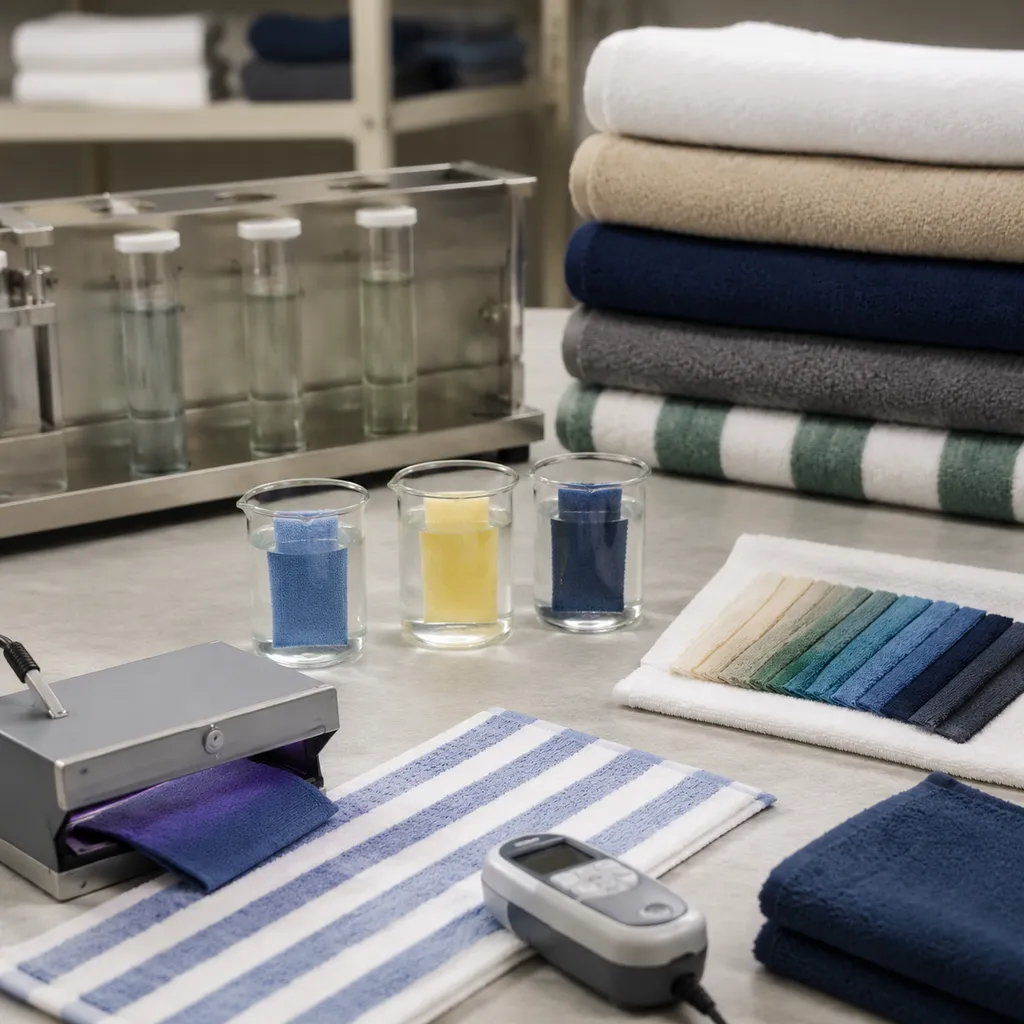
Two technical checks matter here. First, we verify dimensional change after washing using ISO 6330 so the decorated area does not distort more than the body allows. Second, we review colorfastness to washing under ISO 105-C06 when dark thread is used on pale grounds, because thread bleeding can ruin an otherwise acceptable towel. These are not abstract lab points; they change whether a style is safe to scale.
- Common defect mode on plush cotton: monogram edges sink into pile and read fuzzy from one meter away.
- Common defect mode on dense satin letters: localized tightening causes a shallow cup shape after wash.
- Common defect mode near hem turns: embroidery catches thickness change and skews slightly upward.
A realistic price frame by order size
The bands below reflect FOB China quoting for standard export packing, based on what we and comparable OEM mills can run efficiently under certified production systems. They are not commodity-market promises. Cotton price movement, yarn count, and decoration complexity can shift the band, but the table gives buyers a practical sourcing frame for comparison.
| Program example | 500 pcs | 2,000 pcs | 5,000 pcs |
|---|---|---|---|
| 35×35 cm, 450 GSM, single initial | USD 1.08–1.34 | USD 0.87–1.06 | USD 0.79–0.96 |
| 40×60 cm, 480 GSM, two-letter monogram | USD 1.74–2.12 | USD 1.42–1.76 | USD 1.31–1.61 |
| 40×60 cm, 520 GSM, three-letter monogram, gift band | USD 2.03–2.46 | USD 1.69–2.08 | USD 1.56–1.93 |
| 50×90 cm, 540 GSM, crest embroidery, barcode polybag | USD 2.98–3.62 | USD 2.51–3.09 | USD 2.33–2.87 |
If one quote sits far below this range, check the actual towel size after wash, not just nominal cut size. Check also whether the vendor is pricing embroidery with lower stitch density, using carded yarn instead of combed, or excluding packaging components. Buyers comparing hotel and retail offers should also separate replacement-cycle expectations. Hospitality programs care about repeated laundering more than shelf presentation, while boutique retail can tolerate slower replenishment but not messy decoration.
Lead time depends more on approvals than sewing
A standard woven hand towel body does not take long to produce once yarn, dye lot, and loom planning are fixed. The delays usually come from artwork revisions, monogram placement debates, and sample signoff rounds between merchandising, brand, and operations teams. We would rather spend two extra days closing those points before bulk than absorb a week of rework later.
| Stage | Typical days | What can delay it |
|---|---|---|
| Artwork review and digitizing | 2–4 days | No vector file, unclear thread colors |
| Lab dip or white-base confirmation | 3–5 days | Pantone mismatch or trim revisions |
| Embroidery strike-off on towel body | 4–6 days | Placement changes after first sample |
| Bulk production | 18–28 days | Color splits, machine loading, peak season |
| Final inspection and packing | 3–5 days | Barcode verification, assortment count checks |
For freight planning, monogrammed towels are not special in transit, but they are less forgiving of rushed approvals. If delivery is tight, it helps to decide early whether the order moves by sea or air. Our breakdown in container-vs-air-freight-towel-orders is useful if merchandising and logistics are arguing over one late launch date.
How hotels and retail brands should spec them differently
The same product name can hide two different buying logics. Hotel monogram hand towels are usually operational textiles first. The embroidery needs to survive commercial wash conditions, sit consistently on every piece, and avoid guest complaints from puckering or harsh backing. Retail branded hand towels, especially giftable sets, give more weight to handfeel, visual loft, and presentation packaging.
- Hotels should prioritize placement tolerance, wash stability, and easy color reorders.
- Retail brands should decide early whether the monogram is fixed branding or variable personalization.
- Both should specify backing removal standard, because leftover stabilizer can affect handfeel.
Buyers building hospitality programs can compare this with hotel-towel-sourcing-guide-2026 and hotel-towels-wholesale-supplier-guide. If the project is more gift-driven or brand-led, monogrammed-bath-towels-luxury-brand-guide shows how decoration approvals tend to expand once presentation enters the discussion.
Certifications and compliance still belong in the quote file
Even for a small hand towel program, buyers should ask for the same basic compliance discipline they would expect on larger bath lines. We operate under OEKO-TEX Standard 100 Class I, BSCI, and ISO 9001, and those matter because monogram programs add extra components: embroidery thread, backing material, polybags, paper bands, carton labeling. Compliance has to cover the full packed item, not just the cotton pile.
If you are reviewing supplier paperwork, do not stop at a logo on the quotation. Ask which certificate version is current and whether the decorated style uses approved thread and backing inputs. Our article on how-to-read-oeko-tex-certificate helps non-technical buying teams catch the usual paperwork shortcuts.
The shortest buyer checklist before you request pricing
- Fix the towel size and finished GSM range you actually want, not a broad target.
- Send the monogram artwork and note whether it is one logo or multiple initials.
- State the intended use: hotel laundry, spa resale, retail gift, or promotional pack.
- Confirm packaging level: bulk carton, individual polybag, paper band, belly wrap, or boxed set.
- List any compliance requirement up front, including OEKO-TEX 100 Class I, BSCI, and ISO 9001 expectations.
Related reads: build-towel-tech-pack-that-mills-can-quote, negotiate-towel-moq-without-killing-margin, and pantone-color-matching-custom-towels.
Related reads: embroidery-vs-sublimation-vs-jacquard for logo method trade-offs, and towel-gsm-decision-framework if the fabric weight is still not settled.
Need a usable quote sheet for monogram orders?
Send size, GSM target, artwork, quantity split, and packout. We can quote from MOQ 500 pcs per design per color and flag cost risks before sampling. WhatsApp +86 13205717266 or email [email protected].
Request Quote →