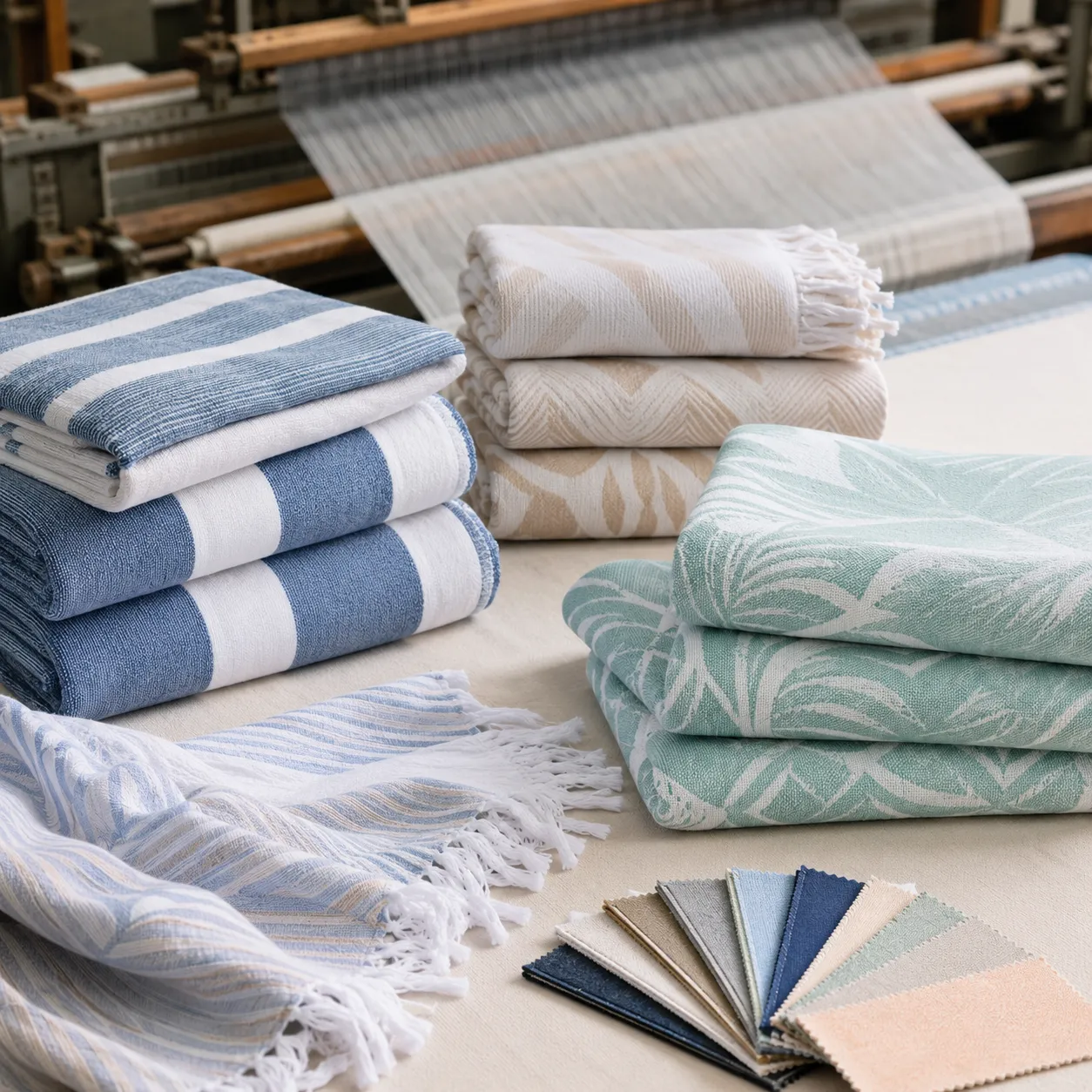
Why oversized formats expose supplier weaknesses earlier
Large towels magnify every small tolerance problem. On a hand towel, 2 cm width loss after dyeing may be irrelevant. On a beach format, the same behavior can throw off a lounger fit, distort a border logo, or push unit weight beyond the freight model you approved. We usually see trouble in four places first: greige planning, pile density consistency across the full width, print registration on sheared velour, and carton discipline once the folded pack gets bulky.
That is why we qualify a supplier for this category differently from a standard bath towel vendor. A mill may produce acceptable 70 x 140 cm bath towels and still struggle with 90 x 180 cm or 100 x 180 cm beach styles because the loom setup, shearing behavior, and finishing allowances are different. Buyers using an oversized beach towels supplier checklist should expect the factory to explain those allowances with numbers, not simply state that large sizes are available.
| Common retail/resort size | Typical finished GSM | Approx. finished unit weight | What changes operationally |
|---|---|---|---|
| 86 x 160 cm | 380-450 GSM | 0.52-0.62 kg | Still manageable on standard fold and carton plans |
| 90 x 170 cm | 380-500 GSM | 0.58-0.77 kg | Print panel and pile leveling become more visible |
| 100 x 180 cm | 400-500 GSM | 0.72-0.90 kg | Greige width planning and carton count need early review |
| 100 x 200 cm | 420-520 GSM | 0.84-1.04 kg | Often forces lower pcs per carton or vacuum-assisted packout |
The first document we want to see is the size-and-construction line sheet
Before pricing, we look for a line sheet or tech pack with finished size, tolerance, construction, ground yarn, pile yarn, border treatment, decoration method, and intended use channel. 'Oversized beach towel' is too broad. A 100 x 180 cm reactive-printed velour towel for retail is a different product from a 95 x 175 cm yarn-dyed jacquard towel for a beach club pool deck.
- Finished size with tolerance, for example 100 x 180 cm +/- 3% after one home-laundry cycle or a separate post-wash standard if the buyer has one
- Construction callout such as 1 side sheared velour / 1 side terry or both-side terry jacquard
- Target GSM measured on finished goods after conditioning, not loom-state estimates
- Fiber and yarn details such as 100% cotton, 16s ground / 21s pile or ring spun vs open-end where relevant
- Decoration location limits, especially whether artwork runs into hems, dobby borders, or sewing margins
If a supplier cannot quote from that level of detail, price comparisons become meaningless. We have seen RFQs where one mill assumed 380 GSM printed velour and another assumed 450 GSM jacquard velour, yet both were presented to the buyer as comparable oversized beach towel offers.
Width planning is the quiet technical check most buyers miss
Editors were right to challenge vague greige-width claims. This area varies by loom setup, weave density, fiber type, and finishing route, so it needs caveats. We do not use a universal width formula. We calculate loom-state target width from the requested finished size plus the mill's historical width loss for that exact construction family. For cotton beach towels, width loss through scouring, dyeing, drying, and final finishing is often greater than length loss, but the ratio can move depending on pile density and shearing.
For example, on a cotton sheared velour beach towel around 420-460 GSM, a factory may plan several percentage points of width allowance before finishing. On a denser jacquard terry style, the allowance can shift again because loom take-up, float structure, and wet relaxation are different. A credible supplier should be willing to discuss its own historical allowance band by construction, even if it does not disclose every internal process setting.
| Checkpoint | What a qualified supplier should provide | Why it matters |
|---|---|---|
| Finished width target | Nominal width plus tolerance and wash condition | Prevents disputes over whether measurement is ex-factory or after wash |
| Loom-state planning basis | Internal allowance based on similar construction history | Shows the quote is engineered, not guessed |
| Hem consumption | Expected fold and sewing take-up per side | Artwork can be lost if this is ignored |
| Print-safe area | Live artwork area excluding hems and skew risk zones | Important for full-face resort graphics |
| Shrinkage benchmark | Test method and internal acceptance band | Stops size arguments after first laundry trial |
Where standards are involved, we prefer to state the method. For dimensional stability, many buyers request ISO 5077 or AATCC 135 depending on market and lab practice. The acceptable result is commercial, not universal. A resort buyer may tolerate a wider band than a retail brand selling exact shelf dimensions, so the PO should state both the method and the pass/fail threshold.
Decoration method changes the right supplier shortlist
The fastest way to filter candidates is by decoration, because the production risks are not the same. Oversized printed cotton velour needs stable shearing, even absorbency on the print face, and disciplined artwork positioning. Jacquard needs card or electronic pattern capability, clean color separation, and realistic minimums per colorway. Embroidery on large beach towels is usually a secondary detail, not the main graphic, because stitch count can harden the handfeel and pucker a large panel.
- For reactive print on cotton velour, ask how the mill controls print clarity after shearing and whether it checks face-side barre or shading before printing
- For yarn-dyed jacquard, confirm whether the logo sits in pile structure or border construction because that affects edge sharpness and loom efficiency
- For piece-dyed solid towels with embroidery, review backing, stitch density, and placement away from high-fold stress lines
Two process details are especially specific to this category. First, the shearing step on velour styles can expose streaking that was not obvious in grey goods; a supplier should inspect after shearing, not only after sewing. Second, full-panel prints on wide towels need a controlled print-to-hem relationship, otherwise one long edge appears visually heavy after folding even if the artwork file was centered.
| Decoration route | Usual MOQ signal | Typical FOB China band | Notes |
|---|---|---|---|
| Piece-dyed solid + simple embroidery | 500 pcs/design/color | USD 3.85-5.40 at 1,000-3,000 pcs | Best for resort ID systems and simpler logos |
| Reactive print cotton velour | 800-1,200 pcs/design | USD 4.70-7.10 at 1,000-3,000 pcs | Price moves with face coverage, GSM, and color complexity |
| Yarn-dyed jacquard | 1,000-1,500 pcs/design | USD 5.60-8.60 at 1,000-3,000 pcs | Higher setup burden but stronger woven identity |
Those FOB bands are not universal market rates. They are realistic sourcing ranges for China OEM production in mid-2026 for oversized cotton beach towel programs in the size class discussed here, excluding destination duty and inland delivery after port arrival. Cotton market movement, artwork complexity, trim packaging, and order concentration can move them materially.
A supplier's test language tells you whether QC is real
We trust suppliers more when they reference actual methods and explain limits. Saying a towel is 'washable' or 'colorfast' tells you almost nothing. On beach programs, we usually see buyers request colorfastness to washing, crocking, seawater or chlorinated water exposure depending on channel, and dimensional stability after laundering. For chemical safety, OEKO-TEX STANDARD 100 is relevant to harmful substances in the certified article scope, but it is not a durability standard and it does not replace performance testing.
- Colorfastness to washing often references ISO 105-C06 or the buyer's regional equivalent
- Rubbing fastness is commonly checked under ISO 105-X12, especially important on dark printed velour faces
- Absorbency and handfeel are usually evaluated as mill or buyer performance criteria rather than one universal compliance standard
- Dimensional stability may be checked to ISO 5077 with the laundering procedure agreed separately
On oversized printed towels, one recurring defect mode is face-side color migration into the terry back after wet processing. Another is skew after finishing, where the side seam and print panel no longer sit square. If a supplier has no inspection point for skew and no agreed tolerance in the spec, the buyer often discovers it only when the towels are stacked on loungers.
Carton planning is part of product development, not a warehouse afterthought
Oversized styles can look commercially fine at sample stage and still become expensive because the fold is too thick for the target carton count. We review pack-out before bulk approval. A 100 x 180 cm towel at roughly 440 GSM with a velour face folds very differently from a lighter flatwoven beach style. If the buyer also wants a bellyband, polybag, insert card, and barcode label, carton efficiency drops again.
| Finished style example | Indicative packout | Carton CBM tendency | Freight implication |
|---|---|---|---|
| 100 x 180 cm, 420 GSM printed velour | 12-16 pcs/ctn | Moderate to high | Air freight gets punitive quickly |
| 100 x 180 cm, 450 GSM jacquard terry | 10-14 pcs/ctn | High | Container planning becomes more critical than FOB delta |
| 90 x 170 cm, 380 GSM velour | 16-20 pcs/ctn | More efficient | Often the better entry spec for seasonal trials |
For that reason, a supplier should quote carton dimensions, gross weight range, and pack count together with FOB. A towel that is USD 0.28 cheaper ex-factory can still cost more landed if it forces inefficient air top-up or wastes container cube. Marco's freight piece on container-vs-air-freight-towel-orders is useful when the buying team is comparing late-season replenishment options.
Sampling should prove the risky points, not just approve color
For large beach formats, we recommend a staged sample path. Lab dips matter, but they are not enough. A strike-off or woven simulation can validate graphics; then a pre-production towel should validate dimensions, pile feel, fold behavior, and the relationship between artwork and hems. If the supplier skips directly from artwork file to bulk because the sample 'looks close enough,' the buyer carries too much risk.
- Approve artwork scale with a live area drawing that marks hem loss and safe zones
- Approve color by lab dip or yarn standard depending on print or jacquard route
- Review one construction sample for handfeel, weight, and border execution
- Review one pre-production sample measured under the agreed method, ideally with wash data attached
- Lock bulk standard against that approved sample, not against a retouched product photo
Related reads: build-towel-tech-pack-that-mills-can-quote, pantone-color-matching-custom-towels, and towel-sizes-dimensions-complete-guide.
Lead time moves with the construction more than buyers expect
Large-format towels are not automatically slow, but the timeline depends on the route. A stocked solid color with simple embroidery can move relatively quickly once sampling is cleared. Reactive print and jacquard usually take longer because prepress or weave preparation adds steps before bulk weaving and finishing even start.
| Program type | Sampling window | Bulk production window | What usually delays it |
|---|---|---|---|
| Solid dyed with embroidery | 7-12 days | 22-32 days | Embroidery placement approval and trim confirmation |
| Reactive printed velour | 10-16 days | 28-40 days | Strike-off approval, print scheduling, shearing queue |
| Yarn-dyed jacquard | 12-18 days | 35-48 days | Yarn booking, pattern setup, loom planning |
Those are mill-side production windows after artwork and commercial details are reasonably complete. Vessel booking, peak-season congestion, and destination handling are separate. For planning discussions, buyers often pair this with beach-club-resort-towel-program and negotiate-towel-moq-without-killing-margin.
The checklist we use before accepting a large beach towel RFQ
By this stage, the oversized beach towels supplier checklist should feel less like a generic questionnaire and more like a filter for supplier competence. We use the points below internally because they expose whether the vendor actually runs this category or is stretching from smaller towels.
- The supplier can show previous production in comparable finished sizes, not just standard bath or pool formats
- Its quote identifies construction, decoration route, tolerance basis, and pack-out rather than one lump-sum FOB line
- Its team can explain width and shrinkage allowance as construction-specific planning, with method references where testing is discussed
- Its sampling route includes a pre-production towel with measurement and wash data, not only a color swatch
- Its QC language includes skew, shearing quality, print placement, and border consistency across the full width
- Its compliance documents distinguish between OEKO-TEX STANDARD 100, social audit such as BSCI, and quality management such as ISO 9001 instead of treating them as the same thing
On that last point, buyers should read certificates carefully. OEKO-TEX certification applies to the article scope shown on the certificate and annex, not to every product a factory could theoretically make. If a supplier mentions OEKO-TEX 100 Class I, ask for the current certificate number and article coverage. Our explainer at how-to-read-oeko-tex-certificate covers what to verify.
Where we push back on buyer briefs
We usually challenge three combinations. First, very large size plus high GSM plus low carton count target. The towel may be physically good but logistically poor. Second, edge-to-edge print with no hem-safe margin. Sewing variation is small, but on a wide towel it becomes visible. Third, resort-use expectations with retail-level softness targets and budget pricing. A towel can be lush on first touch or robust under repeated laundering, but forcing both at the lowest price band usually produces disappointing bulk.
A more workable entry specification for many brands is 90 x 170 cm to 100 x 180 cm, around 400-430 GSM, cotton velour/terry, with a controlled print area and realistic carton count. That generally keeps the handfeel strong without creating a freight problem on the first order. Buyers that need a hotel-pool crossover program may also want to compare against hotel-towel-sourcing-guide-2026 because pool laundering disciplines can be stricter than retail beach sell-through assumptions.
Need a factory-side review of your oversized beach towels supplier checklist?
Send the size, GSM, artwork method, target carton count, and destination market. We will flag the points that usually break pricing or bulk approval before sampling starts. MOQ is 500 pcs per design per color.
Request Quote →Contact us at [email protected] or WhatsApp +86 13205717266. We are a 220-employee OEM towel mill in China, operating since 2007, with OEKO-TEX STANDARD 100 Class I, BSCI, and ISO 9001 certification.