Start With the SKU Math, Not the Unit Price
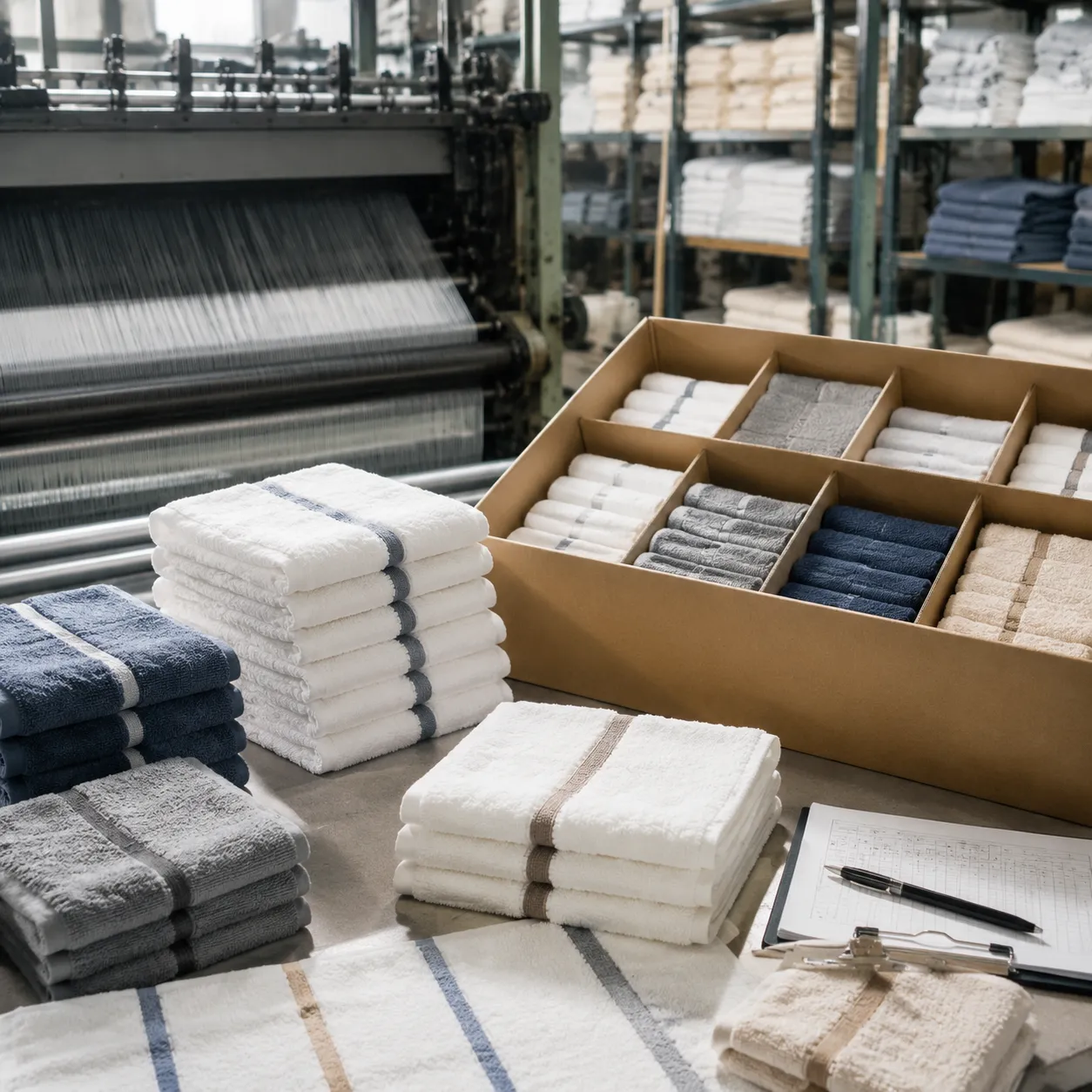
Bar mops look like low-risk towels because the construction is basic: cotton terry, compact size, usually white ground with a colored center stripe or side stripe. The problem is that buyers often multiply too many variables. Size, stripe color, packing method, label type, and carton mark can turn a simple item into 18 production lines before anyone discusses price.
Our standard MOQ is 500 pcs per design / per color. For bar mops, we can sometimes combine white-ground goods across stripe colors, but only if yarn count, GSM, size, border setup, and packing are identical. If one SKU is 40 x 40 cm at 360 GSM and another is 40 x 60 cm at 420 GSM, they are separate production runs even when the cotton is the same.
The practical goal is not to push every color through at the lowest possible quantity. The goal is to build a mix that gives the laundry, kitchen, and retail buyer enough variety without forcing the mill to run inefficient half-batches. That is where negotiation works: reduce avoidable changeovers, keep the base towel consistent, and ask for flexibility only where it does not damage cost or quality.
| Spec variable | MOQ impact | Factory note |
|---|---|---|
| White ground with one yarn-dyed stripe | Moderate | Can share greige terry base if GSM and size match |
| Fully dyed towel body | High | Reactive dyeing requires separate vat and shade approval |
| Different size per SKU | High | Cutting, hemming, and carton packout change |
| Private woven label only | Low | Can usually run across all colors if label is identical |
| Retail belly band per color | Moderate | Artwork plates and packing line sorting add time |
Bar Mop Towel MOQ Negotiation Guide: What We Can Flex
A useful bar mop towel moq negotiation guide separates hard constraints from negotiable ones. We can discuss a 500-piece color split when the towel body is identical. We cannot responsibly promise 150 pieces in eight stripe colors at export pricing because the loom setup, yarn preparation, and inspection time do not shrink in proportion to quantity.
For restaurant bar mop towels bulk programs, the cleanest negotiation is usually a shared base towel. One buyer may use blue stripe for front-of-house wiping, red stripe for kitchen sanitation zones, and green stripe for bar service. If all three are 40 x 40 cm, 380 GSM, 21s cotton yarn, 3 cm hem, same carton, and same label, then the color split is the only real variable.
- Usually negotiable: stripe color splits, master carton mark, polybag quantity, woven label wording, and replenishment timing.
- Sometimes negotiable: total MOQ across two close stripe colors, sample fee credit, and carton pack count.
- Rarely negotiable: yarn count changes below 500 pcs, different GSM by color, separate dyed body colors in tiny lots, and urgent production during peak export weeks.
- Not worth negotiating: skipping wash testing on food-service towels; failure cost is higher than the inspection saving.
For a first order, we prefer the buyer to choose two or three functional colors, not six decorative colors. Kitchens reorder by use case, not by mood board. If a black stripe, navy stripe, and red stripe cover 90% of the laundry sorting requirement, adding teal, orange, and purple often creates dead stock rather than brand value.
Construction Choices That Change Minimums
Most cotton bar towels wholesale inquiries fall into three constructions. The lightest is an economy terry bar mop around 300-340 GSM, used for wiping counters and spill pickup. The middle range is 360-420 GSM, which is where most restaurant distributors land. Heavy-duty kitchen mops can run 450-500 GSM, but they take longer to dry and cost more to ship.
A construction quirk specific to bar mops is the center stripe. If the stripe is yarn-dyed into the terry, it needs stable colorfastness under hot alkaline wash. Printed stripes are cheaper for very short runs, but they often fade or crack after repeated kitchen laundry. For institutional users, we steer buyers toward yarn-dyed stripes and test them under ISO 105-C06 or AATCC 61 conditions before bulk approval.
| Common bar mop spec | Typical use | GSM range | MOQ behavior |
|---|---|---|---|
| 30 x 30 cm economy wipe | Bar spill wiping, compact carts | 300-340 GSM | Can combine colors if stripe yarn is available |
| 40 x 40 cm standard bar mop | Restaurant kitchen and counter use | 360-420 GSM | Best MOQ efficiency for mixed stripe programs |
| 40 x 60 cm long bar towel | Line cooks, brewery, prep stations | 380-460 GSM | Separate cutting plan from 40 x 40 cm |
| 45 x 70 cm utility towel | High-volume cleaning and dish support | 430-500 GSM | Higher yarn consumption; less flexible on small splits |
Edge construction also matters. A low-cost overlock can be acceptable for rental laundry programs that retire towels quickly. For hotel kitchens or branded restaurant groups, a lockstitch hem with reinforced corners reduces edge tunneling after repeated tumble drying. Edge tunneling is the defect where the hem twists inward and forms a rope-like border; it is common when fabric tension and sewing thread shrinkage are not balanced.
Color Splits: The Main Negotiation Lever
The kitchen towel minimum order quantity is easiest to reduce when the color split is logical. A buyer asking for 2,000 pieces total can usually build a better case with four colors at 500 pcs each than with ten colors at 200 pcs each. The total towel volume may be the same, but the second option creates more yarn issuing, line clearance, labeling checks, and shade segregation.
If the buyer already has sales data, we ask for the last 12 months of movement by color. When there is no data, we suggest a demand-weighted split. For example, a 3,000-piece launch could run 1,200 pcs blue stripe, 900 pcs red stripe, 600 pcs black stripe, and 300 pcs green stripe only if the buyer accepts that green may need to join a later replenishment batch. If every color must ship together, 500 pcs per color is the cleaner threshold.
- Lock one base towel size and GSM before discussing colors.
- Rank stripe colors by operational use, not by catalog preference.
- Keep the first order to two to four colors unless sales data proves broader demand.
- Use the same label and carton mark across all colors where possible.
- Plan reorder windows before the first PO so slow colors do not block fast colors.
For striped bar mop towels, shade tolerance should be written into the approval record. We normally use a visual lightbox review under D65 and TL84, then confirm wash behavior through a 60°C cycle test. Red and black stripes need special attention because loose dye can shadow onto the white pile if the yarn dyeing process is rushed.
Price Bands by Quantity and Spec
MOQ negotiation only makes sense when the buyer can see what the factory is trying to recover. Below 500 pcs per color, the fixed work does not disappear: sample loom adjustment, yarn preparation, sewing line setup, QC pull rate, export paperwork, and carton loading all still happen. At higher volume, the same setup spreads across more towels.
The price ranges below are realistic FOB China bands for simple OEM bar mops in 2026. They assume white cotton terry, one yarn-dyed stripe, standard export carton, no retail barcode sticker, and normal production lead time. Final pricing depends on cotton market, exchange rate, packing density, and inspection requirements.
| Order volume | Typical spec | FOB China price band | Negotiation room |
|---|---|---|---|
| 500-999 pcs per color | 40 x 40 cm, 360-380 GSM | USD 0.58-0.82 / pc | Limited; focus on shared label and carton |
| 1,000-2,999 pcs per color | 40 x 40 cm, 380-420 GSM | USD 0.46-0.68 / pc | Good; stripe colors and packing can be optimized |
| 3,000-7,999 pcs per color | 40 x 60 cm, 400-450 GSM | USD 0.74-1.08 / pc | Strong; yarn booking and sewing efficiency improve |
| 8,000+ pcs total program | Mixed bar mop family with shared base specs | USD 0.41-0.95 / pc | Best; annual call-off can support better terms |
A cheap offer can still be expensive in use. One 40 x 40 cm, 320 GSM bar mop at USD 0.49 may survive 38 commercial washes before the edge opens. A 390 GSM towel at USD 0.64 with a stronger hem may reach 82 washes. The first costs about 1.29 cents per wash; the second costs about 0.78 cents per wash. For restaurants washing daily, that difference matters more than the first invoice.
Sample Approval Before You Trade MOQ
We do not recommend negotiating MOQ before sample standards are written down. If the buyer approves only a photo, both sides lose clarity. A bar mop sample should be washed, measured, weighed, checked for lint, and tested for stripe bleeding before the PO is treated as fixed.
Our usual sample workflow is 7-10 days for available yarn and 12-18 days when a special stripe shade needs yarn dyeing. Bulk production is normally 25-35 days after deposit and sample approval. If the order includes retail bands, barcode labels, or multi-language carton marks, add 4-7 days for packaging proof approval.
- Dimensional change: test after three wash cycles using ISO 6330 washing and ISO 5077 measurement logic.
- Colorfastness to laundering: use ISO 105-C06 or AATCC 61 for yarn-dyed stripe stability.
- Absorbency: check wetting time with an AATCC 79-style drop test after prewash.
- Lint release: review dryer screen and dark surface wipe after wash because bar mops are used around glassware and stainless steel.
- Edge strength: inspect hems after tumble drying; loose overlock thread is a common early failure point.
This is where a bar mop towel moq negotiation guide becomes operational rather than theoretical. If testing shows the economy hem is failing, it is better to keep MOQ at 500 pcs and upgrade sewing than to reduce the order and ship a towel that causes complaints after three weeks.
Packout and Cartons Can Save More Than a Tiny MOQ Cut
For low-unit-price towels, carton planning affects landed cost. A buyer may spend three days arguing for 400 pcs per color, then lose the saving through poor packout. Bar mops are dense but still compress unevenly when the pile is high. Overpacked cartons can bulge, fail drop handling, or create inaccurate CBM for freight booking.
For hospitality cleaning towels, we usually quote pack counts such as 12 pcs per inner polybag and 120 or 240 pcs per master carton, depending on size and GSM. If the buyer needs shelf-ready cartons of 24 pcs, unit packing labor rises. If the buyer accepts bulk-packed cartons for laundry distribution, cost and lead time improve.
| Packout option | Best for | Cost effect | MOQ effect |
|---|---|---|---|
| Bulk 120 pcs/carton | Laundry operators and restaurant chains | Lowest packing labor | Helps combine color runs |
| 12 pcs/polybag, 120 pcs/carton | Distributors shipping case packs | Small added cost | Usually acceptable at 500 pcs/color |
| 24 pcs retail carton with barcode | Cash-and-carry wholesale | Higher label and sorting cost | Less flexible for tiny colors |
| Mixed-color carton | Starter kits and trial packs | Higher QC risk | Only useful when reorder logic is clear |
Mixed-color cartons sound attractive, but we use them carefully. A picker must verify exact color count inside every carton, and inspection needs a stricter AQL plan because one carton can contain several SKUs. For a first order, single-color cartons with clear side marks are usually safer.
Compliance and Audit Points for Food-Service Buyers
Bar mops are not medical textiles, but they touch food-service environments and are washed aggressively. Our mill operates under ISO 9001 quality management, BSCI social compliance, and OEKO-TEX Standard 100 Class I certification. Buyers should still confirm that the specific yarn, dye, and accessory package for their order is covered by the documentation, not just ask for a certificate screenshot.
OEKO-TEX matters when dyed stripe yarns or printed labels are added. For a plain white cotton towel, compliance is usually straightforward. For red, black, or dark green stripe yarns, the dye class and residual chemical controls should be checked. A responsible supplier will show certificate scope, validity date, and product class rather than only the logo.
- Ask whether the quoted bar mop uses virgin cotton, recycled cotton blend, or open-end cotton yarn.
- Confirm OEKO-TEX Standard 100 Class I coverage for fabric, dyed yarn, sewing thread, and labels.
- Request the most recent BSCI audit status if the order is for a national restaurant group.
- Write AQL inspection levels into the PO; for bar mops we commonly use general inspection level II with critical defects at 0.
- Keep a sealed approved sample at the buyer office and at the mill for bulk comparison.
Related reads: for buyers comparing cotton specifications, see combed vs zero twist cotton explained and towel GSM decision framework. For PO documentation, we recommend build towel tech pack that mills can quote.
A Practical Negotiation Script for Your RFQ
The strongest RFQ is specific enough for us to calculate cost, but flexible enough to let production suggest a better route. Instead of asking, “What is your lowest MOQ for bar mops?”, ask what changes if the base towel is shared across colors, what packout reduces handling, and whether an annual call-off can support smaller first shipment quantities.
Here is the structure we like to receive for a bar mop towel moq negotiation guide RFQ. It shortens quotation time and avoids a false low price based on missing details.
- State the target size, GSM, and yarn preference, such as 40 x 40 cm, 380 GSM, 21s cotton terry.
- List stripe colors by priority and mark which colors can wait for reorder.
- Give estimated annual volume, not only first PO quantity.
- Choose one packout target, such as 12 pcs/polybag and 120 pcs/carton.
- Confirm whether OEKO-TEX documentation, BSCI audit records, or third-party inspection is required.
- Ask for sample timing, bulk timing, FOB port, carton dimensions, and gross weight in the same quote.
If a buyer can commit to an annual plan of 18,000 pcs but only wants 4,000 pcs in the first shipment, we can discuss staged production more constructively. The mill can book yarn and plan stripe colors, while the buyer avoids overstock. Without annual context, every small order has to stand alone on cost.
Related reads: if you are building a wider food-service towel program, compare this article with restaurant bar mop towels spec guide and restaurant towels laundry life buying guide. For freight planning after MOQ is settled, see container vs air freight towel orders and negotiate towel MOQ without killing margin.
What We Need to Quote Accurately
LUMA & CO. TEXTILE has produced OEM towel programs since 2007, with 220 employees, about 2.4M towels per year, and clients across 47 countries. For bar mops, our job is to keep the spec tough enough for laundry use while removing unnecessary SKU complexity. MOQ negotiation is easiest when the buyer treats the towel as an operating supply, not a novelty item.
- Target size and GSM range, such as 40 x 40 cm at 360-420 GSM or 40 x 60 cm at 400-460 GSM.
- Stripe color list with Pantone references if available.
- First order quantity and expected annual reorder quantity.
- Packing requirement, carton mark format, and whether barcodes are needed.
- Required certifications: OEKO-TEX Standard 100 Class I, BSCI, ISO 9001, or buyer-specific documents.
- Destination port or warehouse so we can flag carton density and freight issues early.
Our normal MOQ remains 500 pcs per design / per color. We can negotiate around shared base specs, annual forecasts, and packing efficiency. We will push back on very small color runs when the result would be unstable pricing, rushed dyeing, or poor wash durability.
Send a Bar Mop MOQ Brief
Share your size, GSM, stripe colors, first order volume, and annual forecast. We will return a practical MOQ split, FOB price band, sample timing, and carton plan. WhatsApp: +86 13205717266. Email: [email protected].
Request MOQ Review →