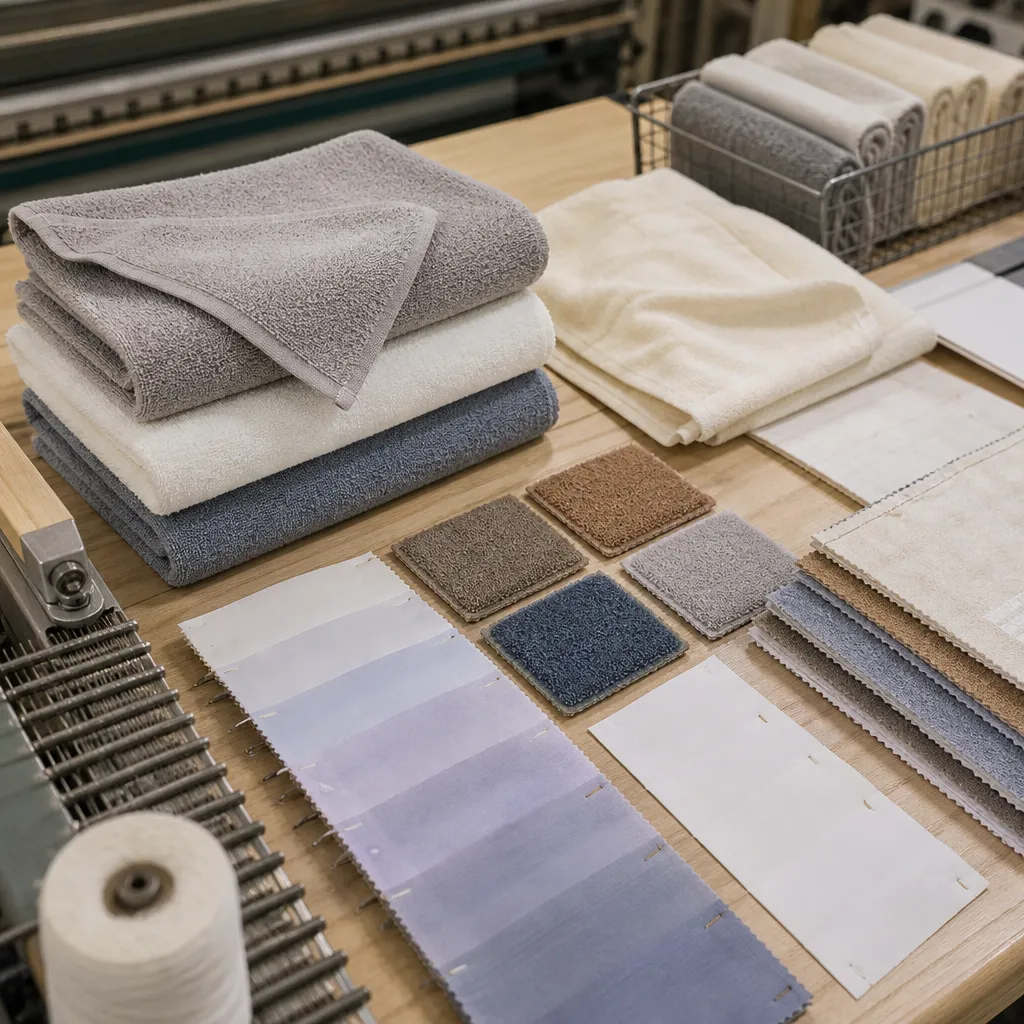
Start with the use case, not the artwork
For oversized resort towels, the first approval point is where the towel lives: beach club daybeds, hotel pool decks, retail gifting, or cruise excursions. A 95 x 175 cm towel for a lounger program behaves very differently from a 100 x 200 cm retail statement piece. In our mill, the same stripe layout can be woven on both, but the freight cost, wash shrinkage risk, and decoration options move quickly once the dimensions pass 180 cm in length.
This is why our oversized beach towels supplier checklist starts with operational questions. If the towel is for pool turnover, we usually keep finished weight between 410 and 520 GSM. If it is for retail shelf impact, brands often push to 540 to 620 GSM, but carton cube rises sharply. Buyers sometimes ask for "extra large and extra thick" at entry-level price. We normally push back there, because a towel that weighs 1.05 kg after finishing is not difficult to make, but it becomes expensive to ship and slower to dry in commercial laundry.
- Define the final use: pool rotation, beach club rental, hotel amenity sale, or DTC retail
- Confirm finished size after wash, not loom-state size
- Set a target piece weight range before approving stripe or jacquard layout
- Decide whether freight cost is calculated by volume limit or gross weight
The three spec lines that usually break the project
In large-format towels, three lines on the tech pack create most of the trouble: finished size tolerance, ground construction, and border structure. Buyers pay attention to face feel and artwork, but our QA team watches these three fields first because they determine whether the towel stays flat after laundering and whether the selvedge starts to torque.
A concrete example: on oversized dobby towels, a narrow side hem under 2.2 cm often looks clean on first sample but begins to draw inward after repeated washing, especially above 500 GSM. Another issue is pick density imbalance. If the ground uses a soft low-twist ring spun pile but the weft count is too open, the towel feels full in hand yet loses visual coverage after the first industrial wash. These are not showroom problems. They are bulk problems.
| Spec line | What we recommend for oversized towels | Common failure mode |
|---|---|---|
| Finished size | Tolerance within +/-3% after one home-laundry wash | Approved loom size but undersized post-wash bulk |
| Ground construction | 16s or 20s ring spun pile with stable base density | Loose face, see-through ground, uneven absorbency |
| Border and hem | 2.5-3.5 cm side hem with balanced tension | Edge waving, torque, curled corners |
An oversized beach towels supplier checklist should test construction, not just appearance
A strong oversized beach towels supplier checklist does not stop at color approval. We advise buyers to ask for at least one construction wash trial before bulk deposit. For cotton beach towels, we usually run dimensional stability and appearance checks after one wash at 40 degrees C and after a repeated cycle benchmark of five washes. If the program is for heavy resort laundering, we also flag likely performance drift versus home wash standards.
Two practical checks matter here. First is loop security at the border transition, especially on velour beach towels where the sheared face meets an uncut border. Second is bowing and skew. Large striped towels can look square on the table but shift visually after finishing if the stripe repeat and tenter tension are not controlled. We often measure skew across the stripe line rather than only measuring side seam length, because that catches distortion faster.
- Request wash testing against ISO 6330 for domestic laundering method reference
- Ask for colorfastness to washing under ISO 105-C06 on dark navy, coral, and saturated green shades
- Review absorbency timing and face appearance after shearing if using velour construction
- Check stripe alignment and skew on a flat table before carton approval
Choose the towel format before you compare factories
Not every supplier handles every oversized format equally well. A mill that is solid at standard bath sizes may not be the right partner for 100 x 180 cm jacquard beach towels or piece-dyed velour with oversized fringed ends. We classify large-format beach programs into four workable families, because each family has different risk points and different machine suitability.
| Format | Typical GSM | Best use | Watch-out |
|---|---|---|---|
| Yarn-dyed stripe terry | 420-500 GSM | Hotel and resort rotation | Stripe bowing across width |
| Velour reactive print | 360-440 GSM | Retail beach and branded clubs | Print penetration and sand retention |
| Jacquard terry | 430-560 GSM | Brand identity and resort logo work | Higher setup and longer loom planning |
| Flatwoven peshtemal-style oversized towel | 240-320 GSM | Travel and fast-dry beach use | Different hand feel than terry expectation |
If the buyer brief says only "oversized beach towel" without naming the format, supplier comparison gets messy. One factory may quote velour print on a 380 GSM base, another may quote terry jacquard at 470 GSM, and a third may offer flatwoven cotton. All three are technically beach towels, but they are not commercially comparable. This is also why beach-towels-in-bulk-buyers-guide.html and turkish-hammam-beach-towels.html are useful side references before RFQ.
What to ask the supplier before sampling
We prefer buyers to qualify the supplier before asking for three rounds of expensive sampling. Large beach towel development is not impossible, but loom allocation, yarn booking, and printing screens all add cost if the brief is still moving. A short approval call can save two weeks.
- Ask whether the supplier weaves large-format towels in-house or subcontracts the greige body.
- Confirm the maximum stable finished width they run regularly, not their theoretical machine width.
- Request two recent bulk references by product type: resort towel, beach towel, or private label retail towel.
- Verify compliance documents: OEKO-TEX STANDARD 100 Class I, BSCI, and ISO 9001.
- Ask for their standard MOQ by design and by color. Our working MOQ is 500 pcs per design per color.
- Confirm whether bulk packing can support barcode labels, belly bands, or polybag retail presentation if needed.
Related reads: build-towel-tech-pack-that-mills-can-quote.html, pantone-color-matching-custom-towels.html, and negotiate-towel-moq-without-killing-margin.html.
Pricing only makes sense after weight and packout are fixed
We see buyers compare prices too early. On oversized towels, a 70-cent gap may come from GSM, from pile yarn, or simply from pack quantity per carton. Until the quote locks size, construction, and packaging, the numbers are not aligned. For cotton oversized beach towels, FOB China pricing in 2026 usually moves more from yarn and piece weight than from decoration, unless the towel uses high-color jacquard or complex reactive print.
| Program type | Volume | Indicative FOB USD/pc | Notes |
|---|---|---|---|
| 95 x 175 cm yarn-dyed terry, 440-460 GSM | 1,000-2,999 pcs | 4.25-5.10 | Solid resort volume, standard export carton |
| 100 x 180 cm velour reactive print, 380-410 GSM | 3,000-7,999 pcs | 4.60-5.55 | Artwork count affects print setup |
| 100 x 180 cm jacquard terry, 470-520 GSM | 3,000-5,999 pcs | 5.35-6.80 | Higher loom planning and yarn prep |
| 100 x 200 cm heavy terry stripe, 540-580 GSM | 800-1,999 pcs | 6.40-8.10 | Freight cube becomes a major cost driver |
Cost-per-use matters here. A lighter 390 GSM printed towel bought at USD 4.48 may look efficient, but if the resort replaces it after one season because edge curl and color wash-down make the set look mixed, the real use cost is poor. We recently modeled two beach club briefs where a 450 GSM yarn-dyed terry cost about USD 0.11 per guest use over projected laundry life, while a cheaper lightweight option landed closer to USD 0.16 because replacement came much sooner.
Lead time expands fast when artwork, yarn dyeing, and carton design overlap
For bulk beach programs, timing is usually tighter than buyers expect because everyone works backward from resort opening or summer launch. Standard large terry programs usually need 7 to 10 days for lab dips or yarn shade approval, 5 to 8 days for sample preparation, and 22 to 32 days for bulk after confirmation. If the project involves jacquard graphing, custom belly bands, or retail barcodes, add time upfront rather than hoping to recover it later.
| Stage | Typical days | What delays it |
|---|---|---|
| RFQ and spec clarification | 2-4 days | Missing size tolerance or unclear construction |
| Color or yarn approval | 7-10 days | Multiple lab dip revisions |
| Proto or salesman sample | 5-8 days | Artwork change after weaving start |
| Bulk production | 22-32 days | Loom scheduling, reactive print queue, rework |
| Final packing and booking | 3-6 days | Carton mark change, barcode mismatch |
For freight planning, large towels consume cube quickly. A resort order that fits in one 40HQ at 80 x 160 cm may need split booking once the size moves to 100 x 180 cm with retail insert cards. Buyers planning launches should cross-check with container-vs-air-freight-towel-orders.html and, for program logic, beach-club-resort-towel-program.html.
QC checkpoints we would not skip on large-format beach towels
Inspection on oversized towels needs a slightly different eye from bath towels. The panel is wider, the stripes or placement graphics are more visible, and fold presentation can hide problems if auditors only review the top layer. We normally inspect both folded and opened pieces, and we sample across early, middle, and late loom lots.
- Measure opened dimensions after conditioning, not only folded warehouse dimensions
- Check piece weight by lot, because oversized towels show wider variation when moisture regain changes
- Open at least one towel per carton sample to review center-panel defects, not just border defects
- Inspect for shearing streaks on velour faces and broken floats on jacquard grounds
- Verify carton drop integrity if the order uses vacuum compression or high-count packout
Two defect modes are especially specific to this category. One is center-panel barre on yarn-dyed stripe towels, where shade bands appear from yarn lot inconsistency under strong sun. The other is diagonal skew that becomes obvious only when the towel is spread on a lounger. These are acceptable nowhere in a resort installation where rows of towels are seen together.
A supplier checklist should include commercial fit, not only factory capability
Some suppliers can make the towel but still do not fit the program. Commercial fit means they can manage your reorder rhythm, label format, carton discipline, and communication speed. For seasonal beach business, reorders matter almost as much as the first PO. A supplier that quotes quickly but misses packing marks or cannot hold stripe shade continuity across a repeat order creates more work than the lower unit price is worth.
We tell buyers to score suppliers on four lanes: technical capability, compliance, communication, and repeatability. If a factory is strong technically but weak in paperwork, your team still absorbs that cost. If they are good at samples but not good at bulk consistency, the program stalls after launch.
- Score sample accuracy against approved tech pack
- Score response speed on revised artwork and packing instructions
- Score documentation quality for OEKO-TEX, BSCI, and inspection records
- Score repeat-order discipline on color continuity and carton labeling
Related reads: how-to-read-oeko-tex-certificate.html, chair-towels-lounger-pool-deck-guide.html, and hotel-towel-sourcing-guide-2026.html.
What we would put on the PO before deposit
If the buyer has reached supplier approval, the PO still needs enough detail to prevent argument later. For oversized cotton beach programs, we recommend listing finished size after wash, GSM tolerance, construction type, border width, artwork method, pack quantity per carton, master carton dimensions, barcode placement, and inspection standard. If one of those lines is missing, the supplier will fill the gap with their house default, which may not match your program.
- Product name and internal SKU
- Finished size and allowed shrinkage tolerance
- Target GSM and acceptable variance
- Fiber content and yarn type
- Decoration method: stripe, jacquard, embroidery, or print
- Packing method with carton marks and barcode format
- Inspection level and approval reference sample
For buyers serving resorts, clubs, and private label brands, we can quote against that level of detail directly. Our MOQ is 500 pcs per design per color, with OEKO-TEX STANDARD 100 Class I, BSCI, and ISO 9001 coverage. Typical sampling and bulk timing depends on format, but we would rather correct the spec before deposit than negotiate quality after arrival. Contact us on WhatsApp at +86 13205717266 or by email at [email protected].
Need a working supplier checklist for your towel RFQ?
Send the target size, GSM range, artwork method, and packing requirement. We will mark the spec lines that affect price, QC risk, and lead time before sampling starts.
Request a quote →