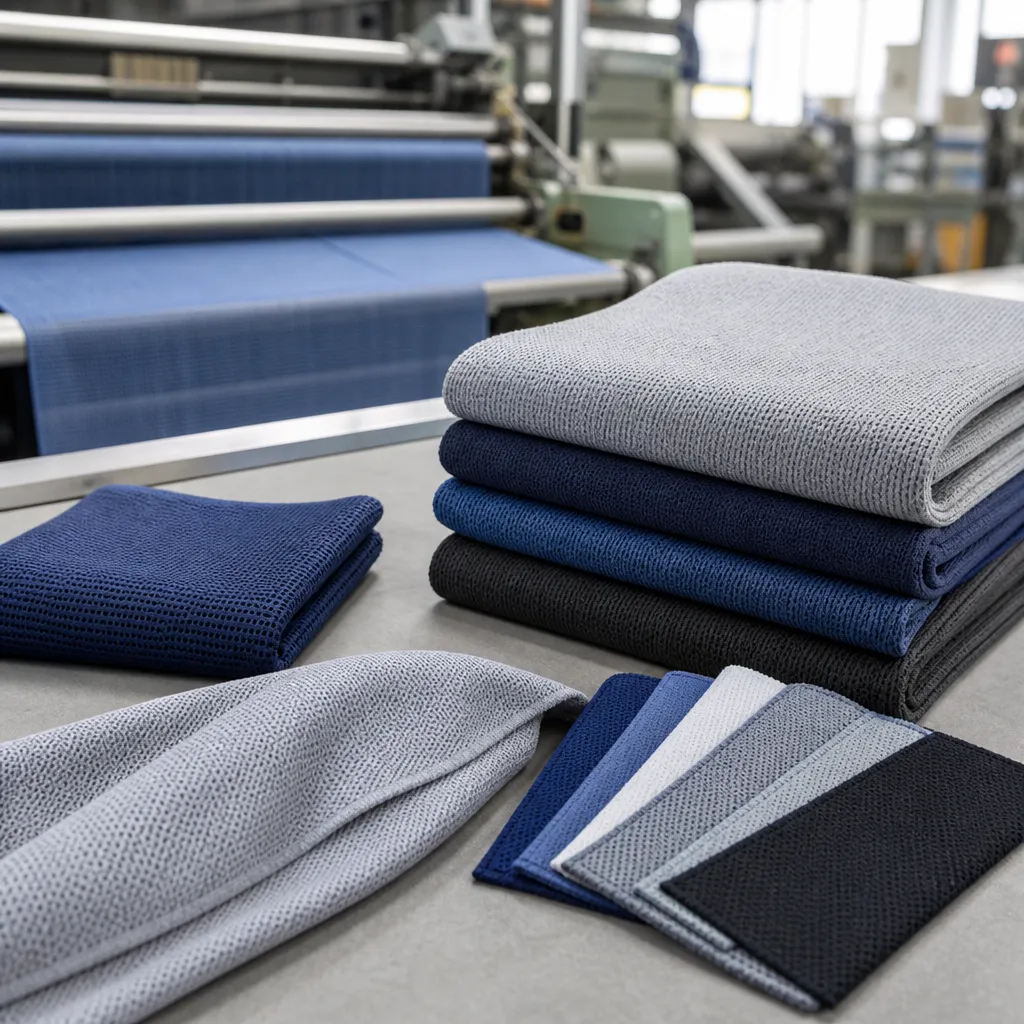
Start with the job, because one cloth cannot cover four jobs
We quote microfiber programs for optical, household, auto-detailing and promotional use, and they should not share the same construction. A 200 GSM suede cloth for sunglasses behaves very differently from a 320 GSM coral fleece cloth for car drying. If a brief says only "microfiber cloth" with no use case, we still have to ask what surface it touches, whether chemicals are involved, how many wash cycles matter, and whether the cloth is sold loose, bagged, or packed into a kit.
| Use case | Typical construction | Usable GSM | Common size | Main risk if underspecified |
|---|---|---|---|---|
| Optical / screen | 80/20 polyester-polyamide suede knit | 170-220 | 15x18 cm, 20x20 cm | Low absorbency is acceptable, but edge abrasion and silicone contamination are not |
| Household general cleaning | 80/20 warp knit short pile | 220-280 | 30x30 cm, 35x35 cm | Poor split ratio leaves streaks on glass and polished steel |
| Auto interior / glass | 75/25 or 80/20 short pile knit | 240-320 | 40x40 cm | Hard overlock edge can mar piano black trim |
| Auto drying / heavy absorption | Twisted loop or coral fleece | 500-900 | 40x60 cm, 50x80 cm | Weight sounds high, but dry hand feel can still be weak if yarn denier is wrong |
- If the cloth touches lenses, spec laser cut or ultrasonic cut and ask for edge-friction review on coated surfaces.
- If it touches car paint, ask whether the face is split microfiber or ordinary filament polyester with brushed pile.
- If it goes into a retail cleaning kit, define individual pack format before sample stage, because fold size changes labor and carton count.
- If the buyer expects repeated laundering, write a wash target in the tech pack rather than assuming it.
The microfiber cloth 2026 buyer guide spec line that matters most: yarn and split
The cloth's real cleaning action comes from split filaments, not from soft handfeel alone. For most cleaning programs we quote 80/20 polyester-polyamide, sometimes 85/15 for lower-cost household lines. On our side, we check whether the yarn is truly split after dyeing and finishing because insufficient splitting leaves the fabric smooth in the hand but weak in pickup. A buyer comparing only GSM can miss this completely.
Two details matter here. First, yarn fineness: 150D/144F and 100D/144F do not behave the same in short pile constructions. Second, pile formation: a warp knit cloth with stable ground structure sheds less at the cut edge than a looser circular-knit imitation. For glass and polished surfaces, we often run a simple panel wipe test after laundering, then compare drag and residue under side light. For formal lab work, absorbency and colorfastness are easier to standardize than cleaning efficiency, so the buyer should ask for both bench trial and standard test report.
| Fiber mix | Cost level | Typical performance | Where we use it |
|---|---|---|---|
| 80/20 | Baseline commercial | Balanced absorbency, softness and wash durability | Most custom microfiber cloth orders |
| 75/25 | Higher | Better moisture uptake and softer wipe on delicate surfaces | Auto glass, cosmetic, higher-end cleaning kits |
| 85/15 | Lower | Acceptable for disposable or low-cycle programs, weaker pickup | Promotional cloths, budget household sets |
| 100% polyester faux microfiber | Lowest | Looks similar initially, weaker capillary action | We usually reject it for any performance-led brief |
Choose construction before you argue about price
A lot of quote gaps come from mixing up suede, short pile, pearl weave, waffle and twisted loop. These are not styling options. They change friction, absorbency, drying speed and how the logo can be applied. Optical cloths are usually flat suede knit so they slide cleanly over coated lenses. Household cloths often work best in short pile warp knit because the structure stays stable after repeated washing. Waffle and pearl textures can improve grab on dust and kitchen grease, but they are not suitable for every printed logo brief.
- For screens, eyewear and glossy packaging inserts, start with suede knit 170-200 GSM.
- For all-purpose wiping, use short pile 230-260 GSM with overlock or hidden edge.
- For streak-sensitive glass, consider tight warp knit 240-280 GSM and avoid fluffy pile.
- For water pickup, move to twisted loop 550 GSM and above, which is no longer the same sourcing discussion as a standard microfiber cloth.
Related reads: for broader material context, see microfiber vs cotton towel comparison, custom microfiber towels wholesale guide, and auto detailing microfiber towel program.
Edge finish is where cheap substitutions show up first
If we receive a complaint on a microfiber cloth program, edge construction is often the first place we look. Overlock is inexpensive and stable, but the seam thread and seam bulk can scratch sensitive surfaces. Edgeless cloths feel safer to the user, yet they need cleaner cutting and better process control because poorly cut edges can fuzz after wash. Ultrasonic cutting seals the edge fast, but on some thicker fabrics it can create a stiffer perimeter than buyers expect.
One of the fastest ways to lose margin is to approve a soft sample with hidden edge, then cut cost in bulk by switching to coarse overlock thread. The savings are visible to the end user in one touch.
| Edge type | Added cost vs basic overlock | Best use | Failure mode to watch |
|---|---|---|---|
| Poly overlock, 3-thread | Base | Household and promo packs | Edge drag on glass, seam curling after wash |
| Microfiber bound edge | +USD 0.03-0.06/pc | Auto interior and better retail kits | Binding mismatch in shade or shrinkage |
| Laser / ultrasonic cut | +USD 0.02-0.05/pc | Optical and edgeless short pile cloths | Heat-hardened rim on thick fabric |
| Turned hem | +USD 0.05-0.08/pc | Larger cloths where framed finish matters | Skewed hemming reduces square shape |
- Ask for edge close-up photos after one wash and five washes, not only ex-factory photos.
- If the cloth is for coated lenses or piano-black trim, request a hand-rub check on actual substrate.
- If color is dark navy or black, inspect for needle heat glazing along bound edges.
- Write seam thread color into the PO when appearance matters; mills otherwise match from stock.
Printing and branding should follow the fabric, not the other way around
Promotional buyers often begin with artwork size, but microfiber reacts differently depending on pile height and knit density. Full-color sublimation works well on white or light polyester-rich suede cloth and gives sharp logos for screen wipes or giveaway cloths. Embroidery is uncommon on small microfiber cloths because it distorts drape and creates a hard backside. Woven label insertion is more practical for retail packs above 30x30 cm. If the fabric is dark-dyed short pile and the logo must stay low-cost, a small heat-transfer mark can be workable, though repeated wash performance should be verified.
We usually advise buyers to separate the decoration brief into two decisions: what the logo must look like on shelf, and what the cloth must still do in use. A lens cloth with dense edge-to-edge sublimation can look strong in packaging, but heavy ink loading can slightly change glide and water uptake. That trade-off is acceptable for promo optics, less so for technical cleaning.
Related reads: decoration choices are covered in embroidery vs sublimation vs jacquard and color approval in pantone color matching custom towels.
The tests worth asking for on a microfiber program
Not every order needs a long lab package, but some tests are worth naming in the spec sheet. For dyed cleaning cloths, we commonly run colorfastness to washing under ISO 105-C06 and colorfastness to rubbing under ISO 105-X12. For dimensional stability after washing, ISO 5077 is a practical reference. If the cloth is sold into baby, beauty or close-contact consumer channels, buyers often also request the current OEKO-TEX Standard 100 certificate review. We hold OEKO-TEX Standard 100 Class I, BSCI and ISO 9001, but a buyer should still match the certificate scope to the actual product group and fiber content.
- For dark shades, require ISO 105-C06 and specify acceptable gray scale rating after washing.
- For white printed cloths, ask for migration and yellowing check after heat transfer or sublimation curing.
- For repeated laundering, add ISO 5077 dimensional change limit, especially on edgeless formats.
- For glass or lens use, request a bench streak test on supplied substrate, since standard textile tests do not capture that well.
Price bands in 2026: what actually moves the FOB number
For a standard custom microfiber cloth order, the cost swing usually comes from four items: polyamide ratio, construction, edge finish and packout. Size matters, but it is rarely the only driver. As a working range from our current quoting, a 30x30 cm 230-250 GSM 80/20 short pile cloth with basic overlock in solid color lands around USD 0.24-0.33 FOB at 10,000-30,000 pcs. The same size in 75/25, darker reactive shade, microfiber bound edge and individual printed polybag can move to USD 0.37-0.49 FOB. Small optical suede cloths are cheaper by area but often carry higher printing and packing cost per piece.
| Spec example | 5,000 pcs | 20,000 pcs | 50,000 pcs | Notes |
|---|---|---|---|---|
| 20x20 cm suede, 180 GSM, full sublimation, single OPP bag | USD 0.19-0.26 | USD 0.14-0.19 | USD 0.12-0.17 | White base, print coverage affects waste |
| 30x30 cm short pile, 240 GSM, 80/20, overlock | USD 0.29-0.38 | USD 0.24-0.30 | USD 0.22-0.28 | Most common household brief |
| 40x40 cm glass cloth, 260 GSM, edgeless cut | USD 0.44-0.57 | USD 0.36-0.46 | USD 0.33-0.42 | Tighter QC and better yarn required |
| 40x60 cm twisted loop drying cloth, 600 GSM, bound edge | USD 1.46-1.78 | USD 1.28-1.57 | USD 1.19-1.46 | Different product family, higher material weight |
Our MOQ is 500 pcs per design per color, but that is only the commercial floor. On microfiber cloth programs, practical MOQ can rise if the buyer wants custom woven labels, printed insert cards, many color splits, or a dye-to-match shade outside stock range. Buyers asking for 12 colors at 500 pcs each often save less than expected once setup waste and mixed carton handling are included. In that case we usually price two or three core colors first, then add shades after sell-through data.
Timeline: where the days go between RFQ and ex-factory
Lead time on these cloths is shorter than cotton towel programs, but not instant. If yarn is in routine count and the shade is straightforward, lab dips take 3-5 days, sample making 5-7 days, and bulk production 18-28 days after approval and deposit. Full sublimation cloths can move faster on knitting but slower on artwork confirmation. A retail set with custom header card, barcode sticker and inner bag audit usually adds 3-6 days because packaging approval has to catch up.
- RFQ and spec check: 1-2 days
- Lab dip or print strike-off: 3-5 days
- Pre-production sample: 5-7 days
- Bulk knitting, dyeing, cutting and sewing: 18-28 days
- Final inspection and booking: 2-4 days
For urgent launches, air freight is possible because microfiber cloth cartons cube out later than cotton towels, but buyers should still compare landed cost against a slightly later sea shipment. We outline that trade-off in container vs air freight towel orders.
A workable RFQ for this category is shorter than most buyers think
The cleaner the RFQ, the fewer sample loops you pay for. We do not need a ten-page brief. We need the lines that decide performance and cost. If one of those lines is missing, the quote becomes provisional, and that is where comparison across suppliers starts to break down.
- End use: lens, household, glass, auto interior, drying, electronics
- Construction: suede, short pile, waffle, pearl, twisted loop
- Fiber mix and target GSM
- Finished size and tolerance
- Edge finish
- Color standard or artwork file
- Packout: loose bulk, polybag, header card, gift box, kit inclusion
- Wash target or test requirement
- Order quantity by color and by design
If you need a format that mills can quote cleanly, build towel tech pack that mills can quote is still useful even though the examples there are broader than microfiber cloths.
What we would approve, reject, or revise before bulk
Approve: an RFQ with use case, construction, size, GSM, edge and packout already fixed. Revise: a brief that says lint-free but asks for fluffy high pile at the same time. Reject: any target price that forces 100% polyester imitation microfiber for a surface-sensitive cleaning job, because that usually creates more claims cost than the savings justify. In one recent household order, the buyer held FOB at USD 0.23 for a 30x30 cm cloth, so the competing sample came back with weaker split and lighter actual weight at 214 GSM versus the requested 240 GSM. After three home-laundry cycles, pickup dropped sharply. The buyer later moved to an 80/20 236 GSM cloth at USD 0.27 FOB and cut complaint replacements by enough to cover the difference inside the first quarter.
For buyers sourcing into retail, hospitality amenities, or branded cleaning kits, that is usually the more useful comparison: not the cheapest unit, but the cost of returns, repacks and missed reorder timing. We supply across 47 countries with OEKO-TEX Standard 100 Class I, BSCI and ISO 9001 systems in place, and we still rely on that same discipline at spec stage because microfiber mistakes are hard to hide once the carton is open.
Quote a microfiber cloth with usable spec lines
Send size, GSM, construction, edge finish, artwork and packout. We can quote from MOQ 500 pcs per design per color and flag any weak points before sampling. WhatsApp +86 13205717266 or email [email protected].
Request Quote →