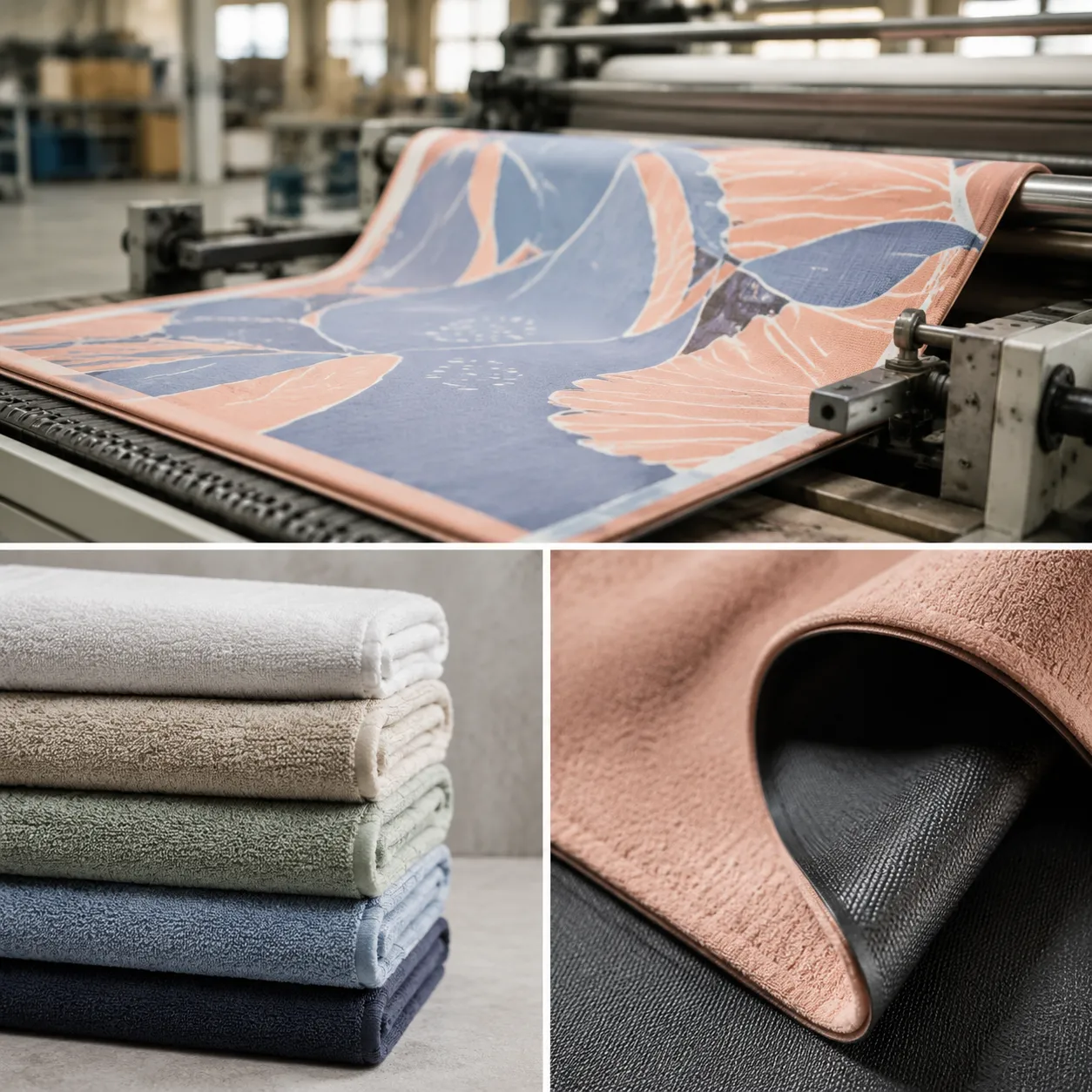
The first question is whether the factory actually makes hair wraps, not just microfiber towels
We see this mistake often: a buyer sends the same brief to three towel mills, two trading companies, and one cut-and-sew workshop, then compares only FOB price. A supplier may be competent with gym towels or cleaning cloths and still struggle with shaped hair wraps because the product introduces curved cutting, closure reinforcement, and fit consistency. A rectangular towel is forgiving. A twist-and-button wrap is not.
For this category, we look for proof in previous production records: shaped pattern markers, closure sewing SOPs, and wash-tested samples with the elastic loop or button tab already attached. If a vendor can only show flat microfiber towels, your approval risk is higher even if the raw fabric is acceptable. This is where a true microfiber hair towels supplier checklist saves time.
- Ask for 2-3 recent bulk references in hair wraps or turban-style towels, not generic microfiber items.
- Request photos of the cut panel before sewing so you can confirm the factory handles curved patterns rather than only straight hem programs.
- Confirm whether sewing is done in-house or subcontracted. Subcontracting is not automatically wrong, but it changes lead-time control and defect accountability.
- Ask for a wash-tested sealed sample with closure attached; an unwashed proto sample tells very little.
Fabric choice decides performance more than the silhouette
Most brand complaints in this category are blamed on “poor absorbency,” but the root cause is usually the wrong knit and pile for the target user. Hair towels need fast water pickup without feeling heavy on the head. In practice, that pushes most successful programs into 250-340 GSM microfiber, usually 80/20 polyester-polyamide or 85/15 when cost pressure is stronger. Below that range, the wrap feels flimsy and can lose body after repeated washing. Above roughly 360 GSM, many users say the wrap feels bulky once twisted and buttoned.
Construction matters as much as GSM. Warp knit coral fleece gives a softer hand and fuller feel, but if the pile is too open it can drag on wet hair and distort after laundering. Short-pile suede or brushed warp knit dries faster and prints more cleanly, but some buyers find it less plush for beauty retail. We usually push buyers to define the use case first: salon retail, DTC beauty accessory, hotel spa amenity, or subscription box. The right fabric is different for each.
| Construction | Typical GSM | Common Use | Watch-out |
|---|---|---|---|
| Warp knit coral fleece | 280-340 | Retail hair wrap, beauty sets | Can feel bulky if pattern is oversized |
| Short-pile brushed microfiber | 250-300 | Travel and fast-dry programs | Less plush hand feel |
| Double-sided fine terry microfiber | 300-360 | Higher absorbency positioning | Heavier twist on head |
| Low-cost plain microfiber knit | 220-260 | Promotional programs only | Weak body and lower perceived value |
Closures are where a lot of bulk orders start failing
The closure system deserves more attention than most buyers give it. On a hair wrap, the button, elastic loop, or stitched tab absorbs repeated torsion. If that point is weak, the product can pass incoming inspection and still fail after ten home washes. We have seen returns triggered by loop elongation, button detachment, and seam grin around the narrow tail section where the wrap is twisted tight.
The practical control points are very specific. We prefer bartack reinforcement at the loop insertion point and a minimum seam allowance that does not collapse after overlock trimming. If the style uses a resin button, ask for needle detector compatibility and confirm button shank thickness; thin decorative buttons crack during tumble drying. If the style uses elastic cord, specify recovery after extension, not just length at rest.
- For elastic loop styles, ask for a 20-cycle pull test on the finished assembly, not only on the cord before sewing.
- For button styles, require button attachment testing to the supplier's internal standard and keep a retained sealed sample.
- Review the tail width and taper. Too narrow looks neat on screen but concentrates stress when the user twists wet hair.
- Check whether edge finishing is 3-thread overlock plus turn-in, or overlock only. Overlock only is cheaper but less stable on curved edges.
A cheap sample can hide a costly bulk problem
Sampling in this product category is deceptive because the first proto is often cut manually and sewn by the most skilled line operator. Bulk production is different. Marker nesting changes grain behavior, operators rotate, and closure placement drifts. That is why we do not treat sample approval as a visual event only. We want a pre-production sample made from bulk-intended fabric, with bulk-intended sewing method, and measured after wash.
Two technical details matter here. First, microfiber can creep during cutting if the lay is too high, so curved edges from the top ply and bottom ply do not match perfectly after sewing. Second, if the pile direction is inconsistent, wraps from the same carton can show shade variation even in solid colors. This is not a dye issue; it is nap direction. A supplier that knows hair wraps will call this out before cutting.
- Approve the pattern dimensions with tolerance before approving color.
- Approve one washed PPS sample with actual closure and final packaging.
- Lock the pile direction standard so all pieces in bulk face the same way.
- Require a top-ply versus bottom-ply cut check during first bulk lay if fabric has noticeable slip.
Ask how absorbency is being proved, not merely claimed
“Super absorbent” is a useless phrase without a method behind it. For microfiber hair wraps, we normally discuss water absorption and wash durability together, because initial pickup can look good even on a weak fabric. A supplier should be able to describe how they test absorbency after laundering, not just on greige or first-finish fabric.
Useful lab references include AATCC 79 for absorbency behavior and AATCC 135 for dimensional stability after home laundering. For colorfastness on darker shades, AATCC 61 is common for wash fastness screening. If the wrap includes printed artwork or a woven label at the seam, we also review whether the accessory changes drying behavior or causes edge curling after wash. These details are product-specific; they are not generic box-ticking.
| Test area | Method often used | What good suppliers show | Why it matters |
|---|---|---|---|
| Absorbency | AATCC 79 | Before-and-after wash data | Initial performance can drop after finishing wears off |
| Dimensional stability | AATCC 135 | Shrinkage results by direction | Poor stability changes fit after first laundry |
| Colorfastness to washing | AATCC 61 | Grade record by shade | Dark fashion colors can bleed onto light packaging or labels |
| Harmful substances | OEKO-TEX 100 Class I | Valid certificate scope | Important for beauty and personal care positioning |
MOQ is simple on paper and complicated in the style mix
Our standard MOQ is 500 pcs per design per color, but hair wrap programs usually become complicated because buyers want three colorways, custom woven labels, a printed care card, and maybe two closure types. The factory minimum can still be 500 pieces, yet the real economic break point moves once trims and packaging are split too many ways. This is where weak sourcing assumptions create friction later.
For example, a plain dyed wrap in 290 GSM brushed microfiber with a stock elastic loop and one main label may be efficient at 1,500 pieces total across three colors. The same silhouette with custom dye-to-match loop, retail belly band, recycled polybag, barcode sticker, and embroidered logo can become inefficient below 2,000-2,500 pieces total, even if the sewing minutes are similar. The additional handling, trim purchasing, and QC checkpoints drive that change.
| Program type | Volume | Indicative FOB China | MOQ logic |
|---|---|---|---|
| Plain dyed, stock loop, care label only | 1,000-1,999 pcs | USD 1.18-1.46/pc | Works from 500 pcs per color if shades are standard |
| Custom color, woven label, basic retail insert | 2,000-4,999 pcs | USD 1.34-1.72/pc | Better trim efficiency above 2,000 pcs total |
| Custom color, embroidered logo, retail pack | 5,000-9,999 pcs | USD 1.62-2.08/pc | Embroidery setup and packing labor need scale |
| Gift-set or multi-piece beauty bundle | 10,000+ pcs | USD 1.88-2.55/pc | Best quoted as full set, not stand-alone wrap |
These ranges assume standard export packing, OEKO-TEX compliant material inputs, and no unusual accessory sourcing. Air freight, FSC paper upgrades, low-volume Pantone matching, or specialty buttons can move the number. If a quote is far below the lower band, ask what was removed: polyamide ratio, closure quality, packaging labor, or GSM.
The factory should talk comfortably about returns, not only production
One useful sign during supplier evaluation is whether the mill can describe actual failure patterns from previous programs. For microfiber hair wraps, the common ones are edge waviness after wash, loop detachment, twisted side seams due to off-grain cutting, and reduced absorbency after softener-heavy finishing. A vendor that has lived through those issues will answer with process controls, not generic reassurance.
We would rather hear a supplier say, “dark plum shades in short-pile microfiber need extra rinse control because cationic softener can flatten pickup,” than hear ten lines about premium quality. The same applies to seam defects. If the curved crown section is fed too quickly into the overlock, you get puckering that only becomes obvious once the wrap is on the head. That is a real production quirk, not theory.
- Ask what top three claims or returns they have seen on hair wraps in the last 12 months.
- Ask how they control pile direction and shade appearance during in-line inspection.
- Ask whether they run a post-wash fit check on the twisted closure position, not just flat measurement.
- Ask what sewing defects are checked at final audit beyond loose threads and measurement.
Lead time usually breaks at dyeing or trims, not sewing
Buyers often over-focus on sewing capacity for this item. In reality, shaped microfiber wraps are not especially slow to sew once the line is set. More delays happen earlier: lab dips, bulk dye approval, custom trim arrival, and packaging confirmation. If the order includes a branded button or custom elastic color, the trim path can govern the whole calendar.
| Stage | Typical timing | Delay trigger |
|---|---|---|
| Quotation and spec review | 2-4 days | Missing pattern measurements or unclear closure spec |
| Proto sample | 5-8 days | Revising silhouette fit or tail length |
| Lab dip or color approval | 4-7 days | Beauty-brand shade sensitivity |
| Pre-production sample | 6-9 days | Waiting on final trims or label artwork |
| Bulk production | 18-28 days | Custom packaging collation or rework after wash test |
| Final inspection and booking | 3-6 days | Carton mark revision or vessel cutoff pressure |
A realistic full cycle for a custom order is usually 35-52 days from approved sample to FOB shipment. Repeat orders with locked fabric and trims can move in 22-30 days. If you need speed, simplify the trim stack before you negotiate sewing price. That usually saves more calendar time than squeezing one or two cents on unit cost.
Compliance is straightforward, but certificate scope still needs checking
Hair wraps sit close to skin and are often positioned in beauty, wellness, or personal care channels, so chemical compliance matters. We work with OEKO-TEX 100 Class I, BSCI, and ISO 9001, but buyers should still verify that the certificate scope actually covers the product family and current production entity. A PDF with the right logo is not enough.
For microfiber programs, we also tell buyers to review label claims carefully. If the item contains an 85/15 blend, do not let packaging imply performance associated with a higher polyamide blend unless you have tested it. If the pack says quick-dry or ultra absorbent, keep corresponding internal test records. This is basic risk control, especially for retailers and marketplace sellers.
- Check the OEKO-TEX certificate number and validity against the issuing database.
- Match the certified entity to the actual exporter and producer, especially if trading companies are involved.
- Confirm whether packaging components also need separate material declarations for your market.
- Keep a signed spec sheet that covers blend ratio, GSM tolerance, dimensions, closure type, and packout.
Related reads: if you are still building the RFQ, start with build-towel-tech-pack-that-mills-can-quote and microfiber-vs-cotton-towel-comparison. If compliance review is slowing down approval, how-to-read-oeko-tex-certificate is the faster reference.
What we would put on the RFQ before asking any supplier to quote
A good RFQ for this category is short but precise. We do not need a long checklist; we need the few details that prevent factories from quoting different products under the same name. Hair wrap sourcing gets messy when one supplier prices 260 GSM plain knit, another prices 320 GSM coral fleece, and both write “microfiber hair towel” on the quotation.
- State the finished dimensions and whether measurements are taken before or after wash.
- Specify the fabric construction and target GSM tolerance, for example 300 GSM brushed warp knit ±5%.
- Define the blend ratio target, usually 80/20 or 85/15.
- Show the closure location with measurement from edge and required reinforcement method.
- State branding method: woven label, embroidery, heat transfer, or no logo.
- List exact packaging components, from care card to barcode label and master carton count.
Related reads: for MOQ strategy, negotiate-towel-moq-without-killing-margin is useful. For decoration choices on synthetic towels, compare methods in embroidery-vs-sublimation-vs-jacquard and color control in pantone-color-matching-custom-towels.
A shorter shortlist usually gives better buying decisions
If we were buying this item brand-side, we would not RFQ ten factories. We would shortlist three: one proven microfiber cut-and-sew source, one vertically integrated towel mill that already makes shaped beauty accessories, and one backup with strong compliance and packaging control. Then we would score them on sample accuracy, closure durability, wash data, and responsiveness to spec corrections. Price matters, but on a product with a small ticket value and high return sensitivity, the wrong supplier is more expensive than the higher quote.
That is the practical purpose of a microfiber hair towels supplier checklist: to remove false comparability. Once fabric, closure, testing, MOQ logic, and approval sequence are aligned, quotations become meaningful. Without that alignment, the cheapest offer is usually just the least-complete interpretation of your brief.
Need a microfiber hair towel quote with real spec control?
Send us your dimensions, target GSM, closure style, logo method, and packaging plan. We will quote against an actual production spec, not a generic towel assumption. MOQ 500 pcs per design per color. WhatsApp +86 13205717266 or email [email protected].
Request a quotation →