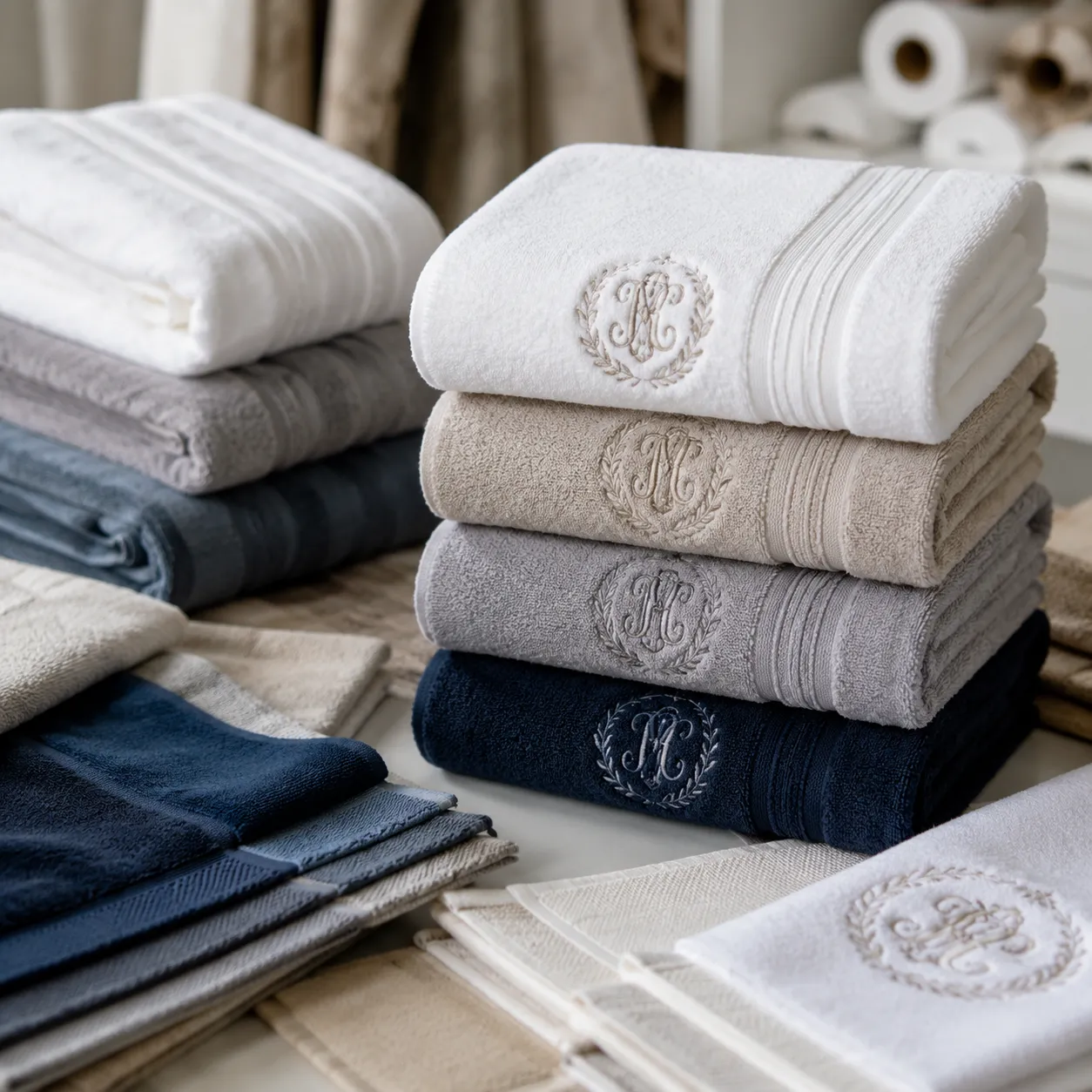
Why the sheet breaks down at the first sample room meeting
The rejection usually starts with one missing line, not one major defect. A brand sends artwork, target size, and a copied certificate PDF. The sample room then has to guess whether the face yarn should be 16s ring spun or 21s/2, whether the border is dobby or plain hem, whether the stated GSM is before wash or after three home-laundry cycles, and whether the logo area must remain within a ΔE tolerance after dyeing. Once those assumptions enter weaving and dyeing, the sample can still look acceptable on screen while failing in weight, absorbency, or documentation.
For an OEKO-TEX program, the paperwork problem is even sharper because the certificate itself does not define your towel construction. Standard 100 confirms the tested article class and certified components under a certificate number. It does not tell the loom what pile height to run, it does not set your warp density, and it does not replace your wash-performance tolerances. That is why the spec sheet has to bridge certification status and manufacturing reality.
Start with the certificate fields that belong on the spec sheet
If the towel will be sold as OEKO-TEX certified, we place the certificate details near the top of the technical data sheet, not buried in an appendix. The exact fields matter. We normally request the following: certificate number, issuing institute, product class, certificate validity date, covered article description, and the certified component scope if the item uses mixed trims such as satin labels, elastic loops, woven labels, or embroidery thread.
For towels intended for babies or sensitive-skin ranges, the sheet should clearly state OEKO-TEX Standard 100 Product Class I. For adult bath, beach, gym, or golf towels, the applicable class is usually Product Class II unless the buyer has a stricter private standard. We also write one practical line that avoids confusion during trim sourcing: "All sewn-in labels, sewing thread, hanger loop, embroidery thread, and packaging in direct contact with article must be covered by valid OEKO-TEX documentation or approved equivalent input declaration." Without that sentence, sample approval can pass using one set of trims and bulk can quietly switch to another.
| Certificate field | What to write | Why it matters |
|---|---|---|
| Standard | OEKO-TEX Standard 100 | Confirms the program is article-based, not a vague eco claim |
| Product class | Class I or Class II | Aligns chemical restrictions with end use |
| Certificate no. | Full alphanumeric number from supplier file | Needed for traceability and buyer verification |
| Issuing institute | For example Hohenstein or TESTEX | Lets compliance teams verify the record |
| Validity | Issue date and expiry date | Expired certificates should not be used for bulk claims |
| Covered components | Fabric, yarn, sewing thread, label, embroidery thread, elastic loop if any | Prevents non-certified trim substitution |
The construction block needs numbers a loom can follow
The middle of the document is where most brand-side sheets become too soft. "Plush," "midweight," or "luxury handle" do not travel into production. A towel mill needs the construction block to state fabric type, pile arrangement, yarn system, density, finished weight basis, and dimensional tolerances. Even for a simple dobby border towel, those lines decide absorbency, drying time, lint level, and pack weight.
A workable construction section will state whether the towel is single-sided terry, double-sided terry, velour face with terry back, waffle, or flat-woven hammam style. It will specify yarn composition such as 100% cotton, 86/14 cotton-poly blend, or recycled polyester ground with cotton pile where relevant. It will also state yarn count. On a cotton bath towel program, for example, we may run 20s ring-spun pile with 16s ground warp and 10s weft, while a tighter athletic hand towel may use a finer pile count to keep bulk down. The point is not one universal formula; the point is that the spec line must exist.
| Spec line | Recommended format | Typical tolerance |
|---|---|---|
| Finished size | 30 x 50 cm after wash | ±3% each direction |
| Finished weight | 430 GSM after wash and conditioning | ±5% |
| Construction | Double-sided terry with 4.2 cm dobby border | No visual deviation without approval |
| Fiber content | 100% cotton, ring spun | Label claim must match test result |
| Yarn count | Pile 20s, ground warp 16s, weft 10s | Mill internal control |
| Color standard | Pantone TCX reference or approved lab dip | ΔE CMC 2:1 ≤ 1.20 to approved standard |
- State whether GSM is measured finished and conditioned or grey-state. We use finished and conditioned because that is what the buyer receives.
- Write border width in centimeters, not "standard border." The difference between 3.0 cm and 5.5 cm changes loom setup and visual balance.
- If the towel has a hanger loop, specify placement from finished top edge and required pull strength in newtons.
- If embroidery is planned, reserve logo area dimensions and maximum stitch density so the ground does not pucker.
Write test methods and pass values, not just the word "tested"
A technical data sheet becomes useful when every critical property has both a method and an acceptance value. For cotton towels, we normally see four frequent blind spots: colorfastness language without grades, shrinkage without wash conditions, absorbency without timing, and pH without a target band. Those gaps lead to arguments later because each lab may use a different routine.
For colorfastness, we recommend citing the ISO method and the minimum grey scale rating. A practical line is: Colorfastness to washing ISO 105-C06 A1S, color change minimum grade 4, staining minimum grade 3-4 on cotton and polyester adjacent fabrics. For dark navy or black reactive shades, some buyers accept staining grade 3 on first bulk if pre-approved, but that concession should be explicit. For rubbing, a line such as ISO 105-X12 dry minimum 4, wet minimum 3 is more useful than "good fastness."
Absorbency also deserves a real criterion. For terry towels, we often use a simple internal drop test for development, but on buyer documents we prefer a stated method basis. If the buyer does not nominate one, we define a vertical or sink-time protocol in the appendix and set a pass value such as first visible wet-through in 8 seconds max for a 430-470 GSM hand towel or 12 seconds max for a denser velour beach towel. Likewise, pH can be stated as ISO 3071, pH 4.0-7.5. This is particularly useful for compliance teams reviewing OEKO-TEX continuity because a compliant certificate does not remove the need to monitor wet-processing control lot by lot.
| Property | Method | Acceptance value |
|---|---|---|
| Colorfastness to washing | ISO 105-C06 A1S | Color change ≥ 4; staining ≥ 3-4 |
| Colorfastness to rubbing | ISO 105-X12 | Dry ≥ 4; wet ≥ 3 |
| Dimensional change | ISO 6330 wash + ISO 5077 measurement | Length and width each within -5% / +3% |
| pH of aqueous extract | ISO 3071 | 4.0 to 7.5 |
| Mass per unit area | ISO 3801 or agreed cut-and-weigh method | Within stated GSM tolerance ±5% |
| Needle detection if required by buyer | Fe 1.2 mm test piece | 100% cartons passed through calibrated detector |
The sample approval section should mirror bulk, not flatter it
One avoidable mistake is approving a presentation sample made under conditions that will never be repeated in production. A hand-cut towel with hand-trimmed fringe, one-piece embroidery, and a one-off softener recipe cannot represent a 12,000-piece run. The data sheet should define which sample types are required and which one becomes the governing standard.
- Lab dip approval against Pantone or physical standard before weaving or dyeing reservation.
- Construction sample for pile density, border layout, loop length, and handfeel review.
- Pre-production sample made with bulk-intended yarn, dye recipe family, trims, and logo method.
- Washed approval sample after the agreed laundering cycle, used as the bulk reference standard.
That final washed approval matters because towel dimensions and hand after washing are often very different from loom-state appearance. If the sheet says 50 x 100 cm but does not say "after one industrial wash" or "after three home washes at 40°C," everyone will measure a different stage. We usually note the exact approval basis in one line: PP sample approved after 3x wash at 40°C, tumble low, conditioned 24 h before measurement. It sounds small, but it removes half the disputes around shrinkage and handle.
Where OEKO-TEX and bulk trim changes usually go wrong
The highest-risk substitutions are rarely the cotton yarn. They are the small inputs added late: woven brand labels, decorative piping, contrast sewing thread, elastic retail loops, zipper pouches for travel sets, and metallic embroidery thread. A towel body can be covered by one valid certificate while a replacement trim arrives with no compliant paperwork at all.
Two very specific failure modes appear often. First, the approved sample uses a polyester satin label from one nominated trim vendor, but bulk purchasing switches to a cheaper label with a different coating finish. Second, the embroidery thread is changed from matte viscose to bright trilobal polyester because the logo reads sharper, yet the certificate file still lists only the original thread article. Neither problem is visible to a final customer at first glance. Both create compliance exposure.
- Add a trim matrix to the sheet listing supplier name, article code, material, color, and certificate reference for each trim.
- Lock the care label language and fiber-content claim before print approval; relabeling after production is expensive and slow.
- If polybag or ribbon will touch the towel surface in retail pack, document material declaration and restricted-substance status.
- If a buyer needs baby-use compliance, do not allow decorative coatings, rubber prints, or adhesive patches without separate review.
The costing lines that belong in a real specification file
A buyer technical sheet is not a quote sheet, but leaving out the commercial assumptions creates avoidable price drift. We usually place a short costing assumption table or note block at the end so both sides are pricing the same article. The three lines that move towel cost fastest are GSM, decoration method, and packaging format.
| Order volume | Typical FOB China price band | Assumption basis |
|---|---|---|
| 500-1,200 pcs | USD 2.05-2.72 per piece | 100% cotton terry hand towel, 420-460 GSM, woven label, single polybag |
| 3,000-8,000 pcs | USD 1.48-2.18 per piece | Same construction, standard reactive shade, export carton pack |
| 15,000+ pcs | USD 1.19-1.86 per piece | Stable color program, optimized loom efficiency, shared dye lot planning |
Those numbers are not universal and should be refreshed for each article and each project, but they show why the sheet must define packout and finishing. If one team prices a folded belly-band retail presentation and another assumes carton bulk pack, the gap can exceed USD 0.24 per piece before freight. If embroidery is added at 8,000 to 11,000 stitches, that can add another USD 0.18 to 0.42 depending on volume and thread count.
Lead time shrinks when the document is written in production order
The fastest towel programs are not the ones with the shortest nominal factory lead time. They are the ones whose technical data sheet follows the same sequence the mill uses to release work. If the spec jumps from packaging to color to certification to sizing with open questions left in each section, approvals stall at every department handoff.
For a standard OEM towel order at our MOQ of 500 pieces per design per color, a realistic calendar is 2-4 days for quotation review if the sheet is complete, 4-7 days for lab dips, 7-12 days for pre-production samples, 18-32 days for bulk production after sample approval, and 3-5 days for final inspection and export booking preparation. Add time for custom packaging, embroidery sampling, or third-party lab testing. A missing trim certificate can hold shipment longer than weaving ever will.
The best spec sheet reads like a release order: certificate first, construction second, tests third, trim control fourth, packing last.
A short buyer-side checklist before you send the RFQ
Before issuing the RFQ, we recommend one final pass from the buyer or sourcing manager who will own claims after shipment. This is where the oeko tex certified towel buyer technical data sheet stops being a design file and becomes a commercial control document.
- Does the sheet name the OEKO-TEX Standard 100 class and certificate fields, not just the logo claim?
- Are size and GSM stated on the same basis: before wash or after agreed laundering?
- Do all critical tests include both method and pass value?
- Are all trims listed with supplier article code or approval reference?
- Is the approved sample type identified as the governing standard for bulk?
- Does packaging specify unit fold, insert, barcode position, carton count, and carton gross weight limit?
If your team is still building the format itself, build-towel-tech-pack-that-mills-can-quote.html is the best starting point. For certificate review, how-to-read-oeko-tex-certificate.html explains the fields compliance teams should actually verify. If GSM disputes keep showing up between development and bulk, towel-gsm-decision-framework.html and pantone-color-matching-custom-towels.html help clean up the spec language upstream.
What we expect to receive before we lock bulk yarn
At mill level, the cleanest handoff includes artwork, size chart, packaging dieline if retail packed, approved color references, target ex-factory date, and the finished oeko tex certified towel buyer technical data sheet signed by the buyer side. Once that file is complete, yarn booking and trim matching become routine instead of risky. Without it, the mill is forced to make assumptions, and assumptions are where cost, compliance, and claims start to drift apart.
Related reads: hotel-towel-sourcing-guide-2026.html, combed-vs-zero-twist-cotton-explained.html, and negotiate-towel-moq-without-killing-margin.html. If your program is for hospitality rather than retail, ../industries/airbnb-vacation-rental-towels.html and /products.html#hotel show the product families that usually need the strictest spec alignment.
Need help cleaning up a towel data sheet?
Send us your current spec or certificate set. We can mark missing fields, test methods, trim risks, MOQ fit, and a realistic bulk timeline before you place the order. WhatsApp +86 13205717266 or email [email protected].
Request a quote review →