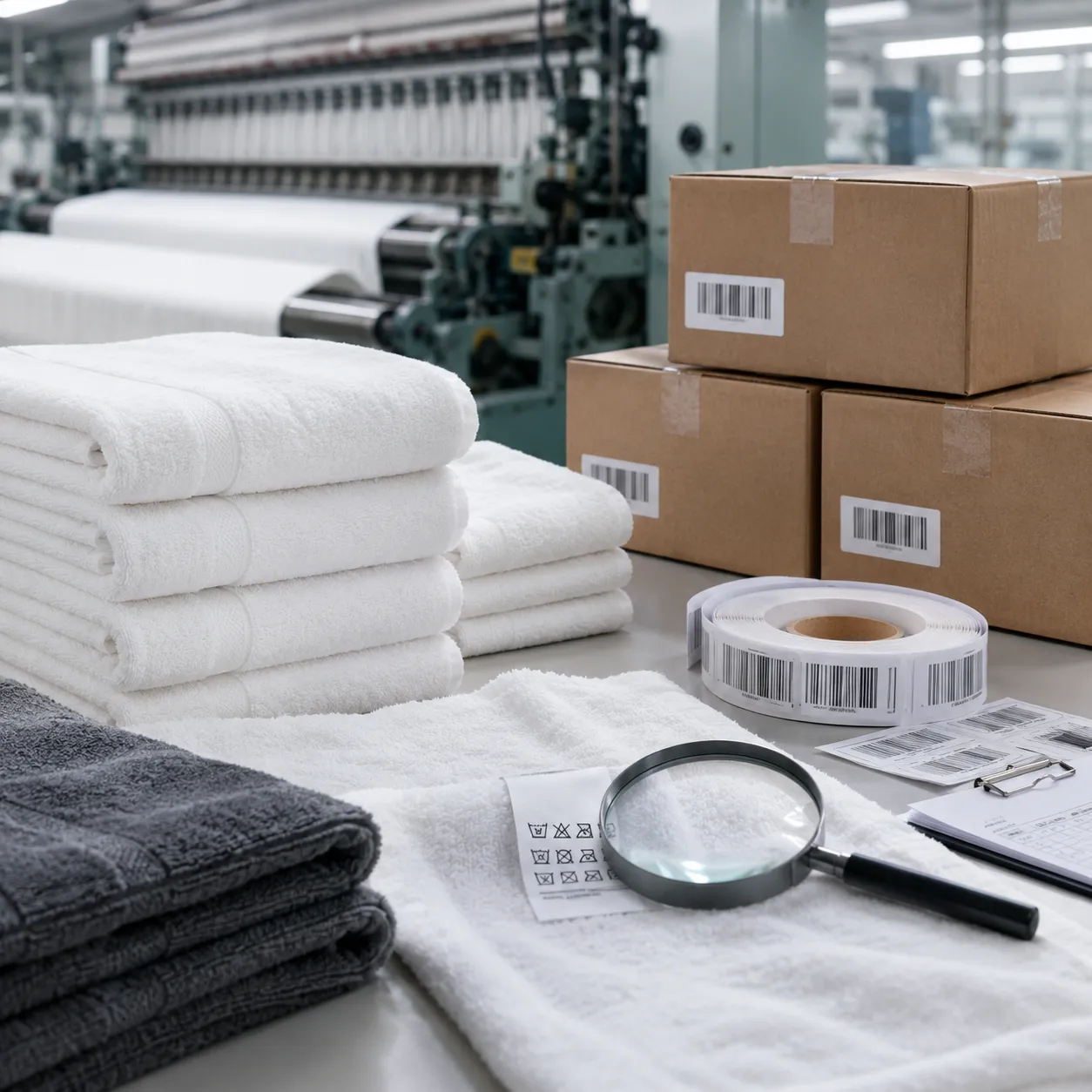
A packaging brief fails before the towel fails
For clinical buyers, the towel itself is only half of the inbound problem. A 450 GSM bath towel can pass absorbency checks and still be rejected at the dock if the GS1-128 carton label is unreadable, the private label insert says “antibacterial” without a test basis, or the care label contradicts the hospital laundry temperature. These are not cosmetic issues. They create receiving delays, relabeling charges, or quarantine of the whole shipment.
At our mill in Gaoyang, we treat packaging as a controlled production route. LUMA & CO. TEXTILE has operated since 2007 with 220 employees, ISO 9001 quality management, BSCI social compliance, and OEKO-TEX Standard 100 Class I certification for eligible towel articles. Our normal MOQ is 500 pcs per design / per color, but private label packaging needs its own MOQ logic because carton labels, woven labels, care labels, polybags, and inserts each have different setup costs.
This article focuses on hospital towel private label packaging for procurement teams that already know their towel type but need a factory-ready packaging specification. If the towel construction is still open, start with hospital medical towel sourcing, towel GSM decision framework, and build towel tech pack that mills can quote.
| Packaging layer | Factory decision | Hospital risk if undefined |
|---|---|---|
| Sewn brand label | Woven, satin printed, or heat-transfer label; 25-45 mm width typical | Wrong fiber claim or label discomfort in patient-use towels |
| Care label | ISO 3758 symbols plus country text; laundry temperature stated | Laundry team washes outside spec and blames towel shrinkage |
| Unit pack | No bag, recyclable OPP, PE bag, paper band, or kit pouch | Clean towels arrive dusty or overpacked for hospital SOP |
| Inner carton | Ward, SKU, size, color, and quantity grouping | Nurses or linen room staff open wrong carton during replenishment |
| Master carton | GS1-128 label, gross weight, dimensions, PO number, destination code | Dock receiving cannot scan or match ASN data |
Hospital towel private label packaging: what must be specified
A private label towel program for hospitals needs a tighter brief than retail bath towels because the carton may pass through centralized receiving, outsourced laundry, ward storage, and infection-control review. The package must identify the product without making unsupported medical claims. The most common missing field is not the logo file. It is the rule for how the towel is counted, grouped, and scanned.
A workable packaging brief starts with a single master SKU table. Each SKU should connect towel size, GSM, fiber, color, label artwork, care wording, unit pack type, units per inner carton, inner cartons per master carton, carton barcode, and pallet pattern. Without this link, a factory can still pack the towels, but the warehouse may receive five carton styles for one product family.
- Towel identity: bath towel, hand towel, washcloth, patient kit towel, discharge towel, or procedure-room utility towel.
- Construction: for cotton hospital towels, common ranges are 360-430 GSM for economical patient use, 440-520 GSM for ward bath towels, and 520-620 GSM for higher-retention hospitality or private clinics.
- Label set: brand label, care label, lot label if required, and carton label with SKU logic.
- Packaging hygiene: bulk carton liner, individual polybag, paper band, or sealed kit pouch depending on how the hospital stores clean linen.
- Receiving data: PO number, GTIN if used, batch or lot code, production date, country of origin, net/gross weight, and carton count.
For a typical 70 × 135 cm hospital bath towel at 480 GSM, the fabric weight before hemming and processing is about 454 g. Finished packed weight often lands near 475-505 g after hemming, moisture regain, label, and packaging allowance. This matters for carton planning: packing 40 pcs per carton creates about 19-21 kg net towel weight before carton board. If the hospital has a manual handling limit of 18 kg gross, the carton quantity must be cut to 32 or 36 pcs.
GS1-128 carton labels and scan verification
GS1-128 is a barcode symbology used to encode structured logistics data with GS1 Application Identifiers. For hospital towel cartons, the most useful fields are usually (01) GTIN, (10) batch or lot, (17) expiration date only if relevant, (21) serial number if requested, and (37) count. Towels do not normally need expiry dating, so adding an artificial expiry field can confuse warehouse systems. We ask buyers to confirm their GS1 company prefix and receiving-system requirements before artwork approval.
The reference documents are the GS1 General Specifications for data content and barcode placement, and ISO/IEC 15417 for Code 128 symbology. Barcode print quality should be verified under ISO/IEC 15416, which grades linear barcodes from A to F. For export cartons, a practical minimum is grade C or better after printing on the actual carton label stock, not only on a digital proof.
Barcode failure often comes from quiet-zone loss. A warehouse label may look fine to the eye, but if the left or right quiet zone is cut by a carton seam, tape edge, or logo border, the scanner fails. Another defect is low contrast after thermal transfer printing on kraft-colored stock. For hospitals using automated receiving, these problems cost more than the label itself.
| Barcode item | Factory control point | Acceptance target |
|---|---|---|
| GS1-128 data string | Check AI sequence against buyer data file before printing | No missing GTIN, count, lot, or PO fields requested by buyer |
| Quiet zone | Keep clear area outside start and stop bars | No tape, graphics, carton edge, or fold line crossing quiet zone |
| Print grade | Verify sample using ISO/IEC 15416 method where required | Grade C or higher for logistics cartons unless buyer requires B |
| Human-readable text | Print SKU, size, color, quantity, lot, and destination below or beside barcode | Readable at 1 m by warehouse staff |
| Carton placement | Apply on two adjacent carton faces for pallet receiving | Label remains flat after carton sealing and strapping |
For hospital towel private label packaging, our pre-shipment carton check includes a scan test on packed cartons after sealing. This is important because carton compression, tape reflection, and label curvature can change scan performance. A barcode that scans on a flat desk is not enough evidence.
Care labels that survive hospital laundry
Care labeling is not a small tag decision. Hospitals often wash towels at higher temperatures and with stronger chemistry than home users. A care label that says “wash cold” may protect a weak retail dye, but it is unrealistic for clinical linen. A label that says “bleach when needed” must be backed by the towel color, dye class, and buyer’s laundry formula.
For international programs, we align care symbols with ISO 3758. For the US market, buyers may also need text that complies with the FTC Care Labeling Rule, and ASTM D5489 can be used as a reference for care symbol systems. EU-destined shipments normally require fiber composition and responsible economic operator details through the brand’s compliance process. Country of origin marking must be consistent across sewn labels, carton marks, and customs documents.
A practical hospital towel care label might state: “100% cotton. Wash at 60°C with similar colors. Tumble dry medium. Do not use chlorine bleach on dyed towels. Iron low if needed.” For white towels used in industrial laundry, chlorine tolerance has to be tested separately because optical brightener, yarn quality, and finishing chemistry affect shade after repeated wash cycles.
- Satin printed labels are economical and clear for care text, but edges must be heat-cut cleanly to avoid scratch feel.
- Woven labels look stronger for brand identity, but small washing symbols below 5 mm can lose detail.
- Heat-transfer labels reduce seam bulk, but they need peel testing after 20-30 industrial wash cycles before hospital approval.
- Lot labels help trace claims when towels are distributed across multiple hospital sites from one PO.
We use AATCC 135 or ISO 6330 wash methods for dimensional-change reference depending on the buyer’s market, then compare label readability after washing. For towels, the label can outlast the ink but fail at the seam if the stitch density is too low. A care label attached with loose lockstitch at a side hem may twist, fray, or detach during tunnel washing.
OEKO-TEX claims cannot be improvised on inserts
OEKO-TEX Standard 100 is a product safety standard for harmful substances in textiles. LUMA & CO. TEXTILE holds OEKO-TEX Standard 100 Class I certification for eligible towel articles, which is the strictest class and is suitable for babies and toddlers. That does not mean every printed insert, adhesive sticker, sewing thread, pigment, or private label claim is automatically covered. The certificate scope and article description must match the product being shipped.
Hospital buyers sometimes ask to print “OEKO-TEX certified hospital towel” on the paper band. That wording may be acceptable only if the towel article, label components, and certificate number are properly controlled. If the buyer wants the OEKO-TEX mark displayed, use must follow OEKO-TEX labeling rules, including the correct label check number and institute. We do not place the mark on packaging until the artwork is checked against the certificate scope.
| Claim on packaging | Evidence needed | Factory action before mass packing |
|---|---|---|
| OEKO-TEX Standard 100 | Valid certificate, product class, article coverage, certificate number | Match towel SKU and packaging artwork to certificate scope |
| 100% cotton | Fiber composition records and yarn purchase documents | Confirm no polyester border, microfiber face, or blended label claim conflict |
| Bleach resistant | Wash and chemical exposure test for the exact color | Reject broad claim unless buyer provides laundry chemistry target |
| Antimicrobial | Regulatory approval and test method such as ISO 20743 where applicable | Do not print claim without legal review by brand owner |
| Latex free packaging | Material declaration for bands, pouch, and elastic if used | Source non-latex components and keep supplier file |
This is where evidence replaces habit. A towel can be safe and still have a noncompliant marketing card. For hospital towel private label packaging, the safest approach is to separate verified textile claims from brand story copy. The carton can carry operational information; the insert can carry approved brand language; the care label can carry fiber and wash instructions.
Unit packing choices: clean, overpacked, or operationally useful
Hospitals do not all want individually bagged towels. Some linen rooms prefer bulk cartons with a clean PE liner because staff can count quickly and reduce plastic waste. Patient discharge kits may need sealed unit pouches because the towel is combined with slippers, toothbrush, or amenity items. Private clinics may want paper bands for brand presentation, but paper bands can tear during humid ocean freight if board grade is too low.
The packaging method should match the hospital’s handling path. If towels go straight to outsourced laundry before first use, individual polybags add cost and labor without much benefit. If towels go into patient welcome kits or emergency-room hygiene packs, sealed pouches make sense. For infection-control-sensitive programs, confirm whether the package needs to be dust-protective or sterile. Standard towel export packaging is not sterile packaging.
| Pack style | Typical use | Added cost at 3,000 pcs | Operational note |
|---|---|---|---|
| Bulk carton with inner liner | Ward towels sent to laundry before use | USD 0.035-0.065 per towel | Lowest waste; needs clear carton count |
| Individual recyclable OPP bag | Private clinic storage or mixed SKU distribution | USD 0.075-0.125 per towel | Good dust control; slower unpacking |
| PE zip pouch | Patient discharge kit or retail-style hospital shop | USD 0.18-0.32 per towel | Reusable look; higher material cost |
| Paper band | Branded clinic towel stack or gift pack | USD 0.06-0.14 per towel | Needs moisture-resistant board and rub test |
| Multi-item kit pouch | Amenity or hygiene kit with towel plus accessories | USD 0.28-0.55 per kit excluding accessories | Requires line balancing and final weight check |
One recent-style cost model: a 500 GSM white hand towel for a private clinic may cost USD 1.42-1.68 at 5,000 pcs with bulk lined cartons. Adding a satin brand label, individual OPP bag, GS1-128 carton label, and printed paper insert can move the landed FOB factory price to USD 1.61-1.94. If that packaging prevents a 2% relabeling or receiving-error loss on a 5,000 pc order, the extra spend is often lower than the labor cost of sorting cartons in the destination warehouse.
Pricing bands by order size and packaging complexity
The towel drives most of the cost, but packaging has more setup points than buyers expect. A plain export carton uses standard materials. A hospital private label route may need label artwork proofing, barcode data proofing, packaging component sampling, carton drop checks, and packing-line instruction sheets. At small volume, these fixed controls create a visible unit cost.
The ranges below are FOB China reference bands for 100% cotton hospital towel programs using OEKO-TEX-eligible materials, normal colors, and non-sterile packaging. They are not quotes; yarn market, towel size, color depth, and carton specification move the final price. MOQ remains 500 pcs per design / per color, but carton labels and printed inserts are more efficient above 1,500-2,000 pcs.
| Order volume | Example towel spec | Packaging level | FOB price band |
|---|---|---|---|
| 500-999 pcs | Washcloth 30 × 30 cm, 400-450 GSM | Sewn label, bulk carton, printed carton mark | USD 0.42-0.68 per pc |
| 1,000-2,999 pcs | Hand towel 40 × 70 cm, 430-500 GSM | Care label, OPP bag, GS1-128 carton label | USD 1.08-1.55 per pc |
| 3,000-7,999 pcs | Bath towel 65 × 130 cm, 450-520 GSM | Brand label, care label, lined carton, verified barcode | USD 3.15-4.45 per pc |
| 8,000-19,999 pcs | Bath towel 70 × 140 cm, 500-580 GSM | Private label set, insert, two-face carton labels | USD 4.10-5.85 per pc |
| 20,000+ pcs | Mixed hospital towel family, 380-560 GSM | SKU-specific carton program and pallet plan | Quoted by SKU; packaging cost often drops 12-22% |
Cost-per-use should be calculated with loss and laundry life, not only purchase price. Suppose a 460 GSM bath towel with basic bulk carton costs USD 3.48 and lasts 105 institutional washes before edge fray reaches the hospital’s rejection point. A lighter 390 GSM towel with the same packaging costs USD 2.76 but is removed after 62 washes due to thinning and hem distortion. The heavier towel costs about USD 0.033 per wash; the lighter one costs about USD 0.045 per wash before counting extra replacements and receiving labor.
Packing-line controls before cartons close
Private label mistakes usually happen late, when the towels are already dyed, dried, hemmed, inspected, and folded. That is why we build a packing-line control sheet before bulk packing begins. The sheet shows folded size, label orientation, bag opening direction, insert face-up rule, carton quantity, carton barcode, and pallet stacking pattern. It is signed by QC, packing supervisor, and merchandiser.
- Approve towel PP sample with sewn label and care label attached, not loose in a sample bag.
- Print barcode pre-production labels and scan them before carton production starts.
- Run a 30-50 pc pilot pack to verify folding size, bag fit, carton quantity, and gross weight.
- Check first sealed cartons for count, assortment, barcode scan, label position, and carton compression.
- Keep one packed carton as a reference sample until final inspection and loading are complete.
Two defects deserve special attention. First, label show-through: a dark woven brand label can shadow through a white towel when folded for a paper band presentation. Second, barcode duplication: if carton label files are manually copied between SKUs, the same GTIN or lot code can appear on two different towel sizes. Our ISO 9001 procedure treats barcode content as controlled data, not as ordinary artwork.
For barcode verification, buyers with strict receiving systems can request a report showing sample scans by SKU and carton face. For textile performance, common checks include GSM by cut weight, dimensional change after washing, absorbency by sink or drop method, colorfastness to washing under ISO 105-C06, and colorfastness to rubbing under ISO 105-X12. Packaging does not replace towel testing; it protects traceability after the towel passes.
Timeline for labels, cartons, and shipment
Packaging adds calendar days because approvals happen in sequence. A towel lab dip can move while the carton mark is being drafted, but barcode approval should wait until the buyer confirms GTIN and warehouse fields. If a buyer changes the SKU name after carton labels are printed, the cost is not only new labels. It can stop packing because cartons cannot be sealed without approved marks.
| Stage | Typical days | Buyer input needed |
|---|---|---|
| Tech pack and packaging brief review | 2-4 days | SKU table, logo files, care wording, carton data rules |
| Lab dip or yarn confirmation | 5-9 days | Pantone target or approved white standard |
| Label and packaging component sampling | 6-12 days | Woven label, care label, insert, bag, carton label approval |
| Bulk towel production | 18-28 days | Final PO, deposit, approved sample route |
| Packing, barcode scan checks, final inspection | 3-6 days | Inspection standard and AQL level if third-party inspection is used |
| Ocean freight handover | 7-14 days to vessel closing depending on port and season | Forwarder booking, shipping marks, destination documents |
A realistic first-order timeline is 38-58 days before vessel departure for a new private label hospital towel program. Repeat orders with unchanged labels and carton data can often run in 24-36 days depending on yarn stock and dyehouse load. Air freight can shorten transit, but towels are bulky; for many hospital programs, ocean freight is the only sensible cost structure. For freight planning, compare container vs air freight towel orders before setting launch dates.
Documents a hospital buyer should request
A clean document pack makes private label packaging auditable. It also protects both sides when a receiving team questions a label, a carton count, or a compliance claim. For hospitals, the documentation should connect the towel article, packaging claim, carton identity, and shipment lot. Loose screenshots of artwork are not enough.
- OEKO-TEX certificate: confirm certificate number, product class, validity date, and article scope; our guide how to read OEKO-TEX certificate explains the fields.
- BSCI and ISO 9001 records: supplier audit evidence for social compliance and quality management process control.
- Care label proof: ISO 3758 symbols, country language requirements, fiber composition, and origin marking checked before sewing.
- Barcode data file: GTIN, SKU, lot rule, count, and GS1-128 Application Identifiers approved by the buyer.
- Packing list format: carton number range, units per carton, gross weight, net weight, CBM, and pallet count if palletized.
- Final inspection report: towel measurements, GSM, appearance defects, label placement, carton marks, and barcode scan result.
Related reads for hospital and healthcare buyers: hospital medical towel sourcing, clinical towel supplier audit checklist, and hospital towel bulk pricing plan. For adjacent high-wash environments, see restaurant towel service and why gym towels fail after 50 washes.
If the towel program includes multiple sites, we also ask for destination coding early. A carton label for “Main Hospital Linen Room” is different from a distribution label for ten clinics under one purchasing group. Site codes can be printed as human-readable text, barcode data, or both. The important point is to decide before packing starts, not during loading week.
A factory-ready packaging checklist
The strongest hospital towel private label packaging briefs are not long; they are precise. They tell the mill what to make, what to print, what to scan, what to claim, and what not to claim. That last part matters. If a claim is not supported by OEKO-TEX scope, wash testing, or regulatory review, it should stay off the package.
- Build one SKU matrix covering towel spec, label spec, packaging spec, carton spec, and barcode fields.
- Lock towel GSM, size, color, and fiber before ordering woven labels or printed care labels.
- Confirm care symbols under ISO 3758 and market-specific text such as US FTC care instructions if needed.
- Provide GS1 data and Application Identifier rules before carton label printing.
- Approve physical packaging samples, not only PDF layouts.
- Require barcode scan checks after cartons are sealed.
- Keep claim language conservative unless certification and test evidence are already in the file.
Our role as the mill is to make the towel and packaging route repeatable. For a new hospital program, we can prepare towel samples, care label options, carton label layouts, GS1-128 placement drawings, and a packed-carton reference sample. The buyer still owns the brand claim and regulatory language, but the factory must control the materials, data, and packing process tightly enough that every carton can be received without improvisation.
Build a hospital towel packaging spec
Send your SKU list, towel sizes, GSM target, logo files, care label language, and GS1 carton data. We will review MOQ, packaging cost, barcode feasibility, and production timing. Contact us by WhatsApp at +86 13384590853 or email [email protected].
Request packaging review →