Start with the use case, because it changes the whole quote
For cooling towels for neck programs, we usually see two very different buying intents. One is a low-cost event giveaway where the towel is used a few times and handed out with a printed bottle or PET pouch. The other is a higher-retention sports or outdoor retail item where buyers care more about handfeel, re-wet activation speed, and wash survival. If you ask for one quote without defining which lane you are in, the numbers are misleading.
| Program type | Typical construction | Common size | Target use life | FOB China reference |
|---|---|---|---|---|
| Event giveaway | 85% polyester / 15% polyamide knit | 30 x 90 cm | 5-15 uses | USD 0.62-0.88/pc at 10k-30k |
| Sports retail | 88% polyester / 12% polyamide denser knit | 30 x 100 cm | 20-40 washes | USD 0.94-1.34/pc at 5k-20k |
| Team or club program | Polyester knit with individual logo pouch | 30 x 80 cm | Seasonal repeat use | USD 0.79-1.10/pc at 8k-25k |
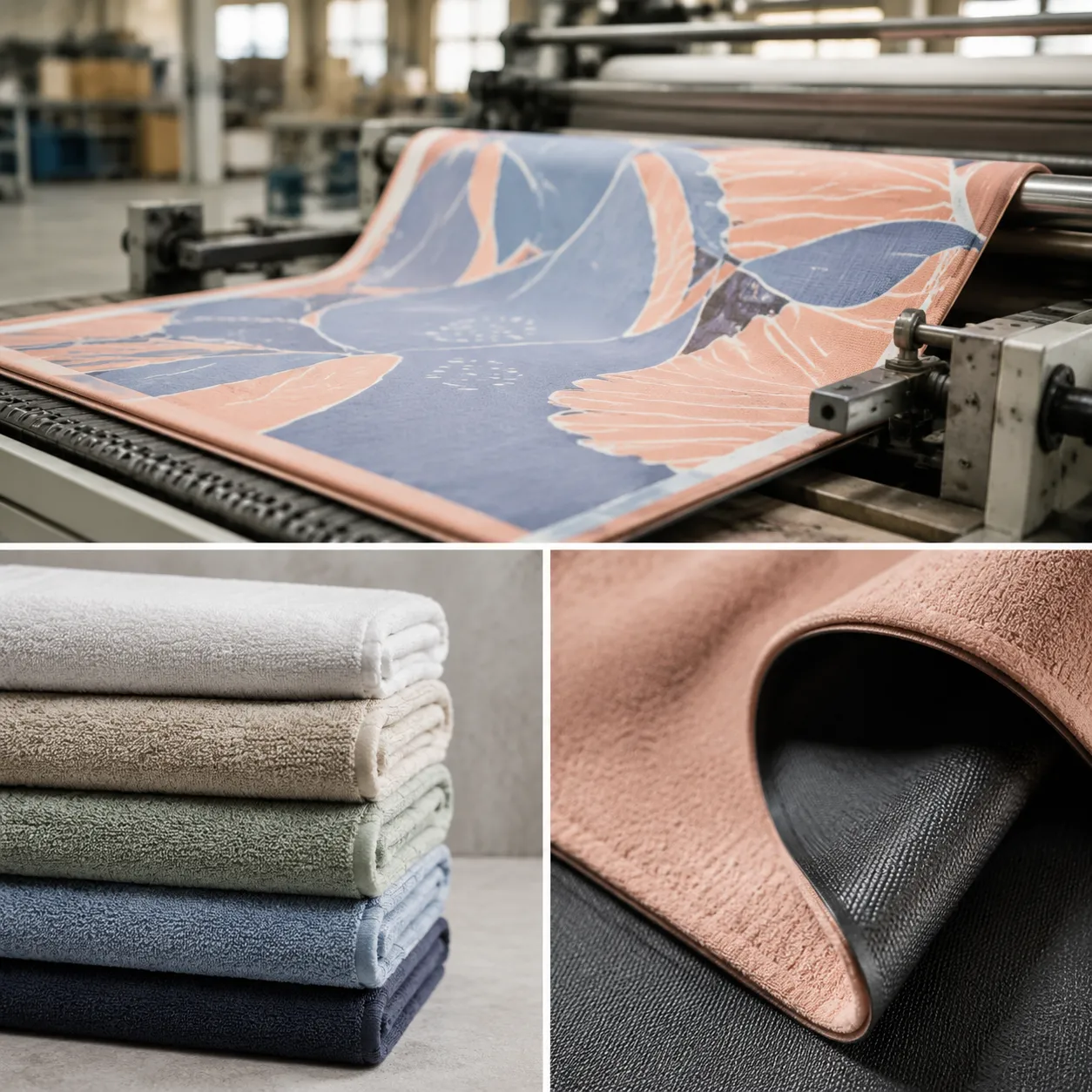
The fabric in this category is usually warp-knit microfiber or a smooth circular knit engineered for evaporative cooling. Two production details matter here and do not behave like cotton towels. First, over-softening in finishing can slow water spread across the panel, so a towel may feel nicer in hand but cool less evenly. Second, edge sealing matters because these lightweight knits can develop fish-eye curling after repeated wet-dry cycles if the cut edge and overlock tension are not balanced.
- If the towel is mainly for a race pack or summer promo, we usually guide buyers to a simpler knit and one-color print.
- If it will sit in retail or club inventory, we push for a denser construction and a wash-tested pouch zipper or bottle cap thread.
- If the item must match a brand palette tightly, lab dips and print strike-offs need to be part of the timeline from day one.
Cooling towels for neck MOQ and pricing: what actually sets the floor
Our base MOQ is 500 pieces per design per color, but that is the factory minimum for a workable run, not always the economical minimum. In this category, the commercial floor is usually created by packaging and decoration. A plain dyed towel in bulk polybag pack can run efficiently at 500 to 1,000 pieces. Add a custom printed pouch, instruction card, barcode sticker, and retail carton layout, and the practical MOQ often becomes 2,000 to 3,000 pieces per SKU.
| Cost driver | Low impact setup | High impact setup | Effect on MOQ/pricing |
|---|---|---|---|
| Fabric color | Stock sport shades | Custom Pantone shade | Custom shades need dye lot control; MOQ usually rises by 500-1,000 pcs |
| Logo method | 1-color screen print | All-over transfer print | Transfer print adds setup and longer prep time |
| Packaging | OPP bag | Custom PET bottle with insert | Bottle programs often need 2,000+ pcs to hold unit cost |
| Assortment | 1 design / 1 color | 4 designs / 4 colors | Split runs increase waste and packing complexity |
Buyers often ask whether they can order 3,000 pieces across six colors. Technically, yes. Financially, the run behaves more like six small orders. On a lightweight evaporative towel, color splits increase knitting changeover, cut planning, print setup, and carton fragmentation. That is why a 3,000-piece order in one color may quote lower than a 5,000-piece order spread across too many SKUs.
- Define whether MOQ is per PO, per artwork, or per sellable SKU. Those are not the same.
- Decide early if packaging is generic or custom. That choice changes the real minimum more than most buyers expect.
- Keep initial launch colors tight. For first production, two colors usually cost better than four.
A realistic FOB price build by volume
For neck cooling towel bulk order planning, we quote by finished unit, not only fabric weight. A 150 GSM knit can be cheaper than a 145 GSM towel if the lighter one uses an expensive bottle pack, tighter print register, or individual insert folding. Below is a practical FOB China price map based on current material and labor conditions for standard 30 x 90 cm product.
| Volume | Plain towel + OPP bag | 1-color logo + OPP bag | Full print + custom pouch | Typical ex-factory lead time |
|---|---|---|---|---|
| 500-999 pcs | USD 0.86-1.06 | USD 0.95-1.18 | USD 1.34-1.72 | 18-24 days |
| 1,000-2,999 pcs | USD 0.74-0.92 | USD 0.82-1.03 | USD 1.18-1.49 | 20-26 days |
| 3,000-9,999 pcs | USD 0.66-0.83 | USD 0.73-0.94 | USD 1.04-1.33 | 22-28 days |
| 10,000-30,000 pcs | USD 0.58-0.77 | USD 0.65-0.86 | USD 0.93-1.21 | 25-32 days |
These bands assume standard microfiber cooling fabric, care label, export carton, and normal AQL inspection. They do not include duty, destination freight, or special compliance testing requested by the importer. For a custom cooling towel pricing exercise, the fastest way to get to a clean quote is a proper spec sheet with size tolerance, fabric composition, print coverage, packaging photo, and shipping term. Our article on build-towel-tech-pack-that-mills-can-quote shows the fields we need.
Packaging is often the hidden cost center
In this category, buyers focus on the towel and forget the packout. That is usually where margin leaks. A simple OPP bag with suffocation warning is stable, fast, and carton-efficient. A mesh pouch looks better and is reusable, but zipper quality and stitch security need checking. A PET bottle is visually strong for retail or events, though it adds more unit assembly time, more cubic volume, and a higher chance of cap-thread damage in transit if the bottle neck tolerance is loose.
- OPP bag pack: best for low FOB cost and denser carton loading.
- Mesh pouch pack: middle ground for sports and outdoor brands.
- PET bottle pack: stronger shelf presence but materially higher freight cost per usable towel.
One technical point specific to cooling towels: if the towel is packed fully dry into a sealed PET bottle after aggressive heat drying, it can pick up static and cling during insertion, which slows packing and can mark a transfer print surface. We usually control this with final moisture balance and a folding board sequence that reduces edge drag. That is a small production step, but it affects output and therefore price.
Print method choices and where buyers overspend
Most cooling towels for neck use are too lightweight and too synthetic for embroidery to make sense. The common choices are screen print, heat transfer, or full sublimation depending on logo area and artwork style. If the logo is simple and the towel ground is dyed solid, screen print is usually the most efficient route. If the artwork is photographic or multi-color edge to edge, sublimation is cleaner.
| Method | Best use | Cost tendency | Risk point |
|---|---|---|---|
| Screen print | Simple logo on dyed ground | Lowest for 1-2 colors | Heavy ink can stiffen cooling zone |
| Heat transfer | Small detailed crest or sponsor mark | Mid | Film edge can lift after repeated wetting if press settings drift |
| Sublimation | All-over graphics on white base | Best for complex art at volume | Color shift if heat profile is uneven across width |
For comparison across methods, see embroidery-vs-sublimation-vs-jacquard. For cooling products specifically, we usually warn buyers away from oversized chest-style logos placed right at the center fold. It makes the towel feel warmer and less flexible around the neck, especially if the ink deposit is thick.
The test points we insist on before bulk approval
A cheap sample can look fine on the table and still fail once the end user wets it, wrings it, and repeats that cycle for two weeks. For evaporative cooling towel MOQ programs, we focus on performance tests that match actual use, not only appearance checks.
- Colorfastness to washing by ISO 105-C06 for printed and dyed components.
- Colorfastness to rubbing by ISO 105-X12, especially on dark promo shades.
- Dimensional change after washing by ISO 5077 so the towel does not twist and shorten badly.
- Absorption or wetting spread check using AATCC 79 or an equivalent internal timed-drop method.
- Seam and edge security review after wet-wring cycling, usually 10 repeated manual cycles on pre-production samples.
The two failure modes we see most often are edge roping after wash, caused by unbalanced overlock tension, and print-face tackiness after activation, usually caused by too much binder or an under-cured transfer. Those are specific to this category. If a buyer only asks for a visual sample and skips a wet-use trial, these problems often show up after the goods land.
Compliance-wise, we can produce to OEKO-TEX Standard 100 Class I material requirements, and our mill is also BSCI and ISO 9001 certified. Buyers should still request the current certificate scope and make sure the claimed product category matches the fiber system and print chemistry. We explain how to verify that in how-to-read-oeko-tex-certificate.
Timeline from RFQ to vessel booking
Lead time in this category is usually shorter than cotton towel production, but only if approvals move cleanly. A stock-color, one-logo program can ship in under four weeks. A custom printed cooling sport towel FOB China program with bottle packaging and barcode assortment can take five to seven weeks.
- RFQ review and target quote: 1-2 working days.
- Artwork check and sample arrangement: 3-5 days.
- Pre-production sample or print strike-off: 5-8 days.
- Bulk fabric and printing: 10-16 days.
- Packing, inline QC, final inspection, booking: 5-8 days.
Freight choice matters if the order supports an event date. These products are light but not always small once bottle or pouch packing is added. We often see buyers underestimate volumetric air cost. Our guide to container-vs-air-freight-towel-orders is useful when the launch window is fixed.
How we usually advise buyers to lower cost without wrecking the item
We push back when buyers try to hit an unrealistic unit price by cutting the wrong spec. Removing 5 cm from length or switching from custom bottle to pouch usually saves money cleanly. Cutting too far on knit density or using a print method that blocks evaporation usually creates complaints later.
- Reduce SKU count before reducing fabric quality.
- Move from PET bottle to mesh pouch if freight and assembly cost are too high.
- Keep artwork to one print position for launch orders.
- Use 30 x 80 cm instead of 30 x 100 cm if the end use is short-duration event distribution.
- Approve a standard care card template instead of custom inserts for the first run.
A recent buyer comparison illustrates this. One program asked for 6,000 units in four shades with custom bottles and two-sided inserts. Another asked for 8,000 units in two shades with mesh pouches and one-color print. Even though the second order used more pieces, the landed cost per usable unit projected better because pack labor, freight cube, and setup waste were lower.
What to send us if you want a quote that survives approval
For cooling towels for neck MOQ and pricing requests, the cleanest RFQs contain enough detail to price once, not three times. Missing packaging and artwork assumptions are what usually force quote revisions.
- Finished size and tolerance, for example 30 x 90 cm +/- 2 cm.
- Target fabric composition and weight, or at least intended use scenario.
- Logo method preference: screen, transfer, or sublimation.
- Packaging style with reference photo if available.
- Order quantity by design and by color.
- Required compliance documents and destination market.
- Needed in-warehouse date, not only ex-factory target.
Related reads: cooling-towel-construction-buyer-guide, build-towel-tech-pack-that-mills-can-quote, and negotiate-towel-moq-without-killing-margin.
Related reads: pantone-color-matching-custom-towels for color approval, container-vs-air-freight-towel-orders for shipping decisions, and microfiber-vs-cotton-towel-comparison if your team is still debating material direction.
Need a workable quote for a cooling towel program?
Send size, artwork, packaging, quantity split, and target delivery date. We will quote against the real MOQ drivers and flag cost risks before sampling. MOQ is 500 pcs per design per color. Contact us at [email protected] or WhatsApp +86 13205717266.
Request Quote →