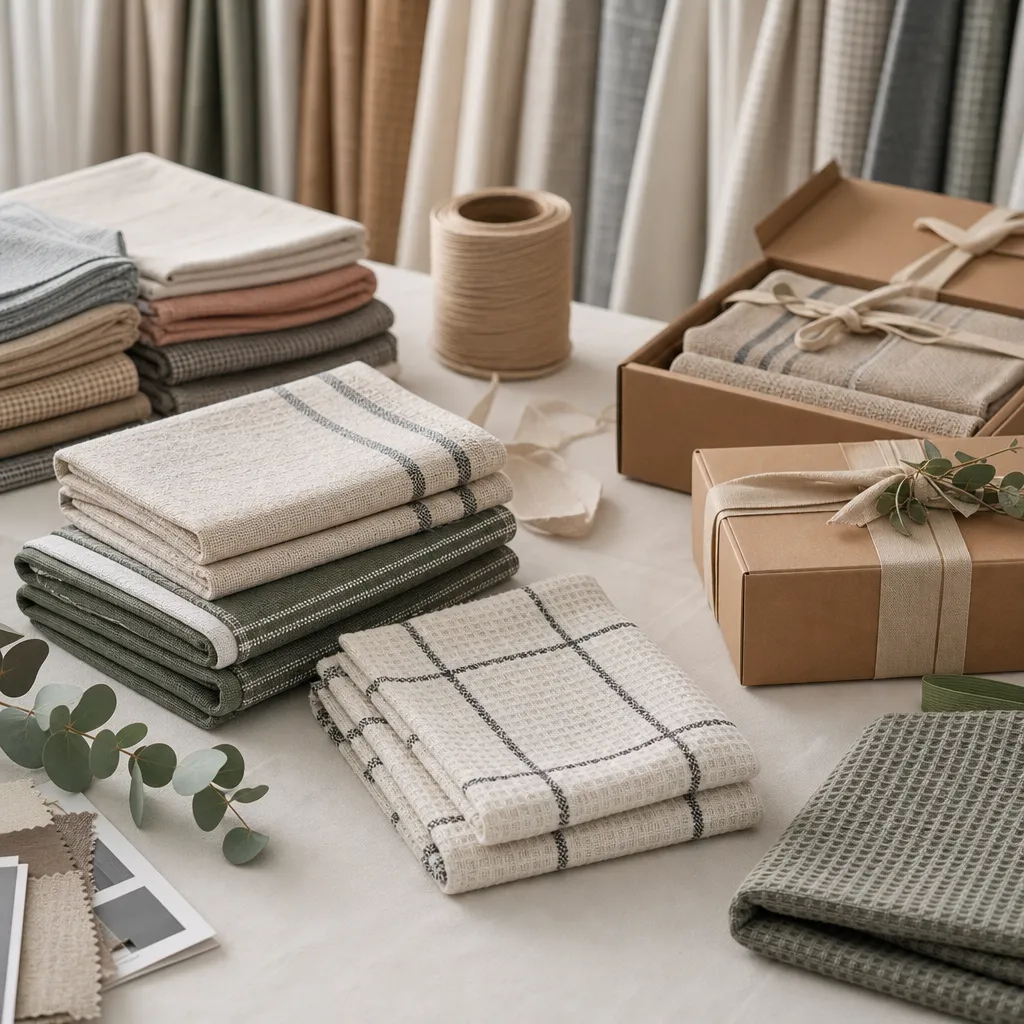
Why dish towels outperform fragile gift categories
For brand-side buyers, the attraction is not only unit price. A towel-based gift program avoids a long list of freight and breakage problems that come with mugs, boards, or coated kitchenware. A folded towel in a belly band or kraft sleeve usually travels as a soft good, holds its shape in parcel shipping, and gives you a larger printable area than most small home accessories.
We usually see personalized kitchen gifts built around three retail use cases. First is seasonal gifting, where the design changes every quarter and speed matters more than heavy decoration. Second is evergreen monogram or surname programs for marketplaces and boutique stores. Third is event-driven volume such as real-estate closings, cooking schools, and corporate gifting, where consistency between lots matters more than novelty.
| Gift format | Typical towel base | Packed weight | Common buyer use |
|---|---|---|---|
| Single tea towel with belly band | Flour sack cotton 150-190 GSM | 55-90 g | Seasonal retail and entry-price gifting |
| 2-piece gift set | Herringbone or dobby kitchen towel 220-280 GSM | 170-260 g | Housewarming and boutique sets |
| Monogram towel with hang tag | Velour-front or smooth terry 300-380 GSM | 110-180 g | Personalization programs |
| 3-piece kitchen linen bundle | Towel plus potholder/apron pairing | 280-420 g | DTC gift boxes and holiday promotions |
Start with the base cloth, not the artwork
The biggest sourcing mistake in this category is approving artwork before confirming the towel construction. A playful all-over print looks sharp on flat flour sack fabric, but the same art can lose edge definition on a looped terry face. An embroidered monogram can elevate a denser dobby towel, but on a loose plain weave it may pucker the ground after washing unless we stabilize the stitch zone.
- Flour sack cotton, 150-190 GSM: best for large printed graphics, recipe towels, and souvenir formats
- Plain weave tea towel, 180-230 GSM: balanced choice for retail, easier hem control, cleaner fold presentation
- Herringbone or dobby kitchen towel, 220-280 GSM: stronger handfeel for gift sets, suitable for woven borders and subtle branding
- Smooth-face terry, 300-380 GSM: works for embroidery or tonal branding, but not ideal for detailed line art
For most custom dish towels sold as gifts, we quote sizes around 45×65 cm, 50×70 cm, and 50×75 cm. A 50×70 cm plain weave towel at 210 GSM lands around 74 g before packing, which is useful if you are trying to stay under a parcel weight tier. If the product is meant to feel more substantial in a gift basket, moving to a 260 GSM herringbone body can push the same general size into the 90-100 g range.
Decoration methods that actually fit personalized kitchen gifts
Not every decoration method belongs in kitchen gifting. Buyers often ask for the look of a boutique monogram with the price of a fast promo print. That combination usually fails either in wash durability or margin. We guide clients by intended sell-through channel, reorder pattern, and artwork variability.
| Method | Best towel surface | Setup profile | What to watch |
|---|---|---|---|
| Screen print / pigment print | Flour sack, flat plain weave | Low to medium at volume | Handfeel and wash fade on dark grounds |
| Digital reactive print | Bleached cotton plain weave | Higher setup, flexible artwork | Requires absorbent pretreatment and tighter color control |
| Embroidery | Dobby, herringbone, smooth terry face | Higher labor per piece | Puckering, backing show-through, thread coverage |
| Jacquard border or woven label | Structured woven towels | Higher MOQ, best for repeats | Longer development and loom planning |
For names, initials, or short monograms, embroidery is still the cleanest option if the towel body can support it. We normally add a temporary backing during stitching and test after one home-laundry cycle to check whether the needle density is pulling the ground yarns. On lighter tea towels, satin stitches wider than about 5-6 mm can distort the fabric unless the stitch count is reduced or the monogram is redrawn.
For illustrated graphics, recipe copy, maps, or holiday motifs, print wins. On flour sack styles, reactive printing gives better penetration and softer hand than heavy pigment layers, but the cloth must be prepared correctly. We check print sharpness after singeing and desizing because loose surface fuzz can blur thin strokes, especially on script fonts that buyers like for personalized tea towels.
What sells at retail: three proven spec lanes
We do not push one universal spec because the margin structure of a museum shop is different from a wedding favor seller or a kitchenware chain. Instead, we usually frame programs in three lanes so the buyer can match product economics to channel.
| Lane | Typical spec | EXW USD/pc | Best fit |
|---|---|---|---|
| Entry giftable | 45×65 cm, 160-180 GSM flour sack, 1-color print | 0.78-1.08 at 3,000 pcs | Impulse gifting, event merch, seasonal promos |
| Mid retail | 50×70 cm, 200-230 GSM plain weave, 2-3 color print or woven label | 1.26-1.82 at 2,000 pcs | Boutique stores, cookbook tie-ins, housewarming lines |
| Personalized premium | 50×70 cm, 230-280 GSM dobby or herringbone, embroidery | 2.14-3.05 at 1,000 pcs | Monogram programs, wedding gifting, elevated DTC bundles |
Those ranges move with cotton cost, stitch count, folding method, and packaging. A name-driven embroidery program can add USD 0.28 to 0.74 per piece simply from letter count and thread coverage. If your assortment has 20 surnames and each style only runs 60 pieces, we may suggest a stock-body approach with decoration added in smaller batches instead of pre-making every SKU in one run.
- If retail is under USD 12, keep the towel body simple and let packaging do part of the gift work.
- If retail is USD 16-24, buyers usually get better sell-through from a heavier handfeel than from extra print colors.
- If you need one-by-one personalization, separate the base-goods PO from the naming workflow early so lead time does not collapse later.
QC points unique to kitchen towel gifting
Kitchen towels look simple, but the failures are specific. A bath towel article would focus on absorbency and bulk; here we spend more time on skew, print placement, hanging loop strength, and post-wash appearance after repeated laundering. Gift buyers also care about fold presentation because many units are sold without being fully opened on shelf.
- Skew and bow: striped or checked kitchen towels can twist visibly after wash if the fabric is not heat-relaxed correctly before cutting.
- Needle-line distortion: embroidery on light plain weave can leave a boxy press mark around the monogram after packing.
- Crocking on deep pigment prints: dark red, navy, or black motifs need rub testing before they sit against pale packaging.
- Hanging loop seam failure: loops stitched only into the hem turn out during use; we prefer loop insertion caught in at least two seam passes.
- Edge waviness: narrow hems on lightweight flour sack bodies can ripple if sewing tension is too high.
For gift programs, we commonly run AATCC 61 for accelerated colorfastness laundering, AATCC 8 for crocking where dark prints are involved, and dimensional stability checks after one and three wash cycles. If the towel includes metallic embroidery thread, we also inspect after tumble drying because that thread can flatten or fray earlier than standard polyester embroidery yarn.
Packaging is part of the sourcing decision
A dish towel sold as a household basic can arrive in a simple polybag. A towel sold as a gift cannot. Packaging changes both cost and defect risk. Belly bands are efficient and recyclable-looking, but they need a stable fold; a soft low-GSM towel may slump on shelf. Kraft sleeves hide fold inconsistency better, while hanger cards work for mass retail pegs but expose more of the printed face.
| Pack style | Added EXW cost | Best with | Operational note |
|---|---|---|---|
| Paper belly band | 0.09-0.16 | Midweight plain weave towels | Needs tight fold tolerance for shelf presentation |
| Kraft sleeve | 0.14-0.24 | Gift sets and heavier towels | Better for barcode and story copy |
| Hang tag + kimble | 0.05-0.10 | Boutique and open-display retail | Fastest packing option |
| Window box for sets | 0.42-0.88 | 2-3 piece kitchen gift bundles | Raises CBM and can affect freight efficiency |
If your program is aimed at housewarming kitchen gifts or realtor closing gifts, the package often matters as much as the towel itself. We recommend asking whether the buyer wants the product to feel artisanal, practical, or monogram-luxury, because each of those pushes the fold, carton count, and insert card design in a different direction.
Related reads: if you are still deciding how much artwork the cloth can carry, compare embroidery-vs-sublimation-vs-jacquard and pantone-color-matching-custom-towels. If the quotation stage is stalling because the brief is incomplete, use build-towel-tech-pack-that-mills-can-quote.
MOQ, assortment planning, and why names get expensive fast
Our normal MOQ is 500 pieces per design per color. That is manageable for printed kitchen towels, but personalization changes the math. Ten names at 100 pieces each is not the same workflow as one art file at 1,000 pieces. Even if the towel body is identical, machine setup, thread changes, labeling, pick-pack logic, and carton segregation all add handling.
For that reason, we usually separate programs into two production models. Model A is bulk-decorated assortment, where each design is treated as a standard SKU and the names are simply multiple embroidery files. Model B is stock-and-finish, where undeco-rated towels are produced in bulk and personalized later in a shorter run. Model B often costs more per finished unit, but it protects you from dead stock.
- Lock the towel base, size, hem, loop, and packaging first.
- Group personalization into families: initials, first names, surnames, or event titles.
- Estimate unit splits by SKU before artwork approval, not after sample signoff.
- Decide whether barcode sits on outer pack or varies by name variant.
- Build a re-order plan for top sellers so your first run is not carrying the entire catalog risk.
Buyers looking for embroidered kitchen towels sometimes insist on very low MOQs for many names. We can do that in some cases, but the buyer should expect a higher unit band and slightly longer finishing time. A cheap personalized program is usually only cheap at PO stage; it becomes expensive when assortment complexity produces remakes and unsold tails.
Lead times buyers should budget for
Sampling is usually faster than clients expect, but bulk gets delayed when art, naming lists, and pack files are approved in stages. For a straightforward print run on a known towel base, development sample timing is often 5-8 days. New woven constructions or a new embroidery placement can extend that because we need to check shrinkage, stitch behavior, and fold appearance together.
| Project stage | Typical timing | Notes |
|---|---|---|
| Artwork review and quote | 1-3 days | Faster when size, GSM, and pack-out are already defined |
| Lab dip / strike-off / embroidery swatch | 4-7 days | Reactive prints and thread matching may need an extra round |
| Pre-production sample | 6-10 days | Useful for checking fold and retail packaging together |
| Bulk production | 18-32 days | Depends on greige availability, decoration method, and pack complexity |
| Export booking and dispatch | 4-9 days | Longer in peak Q4 gift season |
For holiday personalized kitchen gifts, we usually advise brands to count backward from in-warehouse date, not ETD. If the goods need marketplace labeling or kitting after import, add buffer there too. Kitchen towel gifts look operationally simple, but personalization and packaging can easily add 7-12 days if files arrive in waves.
Compliance and buyer documentation
Because these towels touch hands, dishes, and sometimes food-prep surfaces indirectly, compliance should be treated as a routine sourcing requirement rather than an afterthought. We work under OEKO-TEX Standard 100 Class I, BSCI, and ISO 9001, and those matter more when your gifts are sold into family, baby, or holiday channels where retailer compliance review can tighten suddenly.
- Request the current OEKO-TEX certificate number and product scope, not just a logo on a PDF.
- Match the fiber content declaration to the actual woven base; blends in kitchen towels are sometimes mislabeled in the market.
- Confirm care label language early if you sell into multiple countries.
- For printed programs, ask whether the ink system and wash test results will be linked to your approved sample lot.
If your team is reviewing test files internally, how-to-read-oeko-tex-certificate is the practical starting point. Buyers balancing sustainability claims with commercial targets may also want sustainable-towel-buyer-checklist-2026, especially for recycled paper packaging or lower-plastic pack-outs.
How we would brief a first order
If a buyer came to us today with a new personalized kitchen gifts program, we would not start with trend moodboards. We would ask for the intended retail price, target channels, expected reorder cadence, and whether the personalization is true one-by-one naming or simply a small family of monograms. That tells us more than style references alone.
- Choose one of three cloth bases: flour sack print, midweight plain weave, or heavier dobby/herringbone.
- Set one hero size for 80% of the assortment to simplify carton planning.
- Limit the first launch to one decoration method if timing matters.
- Use no more than two pack formats in the first order.
- Approve a wash-tested pre-production sample before releasing bulk embroidery or print.
For a realistic first PO, many brands land well with 1,500-3,000 units across 3-6 SKUs. That is enough to get pricing into a workable band without overbuilding a name assortment that has not yet proven sell-through. If you need help structuring the MOQ, negotiate-towel-moq-without-killing-margin covers the trade-offs in more detail.
Quote a personalized kitchen gifts program
Send us your target price, towel size, decoration method, packaging idea, and SKU split. We can quote base cloth, wash-test route, MOQ, and lead time from the mill side.
Request OEM quote →For direct inquiries, buyers can reach us on WhatsApp at +86 13384590853 or by email at [email protected]. We supply custom towel programs from our Gaoyang operation with MOQ 500 pieces per design per color, and we can advise whether a printed or monogram route makes more sense for your channel before sampling starts.