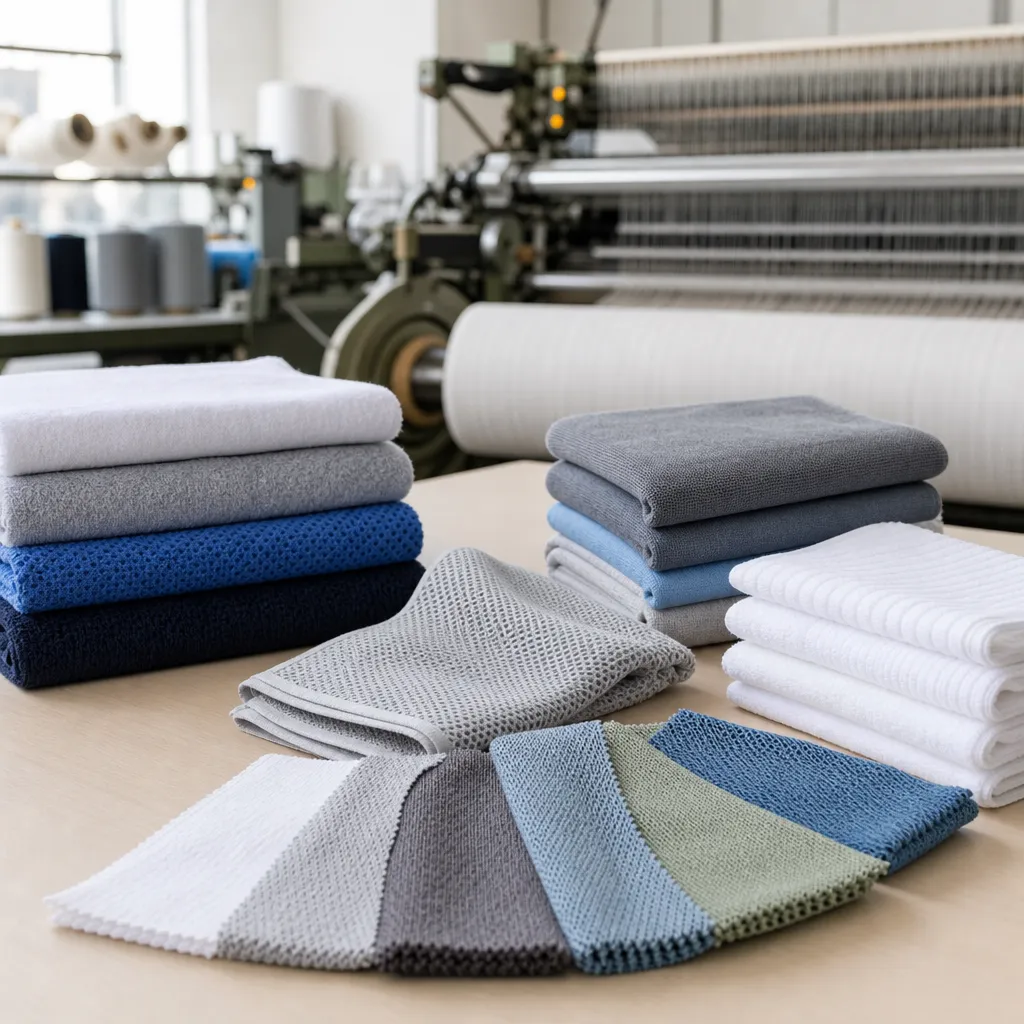
What Is a Cooling Towel in Factory Terms?
In factory language, a cooling towel is a textile engineered to hold water, spread that water across a large surface area, and release it through evaporation at a steady rate. The cooling sensation comes from phase change: as water evaporates from the towel surface, it takes heat away from the skin and surrounding air. That sounds simple, but the difference between a useful sports towel and a cheap giveaway is usually hidden in the fabric cross-section.
For cotton towels, buyers usually start with absorbency, pile height, GSM, and handfeel. For cooling towels, we start with capillary movement, surface area, wet cling, dry stiffness, and whether the towel stays comfortable after repeated wet-dry cycles. A towel that absorbs too much water may feel heavy. A towel that holds too little water cools for only a few minutes. A towel with poor edge control curls into a rope after washing.
When a procurement team asks what is a cooling towel for retail, gym, marathon, or outdoor work use, we first separate the product into three common constructions: PVA sponge sheet, microfiber knit, and nylon-polyester mesh. Each has a different cost, test method, and user complaint pattern.
| Construction | Typical GSM | Cooling Behavior | Best Use | Main Risk |
|---|---|---|---|---|
| PVA sponge sheet | 220-360 GSM dry basis | Strong initial cold feel, high water retention | Outdoor crews, golf, industrial kits | Can harden when dry and crack if packed poorly |
| Polyester micro-mesh | 110-170 GSM | Fast evaporation, lighter handfeel | Running events, gyms, promo retail | Shorter cooling duration in dry wind |
| Nylon-polyester cool-touch knit | 130-190 GSM | Balanced drape and skin contact | Fitness, yoga, travel, branded sports goods | Color migration if disperse dye is not fixed well |
| Microfiber suede finish | 180-260 GSM | Softer feel, moderate cooling | Lifestyle retail, beach club, wellness | Can feel warm if brushed surface is too dense |
The Cooling Mechanism Buyers Should Verify
We do not approve a cooling towel only by touching it under the tap. On the line, touch tests are useful for catching obvious failures, but they are not enough for a repeat OEM program. We measure how much water the towel retains after soaking and wringing, how quickly it loses water in controlled air, and how the handfeel changes after wash cycles.
For a practical mill-side evaporation check, we weigh a conditioned dry towel, soak it for 60 seconds, wring it with a roller gap set to a repeatable pressure, then record weight loss at 10, 20, and 40 minutes in a room held around 23 C and 50% relative humidity. That is not a formal global standard by itself, so for larger accounts we pair it with ISO 6330 domestic washing, ISO 105-C06 colorfastness to washing, and AATCC 197 vertical wicking where the fabric type allows it.
- Water pick-up: a 140 GSM mesh towel usually holds 1.6-2.4 times its dry weight after normal wringing.
- Cooling window: well-built sports mesh often gives 18-35 minutes of noticeable cooling indoors; PVA may run longer but feels less textile-like.
- Dry recovery: after five wet-dry cycles, the towel should not curl more than 8-12 mm along a 30 cm edge.
- Odor control: fast-drying structures help, but antimicrobial claims need separate chemistry review and destination-market compliance.
A buyer comparing this product with gym sweat towels should not use the same acceptance logic. A 420 GSM cotton gym towel is built to absorb sweat and survive hot washing. A 150 GSM cooling towel is built for evaporation and skin contact. The use case is closer to sweat towels for gym programs than to bath linen, but the fabric engineering is different.
Fabric Choices: PVA, Mesh, and Microfiber
PVA gives the strongest cold impression in the first few seconds because it holds a high volume of water. It is useful for industrial safety kits, golf tournaments, and hot-weather work crews. The tradeoff is storage behavior. When dry, PVA can become board-like. If a supplier folds it sharply, compresses it under heavy cartons, or seals residual moisture inside poor packaging, the product may arrive with crease cracks or a sour odor.
Polyester mesh is the most flexible route for custom cooling towels in sports and promotional channels. The fabric can be piece dyed, yarn dyed in limited cases, or sublimation printed when the design needs full color. The yarn is usually 75D/72F or 100D/144F polyester, sometimes blended with nylon to improve touch. A lower filament count may reduce cost by a few cents, but it also makes the towel feel scratchier when wet.
Microfiber suede or peach-finish fabric sits between cooling and lifestyle use. It prints cleanly and feels softer in the package, which helps DTC retail. The risk is over-brushing. If the nap is too dense, air movement drops, the towel retains warmth against the skin, and the product disappoints even if the print looks good.
| Buyer Priority | Recommended Fabric | Spec Range | Factory Comment |
|---|---|---|---|
| Longest wet cooling feel | PVA sheet | 260-320 GSM dry basis | Use rounded corners and avoid sharp compression in cartons |
| Best event giveaway cost | Polyester mesh | 115-145 GSM | Works with pouch packing and simple one-color logo |
| Retail print quality | Microfiber suede | 200-240 GSM | Good for sublimation, but do evaporation checks before approval |
| Fitness brand handfeel | Nylon-poly knit | 150-180 GSM | Higher unit cost, better drape around neck and shoulders |
Size, GSM, and Edge Specs That Change Use
Cooling towel size is more sensitive than many buyers expect. A narrow towel sits well around the neck but has limited surface area. A wide towel cools more skin but feels bulky after soaking. We normally quote sports cooling towels at 30 x 90 cm, 30 x 100 cm, 40 x 80 cm, and 50 x 100 cm. For golf or beach club wellness kits, 40 x 100 cm is common because it can sit across the shoulders without looking like a bath towel.
GSM should be read with construction, not alone. A 150 GSM mesh towel can cool better than a 230 GSM brushed microfiber towel because air passes through the open structure. For OEM quotations, we ask buyers to specify size tolerance of +/-2 cm after washing, GSM tolerance of +/-5%, and edge type. Overlock edge is cheapest, but a flatlock edge feels better on neck products. Ultrasonic cutting can work for some synthetic meshes, though it needs peel checks because weak bonding opens after repeated twisting.
- 30 x 90 cm: compact for race bags, gym counters, and outdoor staff kits.
- 30 x 100 cm: better neck coverage without much carton-weight increase.
- 40 x 80 cm: useful for yoga, tennis, and sideline cooling.
- 50 x 100 cm: stronger retail presence, but freight cost rises quickly when packed in tubes or rigid bottles.
If your assortment includes cotton, microfiber, and cooling items together, use microfiber versus cotton towel comparison and towel GSM decision framework as internal guardrails. The wrong GSM logic is one of the fastest ways to overbuild a cooling towel and make it perform worse.
Decoration and Color Risks
Decoration is where many cooling towel projects lose margin. A flat synthetic towel looks simple, so teams assume any print method will behave. In practice, wet use, body heat, sunscreen, and folding pressure make the decoration choice more demanding than a normal dry promotional cloth.
For polyester mesh and microfiber, sublimation gives the cleanest full-surface artwork. The fabric must be white or very light before printing. Dark base colors are better handled with cut-and-sew panels, woven labels, heat-transfer logos, or single-color screen print depending on fabric. For nylon blends, sublimation is less predictable because nylon accepts disperse dye differently; color can look dull after steaming or fixation.
One defect we watch closely is dye shadowing at fold lines after wet packing. If a towel is printed, folded warm, and sealed before enough rest time, the darker print zones can mark the opposite face. We usually require at least 12 hours of open rest after sublimation before final pouch packing for dark artwork. For high-contrast logos, we also run wet crocking checks similar in spirit to ISO 105-X12, even when the buyer's formal lab package does not demand it.
- Confirm whether the base fabric is polyester, nylon-poly, PVA, or microfiber before artwork approval.
- Match Pantone targets on wet and dry samples, because wet fabric usually reads darker.
- Test sunscreen contact if the towel is for beach clubs, golf, or outdoor retail.
- Approve label placement after soaking; a stiff woven label can scratch the neck when wet.
For deeper decoration tradeoffs, our team usually points buyers to embroidery vs sublimation vs jacquard and Pantone color matching custom towels. Embroidery is rarely comfortable on a neck cooling towel, but it can still work on pouch, hangtag, or accessory branding.
Testing, Certifications, and Claims
A claim like instant cooling towel sounds attractive on packaging, but it needs a test definition. Does instant mean a lower surface temperature after snapping? Does it mean perceived cool touch within five seconds of wetting? Does it mean evaporative temperature drop versus ambient air? Each claim creates a different sampling and compliance burden.
For brand buyers, we recommend separating normal textile compliance from performance validation. OEKO-TEX Standard 100 Class I is relevant for harmful substances and skin-contact confidence. BSCI helps buyers audit social compliance at factory level. ISO 9001 supports repeatable process control. None of those alone proves cooling performance, so we add internal evaporation and wicking tests to the approval file.
| Check | Reference or Method | Target We Use for Approval | Why It Matters |
|---|---|---|---|
| Colorfastness to washing | ISO 105-C06 | Grade 4 or better for shade change on branded programs | Prevents logo fading and dye bleed complaints |
| Dimensional change | ISO 6330 wash conditioning | Within +/-5% for most synthetic cooling towels | Controls edge curl and package fit |
| Vertical wicking | AATCC 197 where applicable | Minimum 70 mm rise in 30 minutes for selected mesh specs | Shows whether moisture spreads beyond the contact point |
| Restricted substances | OEKO-TEX Standard 100 Class I | Valid certificate by article group | Important for skin-contact, kids, resort, and wellness channels |
We hold OEKO-TEX 100 Class I, BSCI, and ISO 9001 certifications at LUMA & CO. TEXTILE. Buyers should still read certificates carefully, because the certificate holder, product class, and covered article description matter. We wrote a separate guide on how to read an OEKO-TEX certificate for teams that need to check this before PO release.
Pricing Bands and MOQ for OEM Orders
Our standard MOQ is 500 pcs per design per color. Cooling towels can technically be made below that quantity, but sampling, dye setup, cutting, printing, and packing labor make the unit economics poor. If a buyer wants six colorways at 300 pcs each, we usually advise reducing the color count first. Fewer colors give better shade control and lower inspection risk.
Current realistic FOB China pricing depends on fabric, size, decoration, and packaging. A plain 30 x 90 cm polyester mesh towel in a polybag is a very different product from a 40 x 100 cm sublimated microfiber towel in a reusable PET jar with a printed insert. The jar alone can add USD 0.22-0.48 depending on mold, color, and cap.
| Order Volume | Basic Mesh 30 x 90 cm | Sublimated Mesh 30 x 100 cm | PVA 30 x 100 cm in Pouch | Microfiber Retail 40 x 100 cm |
|---|---|---|---|---|
| 500-999 pcs | USD 0.92-1.18 | USD 1.34-1.72 | USD 1.58-2.05 | USD 2.10-2.86 |
| 1,000-2,999 pcs | USD 0.74-0.96 | USD 1.12-1.45 | USD 1.36-1.76 | USD 1.78-2.42 |
| 3,000-9,999 pcs | USD 0.61-0.82 | USD 0.98-1.26 | USD 1.18-1.52 | USD 1.52-2.08 |
| 10,000+ pcs | USD 0.52-0.70 | USD 0.84-1.12 | USD 1.02-1.34 | USD 1.31-1.82 |
The cheapest towel is not always the lowest-cost program. For example, a 120 GSM race towel at USD 0.58 may look attractive beside a 160 GSM knit at USD 0.91. If the cheaper towel cools for 9 minutes and gets used twice before being discarded, the cost per useful cooling session is around USD 0.29. If the better towel gives 24 minutes of cooling and survives 18 uses in a gym welcome kit, the cost per session is about USD 0.05. That is the number procurement should take to the brand team.
Sampling and Production Timeline
Cooling towel development is faster than jacquard bath towel development, but slower than a plain stock promo towel when custom artwork and claims are involved. The critical path is usually fabric strike-off, print approval, packaging fit, and moisture-related QC. For PVA, we also check dry hardness after warehouse conditioning because a nice wet sample can still fail in storage.
- Day 1-2: confirm tech pack, size, fabric type, GSM, artwork, packing, and target market.
- Day 3-7: prepare lab dips or print strike-offs; basic blank samples may be faster if fabric is in stock.
- Day 8-12: run wet handling, wicking, shade, and packing fit checks before buyer approval.
- Day 13-30: bulk fabric, printing or dyeing, cutting, sewing, and inline inspection for normal 1,000-5,000 pc orders.
- Day 31-38: final inspection, carton conditioning, export docs, and handover to forwarder.
Air freight is possible for event deadlines, but towels are dense once packed with jars, pouches, and inserts. Sea shipment is usually the better route for planned seasonal programs. For shipment planning, container versus air freight towel orders gives a more detailed cost comparison.
How to Brief a Factory Without Rework
The best brief answers what is a cooling towel for your end user, not only what logo should appear on it. A marathon volunteer, hotel spa guest, beach club member, warehouse worker, and golf tournament player all use the towel differently. The specification should follow that use, or the product will either be overbuilt, underbuilt, or packed in a way that makes no operational sense.
- Use environment: indoor gym, outdoor heat, beach, golf, worksite, race bag, or retail shelf.
- Fabric preference: PVA, polyester mesh, nylon-poly knit, microfiber suede, or request two options for comparison.
- Target GSM and size: include tolerance, not only nominal measurement.
- Decoration method: sublimation, screen print, woven label, heat transfer, pouch branding, or hangtag only.
- Compliance market: EU, US, UK, GCC, Australia, Japan, or mixed distribution.
For structured quotation, we recommend building a simple tech pack with size, fabric, GSM, color standard, artwork file, packing, carton marks, compliance needs, and inspection level. Our guide to building a towel tech pack mills can quote is useful if your team is moving from reseller buying into direct OEM sourcing.
Related reads: for fitness programs, see why gym towels fail after 50 washes and sweat towels for gym spec guide. For custom synthetic programs, compare with custom microfiber towels wholesale guide.
Related reads: resort and outdoor buyers may also want beach towels in bulk buyer's guide, beach club resort towel program, and our industry page for yoga and pilates towels.
Build a Cooling Towel Spec
Send us your size, use case, artwork, target price, and destination market. We will return fabric options, MOQ, pricing bands, and a sampling timeline from our mill team. MOQ is 500 pcs per design per color. WhatsApp: +86 13384590853. Email: [email protected].
Request Cooling Towel Quote →