Start With the Laundry, Not the Logo File
For gym towels, decoration durability is usually decided before the logo artwork reaches our sampling room. A towel washed at home once per week behaves very differently from a towel used in a fitness club, collected damp, washed in 40-60°C water, dried hot, and returned to the floor within 24 hours.
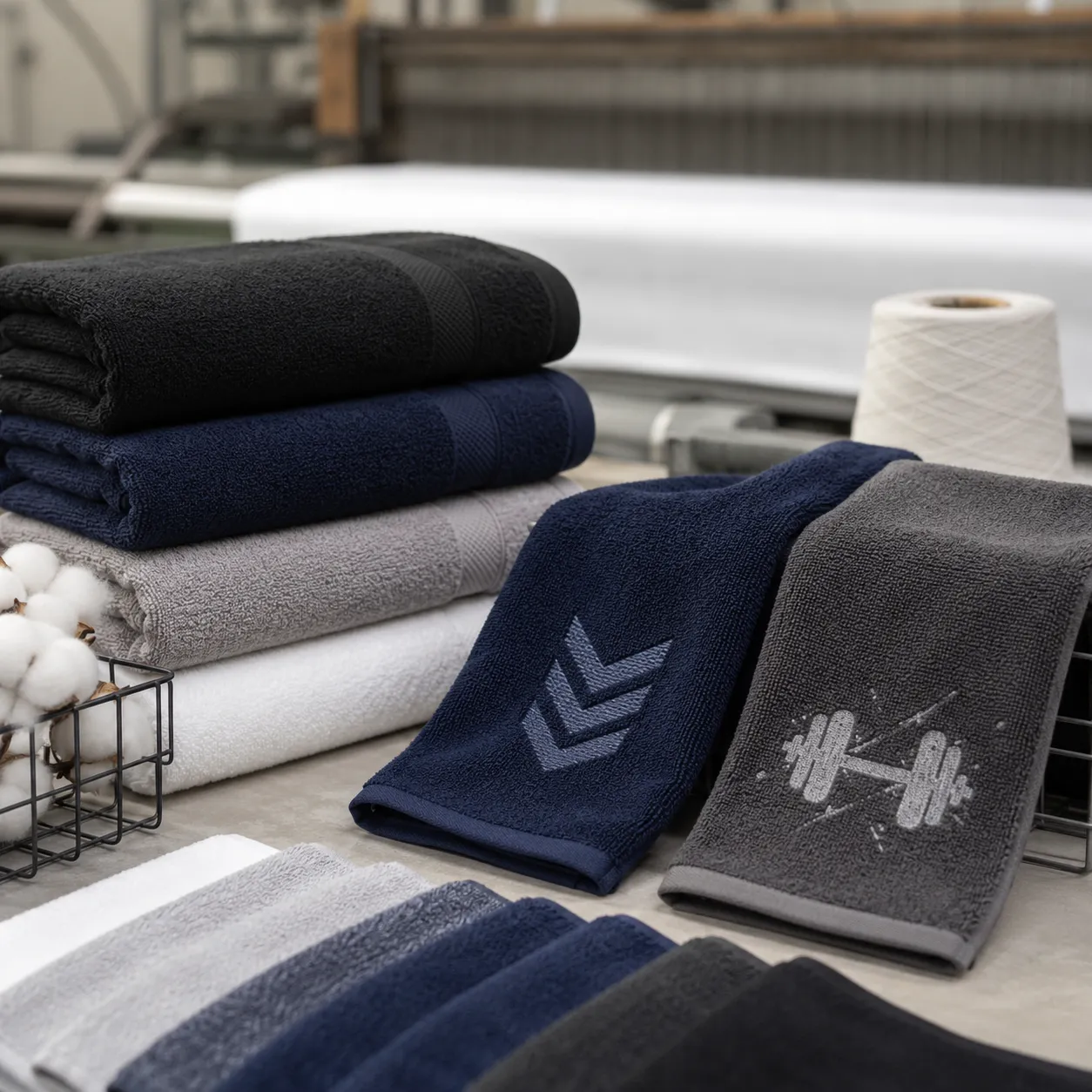
We decorate towels for gyms, yoga studios, hotel fitness centers, and sports clubs. The same logo can be embroidered, woven in jacquard, printed by reactive pigment, or applied as a transfer. Each method can work, but only if it matches the fabric GSM, loop height, wash program, and reorder plan.
For most gym buyers, we build around 360-520 GSM cotton terry for sweat towels and 230-320 GSM microfiber for compact training towels. A 30 × 100 cm cotton towel at 430 GSM lands near 129 g before decoration; a 40 × 80 cm version at the same GSM is around 138 g. Those grams matter because embroidery, label sewing, and carton freight all add cost and handling weight.
| Use case | Common size | GSM range | Decoration risk we watch |
|---|---|---|---|
| Fitness floor sweat towel | 30 × 90 cm or 35 × 90 cm | 380-480 GSM cotton terry | Logo stiffness if embroidery is too dense |
| Spin studio handlebar towel | 30 × 100 cm | 400-500 GSM cotton terry | Puckering along long logo edges |
| Retail gym towel | 40 × 80 cm or 50 × 100 cm | 430-560 GSM cotton terry | Color shade variation between repeat lots |
| Compact training towel | 30 × 80 cm | 230-320 GSM microfiber | Print edge lift after tumble drying |
| Hotel gym amenity towel | 35 × 75 cm | 450-550 GSM cotton terry | Whiteness loss if washing uses chlorine |
Gym Towel Durability Logo Decoration Guide
A practical gym towel durability logo decoration guide starts by separating logo exposure into three zones. The first is direct skin contact, where sweat, sunscreen, and friction hit the yarn. The second is laundry exposure, where detergent pH, temperature, and mechanical agitation attack the decoration. The third is handling exposure, where staff fold, stack, scan, and transport towels in bins.
We ask buyers one question early: will the towel be rented, sold, given to members, or used as a controlled club asset? A retail towel can prioritize visual detail. A rental towel must prioritize repeat wash legibility. For club-owned towels, we usually reject very large rubberized prints because they become hard panels after hot drying and can trap dampness between stacks.
- Rental or club-owned towels: choose jacquard, low-density embroidery, or woven labels with reinforced corners.
- Retail towels: embroidery or high-resolution print can work if the buyer accepts higher decoration cost and slower sampling.
- Event towels: pigment print or sublimation on microfiber is economical when the expected use life is short.
- Hotel gym towels: tone-on-tone embroidery is safer than dark transfer print on white terry because it avoids visible cracking.
- Boutique studios: small logo embroidery near the hem gives brand visibility without creating a rough wiping area.
The phrase gym towel durability logo decoration guide can sound like a design topic, but in our factory it is a wash-test topic. A logo that looks sharp on the first approval photo still has to pass rubbing, laundering, and seam stress checks before we recommend bulk production.
Decoration Methods That Hold Up Differently
Embroidery, jacquard, and print each fail in different ways. That is why we do not quote only from a flat artwork file. We need to know the towel base, the logo dimensions, the colors, and whether the towel will see commercial laundry.
| Method | Best fit | Typical logo cost at 2,000 pcs | Main durability concern | Factory note |
|---|---|---|---|---|
| Embroidery | Small chest-style logo, monogram, club crest | USD 0.18-0.46 per towel | Thread abrasion and backing scratch | Keep fill areas under about 4,500-6,500 stitches for sweat towels |
| Jacquard woven logo | Large repeated logo or border branding | USD 0.10-0.28 per towel after loom setup | Loss of fine detail in small letters | Best for two-color tonal designs, not tiny QR-style marks |
| Reactive or pigment print on cotton | Retail graphic or event towel | USD 0.22-0.58 per towel | Print fading and hand-feel change | Works better on velour face than high-loop terry |
| Sublimation on microfiber | Full-surface fitness or cooling towel | USD 0.16-0.42 per towel | Edge curl and color migration if heat set poorly | Only for polyester-rich microfiber, not cotton terry |
| Woven label or loop label | Inventory marking, subtle branding | USD 0.06-0.18 per towel | Corner fray after wash | Use bar-tack or folded-end label construction |
For embroidered gym towels, our decoration team checks stitch density against pile height. A dense satin stitch over high terry loops can bridge the surface instead of locking cleanly into the ground. After washing, the loops relax and the logo edge may look wavy. We reduce this by trimming the pile in the logo zone for selected orders, using lighter underlay, or moving the logo closer to the dobby hem where the surface is flatter.
Jacquard is the most integrated option because the logo is built into the weave. The trade-off is artwork discipline. A 12 mm letter in a woven terry logo may fill in after pile bloom, especially with rounded fonts. For gym towel GSM above 500, we often enlarge lettering or move the logo into a flat border to avoid fuzzy outlines.
Print has the best graphic freedom but the harshest durability questions. On cotton terry, pigment print sits partly on the fiber surface. If the print paste is too heavy, the towel loses absorbency in that area. If the binder is too light, the print abrades. We test both wet and dry rubbing before we approve production.
What We Test Before Bulk Approval
For custom gym towels with logo, we do not rely on a single beauty sample. Our standard development path includes a blank fabric sample, a decorated counter-sample, and a wash-tested approval sample. For repeat programs, we keep a sealed control sample in our QC room and compare bulk output against it under D65 lighting.
Two named tests matter often for towel logo wash durability. We use ISO 105-C06 as a reference for color fastness to domestic and commercial laundering, adjusted to the buyer’s wash temperature. For rubbing, ISO 105-X12 helps us compare dry and wet crocking on printed or dyed areas. For dimensional stability, we record shrinkage after repeated wash and tumble cycles using an internal template based on ISO 6330 washing procedures.
- Check artwork at actual size, not only in vector zoom view.
- Produce strike-off or embroidery sample on the real towel base, not spare fabric.
- Wash the decorated sample for 5 cycles at the intended temperature and detergent type.
- Inspect logo edge, stitch pull, label corners, linting, shrinkage, and shade change.
- Run a final approval photo set beside the unwashed sample before cutting bulk yarn or fabric.
A specific defect we see on printed sweat towels is cracking across folded zones. Gym staff often fold towels logo-out, so the same printed line may be compressed thousands of times. For transfers, we check edge lift with a fingernail test after tumble drying. For embroidery, we check backing residue and scratch feel because a rough stabilizer can irritate skin when members wipe their face.
| Test checkpoint | Typical acceptance target | Applies to | What failure looks like |
|---|---|---|---|
| Wash color fastness | Grade 4 or better on staining where possible | Dyed yarn, print, embroidery thread | Logo color bleeds into white towel ground |
| Wet rubbing | Grade 3-4 or better depending color depth | Dark print and deep dyed towels | Color marks transfer to white test cloth |
| Shrinkage after 5 washes | Within 4-7% depending construction | Cotton terry gym towels | Logo shifts, towel becomes short, borders curl |
| Embroidery seam security | No loose thread longer than 3 mm after wash | Embroidered gym towels | Thread tails catch in laundry or unravel |
| Label corner strength | No open corner after 5 wash cycles | Woven labels and care labels | Label lifts and twists during folding |
Logo Placement Can Add or Remove Months of Use
A durable decoration can still fail if placement is wrong. On gym towels, the center wiping area gets the most friction and detergent residue. We usually place embroidered logos near the lower hem, 35-60 mm above the edge, or inside a dobby border. This keeps the logo visible when folded and avoids the most aggressive wiping zone.
For a 30 × 90 cm sweat towel, a logo width of 60-85 mm is usually enough for club identification. Increasing to 140 mm may look better in a mockup, but it can double the stitch count and create a stiff area. On a 40 × 80 cm towel sold at retail, we can go larger, but we still check hand-feel after wash.
- Avoid dense embroidery in the middle third of a face-wiping towel.
- Keep small text above 5 mm height for embroidery and above 9-12 mm for jacquard terry.
- Use tone-on-tone thread when the laundry program uses strong optical brighteners.
- Place woven labels on a hem seam, not floating on loop pile.
- For microfiber sublimation, keep critical logo elements at least 15 mm from the cut edge to allow sewing tolerance.
Logo placement also affects packing. A thick embroidery stack in the same corner of every towel can create carton bulge and uneven compression. For 500-1,000 pcs, this is manageable. For 10,000 pcs shipping in export cartons, uneven stacks can increase carton deformation during ocean freight.
Costing: Cheap Decoration Often Costs More Per Use
We understand why buyers ask for the lowest logo price. Gym programs can lose towels through member carry-out, laundry miscounts, and staff handling. Still, the cheapest decoration is not always the lowest operating cost.
Here is a realistic example from how we cost internally. Suppose a 35 × 90 cm cotton gym towel at 420 GSM costs USD 2.05 at 3,000 pcs with a small woven label. If the club washes it 85 times before replacement, the textile cost is about USD 0.024 per use. A lower-cost towel with a heavy transfer logo might land at USD 1.72, but if the transfer cracks and the club removes it after 38 washes, textile cost becomes about USD 0.045 per use. That excludes the staff time of sorting rejects.
| Order volume | Cotton terry with small embroidery | Cotton terry jacquard border | Microfiber sublimation towel | Typical lead time |
|---|---|---|---|---|
| 500 pcs MOQ | USD 2.65-3.80 | USD 2.90-4.35 | USD 1.45-2.25 | 18-26 days after approval |
| 1,000-2,999 pcs | USD 2.15-3.25 | USD 2.45-3.75 | USD 1.18-1.92 | 22-32 days after approval |
| 3,000-7,999 pcs | USD 1.78-2.85 | USD 2.05-3.25 | USD 0.98-1.66 | 28-38 days after approval |
| 8,000+ pcs | USD 1.52-2.48 | USD 1.78-2.86 | USD 0.86-1.42 | 35-48 days after approval |
These bands assume standard export packing, one logo position, and normal-size artwork. Oversized embroidery, individual polybags, retail belly bands, RFID labels, or barcode stickers change the quote. Our MOQ is 500 pcs per design per color, but the best unit economics for decorated gym towels usually start above 2,000 pcs.
If a buyer is comparing decoration methods, we recommend quoting the same towel base across all methods. Otherwise the numbers become misleading. A 460 GSM combed cotton towel with embroidery cannot be fairly compared with a 300 GSM microfiber sublimation towel unless the use case changes too.
Fiber, Dye, and GSM Choices Behind the Decoration
Decoration durability is tied to the base towel. Cotton terry gives good absorbency and a familiar hand-feel, but it shrinks and blooms. Microfiber dries fast and prints cleanly, but it can feel less substantial in high-end locker rooms. Blended yarns can reduce drying time, though they must be tested for pilling and heat response.
For fitness floor towels, we often recommend ring-spun or combed cotton in 380-480 GSM. For hotel gym and spa crossover towels, 480-560 GSM feels more substantial, but laundering takes longer. For compact performance towels, 240-300 GSM microfiber is common because sublimation gives sharp logos and fast drying.
- White cotton terry: easiest for hotel gym programs, but stains and grayness show quickly if laundry sorting is weak.
- Navy or charcoal cotton: hides stains, but wet rubbing and shade fastness must be checked carefully.
- Reactive dyed cotton: better hand-feel than heavy surface print for long-use towels.
- Yarn-dyed jacquard: stable for repeated branding, but artwork detail is limited by loom construction.
- Polyester microfiber: best for full-color printed sweat towels and event fitness towels.
One construction quirk matters for logo work: terry loop height changes how embroidery sits. A loose 500 GSM towel may feel soft, but its tall loops can swallow fine details. A tighter 430 GSM towel with a clean dobby hem can carry a small logo more neatly. This is why we sometimes recommend a lower GSM for better branding performance, not to cut cost.
Certification and Compliance for Fitness Brands
For gym chains and athletic brands, compliance is not only paperwork. Towels touch the face, neck, and hands when the user is sweating. We produce under OEKO-TEX Standard 100 Class I for applicable towel programs, which is the strictest product class and covers baby-contact articles. Many adult fitness buyers accept Class II, but Class I gives stronger reassurance for broad use.
Our mill is also BSCI audited and ISO 9001 certified. ISO 9001 does not guarantee that a logo will never fade, but it does require controlled production records, inspection checkpoints, and corrective action when a process drifts. For a decorated towel program, that means we document yarn lot, dye lot, thread color, artwork file, approved sample, and packing specification.
If the towel will be sold in retail channels, we also confirm care label language, fiber content, country of origin, and packaging claims. A claim like “bleach resistant” should not be printed unless the towel and logo have been tested for the buyer’s actual bleach concentration. For gym laundry using oxygen bleach, we test differently than for chlorine exposure.
Production Timeline From Artwork to Carton
A normal decorated gym towel project takes 25-45 days after sample approval, depending on yarn availability, decoration method, and order size. Sampling is where buyers can save the most time. A clean vector file, Pantone references, size table, carton requirement, and laundry expectation can reduce back-and-forth by a week.
- Day 1-2: review tech pack, logo file, Pantone colors, and intended wash program.
- Day 3-7: prepare lab dip, thread card, print strike-off, or jacquard CAD depending on method.
- Day 8-14: make decorated pre-production sample and internal wash check.
- Day 15-17: buyer approval, comments, or adjustment round.
- Day 18-35: bulk weaving, dyeing, cutting, decoration, sewing, and in-line QC for most 1,000-5,000 pc orders.
- Day 36-45: final inspection, carton marking, export packing, and shipment handover for larger or mixed-SKU programs.
For urgent events, air freight can move finished goods quickly, but it rarely fixes late artwork approval. A 2,500 pc microfiber sublimation order may finish in about 24-30 days if artwork is clean. A cotton jacquard towel with custom yarn dye and border logo can require 38-50 days because loom scheduling and dye matching take longer.
Related reads: for base towel sizing, see our towel dimensions guide. For fabric weight decisions, use the GSM decision framework, and for gym failure modes read why gym towels fail after 50 washes.
Approval Checklist We Use With Buyers
Before bulk production, we want the buyer to approve more than a photo. A gym towel durability logo decoration guide should end with a written approval checklist, because verbal comments like “make it stronger” or “logo looks good” do not protect either side during production.
- Approved towel size, GSM, yarn type, color, and shrinkage tolerance.
- Approved logo method, logo size, position from edge, thread or print color, and stitch count if embroidered.
- Approved wash-test result, including temperature, detergent type, drying method, and number of cycles.
- Approved packaging: bulk carton, inner bundle count, polybag, care label, barcode, or club inventory label.
- Approved final AQL inspection level, carton marks, ship window, and destination documents.
We use ISO 2859-1 sampling logic for final inspection unless the buyer specifies another AQL plan. For decorated gym towels, our inspectors check visual defects, open seams, skipped stitches, logo position, shade consistency, lint contamination, and carton count. If a defect appears in one carton, we trace it back by production batch instead of only replacing the visible rejects.
Related reads: if you are still choosing between decoration methods, compare embroidery, sublimation, and jacquard. For color control, review Pantone color matching for towels. For building a spec sheet we can quote accurately, use our towel tech pack guide.
Where We Push Back on Risky Requests
We will make a cheap event towel if that is the right use case. We will also push back when a buyer asks for a low-cost decoration that conflicts with a commercial laundry program. A large rubber transfer on a cotton sweat towel, a tiny jacquard logo with 4 mm letters, or a 12,000-stitch embroidery in the wiping zone may pass a desk review but fail in the club.
The better path is to define the expected wash life first. For a promotional gym opening towel, 10-15 washes may be enough. For a member retail towel, 40-70 washes is a fair target. For club-owned towels, we usually design for 80-120 wash cycles with visible branding, assuming the laundry process is controlled.
This is why our gym towel durability logo decoration guide always ties the artwork to testing, not just appearance. Buyers who approve decoration after wash testing usually have fewer reorder disputes and better cost-per-use because the towel program is engineered around real handling.
Build a Wash-Tested Gym Towel Program
Send us your logo, target GSM, laundry method, and quantity. MOQ is 500 pcs per design per color. Contact WhatsApp +86 13205717266 or [email protected] for a decoration quote and sample plan.
Request Gym Towel Quote →