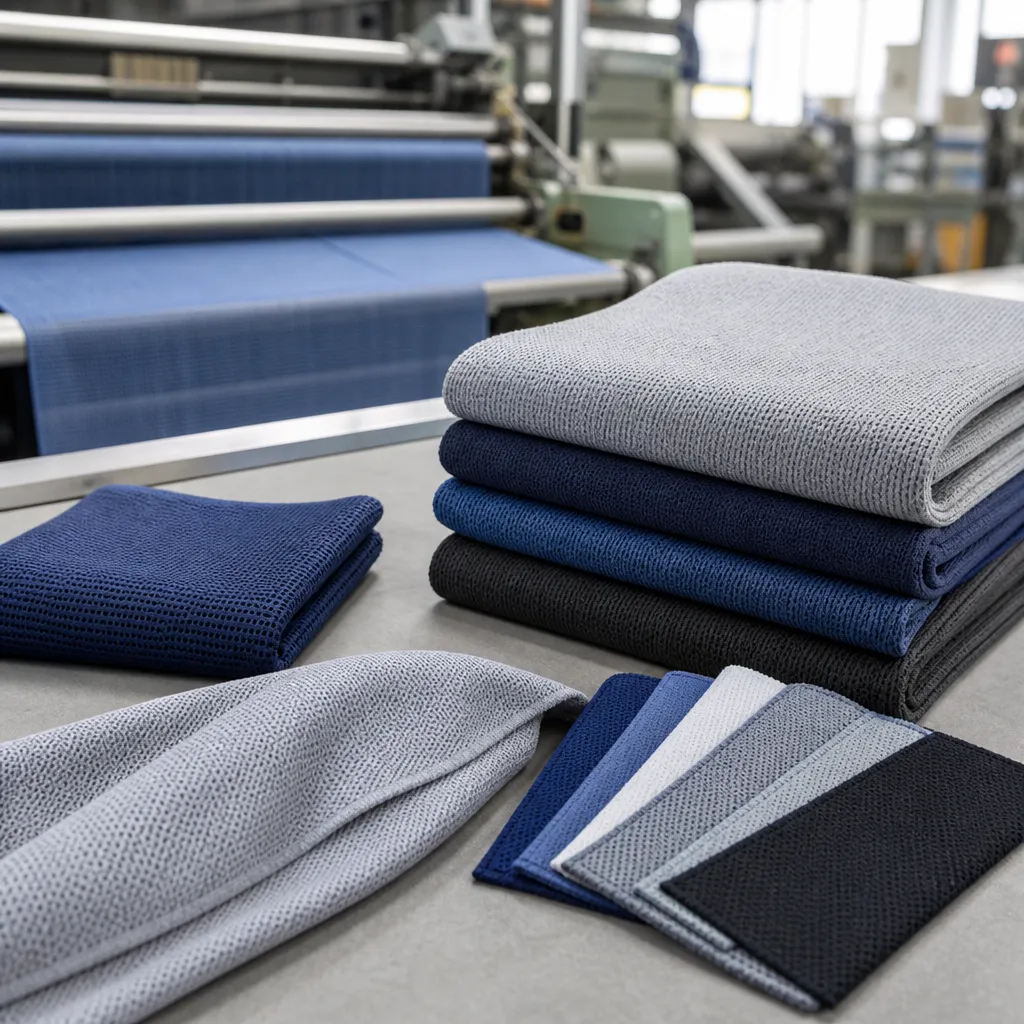
Start with the job, not the fabric name
Microfiber is not one product family. A cloth for optical wiping, a towel for auto drying, and a gym print towel can all be described loosely as microfiber, yet they are built with different yarn fineness, knitting routes, finishing chemistry, and edge treatments. If your RFQ only says "microfiber cloth, soft handfeel, logo optional," you will get price noise rather than comparable offers.
For B2B buying, we usually sort projects into four use cases first: glass and screen wiping, general cleaning, detailing and polishing, or body-contact textile use. That decision tells us whether to prioritize low lint, capillary pickup, glide on coated surfaces, or wash durability after repeated laundering. It also changes the acceptable GSM window by more than 200 grams per square meter.
| Use case | Typical construction | Working GSM | Common risk if underspecified |
|---|---|---|---|
| Optical / screen | suede or very short-pile warp knit | 160-220 | drag marks or edge scratching from overbuilt cloth |
| General cleaning | short-pile terry knit | 220-300 | poor pickup and early edge curl |
| Auto detailing | dual-pile or dense terry warp knit | 320-520 | linting, seam drag, inconsistent absorbency |
| Sports / printed promo | smooth knit for transfer print | 180-260 | print bleed, low opacity, poor recovery after wash |
- State the end surface: painted panel, mirror, stainless steel, touchscreen, skin, or equipment.
- State the liquid or soil: water, dust, polish residue, sanitizer, sweat, or detergent carryover.
- State the care route: hand wash, domestic wash, or commercial laundry at 60°C or 71°C.
- State the failure you cannot accept: lint, dye bleeding, drag, streaking, shrinkage, or curled corners.
The construction choices that move performance the most
The biggest sourcing mistake we see is buying by fiber ratio only. "80/20 polyester-polyamide" matters, but it does not tell you whether the yarn was properly split, whether the loops are dense enough to hold residue, or whether the finish leaves the surface grabby. Two cloths can both be 80/20 and still behave very differently.
Three build details deserve more attention in your spec sheet. First is split microfiber: the filament must be mechanically or chemically split to create the wedge-shaped microchannels that improve pickup. Second is knit structure: warp knit is usually more dimensionally stable and common in detailing grades, while weft knit can be softer and lower cost but may distort more in laundering. Third is edge finish. Ultrasonic cut, hidden edge, overlock, and silk-banded edges all change scratch risk and sewing yield.
| Spec line | What to ask for | Why it matters in use |
|---|---|---|
| Fiber ratio | 70/30 or 80/20 with declared split process | polyamide level affects softness and absorbency, but splitting affects pickup |
| Knit type | warp knit, weft knit, suede, coral fleece, waffle | changes bulk, drag, recovery, and lint profile |
| Pile height | single short pile, dual pile, suede flat face | controls whether cloth wipes cleanly or pushes residue |
| Edge finish | ultrasonic, edgeless folded, overlock, binding | affects scratch complaints, corner lift, and sewing cost |
| Weight tolerance | for example ±5% per piece after conditioning | prevents carton-to-carton inconsistency |
Read GSM together with size and edge method
Buyers often compare quoted GSM without calculating finished piece weight. That can hide cost differences and create false assumptions about absorbency. A 35×35 cm cloth at 250 GSM is only around 31 g before edge treatment. The same article at 40×40 cm becomes around 40 g. If one supplier is quoting ultrasonic cut and another is quoting overlock with four-thread edge, the per-piece weight and labor cost will separate further.
For that reason we prefer to approve both GSM and conditioned piece weight. In our factory checks, conditioned means the sample has rested after finishing rather than being weighed warm off the stenter. This avoids optimistic weights caused by temporary moisture content. On medium terry microfiber cloths, a realistic production tolerance for finished size is often within about 2 cm and for weight within 5%, assuming one construction and one dye lot.
- Lock the finished size in centimeters, not inches only.
- Approve a target GSM range tied to one knit structure.
- Add a minimum finished piece weight per size.
- Specify whether measurement is taken before or after first wash.
- Specify edge construction because it changes both weight and touch.
Which test methods actually prove the cloth will work
The editor was right to reject generic durability claims without method detail. If you want evidence, ask for test names, sample conditioning, and pass criteria. For fiber content we can test to ISO 1833 where applicable. For dimensional change after domestic laundering, ISO 6330 is the usual wash procedure reference and ISO 5077 is used for shrinkage evaluation. For colorfastness to washing, ISO 105-C06 is standard. For crocking or rubbing, ISO 105-X12 is commonly used.
Absorbency and pickup need more care because there is no single universal benchmark buyers all use. In our lab practice for cleaning-grade articles, we compare conditioned specimens of equal area and record water uptake by mass over a timed immersion-and-drain sequence. For streak-sensitive projects like glass cloths, we also run a panel wipe test on black coated acrylic and mirror glass under fixed lighting, then grade residue visually against approved retain samples. That is not a global ISO method, so it must be documented as an internal protocol if used for approvals.
| Property | Method we would cite | Typical approval language |
|---|---|---|
| Colorfastness to washing | ISO 105-C06 | minimum grade 4 color change and staining on agreed adjacent fibers |
| Dimensional stability | ISO 6330 + ISO 5077 | shrinkage within agreed range after stated cycles and temperature |
| Fiber composition | ISO 1833 | composition within contractual tolerance of declared ratio |
| Rubbing fastness | ISO 105-X12 | dry and wet rubbing grade as required by end use |
| Restricted substances | OEKO-TEX Standard 100 Class I certificate scope | valid certificate covering finished article category or relevant component route |
If a supplier says a cloth is "tested" but cannot name the method, cycle count, temperature, and pass line, treat that claim as sales copy rather than technical evidence.
Failure modes we see in bulk, and how to spec around them
Most microfiber complaints do not start as catastrophic failures. They start as small variances that only become obvious after use. A cloth that is slightly under-split can feel acceptable dry, then underperform on first wiping. An over-softened finish can make a sample feel luxurious but reduce grab on glass. An aggressive ultrasonic edge can harden the perimeter enough to cause drag on piano-black trim.
- Linting after first wash: often tied to low loop stability, weaker yarn, or brushing imbalance. Ask for one pre-production wash check before mass cutting.
- Corner curling: common on lighter weft-knit articles with narrow overlock tension. Request packed-flat approval samples and a wash-retained sample.
- Shade variation carton to carton: more likely when multiple dye lots are packed together. Require lot segregation on outer carton markings.
- Streaking on glass: may come from finishing residue rather than the base knit. Ask whether post-dye silicone or softener is used, and request reduced-finish option for glass programs.
- Scratch complaints on glossy surfaces: often edge-related rather than fabric-body related. Approve edge construction on the actual substrate, not only by handfeel.
Two process details that matter here and are often omitted from RFQs: whether the cloth is heat-set after dyeing to control skew and width stability, and whether the pile surface has undergone one-side raising or shearing. Those steps can improve the look of a showroom sample, but they also change friction, absorbency onset, and wash appearance.
What current pricing really depends on
FOB China pricing for 2026 is still very sensitive to knit density, polyamide percentage, finishing route, and packaging labor. The numbers below reflect mainland China production for standard export cartons, one-color solids, and normal compliance paperwork. They do not include destination duties, local inland freight outside the named port, or retail-ready gift packaging.
| Product type | Spec basis | MOQ | Indicative FOB China price |
|---|---|---|---|
| General cleaning cloth | 30×30 cm, 230-260 GSM, 80/20, overlock edge | 10,000 pcs | USD 0.20-0.29/pc |
| Glass / screen cloth | 30×30 cm, 170-200 GSM suede knit, ultrasonic cut | 12,000 pcs | USD 0.17-0.25/pc |
| Detailing cloth | 40×40 cm, 320-380 GSM warp knit terry, edgeless | 8,000 pcs | USD 0.58-0.86/pc |
| High-bulk drying cloth | 50×80 cm, 430-520 GSM dual-pile, hidden edge | 5,000 pcs | USD 1.48-2.18/pc |
Add roughly USD 0.02-0.06 per piece for sewn labels and simple belly bands, depending on pack style and insertion count. Pantone-critical dyeing on lower-volume custom colors can push the dyed fabric cost upward because the machine utilization is less efficient. Polyamide-rich constructions also shift pricing because nylon cost is less forgiving than polyester when markets move.
Our own MOQ for custom towel programs is 500 pcs per design and per color, but for microfiber cloths the practical MOQ depends on knitting and dyeing economics. On stock greige routes with standard colors, smaller runs can work. On fully custom colors plus branded packaging, the commercial floor is usually higher if you want stable unit economics.
Certificates are useful only when the scope matches the item
Buyers ask for OEKO-TEX, BSCI, and ISO 9001 regularly, which is sensible, but the document itself needs reading. We hold OEKO-TEX Standard 100 Class I, BSCI, and ISO 9001 certifications. For a microfiber order, the practical question is whether the certificate scope covers the finished article category or the relevant processing chain, and whether the document is valid on the shipment date.
A certificate from a yarn supplier is not the same as a certificate covering the finished dyed and sewn cloth. Likewise, a social audit report for one factory address does not automatically extend to a subcontracted cutting or packing unit. If your customer requires restricted-substance assurance for baby-contact or skin-contact use, ask for the certificate number, validity date, product class, and factory name that will appear on your PO paperwork. For buyers new to this, our article on how to read an OEKO-TEX certificate explains what to verify.
- Check the certificate holder name against the invoicing factory.
- Check the scope and product class rather than the logo alone.
- Check the validity date against shipment timing, not sample timing.
- Check whether any subcontract process sits outside the audited site.
Lead time usually breaks at dyeing and packout
For repeat microfiber cloths on approved materials, the schedule can be straightforward. New developments take longer because the risk sits in handfeel approval, color matching, and packaging assembly rather than cutting and sewing alone. The common misunderstanding is to count knitting capacity but ignore time for lab dips, print strike-off if relevant, and final carton assortment.
| Stage | Typical days | What delays it |
|---|---|---|
| RFQ review and spec clarification | 2-4 days | missing edge spec, undefined test standard, unclear packaging |
| Sample development | 7-12 days | custom color, revised pile feel, logo packaging mockup |
| Lab dip or color approval | 3-6 days | dark shades, fluorescent tones, brand approval loops |
| Bulk production | 18-30 days | multi-color split, outsourced print, mixed pack ratios |
| Final inspection and dispatch booking | 3-7 days | carton relabeling, barcode issues, vessel space |
If you are deciding between sea and air for a launch window, container-vs-air-freight-towel-orders gives the cost trade-offs. For many cloth programs, compressibility helps, but volumetric air cost still rises fast once you move into higher-pile detailing items.
The RFQ fields that save the most back-and-forth
A good microfiber inquiry is compact but specific. We can usually quote within one revision if the buyer provides a usable data set. We need less narrative and more fixed fields. If your team already uses technical packs, adapt that template rather than starting from a moodboard.
- Finished size and tolerance
- Target GSM and minimum piece weight
- Fiber ratio and whether split microfiber is required
- Knit type or reference sample photo with front/back closeups
- Edge finish and corner treatment
- Color standard: Pantone, existing swatch, or retained sample
- Packaging unit: individual, polybag count, inner carton, outer carton
- Required test methods and pass grades
- Destination market and any compliance notes
- Forecast quantity by color and reorder cadence
If your current documents are too loose for mills to quote cleanly, build-towel-tech-pack-that-mills-can-quote is still relevant even though it was written around towels rather than cloths. The same logic applies: define what changes cost, what affects QC, and what cannot drift.
Related reads
If your project overlaps automotive or mixed-material programs, see auto-detailing-microfiber-towel-program and microfiber-vs-cotton-towel-comparison. For spec writing and color control, pantone-color-matching-custom-towels and towel-gsm-decision-framework are useful companion pieces.
Buyers planning custom pack formats should also review build-towel-tech-pack-that-mills-can-quote and negotiate-towel-moq-without-killing-margin. Even for cloth programs, those two articles reduce quoting ambiguity and help avoid the wrong low-price offer.
Need a microfiber cloth quote with real test lines
Send size, GSM, knit, edge finish, packaging, and target quantity. We will quote against a defined spec, not a vague category name. WhatsApp +86 13205717266 or email [email protected].
Request a quote →