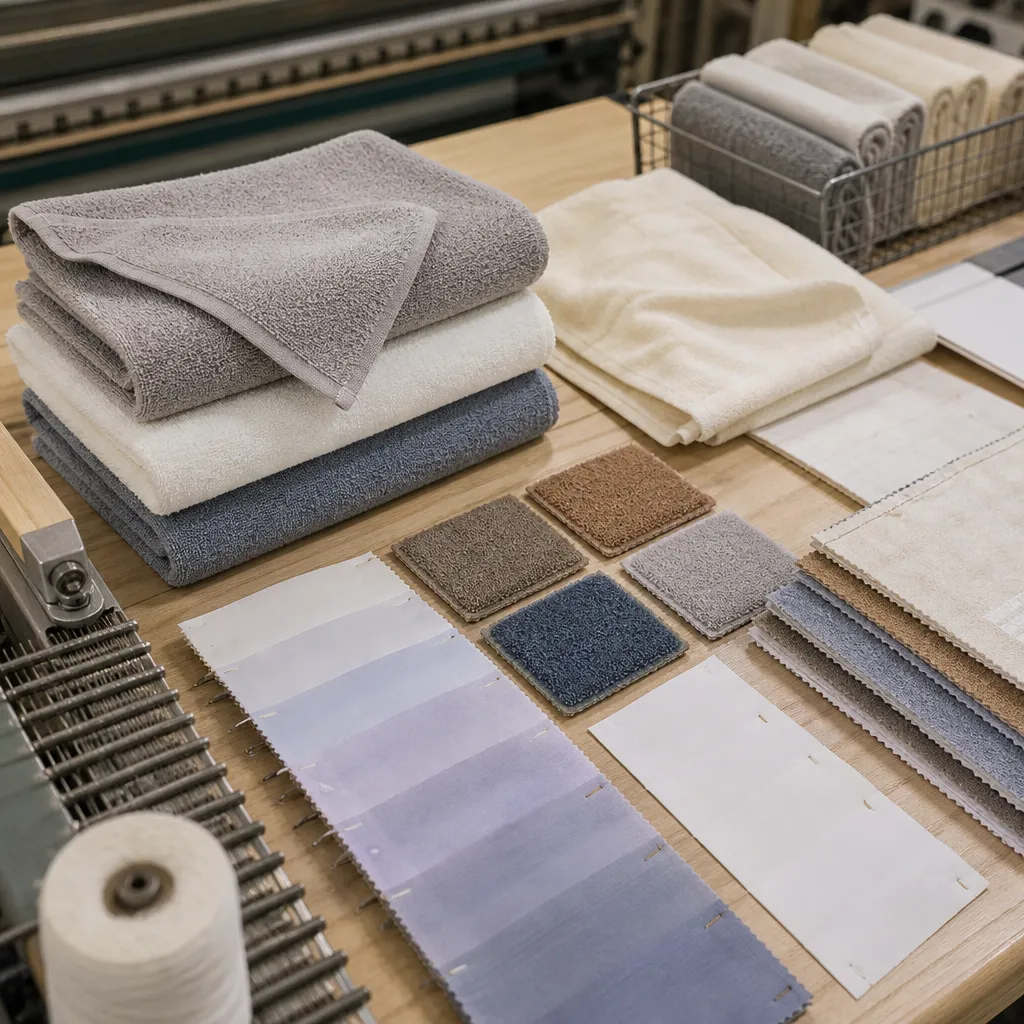
Microfiber Towels for Cleaning MOQ and Pricing: The Short Version
For our mill, the practical MOQ is 500 pcs per design per color. That is the lowest point where dyeing, cutting, stitching, packing, and inspection can be run without turning the order into a sample-room job. For stock-color plain cloths we can sometimes discuss mixed color cartons, but custom PMS dyeing or private label packing still needs clean color lots.
Most cleaning programs we quote sit between 200 and 420 GSM. A 30 x 30 cm 250 GSM cloth is a small screen or countertop item. A 40 x 40 cm 320 GSM cloth works for general household and janitorial use. A 40 x 60 cm 380 GSM cloth is closer to car, glass, and equipment wiping where hand feel and water pickup matter more than the lowest unit price.
| Spec direction | Typical use | FOB China band at 3,000 pcs | MOQ note |
|---|---|---|---|
| 220-250 GSM, overlock edge | Promo cleaning kits, light dusting | USD 0.22-0.36 per pc | 500 pcs/color if using available yarn colors |
| 280-320 GSM, overlock or folded edge | Retail household, janitorial refill packs | USD 0.38-0.62 per pc | 1,000 pcs/color preferred for custom dyed lots |
| 340-380 GSM, folded edge | Auto, appliance, gym equipment cleaning | USD 0.66-0.98 per pc | 500 pcs/color possible, better price at 2,000 pcs |
| 400-450 GSM, plush pile | Detailing, high-value retail bundles | USD 1.05-1.48 per pc | Usually 1,500 pcs/color to control shade and pile consistency |
Those bands assume polyester/polyamide microfiber, normal export carton packing, and a clear approved sample before bulk. If the brief adds individual opp bagging, printed belly bands, barcode stickers, or Amazon carton labels, the unit price and lead time move. That is why a real quote has to separate towel cost from packout cost.
What Actually Sets the MOQ
MOQ is not only a sales rule. It comes from machine setup, color control, cutting loss, and how many pieces we can inspect per batch without mixing shade lots. For microfiber cleaning towels bulk orders, the color plan usually creates more MOQ pressure than the size.
- Color split: one order of 2,000 pcs in one gray is easier than 500 pcs each in four PMS colors because dyeing and shade approval repeat four times.
- Fabric availability: white, black, navy, gray, and common blues can often use planned yarn or greige stock; unusual coral, mint, or brand-specific green usually needs custom dyeing.
- Edge construction: overlock is faster and cheaper; folded edge needs more sewing time but gives a cleaner retail look and better edge durability.
- Packing style: bulk 50 pcs/polybag is efficient; 1 pc/opp bag with barcode creates more labor, film consumption, and inspection touchpoints.
- Logo method: heat transfer label, woven label, screen print, and sublimation each have different setup losses and approval steps.
For mixed-color packs, we ask buyers to define the commercial unit first. A 4-pack with blue, green, gray, and yellow is not the same as a carton containing four separate solid-color SKUs. The first requires pack assembly control. The second requires inventory control. Both can work, but the quote sheet should not blur them.
Price Drivers Buyers Underestimate
The largest cost driver is still weight. GSM multiplied by size gives the fabric consumption before cutting loss. A 35 x 35 cm cloth at 300 GSM uses about 36.8 g of fabric before edging and waste. A 40 x 40 cm cloth at the same GSM uses about 48 g. That 30% area increase often surprises buyers because the size difference looks small on a desk.
| Cost driver | Low-cost choice | Higher-control choice | Factory comment |
|---|---|---|---|
| Fiber split | 100% polyester microfiber | 80/20 or 70/30 polyester/polyamide | More polyamide usually improves softness and absorbency, but raises yarn cost. |
| GSM | 220-260 GSM | 320-420 GSM | Low GSM saves freight and yarn but can feel too thin for retail repeat purchase. |
| Edge | 3-thread overlock | Folded edge with reinforced corners | Folded edge reduces fray complaints after repeated wash but slows sewing. |
| Color | Stock black or gray | Custom PMS dyed color | Custom shade adds lab dip, dye minimum, and more rejection risk. |
| Packing | Bulk inner polybag | Retail pack with insert card and barcode | Retail packout can add USD 0.05-0.18 per pc depending on materials. |
Cheap construction can be rational for a disposable promotional cloth. It is usually false economy for janitorial, auto, or retail cleaning programs. If a 240 GSM overlock cloth costs USD 0.29 and lasts 35 commercial wash cycles, the towel cost is about USD 0.0083 per wash. A 340 GSM folded-edge cloth at USD 0.58 lasting 95 wash cycles costs about USD 0.0061 per wash. The invoice is higher, but the cost-per-use is lower and complaints are usually fewer.
Volume Bands We Use for FOB Quoting
Below is a realistic FOB China planning table for plain microfiber cleaning cloths. It is not a final quotation because exchange rate, yarn market, dye choice, and packing all matter. It does show where volume starts to change the math.
| Order volume | 30 x 30 cm, 250 GSM | 40 x 40 cm, 320 GSM | 40 x 60 cm, 380 GSM | Typical use |
|---|---|---|---|---|
| 500 pcs/color | USD 0.31-0.46 | USD 0.56-0.78 | USD 1.02-1.36 | Pilot run, regional launch, sample resale test |
| 1,000 pcs/color | USD 0.27-0.40 | USD 0.49-0.70 | USD 0.92-1.24 | Small retail program or B2B replenishment |
| 3,000 pcs/color | USD 0.22-0.34 | USD 0.40-0.60 | USD 0.78-1.08 | Normal OEM cleaning towel order |
| 10,000 pcs/color | USD 0.18-0.29 | USD 0.34-0.52 | USD 0.68-0.94 | Chain retail, distributor, or subscription pack |
For microfiber towels for cleaning MOQ and pricing, we also watch carton cube. A low unit price can disappear when the buyer chooses a thick plush pile, individual hang tags, and air freight. For sea freight, dense folded cartons are usually fine. For courier or air shipment, cloth thickness and retail packaging can become a bigger cost issue than the FOB difference between two factories.
Construction Choices That Affect Complaints
Microfiber cleaning cloth claims usually do not come from one dramatic failure. They come from linting, edge curl, shade variation, poor absorbency after finishing, or a cloth that scratches coated surfaces because the wrong edge or label was selected. These defects are avoidable if the specification sheet names the risk.
- Specify fiber composition, such as 80/20 polyester/polyamide or 70/30 polyester/polyamide, instead of writing microfiber only.
- Define GSM tolerance, usually +/-5% for normal orders and tighter only when the program can pay for more sorting.
- Confirm edge type: 3-thread overlock, 4-thread overlock, ultrasonic cut, or folded stitched edge.
- State lint requirement and test method, especially for glass, optics, auto interiors, or stainless appliances.
- Approve one folded and packed sample, not only a loose fabric swatch.
Two topic-specific tests matter here. We run absorbency checks using a modified AATCC 79 water drop test to see whether finishing residue slows wetting. We also use a tape-lift lint check after wash and tumble dry for high-risk glass and detailing cloths. If a buyer wants a claim-resistant program, these tests belong in the approval record before mass production.
Compliance, Wash Testing, and AQL
Our standard export framework uses OEKO-TEX Standard 100 Class I, BSCI, and ISO 9001 factory management. For cleaning cloths that touch skin indirectly or go into household kits, OEKO-TEX documentation is often requested by brand compliance teams. It does not replace performance testing, but it helps close chemical-restricted-substance questions.
| Control point | Common standard or method | Practical acceptance target |
|---|---|---|
| Chemical safety | OEKO-TEX Standard 100 Class I | Certificate scope must cover the product material and dye route |
| Factory social audit | BSCI | Valid audit record before deposit for new brand programs |
| Quality management | ISO 9001 | Traceable inspection, nonconformance handling, and batch records |
| Colorfastness to washing | ISO 105-C06 | Grade 4 or better for most dark and medium colors |
| Colorfastness to rubbing | ISO 105-X12 | Dry grade 4, wet grade 3-4 or better depending on color |
| Final inspection | ANSI/ASQ Z1.4, General Level II | AQL 2.5 major, 4.0 minor unless buyer standard differs |
For white or light gray cloths, visual defects stand out less but soil during sewing and packing becomes the issue. For black, navy, and red, rubbing and wash colorfastness deserve more attention. For bright assorted packs, shade grouping must be checked under D65 light because one off-tone cloth in a transparent retail pack makes the whole pack look uncontrolled.
Timeline From RFQ to Shipment
A clean microfiber cloth program is faster than jacquard or heavy embroidery, but custom color and retail packing still take time. We normally ask buyers to budget 31-48 days from confirmed tech pack to FOB handover for a repeatable order. Rushing below that window is possible only when fabric, color, and packaging are already approved.
- RFQ and spec clarification: 1-3 days when size, GSM, fiber split, edge, logo, packing, and target quantity are clear.
- Lab dip or color confirmation: 4-7 days for custom dyed colors; stock colors can move faster.
- Pre-production sample: 5-9 days for plain cloths, 8-12 days with label, print, or retail packout.
- Bulk weaving or knitting, dyeing, cutting, sewing: 14-24 days depending on volume and color count.
- Internal QC and final packing: 3-5 days, longer if carton labels or mixed pack assembly is complex.
- Export booking and FOB handover: 4-7 days after final inspection and balance payment arrangement.
Air shipment can save transit time, but it rarely fixes a late approval. A buyer who takes 11 days to approve a lab dip and then asks for a 20-day delivery window is not solving the real bottleneck. The fastest orders are the ones where the first RFQ already includes a usable tech pack. We explained the broader format in build towel tech pack that mills can quote.
How We Quote Mixed Packs and Private Label
Private label cleaning cloths often sell as 2-packs, 4-packs, 6-packs, or car-care bundles. The factory work changes once we move from single-color bulk cartons to retail-ready packs. Assembly accuracy becomes a QC item, not just a packing instruction.
- For a 4-pack assorted color set, define the color sequence and whether substitution is allowed if one shade is delayed.
- For a barcode retail pack, provide EAN or UPC files and carton label data before sample approval.
- For a hanging card, confirm hole position, paper weight, and whether the towel edge is visible through the pack.
- For an Amazon-style carton, provide carton weight limit, FNSKU rules, and drop-test expectations before carton artwork is printed.
We normally add USD 0.03-0.08 per piece for simple label and barcode work, USD 0.06-0.14 for individual opp bagging with insert card, and USD 0.10-0.22 for more complex retail bundle assembly. These numbers vary with pack size and labor sequence. A 6-pack is not just six towels priced together; it needs counting control, color order control, and final weight checks.
RFQ Data That Prevents Re-Quoting
The fastest way to control microfiber towels for cleaning MOQ and pricing is to give the mill enough data in the first message. A vague target price without use case usually leads to a cheap sample that the buyer rejects later.
- Send size in centimeters, GSM, fiber split, edge type, and target use case.
- State total order quantity and color split by SKU, not only the total annual forecast.
- Confirm whether the order needs logo, woven label, care label, insert card, opp bag, master carton mark, or palletization.
- Name the test requirements: OEKO-TEX, ISO 105-C06, ISO 105-X12, lint check, wash cycles, or buyer-specific protocol.
- Provide delivery term, destination port, and whether you need FOB, CIF, DDP estimate, or courier sample freight.
Related reads: compare cleaning cloth fibers in microfiber vs cotton towel comparison, review bulk program setup in custom microfiber towels wholesale guide, and use microfiber cloth sourcing specs when building a buyer-side specification sheet.
For buyers also sourcing adjacent categories, auto-detailing microfiber towel program, microfiber cleaning cloth supplier scorecard 2026, and how to read OEKO-TEX certificate cover audit and claim-prevention details that overlap with cleaning towel programs.
Our Practical Recommendation
For a first OEM cleaning program, we usually recommend a 40 x 40 cm, 300-340 GSM, 80/20 microfiber cloth with folded edge if the product is for retail or repeated janitorial use. For a lower-cost promotional pack, a 30 x 30 cm, 240-260 GSM overlock cloth is more realistic. For auto or glass buyers, we would rather reduce packaging cost than cut the cloth below the performance level.
A workable first order is often 2,000-4,000 pcs across two colors, with one approved pack style and one carton label format. That keeps MOQ manageable while giving enough production volume to stabilize cutting, sewing, and inspection. After the first sell-through data comes back, reorder quantities can move to 6,000-12,000 pcs per color where FOB pricing becomes more efficient.
Quote a Cleaning Microfiber Program
Send size, GSM, color split, packing style, target quantity, and test requirements to [email protected] or WhatsApp +86 13205717266. MOQ starts at 500 pcs per design per color.
Request a Quote →