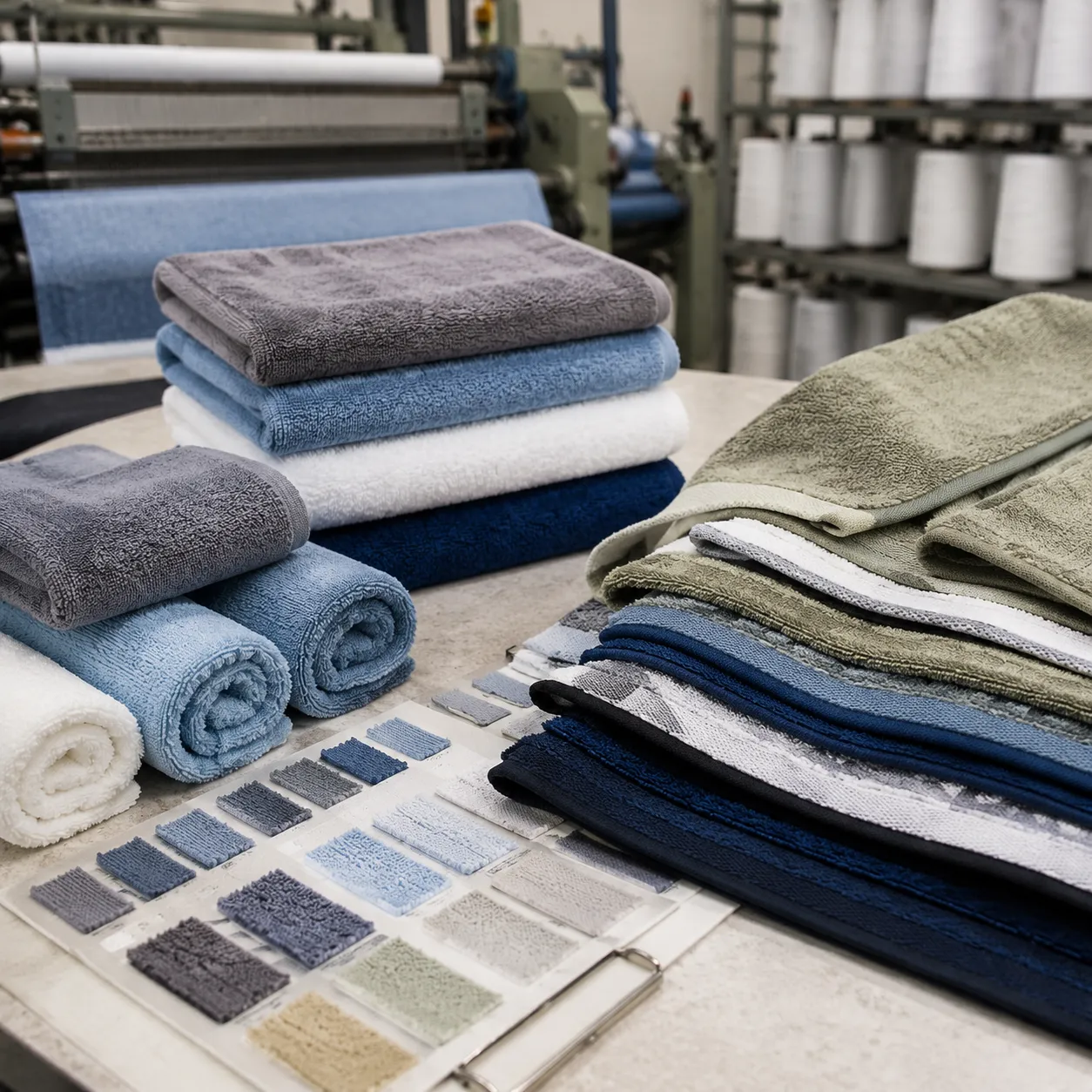
Why MOQ Is Different for Microfiber Cleaning Towels
Microfiber MOQ is not only about how many towels we can weave or knit. It is about fabric roll dyeing, pile stability after splitting, edge finishing speed, and how many times the line must stop for color, label, carton mark, and polybag changes. At LUMA & CO. TEXTILE, our working MOQ is 500 pcs per design / per color. We can discuss mixed cartons or staged shipping, but dropping below that quantity usually moves cost from fabric into handling.
For microfiber cleaning cloth bulk programs, the real constraint is often color spread. A 3-color order at 1,000 pcs each is easier to control than a 10-color order at 300 pcs each, even though both total 3,000 pcs. Each color needs lab dip control, shade band approval, fabric booking, cutting markers, and QC records. If the towel uses different edges by color, the sewing line loses additional time changing thread cones and tension settings.
Our mill has 220 employees and produces around 2.4M towels annually for 80+ brand clients in 47 countries. For microfiber, we usually run cleaning towels from 220 to 420 GSM, with 280-320 GSM being the most common range for household cleaning kits and 350-400 GSM used for auto-detailing or high-absorbency retail packs. Heavier GSM does not automatically mean better cleaning; it changes absorbency, drying time, and carton volume.
| MOQ factor | What drives it | Factory impact | Buyer lever |
|---|---|---|---|
| Color count | Each shade needs dye control and roll allocation | More lab dips, shade bands, and leftover fabric risk | Reduce launch colors or group colors by reorder cycle |
| GSM spread | Different weights require separate fabric booking | Cutting yield and packing weights change | Use one base GSM, vary size or edge instead |
| Edge type | Overlock, silk border, ultrasonic cut, or edgeless | Different sewing speeds and defect risks | Keep one edge finish across colors |
| Logo method | Woven label, heat transfer, embroidery, or printed card | Extra approval and attachment steps | Put brand on packaging first, towel second |
| Packing style | Bulk pack, belly band, retail polybag, barcode carton | Labor time and carton cube change | Separate launch packing from replenishment packing |
Microfiber Cleaning Towel MOQ Negotiation Guide: What We Can Actually Move
A practical microfiber cleaning towel moq negotiation guide separates flexible variables from fixed production realities. Buyers often ask us to “just lower the MOQ,” but the better discussion is usually about which part of the order can be combined. We can combine yarn base, GSM, size, carton layout, and some packaging materials. We cannot combine dye lots across unrelated colors or pretend that 14 small colorways behave like one large production run.
- Flexible: carton marks, master carton quantity, label language variants, inner polybag count, and delivery split between warehouse destinations.
- Sometimes flexible: edge thread color, towel size within the same cutting plan, woven label placement, and barcode sticker version.
- Harder to flex: body color, GSM, pile construction, suede versus terry microfiber face, and silicone or magnet accessory attachment.
- Not recommended to flex below MOQ: new custom Pantone shades, edgeless laser-cut retail cloths, and dual-sided cleaning towels with different face structures.
For a first PO, we often advise buyers to negotiate fewer SKUs with better testing, not more SKUs with weak quantities. A 2,500-piece launch in five colors at 500 pcs each gives the factory enough material to stabilize dyeing and sewing. The same 2,500 pieces spread across 10 colors at 250 pcs each forces surcharge pricing and creates a higher chance of shade variation between reorder lots.
This is where cost-per-use matters. For example, a 30 × 40 cm, 320 GSM towel may quote around USD 0.58-0.72 at 3,000 pcs if the program uses three colors and bulk packing. If the same total order is split into nine colors with individual retail sleeves, the unit may move to USD 0.81-0.98. If the towel survives 120 household wash cycles, the first option lands near half a cent per use; the second option is still affordable, but the extra cost is paying for SKU complexity, not better wiping performance.
Choose the Base Cloth Before Fighting MOQ
MOQ negotiation becomes cleaner after the base towel is fixed. For custom microfiber towels, we normally ask buyers to decide four technical points before we quote: blend, GSM, pile face, and edge. If these are still changing, any MOQ number is only a placeholder.
| Application | Common size | GSM range | Recommended construction | MOQ note |
|---|---|---|---|---|
| Household cleaning kit | 30 × 30 cm or 30 × 40 cm | 240-300 GSM | 80/20 polyester-polyamide, terry loop | Can combine colors if same edge and packing |
| Glass and screen cleaning | 30 × 30 cm | 200-260 GSM | Suede or flat microfiber | Needs stricter lint and oil-residue control |
| Auto detailing microfiber towels | 40 × 40 cm | 320-420 GSM | 70/30 or 80/20 terry, medium pile | Better at 800-1,000 pcs per color due to weight |
| Commercial janitorial cloth | 35 × 35 cm | 280-340 GSM | Short pile, overlock edge | Color coding works well at 500 pcs per color |
| Retail multipack | 30 × 30 cm mixed pack | 250-320 GSM | Same base cloth, multiple colors | Negotiate by pack set, not by single cloth |
For cleaning use, an 80/20 polyester/polyamide blend is the standard balance of cost and wiping performance. A 70/30 blend can feel softer and absorb faster because the higher polyamide content improves water uptake, but it costs more and can be less attractive for price-sensitive promotional packs. We check absorbency with a drop test similar to AATCC 79, watching wet-out speed after prewash because some microfiber cloths arrive with finishing residue that slows first-use absorption.
Edge construction also changes MOQ economics. A basic overlock edge is faster and works well for janitorial and household cloths. An edgeless microfiber cloth gives a cleaner retail look and reduces edge scratch risk for car paint, but it requires more careful cutting and inspection for loose filament dust. Ultrasonic cutting can seal edges on some microfiber structures, but if heat is too high it creates a hard rim that detailers dislike. We test this by rubbing the edge on black acrylic panels and checking for visible drag marks under angled light.
Color Strategy: The Fastest Way to Lower Surcharges
Color is usually the biggest MOQ trap. Buyers want color-coded cloths for kitchen, bathroom, glass, and car use. That makes sense operationally, but every colorway has a dye lot and a shade tolerance. For microfiber, dark shades like black, navy, and deep red also need tighter crocking checks because loose dye can transfer during first washes.
We use ISO 105-C06 for domestic and commercial laundering colorfastness reference and check rubbing behavior against ISO 105-X12 principles when a cloth is intended for wet cleaning. OEKO-TEX Standard 100 Class I compliance matters because microfiber cleaning towels often touch skin, food-prep surfaces, or baby-care products. Our factory also works under BSCI social compliance and ISO 9001 quality management systems, but certificates do not replace lot-by-lot shade approval.
- Start with three functional colors: one light, one medium, one dark. This gives buyers a real color-coded line without fragmenting MOQ.
- Use standard shade families where possible. A stock-like grey or blue is easier than a tightly controlled seasonal Pantone.
- Keep the same thread color on the edge when brand rules allow it. Matching overlock thread on tiny lots adds changeover time.
- Group reorders by shade family. Reordering blue and teal together is usually easier than mixing neon yellow with charcoal.
- Approve a shade band, not a single perfect cutting. Microfiber pile reflects light differently when brushed in opposite directions.
Pantone matching can work, but buyers should understand that microfiber reflects color differently from cotton terry. The same Pantone target may look lighter on suede microfiber and deeper on high-pile terry. For more detail on shade approval, our team’s article on Pantone color matching custom towels explains why lab dips need viewing under D65 and store-light conditions, not only office lighting.
Pricing Bands by Volume and Spec
The following pricing bands are realistic FOB China ranges for microfiber cleaning towels in 2026. They assume OEM production, export carton packing, OEKO-TEX compliant materials, and normal QC inspection. Prices move with exchange rate, fiber cost, packaging, and whether the buyer asks for special tags, retail cards, or Amazon-ready carton labeling.
| Spec example | 500 pcs/color | 1,500 pcs/color | 5,000 pcs/color | Best use |
|---|---|---|---|---|
| 30 × 30 cm, 250 GSM, overlock, bulk pack | USD 0.34-0.46 | USD 0.28-0.36 | USD 0.22-0.30 | Household multipack, giveaway kit |
| 30 × 40 cm, 300 GSM, overlock, 10 pcs/polybag | USD 0.52-0.68 | USD 0.43-0.55 | USD 0.36-0.47 | Retail cleaning set, janitorial program |
| 40 × 40 cm, 360 GSM, edgeless, bulk pack | USD 0.86-1.12 | USD 0.72-0.91 | USD 0.62-0.78 | Auto care, high-touch polishing |
| 40 × 60 cm, 400 GSM, silk border, label | USD 1.42-1.82 | USD 1.19-1.48 | USD 1.02-1.29 | Detailing drying towel, premium kit |
| 30 × 30 cm suede, 220 GSM, printed insert card | USD 0.41-0.57 | USD 0.35-0.45 | USD 0.29-0.38 | Screen, lens, and glass cleaning |
At 500 pcs per design / per color, the price carries setup time and fabric loss. At 1,500 pcs per color, cutting yield improves and the sewing team can run longer without changing cones or labels. At 5,000 pcs per color, we can usually optimize fabric booking, carton quantity, and inspection flow. That does not mean every buyer should start at 5,000 pieces. It means the MOQ negotiation should be linked to forecast confidence.
A first-year brand that expects 20,000 pieces across four colors should not necessarily buy all 20,000 immediately. A safer plan may be 6,000 pieces in the first PO, then a 45-60 day reorder trigger after online reviews and return data come in. For more general MOQ logic, see our article on how to negotiate towel MOQ without killing margin. The same principle applies to microfiber: a smaller first run can be smart, but only if it is not split into too many underweight SKUs.
Testing Points That Protect the Buyer and the Mill
Microfiber failure does not always show up on day one. Some defects appear after washing, edge abrasion, or high-speed wiping. We prefer to put test requirements into the tech pack before sampling, because negotiating MOQ after a failed test is slower than agreeing on the test method upfront.
- Lint release: dark acrylic wipe test and white paper shake test after one wash. High lint is common when cutting blades are dull or edgeless cloths are not vacuum cleaned.
- Absorbency: water drop wet-out check before and after prewash. Silicone softener residue can make cloth feel nice but slow first-use absorption.
- Edge durability: 20-cycle wash trial at 40°C, then inspect overlock breaks, skipped stitches, and hard ultrasonic rims.
- Colorfastness: ISO 105-C06 wash reference plus wet rubbing check for black, red, burgundy, and navy cloths.
- Dimensional stability: measure shrinkage after washing. Microfiber usually has low shrinkage, but heat setting problems can distort rectangular towels.
One construction quirk buyers should know: terry microfiber has a nap direction. If cutting markers rotate pieces to save fabric, two cloths from the same roll can reflect light differently. For solid color cleaning towels this may look like shade variation even when the dye lot is within tolerance. We avoid mixed nap direction in retail-facing orders unless the buyer accepts it in the approved sample standard.
Another defect mode is needle cutting on dense microfiber. If the sewing needle is too large or the stitch tension is too tight, the edge can develop tiny perforation lines. These may not fail during inspection, but after repeated laundering the edge starts to wave or split. We specify needle size and check seam stretch during inline QC, especially for 350 GSM and above.
Sample Approval: Keep It Narrow but Real
Sampling should answer production questions, not create a showroom of options. For a microfiber cleaning towel program, we usually recommend one base sample, two color lab dips, and one packaging mockup. If the buyer wants to compare 70/30 and 80/20 blends, we sample both in the same size and GSM so the difference is meaningful.
| Stage | Typical timing | Buyer decision | Factory output |
|---|---|---|---|
| Tech pack review | 1-2 days | Confirm size, GSM, blend, edge, packing | Quote sheet and MOQ options |
| Lab dip or color card | 4-6 days | Approve target shade or shade band | Dye reference for bulk |
| Prototype sample | 7-10 days | Check handfeel, edge, logo, label | Physical approval sample |
| Pre-production sample | 5-7 days after deposit and material ready | Approve final construction | Sealed PPS for QC |
| Bulk production | 22-32 days | No spec changes unless re-quoted | Cutting, sewing, packing, inspection |
| Export and documents | 3-5 days | Confirm shipping marks and consignee data | Invoice, packing list, certificate copies |
For buyers building a full towel or cleaning accessory kit, the tech pack should include more than dimensions. It should state fabric composition, GSM tolerance, edge type, stitch density, label position, carton quantity, barcode rules, inspection AQL, and washing standard. Our guide on building a towel tech pack that mills can quote is useful if your current RFQ is mostly photos and target price.
We advise buyers not to approve microfiber samples only by handfeel. Softness can be adjusted with finishing, but too much finishing agent reduces wipe performance. A practical sample review includes first-use absorption, lint after one wash, and edge feel on the actual surface: glass, stainless steel, painted car panels, gym equipment, or countertop material.
Packaging and Carton Choices Affect MOQ More Than Expected
Packaging is often where small orders become expensive. A bulk-packed cleaning cloth in a master carton is simple. A retail set with printed belly band, UPC sticker, multilingual insert, individual polybag, and color-sequenced bundle requires separate approval and more manual work. If the buyer also wants mixed-color sets, MOQ must be discussed by set configuration, not only by towel color.
- For janitorial B2B supply, use 50 or 100 pcs per inner polybag and a clear carton label by color. It is fast to pack and easy for warehouse picking.
- For retail 4-packs, keep all colors at the same GSM and size. Mixed GSM in one pack slows inspection and creates uneven folding height.
- For Amazon or DTC cartons, confirm FNSKU or barcode placement before bulk packing. Relabeling cartons after sealing adds avoidable labor.
- For private label launch orders, print one universal insert card and vary only the barcode sticker by SKU. This keeps MOQ manageable.
- For export pallet planning, avoid over-heavy cartons. Microfiber is dense; a carton that looks small can exceed comfortable manual handling weight.
A 40 × 40 cm 360 GSM cloth weighs about 58 g before packaging. A carton of 200 pcs is roughly 11.6 kg net, often 13-14 kg gross after inner bags and carton board. That is comfortable for most warehouse teams. If the buyer pushes 300 pcs per carton, the gross weight may move near 20 kg, which can increase handling complaints and carton deformation during sea freight.
For logistics planning, microfiber often ships well by sea because it compresses better than thick cotton bath towels. Air freight can make sense for launch shortages, but it can erase the savings gained from MOQ negotiation. Our logistics note on container vs air freight towel orders explains when speed is worth the freight premium.
A Practical Negotiation Script for Buyers
The best MOQ conversations are specific. Instead of asking, “Can you do 200 pcs per color?”, send the mill a structure that gives room to optimize. We can then quote a base option, a surcharge option, and a reorder option without guessing your real launch risk.
- State your firm launch quantity and your realistic 6-month forecast. If the forecast is soft, say so; we can design a lower-risk first PO.
- Limit the first PO to the colors that prove demand. Keep extra colors as lab dips, not bulk production.
- Ask for pricing at 500, 1,500, and 5,000 pcs per color. This shows where the cost curve changes.
- Offer to keep one GSM and one edge type across all colors. This is more useful than promising vague future volume.
- Discuss reorder lead time before deposit. A good reorder calendar can reduce your need to overbuy the first run.
- Put certifications and test standards in the RFQ. OEKO-TEX, ISO 9001 process control, and BSCI audit status should be clear early.
Here is a negotiation structure that usually works: launch with 3 colors at 800 pcs each, approve 2 extra colors as lab dips only, and lock a reorder price valid for 60 days if the buyer repeats the same GSM, size, and edge. This gives the brand market flexibility and gives the factory enough volume to run stable production. It also avoids the common mistake of launching eight colors that each sell too slowly to reorder efficiently.
If the MOQ request creates more changeovers than production time, the unit price will rise even when the total order quantity looks healthy.
Related reads: For buyers comparing material choices, see microfiber vs cotton towel comparison and custom microfiber towels wholesale guide. If your cleaning towel is part of an auto kit, our auto-detailing microfiber towel program covers pile height, edge feel, and paint-safe testing in more detail.
Related reads: If you are building a broader sourcing file, pair this microfiber cleaning towel moq negotiation guide with how to read an OEKO-TEX certificate and private label vs white label towel programs. Those two decisions often affect MOQ as much as the cloth itself.
Lead Time and Reorder Calendar
For normal microfiber cleaning towel production, we plan 7-10 days for prototype samples, 4-6 days for lab dips, and 22-32 days for bulk production after deposit, PPS approval, and material readiness. More complex retail packing can add 5-8 days because printed cards, barcode stickers, and carton marks need approval before final packing. Sea freight then adds roughly 18-38 days depending on destination port, sailing schedule, and customs clearance.
Reorder timing should start before the first PO ships. If your monthly sell-through is expected to be 1,200 packs and each pack contains four cloths, you are consuming 4,800 towels per month. With a 35-day production and document window plus sea freight, the reorder trigger should happen when at least 10-12 weeks of stock remain. Waiting until only 3 weeks of inventory remain usually forces air freight or emergency color substitutions.
Our recommendation for new programs is simple: negotiate MOQ once, then negotiate repeatability. Lock the base cloth, keep the color list disciplined, define test standards, and set a reorder window. That is how buyers reduce unit cost without asking the factory to run a production structure that creates defects, delays, or hidden surcharges.
Build a Microfiber MOQ Plan
Send your target size, GSM, color list, edge type, packing method, and forecast. We will quote MOQ options from 500 pcs per design/color with realistic pricing and timing. WhatsApp: +86 13205717266. Email: [email protected].
Request MOQ Quote →