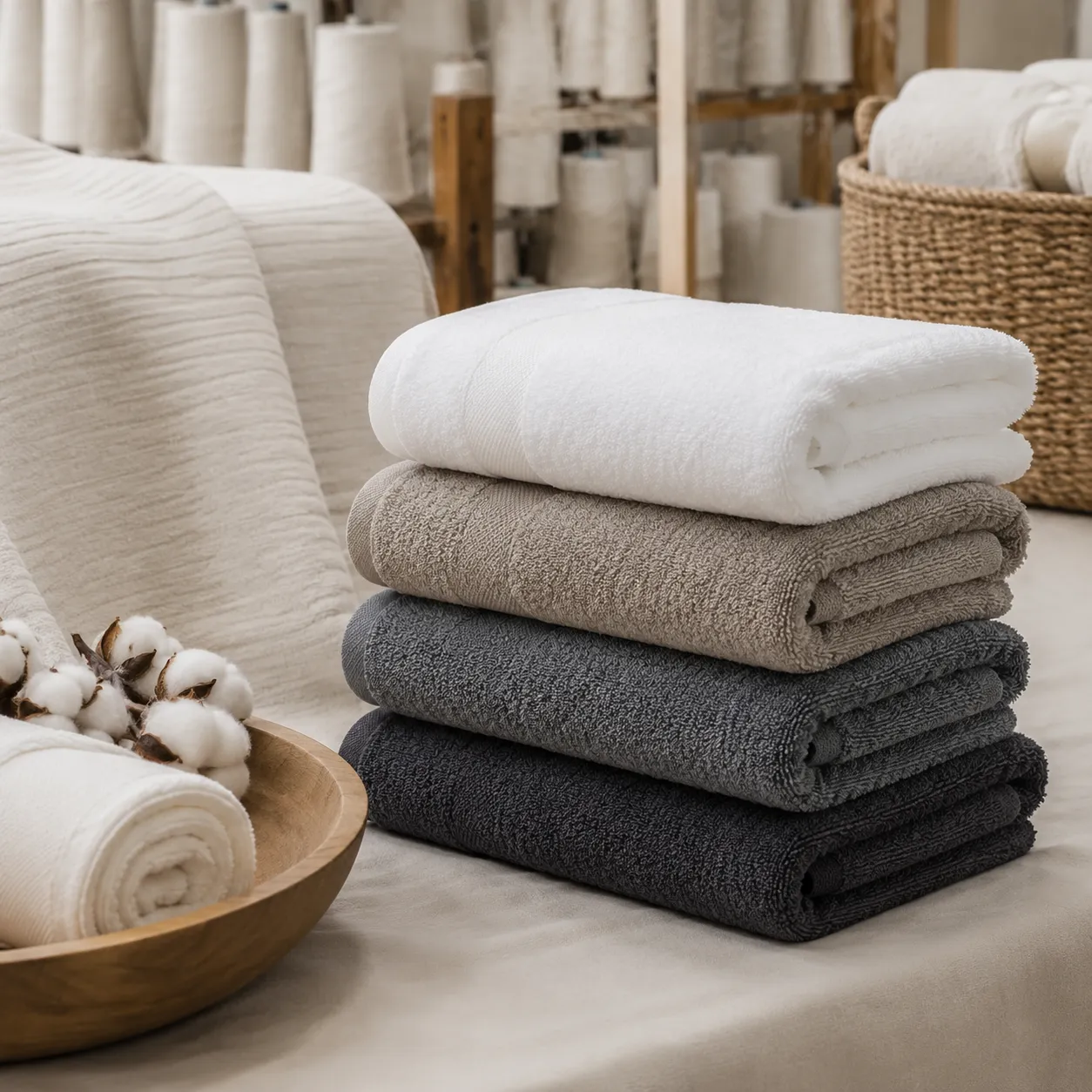
Why Spa Towel MOQ Is Usually a Color Problem
For treatment-room towels, MOQ pressure rarely starts with total quantity. It starts when a spa wants six calm colors across three sizes, each with a small embroidered logo or woven label. Our factory MOQ is 500 pcs per design / per color, because dyeing, cutting, sewing, inspection, and carton marking all become separate production controls once the color or construction changes.
If a buyer orders 3,000 towels in one color, the line is straightforward. If the same 3,000 towels are split into eight colors and four sizes, we are not making one order; we are controlling many mini-orders. The dye house still needs a practical liquor ratio, the sewing floor still changes thread cones and size guides, and QC still has to approve shade bands under D65 light.
Spa programs add one extra complication: treatment oils. Dark charcoal hides oil stains better, but it shows lint and alkaline streaks. Ivory feels clean in a treatment room, but it shows massage oil oxidation after repeated hot washing. MOQ negotiation should start with the operating reality, not only with the color palette.
| MOQ unit we control | Why it matters in spa production | Typical flexibility |
|---|---|---|
| Color | Reactive dyeing needs stable batch size and shade approval | Low flexibility below 500 pcs |
| Size | Cutting markers, hem allowances, and carton counts change | Moderate flexibility if same color continues |
| Logo method | Embroidery, woven label, or heat-transfer label need separate setup | Flexible if logo position and thread stay same |
| GSM | Different yarn consumption and drying time affect costing | Low flexibility once bulk yarn is booked |
Spa Treatment Towel MOQ Negotiation Guide
A practical spa treatment towel moq negotiation guide should not begin by asking the mill to ignore its minimum. It should ask which specifications can be combined without increasing defect risk. In our Gaoyang facility, the easiest way to make MOQ workable is to hold one dyed body color across several towel sizes, then vary carton packing or labels by room type.
For example, a spa chain opening eight treatment rooms may not need separate towel colors for massage, facial, hydrotherapy, and retail. A better first order is often one core shade for treatment towels, one bleach-tolerant or peroxide-resistant shade for face contact, and one accent towel for retail display. That keeps production inside controlled lots while still giving operations enough separation in the laundry.
- Negotiate color count first: Reducing from five colors to two usually saves more than trimming towel weight by 20 GSM.
- Group sizes by shade: Face, hand, and treatment towels can share the same dye lot if the base yarn and pile construction match.
- Keep logo execution consistent: One embroidery thread color across sizes avoids extra machine setup and approval loops.
- Use packaging to create departments: Carton labels can separate rooms without requiring separate towel colors.
- Plan replenishment with the same shade card: Reorders are easier when the first order includes approved Lab values and a retained cutting sample.
The Specs Worth Holding Firm
Some details should not be traded away to force a lower minimum. Spa towels sit in warmers, absorb oil, meet skin repeatedly, and go through aggressive laundering. A towel that looks acceptable in the first unpacking can fail quickly if the GSM, yarn, or dye route is chosen only to reduce the opening PO.
For facial and treatment use, we normally quote cotton terry from 420-550 GSM. Below 400 GSM, the towel dries quickly but may feel thin after 25-35 wash cycles. Above 600 GSM, it feels heavier but dries slowly in commercial laundry and can smell sour if stored damp in warm cabinets. For hot towel cabinets, we also check shrinkage after steam exposure because a tight folded towel can curl at the side hem if the weft tension was not balanced.
| Spa towel type | Common size | Recommended GSM | Construction note |
|---|---|---|---|
| Facial towel | 30 x 30 cm or 32 x 32 cm | 420-480 GSM | Shorter loop reduces lint around skincare products |
| Treatment hand towel | 35 x 75 cm or 40 x 80 cm | 450-520 GSM | Double-stitched long hems resist warmer handling |
| Body treatment towel | 70 x 140 cm or 80 x 160 cm | 500-550 GSM | Medium pile balances absorbency and drying time |
| Wrap or cover towel | 90 x 150 cm or 100 x 180 cm | 430-500 GSM | Lower pile helps folding stacks stay flat |
We prefer combed cotton for most spa programs because the shorter fibers are removed before spinning. Ring-spun carded cotton can be cheaper, but it usually releases more lint during the first 5-8 washes. For buyers comparing yarns, our article on combed vs zero twist cotton explains why softness on a sample table is not the same as wash stability.
Where Mills Can Actually Bend MOQ
We can sometimes support a lower practical entry order if the buyer gives us a clean technical path. The factory still books material, dyeing, sewing time, and QC labor. But we may combine production more efficiently when the towel family is designed around shared inputs.
- Choose one base yarn and one GSM band across the program, such as all 480-520 GSM cotton terry.
- Keep all treatment-room towels in one dyed color and use carton stickers for department separation.
- Approve one logo size and one thread color for embroidery across every size.
- Use standard export cartons instead of custom rigid boxes for the first PO.
- Commit to a written reorder window, for example 90-120 days after launch, so yarn and shade references are retained.
What does not work well is asking for 200 pcs in seven colors with different GSM, different logo placements, and private label packaging for each room type. The unit price rises because each variation consumes sampling, setup, inspection, and packing attention. In that situation, a lower MOQ is not actually cheaper; it simply moves the cost into surcharges and higher defect risk.
For spa towels, the cleanest negotiation is usually not “Can you lower the MOQ?” It is “Which SKUs can share yarn, color, logo setup, and carton structure without hurting laundry life?”
Cost Bands Buyers Should Expect
Below are realistic FOB China ranges we see for OEM spa treatment towels using cotton terry, OEKO-TEX compliant dyes, and standard export packing. Prices move with cotton yarn, exchange rate, embroidery stitch count, carton density, and whether the buyer needs individual polybags or paper belly bands.
| Order structure | Typical volume | FOB USD range per pc | What usually drives the price |
|---|---|---|---|
| Face towel, no logo | 500-999 pcs per color | $0.42-$0.68 | GSM, yarn grade, dye color depth |
| Face towel with small embroidery | 1,000-2,999 pcs per color | $0.55-$0.86 | Stitch count under 3,500 and thread color changes |
| Treatment hand towel | 500-1,499 pcs per color | $1.05-$1.68 | Size, hem width, carton packing ratio |
| Body treatment towel | 500-1,499 pcs per color | $3.10-$5.40 | Weight, pile height, darker dye, logo method |
| Coordinated three-size set | 3,000-8,000 pcs total | $0.48-$4.95 by item | Shared color and one decoration route reduce setup cost |
A buyer recently compared a 390 GSM hand towel at about $0.92 FOB with a 500 GSM version at about $1.28 FOB. The cheaper towel looked attractive on the PO, but the laundry trial showed visible edge twisting after roughly 38 commercial washes. The heavier towel held shape beyond 72 washes in the same plant. If each towel is used twice per treatment day, the difference can be less than one cent per guest contact over a three-month cycle.
This is why we push back on very light towels for spas using hot cabinets and oil-heavy treatments. The towel is not only a guest-facing textile; it is a washable tool. For more general weight decisions, see our towel GSM decision framework and towel sizes guide.
Color, Oil, and Laundry Tests Before Bulk
Spa towels fail in different ways from hotel bath towels. The defect is not always a hole or broken hem. More often it is an oily gray cast, shade fading near the fold line, lint clinging to facial products, or hard hand-feel after sanitizer buildup. A good MOQ discussion should include a sample approval method that reflects these risks.
For bulk approval, we can run wash and colorfastness checks aligned with ISO 105-C06 for domestic and commercial laundering colorfastness, plus internal absorbency checks after three pre-washes. For dark spa colors, we also check crocking with dry and wet rubbing because treatment staff may use towels against white robes or sheets. If the buyer uses benzoyl peroxide skincare products, we recommend avoiding deep navy, chocolate, and certain warm grays unless the laundry chemistry is controlled.
- Oil shadowing: Massage oils can oxidize into yellow-gray marks if towels are stored warm before washing.
- Side-hem roping: High dryer heat can twist long hems when sewing tension and shrinkage are not balanced.
- Lint release: Short fibers or loose pile can transfer onto facial masks, wax, or polish removal pads.
- Shade migration: Poorly rinsed dark towels may leave tint on lighter treatment sheets during mixed loads.
- Cabinet curl: Repeated steaming can make square face towels cup at corners if the border is too tight.
We keep counter samples and dye records for repeat orders. For spas with several branches, we also recommend a simple laundry log during the first month: wash temperature, detergent type, sanitizer, drying temperature, and rejects by reason. This gives purchasing a factual basis for the second PO instead of relying on room manager impressions.
A Negotiable First-Order Structure
For a new spa opening, we often build a first PO around functional towel counts rather than a full brand assortment. The buyer can add more colors after the towel proves itself in laundry. This approach protects cash flow while still meeting our 500 pcs per design / per color production rule.
| Program part | Suggested first PO | Negotiation logic | Reorder trigger |
|---|---|---|---|
| Core treatment face towel | 1,000 pcs in one color | High daily consumption justifies full dye lot | When clean stock drops below 350 pcs |
| Treatment hand towel | 500-800 pcs same color | Shares dye direction and logo setup | After 45-60 operating days |
| Body treatment towel | 500 pcs same color or neutral shade | Keeps opening inventory controlled | After first laundry reject report |
| Retail or VIP accent towel | Defer or 500 pcs only | Avoids splitting first order into small colors | Add after occupancy stabilizes |
| Private label carton marking | Standard carton plus item sticker | Avoids custom packaging MOQ | Upgrade on second shipment |
This kind of structure works better than asking for 150 pcs of every item. It gives the spa enough towels for rotation, keeps factory setup clean, and leaves room to adjust after real use. For buyers still building the technical file, build a towel tech pack that mills can quote is the best companion article.
Certification and Compliance Lines to Keep in the PO
MOQ negotiation should never remove compliance language from the purchase order. Our mill holds OEKO-TEX Standard 100 Class I, BSCI, and ISO 9001 certification. For spa towels, OEKO-TEX is especially relevant because towels touch the face and body after steam, oil, and exfoliation. Class I is the strictest category, originally for baby articles, and gives buyers a conservative chemical safety baseline.
The PO should identify the product, fiber content, GSM tolerance, color reference, decoration method, carton marking, inspection level, and certification expectation. We normally allow GSM tolerance of about ±5% after conditioning, and size tolerance depends on the construction and wash requirement. If a spa needs retail labels, care labels should match the destination market, not only the factory default.
- State OEKO-TEX Standard 100 Class I requirement on the PO and artwork file.
- Reference ISO 9001 process control for production records and inspection retention.
- Ask for a copy of the current BSCI audit summary if corporate sourcing requires social compliance.
- Define wash testing before bulk shipment, not after towels arrive at the spa.
- Confirm label language, fiber content, and country-of-origin rules for the selling market.
If your team is unsure how to read the certificate scope, our guide on how to read an OEKO-TEX certificate explains product class, validity dates, and facility matching.
Lead Time and Sampling Calendar
A realistic spa treatment towel moq negotiation guide also has to include timing. Small orders do not always move faster than standard orders. If the order has several colors, embroidery, or retail packaging, the approval steps can take longer than the sewing time.
For a straightforward cotton terry spa towel program, our usual timeline is 7-10 days for lab dip or stock color confirmation, 10-14 days for pre-production samples with embroidery or label placement, 25-35 days for bulk production after deposit and approvals, and 5-7 days for final inspection, carton packing, and export documentation. Sea freight timing depends on destination; air freight can help launch shortages but is rarely economical for body-size towels because of volumetric weight.
- Send RFQ with size, GSM, color reference, fiber content, logo file, and target annual volume.
- Approve lab dip under agreed lighting, ideally D65, and keep one signed shade reference.
- Approve pre-production sample after wash, shrinkage, logo, and hand-feel review.
- Release deposit and final PO with carton marks, delivery terms, and inspection plan.
- Review bulk photos, measurement report, and packing list before balance payment and shipment.
For a wider logistics comparison, see container vs air freight towel orders. If your project includes hotel rooms as well as spa areas, setting up a hotel linen program gives a useful planning model.
Information That Helps Us Quote Fairly
The fastest way to improve MOQ terms is to send a quote request that shows the real program, not only one trial SKU. We do not need a polished brand deck. We need enough operational detail to group production correctly and avoid quoting a low price that will not survive sampling.
- Annual forecast by size and color, even if the first PO is smaller.
- Expected treatments per day and laundry turns per week.
- Laundry chemistry, especially peroxide, chlorine, or high-alkaline detergent exposure.
- Preferred GSM range and whether towels go into hot cabinets or steamers.
- Logo method, logo size, stitch count if known, and exact placement from towel edge.
- Packing plan: bulk carton, inner bundle, paper band, woven label, or retail polybag.
Our MOQ remains 500 pcs per design / per color, but clear information lets us propose a workable structure. Sometimes that means combining sizes in one dye lot. Sometimes it means moving a decorative accent towel to the second PO. Sometimes it means using a stock yarn count so the buyer does not carry unnecessary opening inventory.
Related reads: negotiate towel MOQ without killing margin, private label vs white label towel programs, and spa towels need different cotton than hotel towels. For finished spa categories, buyers can also review our spa towel products before preparing an RFQ.
Build a Spa Towel MOQ Plan
Send your size list, target GSM, color count, logo file, and annual forecast. We will map which SKUs should share dye lots and where MOQ can be negotiated without creating laundry failures. WhatsApp: +86 13205717266. Email: [email protected].
Request MOQ Review →