Start With the Jobs Inside the Kit
A retail detailing pack has to solve different cleaning jobs without confusing the customer. The towel that lifts water from a hood should not be the same construction as the cloth used on interior screens. If the bundle treats every cloth as one generic microfiber square, returns usually come from streaking, lint, edge scratches, or a towel that feels impressive in the hand but dries too slowly after use.
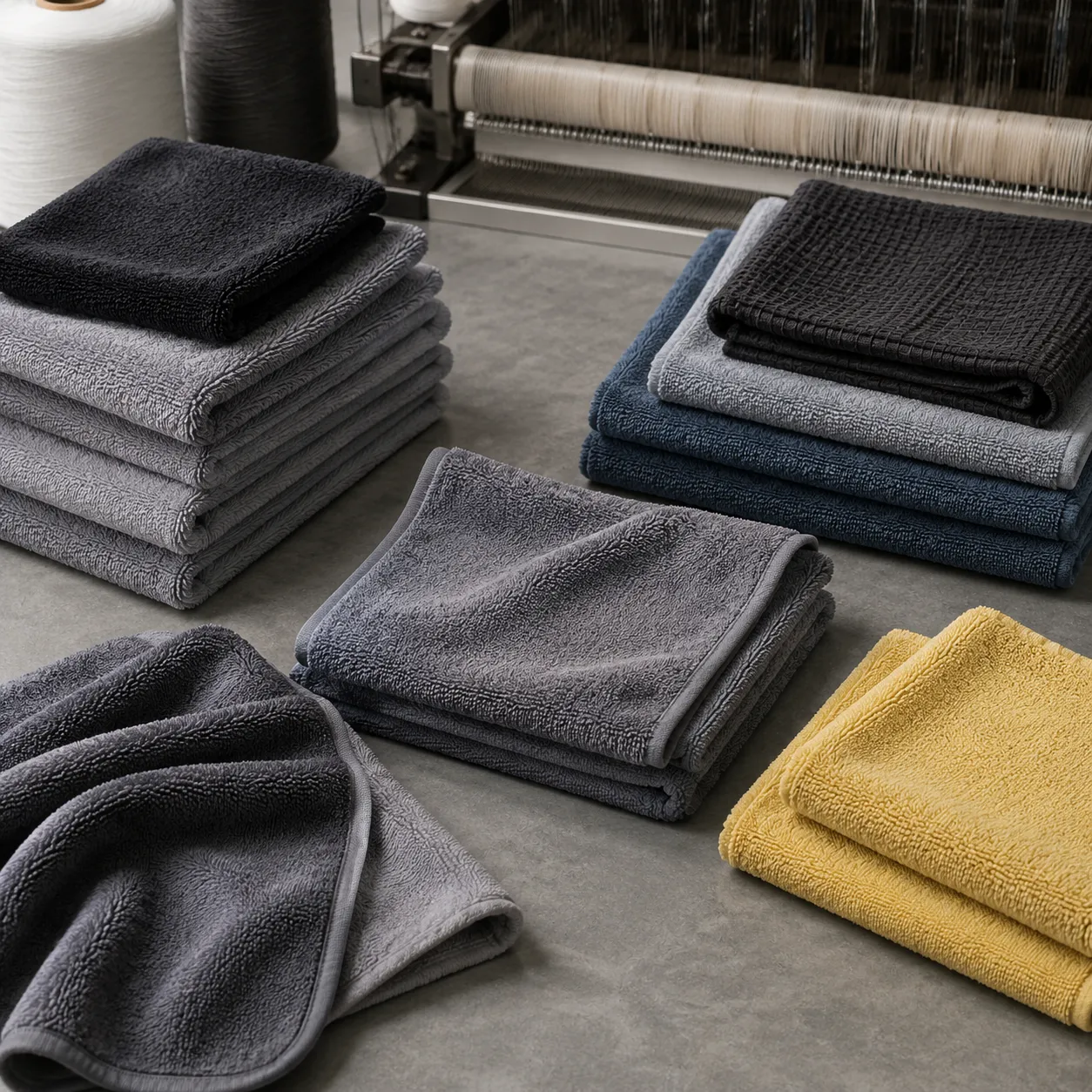
For OEM sourcing, we break the kit by surface and risk level. Paint contact needs soft edges and controlled pile height. Glass needs low lint and a tighter weave. Wheels and lower panels need a cheaper cloth that can be stained without making the consumer feel the whole pack failed. That is the specification work behind a credible detailing towel kit.
| Kit position | Recommended construction | Typical GSM | Main QC concern |
|---|---|---|---|
| Drying towel | 70/30 or 80/20 twist-loop microfiber, satin or ultrasonic edge | 420-650 GSM | Water pickup and edge abrasion |
| Paint buffing cloth | Split microfiber terry, medium pile | 300-380 GSM | Lint, dye transfer, swirl risk |
| Glass cloth | Microfiber waffle or fish-scale weave | 250-320 GSM | Streaking after IPA wipe |
| Interior cloth | Short-pile microfiber, soft handfeel | 260-330 GSM | Snagging on plastic trim |
| Wheel cloth | Economy terry microfiber, darker color | 240-300 GSM | Colorfastness and soil visibility |
What an AutoZone car detailing kit Teaches Buyers
The AutoZone car detailing kit search tells us buyers are benchmarking a convenient retail bundle, not just a towel. They want to know what a consumer already accepts: pack count, cloth size, color coding, and the promise printed on the header card. For a brand-side buyer, the smarter move is to treat retail packs as market evidence, then rebuild the towel specs around your own warranty risk and target margin.
Retail kits often use similar-looking towels to control packaging cost. That can work for low-frequency users, but it is weaker for car wash operators, subscription brands, and DTC car care companies where repeat use matters. A kit with one 60 x 90 cm drying towel, two 40 x 40 cm buffing cloths, one 40 x 40 cm glass cloth, and one 30 x 30 cm wheel cloth usually performs better than five identical towels sold under different names.
- Do not copy only the piece count. Check whether each towel has a different weave, GSM, and edge finish.
- Measure real packed weight. A 5-piece kit that looks large online may contain less than 230 g of fabric.
- Look at the washing instruction. If the label permits high heat drying, polyester edge tape and thread choice need attention.
- Check color assignment. Dark gray for wheels and light blue for glass reduces misuse better than printed instructions alone.
Fiber Blend and Split Quality Matter More Than Color
Most car wash microfiber towels use polyester and polyamide. Polyester gives structure and durability; polyamide improves water absorption and softness. The common blends are 80/20 and 70/30. A 70/30 drying towel costs more because polyamide is more expensive, but it can absorb faster and feel safer on clear coat when the pile is properly split.
The named blend alone is not enough. During production, microfiber must be split correctly through dyeing and finishing. If splitting is weak, the towel can look full but push water around the panel. In our mill checks, the simple warning sign is a droplet test: water should sink into a washed sample quickly instead of sitting as beads on the surface. For formal QC, buyers can request absorbency by AATCC 79 and dimensional change after laundering by ISO 6330.
| Blend | Best use | Buyer advantage | Watch point |
|---|---|---|---|
| 80/20 polyester-polyamide | General wipe-down, interior, wheel cloths | Lower unit cost and good durability | Less forgiving on paint if pile is thin |
| 75/25 polyester-polyamide | Balanced kits for retail shelves | Better absorption without a sharp price jump | Needs stable supplier control to avoid batch drift |
| 70/30 polyester-polyamide | Drying towels and paint buffing | Softer handfeel and faster pickup | Higher fabric cost; not necessary for every piece |
For a deeper comparison of towel fibers outside the car category, our microfiber vs cotton towel comparison explains why cotton is still useful in hospitality but poorly matched to paint-safe drying. Buyers building a broader car care line can also use our custom microfiber towels wholesale guide for packaging and MOQ planning.
Edges Are a Scratch-Risk Detail, Not Decoration
A towel edge is the first place we inspect when a customer wants paint-safe claims. Hard overlock thread, exposed polyester binding, or a thick corner knot can create complaints even when the fabric face is good. The issue is most visible on black cars under inspection lights because tiny marring marks show faster.
For drying towels, satin binding is common because it looks finished and controls shape after washing. For higher-grade paint contact, ultrasonic cut edges or edgeless construction reduce the amount of hard material touching the panel. The trade-off is durability: an edgeless towel must be cut cleanly and heat sealed correctly, or the edge can fuzz after 15-20 wash cycles.
- Satin edge: suitable for mid-tier retail kits when the binding is soft and colorfast.
- Ultrasonic edge: clean appearance and lower abrasion, but needs accurate cutting temperature.
- Edgeless cut: best for enthusiast paint use, with higher fabric waste during cutting.
- Overlock edge: acceptable for wheels or engine bay cloths, risky for paint-facing pieces.
A practical test is to rub the finished edge across a coated black acrylic panel under a fixed load, then inspect under LED light. It is not a replacement for laboratory abrasion testing, but it catches problems before cartons leave the sewing line. For formal programs, buyers can include ISO 12947 Martindale abrasion as a reference, although the test was not designed specifically for automotive paint.
A Better Kit Map for Private Label
A private label car care kit should be easy for the customer to use without reading a long leaflet. Color coding and size differences do that work. A large towel means drying. A flat-weave cloth means glass. A dark cloth means dirty zones. This lowers misuse, which matters because many online complaints are caused by using the wheel cloth on paint, then blaming the full set.
| SKU concept | Contents | Suggested colors | Target retail position |
|---|---|---|---|
| Entry 4-piece | 1 drying towel, 2 all-purpose cloths, 1 wheel cloth | Teal, gray, black | Budget retail or promo add-on |
| Core 6-piece | 1 drying towel, 2 buffing cloths, 1 glass cloth, 2 utility cloths | Blue, lime, charcoal | Mainstream DTC starter kit |
| Pro 9-piece | 2 drying towels, 3 buffing cloths, 2 glass cloths, 2 wheel cloths | Navy, silver, black | Detailing enthusiast or wash membership gift |
The AutoZone car detailing kit benchmark is useful here because it reminds us that shelf-ready clarity matters. But a wholesale detailing towels program can outperform a retail benchmark when each cloth has a defined job and the packaging explains that job with icons, color blocks, and short wash instructions.
- Define the surfaces: paint, glass, interior, wheels, or drying-only.
- Assign a separate construction to each surface instead of changing color only.
- Confirm dimensions after wash, not only before sewing.
- Approve one packed sample with the final insert, barcode, warning label, and carton mark.
- Run a 5-cycle wash check before bulk cutting when the kit will claim reusable performance.
Pricing Bands We Can Actually Defend
FOB China pricing changes with yarn blend, towel size, edge finish, packaging, exchange rate, and whether cartons need retail-ready inner boxes. The ranges below are working procurement bands from current microfiber programs we quote, not a guarantee for every artwork or pack format. They are meant to help buyers check whether a target price is physically realistic.
| Order volume | 4-piece entry kit FOB | 6-piece core kit FOB | 9-piece pro kit FOB |
|---|---|---|---|
| 500-999 kits | USD 2.85-3.70 | USD 4.35-5.80 | USD 7.20-9.40 |
| 1,000-2,999 kits | USD 2.45-3.25 | USD 3.85-5.10 | USD 6.45-8.30 |
| 3,000-9,999 kits | USD 2.18-2.95 | USD 3.45-4.65 | USD 5.95-7.60 |
| 10,000+ kits | USD 1.96-2.70 | USD 3.15-4.25 | USD 5.45-7.10 |
A cheap 6-piece kit can look attractive if the quote is USD 3.05 FOB, but the saving may come from a small drying towel and low split quality. Suppose a DTC brand sells 4,000 kits and receives 86 towel-related replacement claims at a USD 6.40 handling and replacement cost. That is USD 550.40 before staff time and review damage. Upgrading the drying towel from 360 GSM to 520 GSM may add USD 0.48 per kit, or USD 1,920 across the run. Whether that upgrade is justified depends on retail price and claim sensitivity, but the calculation belongs in sourcing, not after launch.
For towel weight decisions, the towel GSM decision framework gives a general method for matching fabric weight to use case. Automotive programs have their own friction and lint risks, so the framework should be adapted, not copied line by line.
Testing, Certifications, and Claims
Microfiber car towels are not medical products, but claims still need discipline. If a pack says scratch-free, lint-free, streak-free, or paint-safe, the buyer should define how that statement will be checked. No mill can honestly certify that a towel will never scratch a vehicle under every condition; dirt on the panel, trapped grit in the towel, and washing with fabric softener can all change the result.
- Absorbency: AATCC 79 water drop absorbency or an agreed internal pickup test after pre-wash.
- Dimensional stability: ISO 6330 laundering, then measure shrinkage and edge distortion.
- Colorfastness: ISO 105-C06 washing and ISO 105-X12 rubbing for dark wheel cloths and colored bindings.
- Lint check: visual inspection on glass and black acrylic after dry and damp wiping.
- Needle and metal control: inline broken-needle log plus final metal detection for sewn packs.
LUMA & CO. TEXTILE operates under ISO 9001 quality management and BSCI social compliance. For textile safety, OEKO-TEX Standard 100 Class I can be requested for eligible towel materials and trims, but buyers should confirm that the certificate scope covers the exact fiber, dye, and accessory combination in the kit. Our article on how to read an OEKO-TEX certificate shows where those scope details appear.
MOQ, Sampling, and Production Timing
Our standard MOQ is 500 pcs per design per color. For kits, that usually means 500 complete packs when the towel colors and packaging are fixed. If a buyer wants three colorways, each with different cloth colors or printed inserts, the practical MOQ becomes 500 kits per colorway. Shared neutral towels with different belly bands can reduce inventory pressure.
| Stage | Typical timing | What happens |
|---|---|---|
| Spec review | 1-3 days | Confirm cloth count, dimensions, GSM, blend, edge, packaging, and carton plan |
| Lab dip or color approval | 4-7 days | Match towel colors, binding, and printed packaging to buyer references |
| Proto sample | 6-10 days | Cut and sew representative towels, assemble pack, check barcode placement |
| Bulk production | 18-30 days | Dyeing, finishing, cutting, sewing, inspection, packing |
| Final inspection and booking | 2-5 days | AQL inspection, carton sealing, forwarder handoff |
A new private label car care kit normally needs 31-52 days from complete tech pack to cargo-ready goods. Air freight can rescue a launch date, but towels are bulky for their invoice value. For planning cartons and freight trade-offs, container vs air freight towel orders gives the wider logistics picture.
Good tech packs shorten this schedule. Include towel drawings, folded pack layout, care label copy, barcode files, carton marks, and any restricted substances requirements. Buyers who have not built one before can use our guide to towel tech packs mills can quote before sending RFQs.
Packaging That Survives Retail and E-Commerce
The towel may be correct while the kit still fails because packaging bends, tears, or hides the product. Header cards are low cost and work for peg display, but they expose towels to dust and handling. Zipper pouches feel cleaner for e-commerce and gift sets, although they add material cost and can trap moisture if towels are packed before full conditioning.
- Header card with band: lowest cost, good shelf visibility, weaker for parcel shipping.
- Printed kraft box: better for gift positioning and barcode control, higher carton volume.
- Reusable zipper pouch: useful for enthusiast kits, needs ventilation and odor checks.
- Shrink wrap plus insert: compact for wholesale clubs, less sustainable and less tactile.
For a retail-style AutoZone car detailing kit alternative, packaging should name each towel by task. A buyer may save USD 0.06 by using a plain belly band, then lose clarity at the point of use. We prefer short labels such as Dry, Buff, Glass, and Wheels because they reduce translation issues across markets.
How We Quote a Kit Without Guesswork
The fastest quote starts with the target retail price and the surfaces the kit must handle. A USD 12.99 shelf pack has different fabric room than a USD 29.99 enthusiast bundle. Once that is clear, the factory can decide where to spend money: often on the drying towel and glass cloth first, then on packaging, then on the wheel cloth last.
- Send the target kit count, size for each towel, and expected retail channel.
- Choose 80/20, 75/25, or 70/30 blend by towel position.
- Confirm whether the drying towel needs twist-loop, terry, or waffle construction.
- Select edge finish by paint-contact risk, not only by appearance.
- Add packaging files and compliance requirements before sample approval.
Related reads: buyers developing a full automotive towel line should review our auto detailing microfiber towel program, while teams comparing decoration methods for branded towels can use embroidery vs sublimation vs jacquard to avoid choosing a process that fights the fabric.
Related reads: for procurement negotiations, negotiate towel MOQ without killing margin explains where lower quantities are possible and where they create hidden cost. For color-controlled retail kits, Pantone color matching custom towels covers lab dips, batch tolerance, and buyer approvals.
Build a Car Care Towel Kit With Factory Specs
Send your target pack count, towel sizes, GSM range, packaging idea, and launch quantity. LUMA & CO. TEXTILE can quote OEM detailing towel kits from 500 pcs per design per color, with ISO 9001 production control, BSCI compliance, and OEKO-TEX Standard 100 Class I options where applicable. WhatsApp: +86 13384590853. Email: [email protected].
Request a Kit Quote →