Start with the construction, not the handfeel
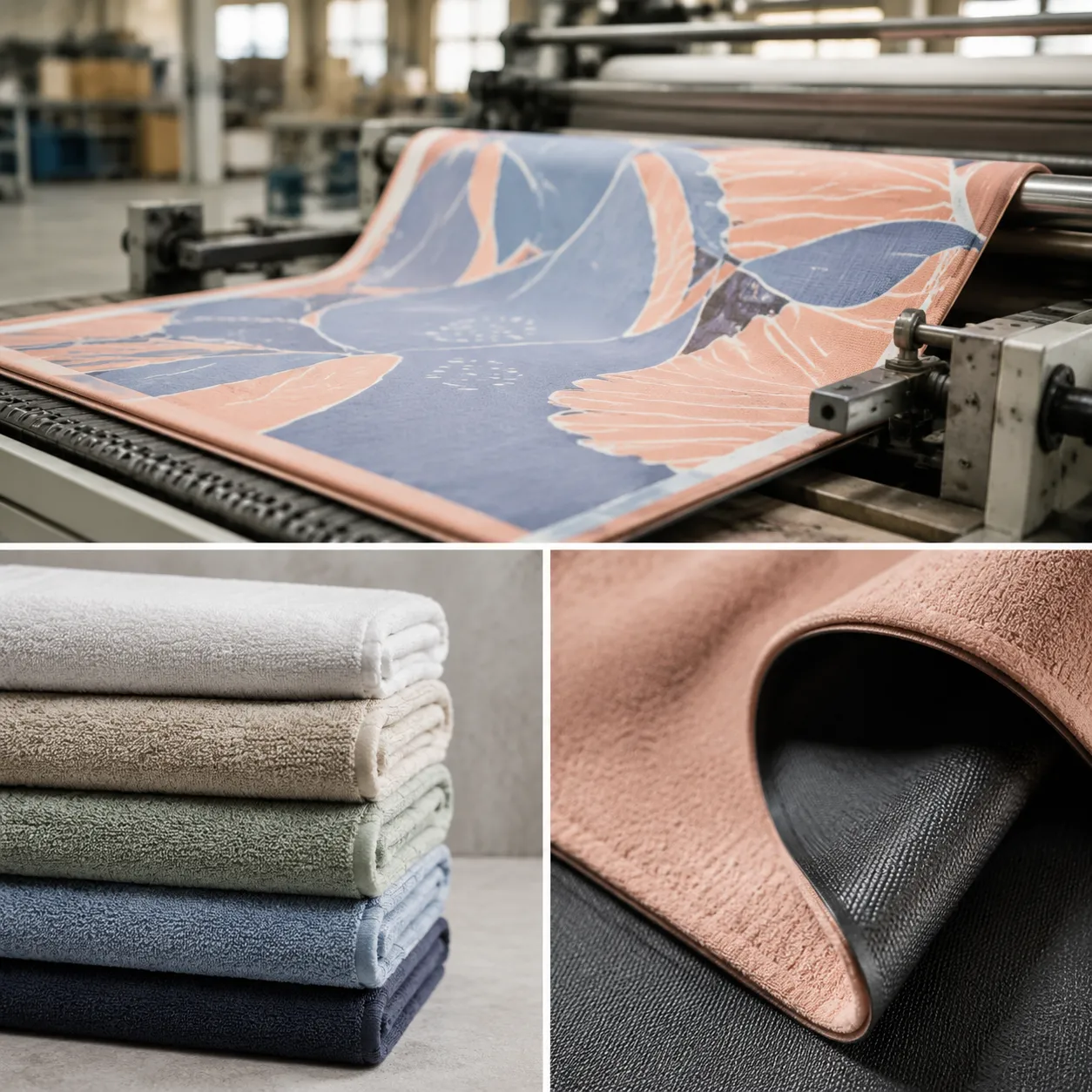
For bath use, microfiber behaves very differently depending on knit structure, yarn split quality, and finishing chemistry. Buyers often judge first touch and assume the softer sample is the better one. In reality, the better bath towel usually comes from a more stable ground construction with controlled pile height and a cleaner splitting result, even if the surface feels slightly drier in the sample room.
The two constructions we quote most often are warp knit coral fleece and warp knit terry-effect microfiber. We rarely recommend low-density weft knit flannel for bath programs because edge growth and distortion are harder to control once the towel goes through repeated laundering. For adult bath sizes, a stable range is usually 280-420 GSM depending on target use. Under that, the towel dries fast but can feel underweight. Above that, quick-dry claims start to lose credibility.
| Construction | Typical GSM | What it does well | Main risk |
|---|---|---|---|
| Warp knit coral fleece | 280-340 | Soft touch, fast drying, efficient cost | Can feel less absorbent if split is poor or finish is too slick |
| Warp knit terry-effect microfiber | 320-420 | Better bulk, stronger bath-use perception | Longer drying time and higher lint visibility if shearing is uneven |
| Weft knit brushed microfiber | 240-300 | Low cost and light pack volume | Higher skew, edge waving, weaker luxury perception |
The spec line that decides performance: fiber blend and split ratio
If your RFQ only says "80/20 microfiber," it is incomplete. Buyers need two different numbers: polymer blend and filament split quality. Most bath microfiber uses polyester/polyamide blends of 85/15 or 80/20. The higher polyamide content improves capillary action and initial water pickup, but it also raises yarn cost. For a bath towel program where absorption matters more than optical gloss, we normally see the best balance at 80/20.
Split quality is the part many importers never ask about. A yarn can be sold as microfiber yet remain poorly opened after dyeing and finishing. We usually discuss this with suppliers in practical terms: target split opening above 90% under lab check, with a filament fineness commonly around 0.2-0.35 denier per filament after splitting. If the filaments are not properly opened, the towel feels smooth but pushes water around rather than pulling it in.
- For mass bath programs, ask for 80/20 polyester/polyamide unless there is a cost reason to move to 85/15.
- Ask the mill to confirm split opening rate from internal lab control; we treat 90%+ as a dependable commercial target.
- Request whether the yarn is island-in-sea split type or another splitting route; this affects consistency lot to lot.
- If the towel is marketed as quick dry, ask for absorption and dry-time method, not only a handfeel comment.
Why some samples absorb badly even at higher GSM
Three things usually cause disappointment. First, too much softener or silicone finish. It makes the sample look retail-ready but suppresses water uptake on early washes. Second, over-shearing. If pile tips are cut too aggressively, you get a cleaner visual surface but lower effective surface area. Third, wrong pile geometry. A towel with short dense naps may feel plush in hand but not move moisture efficiently.
For bath towels, we prefer buyers to specify pile behavior instead of just "soft." A practical factory language is cut pile face with pile height around 2.5-3.8 mm, even shearing tolerance, and no hard resin hand builder. On denser terry-look microfiber, face weight can be split roughly 60/40 between pile layer and ground, which keeps body without making the towel boardy.
The sample that feels richest on day one is not always the one your customer will like after wash three.
| Failure mode | What we see in QC | How to spec around it |
|---|---|---|
| Hydrophobic surface finish | Water beads in first contact test | Limit silicone-heavy finish; require pre-wash absorption result |
| Over-sheared pile | Flat visual face, weak bulk after laundering | Set acceptable pile height range and shearing uniformity standard |
| Under-split filaments | Soft slide, low pickup, poor wipe efficiency | Ask for split ratio confirmation and absorption benchmark |
| Loose edge stability | Edge waving after wash | Use stronger overlock or hem turn-back with balanced tension |
The minimum lab thresholds we would put into the RFQ
A serious microfiber bath towel sourcing playbook needs test gates before bulk approval. We usually align on a small but meaningful set rather than writing twenty lab lines no one follows. The exact thresholds depend on whether the towel is for hospitality, spa resale, gym recovery, or DTC bath use, but buyers should still define the floor.
- Wash dimensional change after 5 cycles: within ±3% in length and width under agreed domestic wash method.
- Skew or spirality after 5 cycles: not over 3% for rectangular bath formats.
- Colorfastness to washing: grade 4 minimum under ISO 105-C06 for darks; light shades can usually hold better.
- Colorfastness to rubbing: dry 4 / wet 3-4 under ISO 105-X12.
- Water absorption: define either seconds to wet-out or times own weight absorbed; one method must be named in the PO.
- Bursting strength for knit base: use an agreed lab method such as ISO 13938-2 where structure demands it.
We also recommend checking appearance retention after laundering rather than only pass/fail lab data. For microfiber, visual issues such as glazing, pile matting, and edge rope effect often become the real commercial complaint. Those can pass a narrow test sheet and still trigger returns.
Size, weight, and pack volume trade off against each other
Bath microfiber is often chosen because a brand wants lower ship weight and faster drying than cotton. That benefit disappears if the spec drifts into oversized heavy formats. A 76×152 cm towel at 300 GSM gives a very different freight profile from an 86×178 cm towel at 390 GSM. Both can be called bath towels. Only one is likely to fit a compact DTC parcel strategy.
| Nominal size | Commercial use | Practical GSM band | Approx. piece weight |
|---|---|---|---|
| 70×140 cm | Value bath / travel crossover | 280-320 | 275-315 g |
| 76×152 cm | Standard bath retail | 300-360 | 345-415 g |
| 80×160 cm | Spa / comfort bath | 320-380 | 410-485 g |
| 86×178 cm | Oversize bath sheet | 340-420 | 520-645 g |
Those numbers are where many programs become commercially clear. If your landed target forces the towel under roughly 300 g in a full adult bath size, the customer may accept quick dry but not drape. If your retail position wants a full bath-sheet feel, freight and carton cube must be reviewed early with the sourcing team.
Price bands by volume: what actually moves the needle
For microfiber bath programs, the biggest cost drivers are blend ratio, GSM, size, finishing route, and packaging. Decoration matters too, but many plain dyed programs rise or fall on material consumption and final presentation. A recycled poly claim can add cost if the chain of custody is strict, though that is a separate sourcing decision.
| Spec basis | 500-999 pcs | 3,000-4,999 pcs | 10,000+ pcs |
|---|---|---|---|
| 70×140 cm, 300 GSM, 85/15, care label only | USD 2.05-2.42 | USD 1.72-2.03 | USD 1.54-1.84 |
| 76×152 cm, 320 GSM, 80/20, hangtag + belly band | USD 2.66-3.12 | USD 2.24-2.71 | USD 1.98-2.38 |
| 80×160 cm, 360 GSM, 80/20, custom polybag print | USD 3.18-3.86 | USD 2.76-3.31 | USD 2.42-2.95 |
| 86×178 cm, 390 GSM, 80/20, retail-ready folded set-up | USD 4.48-5.36 | USD 3.92-4.68 | USD 3.41-4.09 |
MOQ at our mill is 500 pcs per design per color, but microfiber bath projects usually price more efficiently from 1,500 pcs upward because knitting and finishing loss percentages settle better. If a buyer wants three colors at exactly 500 each with separate printed packs, the per-piece cost will move up faster than many expect.
The sample approval path that prevents bulk surprises
We prefer a four-step approval path for this category because microfiber is unusually sensitive to finishing changes. A buyer who approves only a color swatch and a pre-production photo is taking unnecessary risk.
- Approve the base fabric hanger first: construction, blend, target GSM, pile visual, and intended finish.
- Approve a sewn proto in the actual size with hem construction, label position, and fold method.
- Run a mini wash set on the approved proto: appearance after 1 and 5 cycles, absorption behavior, and dimensional change.
- Approve the pre-production sample from bulk dye lot before final cutting starts.
The critical point is step three. We have seen approved lab dips turn into commercially weak bath towels because the finishing line used a different softening recipe on bulk. A simple five-cycle check catches more than long email debates ever do.
Related reads: If you are still building the spec sheet, start with build-towel-tech-pack-that-mills-can-quote and our broader custom-microfiber-towels-wholesale-guide. For a direct material comparison, microfiber-vs-cotton-towel-comparison helps teams explain the trade-offs internally.
Lead times: where the calendar usually slips
For plain dyed microfiber bath towels, a realistic calendar is shorter than cotton jacquard, but not instant. Yarn availability helps, yet finishing, wash testing, and retail packing still take time. Buyers who hear "microfiber is easy" often compress the schedule too much at artwork or packaging stage.
- Base proto sampling: 5-8 days
- Lab dip or shade approval: 3-5 days
- Pre-production sample with labels and packing: 7-10 days
- Bulk production after approvals: 18-28 days for plain dyed orders
- Retail-ready custom packaging add-on: usually +4-7 days
- Final inspection and booking buffer: 3-5 days
Shipment mode then changes the real arrival date. For this reason, we usually ask buyers to decide freight assumptions before final PO issue. container-vs-air-freight-towel-orders is worth sharing with finance if the team is comparing landed cost against launch dates.
Compliance and claim language buyers should keep clean
For children’s contact or sensitive-skin positioning, buyers often ask whether microfiber can still sit inside a compliant program. The answer is yes, but the paperwork needs to be exact. We hold OEKO-TEX Standard 100 Class I, BSCI, and ISO 9001, and we recommend that buyers ask suppliers for current certificate scope, product category relevance, and issue validity instead of accepting a logo dropped into a PDF deck.
Do not overstate sustainability claims on conventional microfiber unless the yarn source and certification chain support it. Also be careful with "antibacterial" wording. If the towel has no validated treated-fabric claim with jurisdiction-appropriate documentation, keep the merchandising language to quick dry, lightweight, and easy-care performance.
- Request current OEKO-TEX Standard 100 Class I certificate copy and article scope.
- Confirm supplier has BSCI social compliance and ISO 9001 quality system in active status.
- If recycled content is claimed, ask for exact percentage and chain-of-custody support before using hangtags.
- Match the care instruction to actual wash trial; microfiber care claims are often copied from older cotton programs.
A compact RFQ checklist for microfiber bath towel programs
This is the shortest version we would accept if a buyer wants an efficient quotation round. It covers the lines that most directly affect sample accuracy and bulk consistency.
- Size tolerance: finished size and allowable variance after wash
- Construction: warp knit coral fleece or terry-effect microfiber
- Blend: 80/20 or 85/15 polyester/polyamide
- GSM: target and tolerance, for example ±5%
- Pile spec: cut pile, target height, shearing expectations
- Color route: Pantone reference or physical standard
- Performance tests: absorption, wash shrinkage, skew, rubbing, wash fastness
- Hem / edge: fold width, overlock color, hanging loop requirement
- Packaging: folded or rolled, polybag type, barcode, carton count
- Order split: colors, sizes, and destination labeling
Related reads: Buyers comparing size economics should use towel-sizes-dimensions-complete-guide. If color approval keeps delaying signoff, pantone-color-matching-custom-towels gives the cleaner route. For certification review, how-to-read-oeko-tex-certificate helps non-technical teams catch document gaps.
Where we push back on "cheaper but same feel" requests
The most common cost-cut request is to keep the same sample handfeel while lowering blend cost, reducing GSM, and simplifying sewing. Usually that means moving from 80/20 to 85/15, trimming weight by 25-40 GSM, and narrowing hem turn-back. That can work for a travel or promo crossover item. It often does not work for a true bath towel because the customer reads the loss immediately in water pickup and drape.
A recent buyer comparison in our sampling room showed why. Their original target was a 76×152 cm, 320 GSM, 80/20 bath towel quoted near the middle of the commercial range. The reduced-cost version saved about USD 0.31 per piece at the planned volume by changing to 85/15 and dropping to 290 GSM. After five wash cycles, the lighter option dried fast but looked flatter, and the absorption result fell enough that the brand kept the original spec. On a direct-to-consumer retail program, saving a few dimes on a towel that drives repeat reviews is usually not the right place to squeeze.
Need a microfiber bath towel quote with real lab gates?
Send your target size, blend, GSM, packaging, and test requirements. We will quote against a workable spec, not a generic placeholder. MOQ 500 pcs per design per color. Contact us on WhatsApp +86 13205717266 or [email protected].
Request a quote →