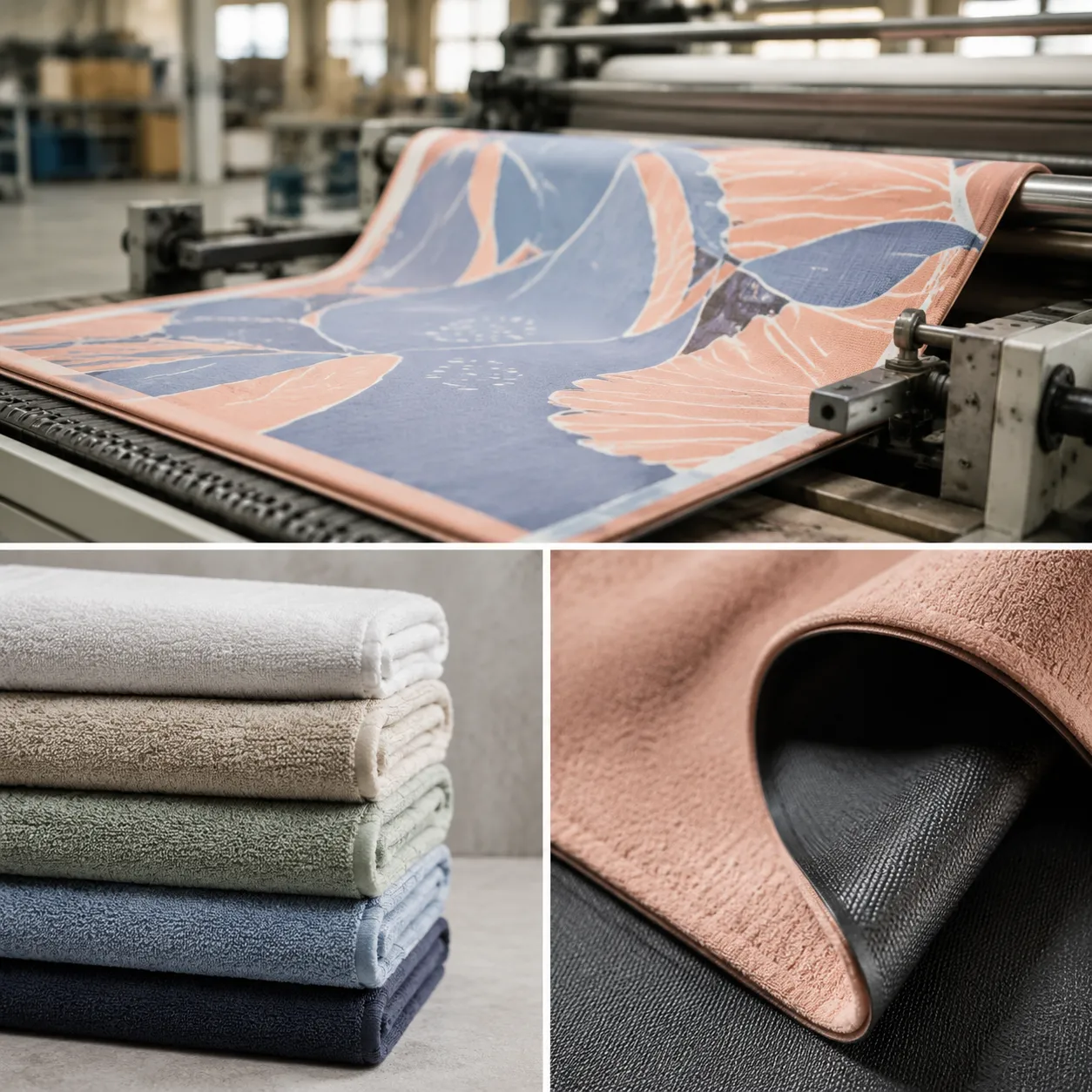
Start with the use case, not the logo
For golf, the first decision is what the towel has to do on course. A tournament giveaway, a private-label pro shop item, and a country club member towel should not share the same construction. The wiping job is different, the attachment method is different, and the tolerance for shrinkage or hardware failure is different.
We usually ask four questions before quoting: does the towel hang from the bag or stay folded on the cart, does the golfer use it mainly for club heads or for hands as well, is the logo meant to read from six feet away or function like a retail brand mark, and will the towel be replenished seasonally or sold year-round. Those answers narrow the right body fabric faster than any mood board.
- Tournament handout: price-sensitive, logo-led, usually 350-430 GSM microfiber or 380-450 GSM cotton waffle
- Club merchandise: better hand feel, stronger edge finishing, often 420-520 GSM cotton terry or waffle
- Bag-use performance towel: attachment hardware matters more than large decoration area
- Corporate event towel: packout and freight density can matter as much as fabric choice
The three constructions buyers compare most
In golf towels, buyers usually land in one of three bodies: cotton terry, cotton waffle, or microfiber waffle. Each has a different cleaning behavior. Terry lifts more moisture and feels more familiar in hand. Waffle structures trap soil in the recesses and clean grooves well, but the cell depth has to be controlled or the towel can feel rough after laundering. Microfiber gives the sharpest print result, but it behaves differently from cotton in repeated club-cleaning use.
| Construction | Typical GSM | Best fit | Watch point |
|---|---|---|---|
| Cotton terry | 400-520 | Club shops, member programs, embroidery | Bulkier pack volume and slower drying |
| Cotton waffle | 360-430 | Bag towels, groove cleaning, resort golf | Can skew after wash if cell structure is too open |
| Microfiber waffle | 260-320 | Full-bleed print, tournament promos | Less plush feel; hook-and-loop snag risk if packed poorly |
One technical point buyers often miss: waffle is not one thing. A shallow square waffle knitted tight behaves very differently from a loose honeycomb effect. On club-cleaning towels we prefer a stable waffle repeat with balanced wale density because it resists diagonal distortion after wash. If the structure is too open, the towel may arrive looking flat, then tighten unevenly after the first laundry cycle.
Size decisions that affect actual on-course use
The bag tells us more than the artwork file does. A towel that is too short looks decorative but cleans poorly once folded. A towel that is too long brushes the ground when clipped low on a stand bag. For that reason, we quote around the final hanging geometry, not only the cut size.
| Format | Common cut size | Typical folded result | Use note |
|---|---|---|---|
| Tri-fold towel | 40×50 cm | about 13×50 cm visible drop | Clean retail look and easy clip attachment |
| Rectangular bag towel | 40×60 cm | full length or center fold | More wiping area for repeated club use |
| Caddie towel style | 50×76 cm | usually draped or looped | Better for premium club programs than giveaway events |
If you are specifying a tri-fold, state whether the fold is stitched in production or only folded for packing. A stitched fold line improves presentation but slightly stiffens the center panel. For cotton terry, that can reduce drape. For microfiber waffle, it usually holds the shape well. This is a small detail, but it changes both appearance and use.
- For stand-bag attachment, we often keep finished drop under 52 cm
- For cart-heavy programs, longer formats are acceptable because drag risk is lower
- If embroidery sits on a fold panel, allow enough flat area to avoid puckering across the crease
Hardware is where a lot of claims start
On golf towels, the hardware is not a trim afterthought. It is a failure point. The most common issues we see are rust marks from low-grade eyelets, edge tearing around the grommet because reinforcement was skipped, and magnets that hold well on a showroom rack but release when the towel becomes damp and heavier during play.
For metal eyelets we prefer stainless or properly plated brass depending on the target price. If the towel is cotton and the eyelet sits close to the hem, we often add an inside reinforcement patch before setting the eyelet. That extra step costs little per piece but prevents radial tearing from repeated bag movement. For carabiner sets, spring tension consistency matters; cheap clips vary enough that one carton may feel fine and the next weak.
| Attachment option | Typical add-on cost at 3,000 pcs | Best use | Qualification note |
|---|---|---|---|
| Metal grommet only | USD 0.05-0.08 | Buyer adds own hook | Specify inner diameter and reinforcement need |
| Grommet + aluminum carabiner | USD 0.13-0.19 | Tournament and club resale | Check salt spray resistance if coastal use |
| Sewn loop + clip | USD 0.10-0.16 | Softer look, less metal contact | Loop bartack strength must be tested |
| Embedded magnet tab | USD 0.22-0.34 | Premium bag towels | Require pull-force check in dry and damp state |
For magnetic styles, we do not rely on a casual desk test. We check holding force against a painted steel panel with the towel dry, then again after moisture gain. A magnet that holds a 95 g dry towel may struggle once the towel reaches 165 g after use. If you are buying a magnetic golf towel, ask for the magnet placement drawing and the pull-force result, not just a sample photo.
Logo method should match fabric, not just artwork
Embroidery looks strong on cotton terry and some cotton waffles, but it adds stiffness and can distort lighter constructions. Sublimation gives the cleanest graphics on microfiber, especially for tournament sponsors or detailed gradients. Jacquard is possible for some woven concepts, but on most golf towel programs it is not the most efficient route unless the order is large and the branding is long-term.
| Decoration method | Works best on | Minimum practical run | Main limitation |
|---|---|---|---|
| Embroidery | Cotton terry, dense cotton waffle | 500 pcs per design/color | Backside threads and panel stiffness |
| Sublimation | Polyester microfiber waffle | 500 pcs per design | Not suitable for 100% cotton bodies |
| Woven label or patch | Cotton or microfiber | 1,000 pcs | Smaller branding area |
| Hem tag + simple body | Retail private label | 1,000 pcs | Low visual impact for event use |
A practical detail: if you embroider through waffle cells, stitch density has to be reduced and underlay controlled or the logo sinks unevenly into the recesses. We often enlarge satin borders slightly compared with a terry version for that reason. Buyers comparing two embroidery samples should look at backside thread control as well as front appearance.
Related reads: if you are still comparing branding methods, see embroidery-vs-sublimation-vs-jacquard, pantone-color-matching-custom-towels, and build-towel-tech-pack-that-mills-can-quote.
What pricing usually moves on a golf towel PO
Buyers often ask for a single unit price too early, but this category has a wider spread than it first appears. The cost is pushed less by the base towel alone and more by the combination of fabric, hardware, decoration, fold style, and individual packaging.
As a working range, a cotton waffle towel around 40×50 cm with grommet and simple embroidery may land around USD 1.28-1.74 FOB China at 1,500-3,000 pcs. A microfiber waffle sublimated style of similar size with hook can land closer to USD 0.86-1.18. A larger cotton caddie towel with reinforced eyelet, denser embroidery, and header-card retail packing can move into USD 2.10-2.95. These are not universal prices; they assume normal yarn and accessory markets, OEKO-TEX compliant dyes, and standard export carton packout.
- Embroidery count changes price quickly once logos exceed roughly 8,000-10,000 stitches
- Magnet assemblies create more spread than buyers expect because housing style and strength vary a lot
- Individual polybag, belly band, or hangtag programs affect both labor and carton efficiency
- Dark cotton shades with strict shade-band approval usually need tighter dye control than white-ground programs
Samples that deserve signoff before bulk
For this category, we prefer buyers to approve three things separately if the order has any complexity: the fabric hand and color, the decoration, and the hardware assembly. A single salesman sample can hide too many variables. We have seen buyers approve an attractive pre-production sample, then object later because the bulk carabiner had a different finish or the fold line shifted the visible logo position.
- Approve towel body size, GSM tolerance, and fabric construction first
- Approve logo strike-off or embroidery run sheet with measured placement
- Approve eyelet, clip, or magnet assembly on an actual towel corner or tab
- Confirm fold presentation and individual packing before bulk starts
If you need lab checks, the most useful ones here are not exotic. For cotton styles, we normally run dimensional stability after washing and colorfastness to washing under ISO 105-C06, then check metal trim for visual corrosion risk if the item will be used in humid coastal clubs. For loop or tab attachment, a simple seam strength pull check is more useful than a generic appearance review.
Lead time is usually lost between artwork and accessories
Bulk production of golf towels is rarely delayed by the towel body alone. Delays usually come from custom accessory sourcing, logo revision loops, or buyers finalizing packaging after the fabric is already booked. If your order uses standard cotton colors and a stock clip, the path is straightforward. If you want a branded magnet tab, custom Pantone embroidery thread match, and retail carding, the calendar gets tighter.
| Stage | Typical days | Where delay happens |
|---|---|---|
| RFQ to quote alignment | 2-4 days | Missing hardware or packout details |
| Sampling | 7-14 days | Logo revisions and accessory approval |
| Material booking | 3-6 days | Waiting for deposit and final signoff |
| Bulk production | 18-28 days | Embroidery queue or accessory arrival |
| Final inspection and packing | 3-5 days | Fold spec inconsistency or barcode issues |
For in-season events, the safer plan is to lock hardware early and treat packaging as a production component, not an afterthought. We can usually make up two or three days on towel sewing. We cannot always recover six days lost waiting on a custom carabiner color or a revised header card barcode.
Related reads: for scheduling and freight planning, see container-vs-air-freight-towel-orders, country-club-golf-towel-program, and negotiate-towel-moq-without-killing-margin.
A usable RFQ for golf towels
The fastest quotes come from buyers who specify the item as a working tool, not only as branded merch. A short but complete RFQ avoids most back-and-forth and makes pricing more believable because the factory is not guessing hidden trims.
- Body fabric: cotton terry, cotton waffle, or microfiber waffle, with target GSM
- Finished size and whether tri-fold is stitched or pack-folded only
- Attachment: eyelet only, eyelet plus hook, sewn loop, or magnet tab
- Logo method, artwork size, stitch count estimate if known, and placement drawing
- Color reference: Pantone TCX/TPG, existing sample, or physical swatch
- Packing: bulk carton, individual polybag, header card, belly band, barcode label
- Order split by design and color, noting our MOQ of 500 pcs per design per color
- Required compliance documents such as OEKO-TEX 100 Class I, BSCI, or ISO 9001 file set
If the order is for a club chain or reseller, add one more field: replenishment expectation. A 1,200-piece launch that may repeat every quarter should be quoted differently from a one-off sponsor giveaway, especially if custom accessory tooling or thread booking is involved.
Where we push back on the cheapest option
The weakest briefs are usually trying to combine a very low unit target with too many visible features: large embroidery, magnetic tab, thick cotton body, and retail-ready packing. On paper it sounds efficient. In production it often means one of those elements gets downgraded quietly unless the spec is controlled.
We would rather tell a buyer to remove one feature than let the whole item underperform. For example, shifting from a weak magnet assembly to a reinforced eyelet and clip can save roughly USD 0.14-0.18 per piece on a 2,500-piece order while improving reliability. On another program, reducing embroidery coverage and moving brand identity to a woven hem label cut around USD 0.21 per piece and shortened sampling by four days. Those are real sourcing choices, not cosmetic edits.
A golf towel that stays attached, dries reasonably fast, and keeps its shape after washing will be reordered. A cheap one with failing hardware usually disappears from the program after the first event.
What to prepare before asking for the final quote
Before you ask a mill for last-price confirmation, make sure the unknowns are reduced to small tolerances. The body, hardware, decoration, and packout should each be visible in either a signed sample or a written spec line. That is the difference between a clean PO and a quotation that has to protect itself with broad assumptions.
- Lock the towel body and finished dimensions
- Choose one attachment method, not two under review
- Approve logo size and placement with a measured sample
- Confirm retail or bulk packing before deposit
- State ship window and destination so freight strategy can be judged early
We produce around 2.4 million towels a year with MOQ 500 pcs per design per color, and golf towel projects move fastest when the spec is disciplined at the beginning. If you need us to quote or review an RFQ, send the draft to [email protected] or WhatsApp +86 13205717266.
Need a golf towel RFQ checked before sampling?
Send us your towel body, hardware, logo, and packout details. We will flag the gaps before you spend time on the wrong sample.
Request a Quote →