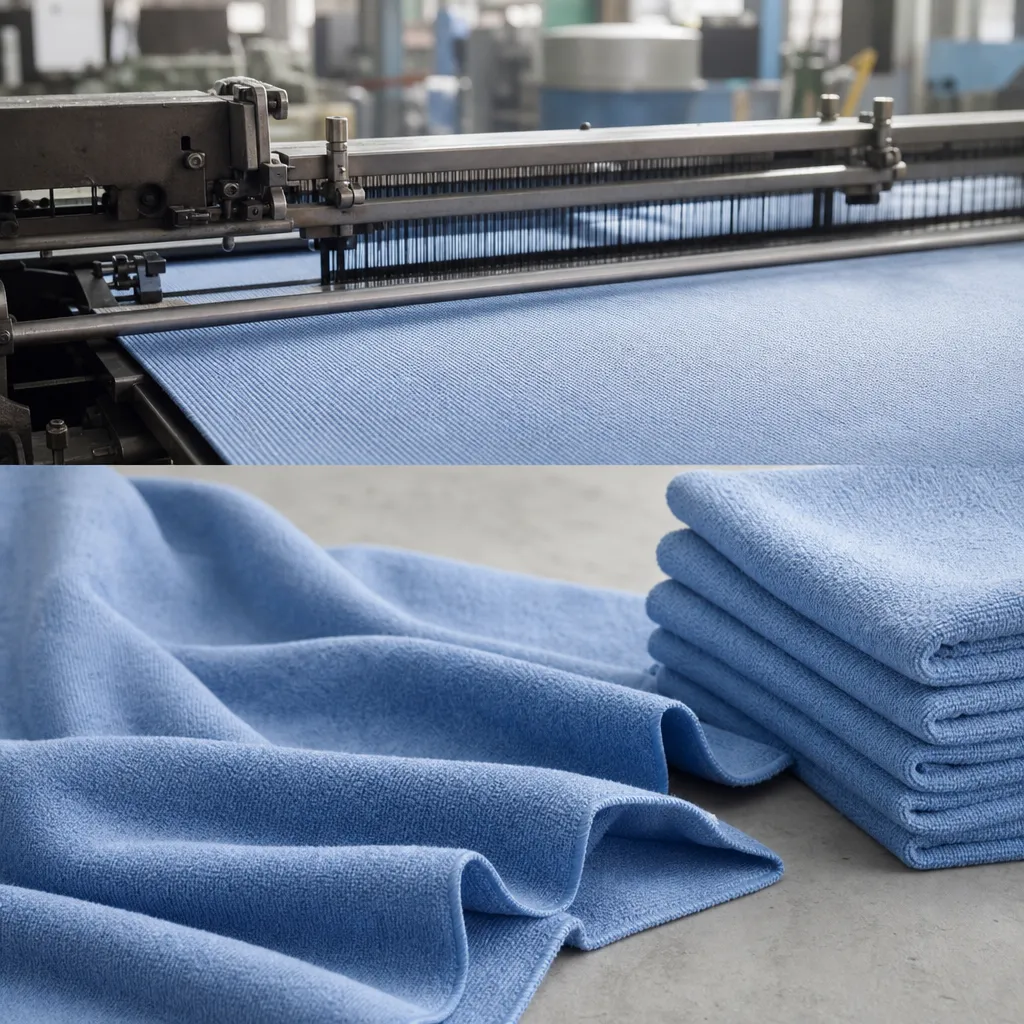
Start with the failure points buyers actually get charged for
In luxury bath programs, the expensive mistakes do not usually come from obvious defects like holes or wrong labels. They come from issues that pass a quick visual check and then create claims after launch: short weight, tight sewing that drives edge draw-in, weak whiteness consistency between lots, low wet rub fastness on dark shades, or pile recovery that collapses after tunnel finishing at the laundry. We inspect those first because they affect resale, guest feel, and replacement rate.
For this article, we are talking about ring-spun or combed cotton bath towels in the 520-760 GSM range, mostly in 30x56 in, 27x54 in, 70x140 cm, and 80x160 cm. At our mill, MOQ is 500 pcs per design per color, but QC criteria should be locked before PP sample approval, not negotiated after bulk is woven.
| Failure mode | What causes it | What we check | Reject threshold |
|---|---|---|---|
| Edge draw-in after wash | Over-tight side hems or unbalanced ground tension | Width loss after 3 wash cycles | Reject if average width shrinkage exceeds 6.0% or any sample exceeds 7.5% |
| Harsh handfeel in bulk | Low pile height, over-drying, or excessive softener variation | Panel comparison to sealed approval sample | Reject if bulk is clearly harsher than signed sample under blind comparison |
| Shade mismatch lot to lot | Dye recipe drift, peroxide variation in bleaching, uneven drying | D65 light box assessment | Reject if visual difference exceeds grey scale 4 against approval standard |
| Loose pile shedding | Low loop lock, weak yarn twist control, poor singeing | Shake test and first-wash lint review | Reject if obvious bare bands or visible lint cloud from 5-piece sample set |
| Short actual weight | Low pick density or underweight finishing | Piece weight vs approved spec | Reject if average piece weight is below ordered tolerance band |
Lock the spec sheet before inspection day
A reliable inspection starts from a spec sheet that leaves little room for interpretation. If the PO says only "luxury white bath towel," the inspector can count defects but cannot judge whether the product matches the order intent. We ask buyers to freeze five lines: size after wash, finished GSM, finished piece weight, border construction, and wash performance. Without those, the final report becomes descriptive instead of enforceable.
- State size as finished size after wash, not loom size. Example: 70x140 cm after 3 home-laundry cycles at 40°C.
- Use finished GSM tolerance of ±5% for solid-dyed cotton bath towels above 550 GSM. For white hotel towels with tighter reorder control, we prefer ±4%.
- Add piece weight tolerance in grams, not only GSM. GSM alone can hide width or length drift.
- Specify hem width and stitch density. A common working line is 25-35 mm hems with 8-10 stitches per inch, depending on style.
- Define the wash standard that decides approval: home laundering, hospitality laundry, or retail consumer use.
If you need a cleaner RFQ structure before sampling, see build-towel-tech-pack-that-mills-can-quote and towel-sizes-dimensions-complete-guide. Buyers also often pair this with towel-gsm-decision-framework when deciding whether a 600+ GSM luxury build is justified for the intended laundry cycle.
Use firm laboratory parameters, not loose claims
The editor was right to reject vague lab language. If a report says "good colorfastness" or "acceptable shrinkage," it is not useful. Below are the test methods and acceptance values we use most often for high-end bath towels. These are realistic buying controls for OEKO-TEX 100 Class I, BSCI, and ISO 9001-managed production, not decorative certificate mentions.
| Property | Test method | Test parameter | Suggested acceptance for luxury bath towels |
|---|---|---|---|
| Colorfastness to washing | ISO 105-C06 | A2S, 40°C, with adjacent multifiber fabric | Color change min grade 4; staining min grade 3-4 |
| Colorfastness to rubbing | ISO 105-X12 | 10 dry rubs / 10 wet rubs | Dry min grade 4; wet min grade 3 for dark shades, 3-4 for mid tones |
| Water absorbency | Internal drop test or sink test tied to sealed standard | 5 drops center body panel | Average full absorption within 6 seconds for dense luxury pile towels |
| Dimensional stability | ISO 5077 / ISO 6330 | 3 wash-dry cycles at declared care condition | Length and width shrinkage each within 6.0% unless PO states tighter |
| pH of aqueous extract | ISO 3071 | Finished towel | pH 4.0-7.5 |
| Azo / harmful substances | OEKO-TEX Standard 100 Class I scope | Current certificate validity check | Certificate must cover finished article category and production site scope |
For white towels, absorbency is often where buyers get surprised. Heavy softener can make a new towel feel smooth on the table while delaying wet pickup. We therefore compare the bulk lot against the approved pre-production sample after one standard wash. On dark navy or charcoal programs, wet crocking is the bigger risk; we make sure the buyer signs off the wet rub requirement before dyeing.
How we inspect size, weight, and GSM on the floor
A bath towel can technically hit GSM and still be wrong for the order if the dimensions drift. That is why we do not rely on one metric. We measure finished piece weight, finished dimensions, and fabric mass separately. For cut-pile or sculpted borders, we also measure the usable body panel because decorative sections distort a simple average.
- Condition samples at standard room conditions before measuring to reduce moisture swing.
- Measure length and width on a flat table without tension, from outer finished edge to outer finished edge.
- Weigh each selected piece on a calibrated digital scale to 0.1 g resolution.
- For GSM, cut a standard test swatch from the body panel using a GSM cutter, avoiding borders and hems.
- Record both average and range; average alone can hide one weak carton line.
| Ordered towel | Control point | Working acceptance band | Notes |
|---|---|---|---|
| 70x140 cm, 650 GSM | Finished size after wash | Length 136-140 cm; width 67-70 cm | Assumes approved shrinkage allowance already built into loom size |
| 70x140 cm, 650 GSM | Finished GSM | 624-683 GSM | Equivalent to ±4% |
| 70x140 cm, 650 GSM | Piece weight | 595-625 g | Use piece weight together with size result |
| 80x160 cm, 700 GSM | Finished size after wash | 155-160 cm x 77-80 cm | Large-format bath or spa sheet |
| 30x56 in, 600 GSM | Piece weight | 655-690 g | Imperial retail spec converted to approved finished area |
Those are not generic internet bands. They are the kind of acceptance windows we put into bulk control documents so both buyer and mill know what fails and what can ship. If the order is sold as oversized luxury retail, we would tighten piece-to-piece consistency more than on an institutional hotel program.
Pile quality is where luxury claims are won or lost
The most common disconnect in luxury bath towels is that the towel photographs well but does not recover after compression. Pile quality is not only about cotton grade. It depends on loop density, pile height, yarn evenness, and whether the finishing line has over-flattened the face. We assess this by hand, but we tie it back to construction details.
- Check for reed marks across the width under side light. On white towels, these appear as faint bars and become obvious in hotel bathrooms.
- Open the pile with fingers at three body locations. If the ground shows too quickly, the construction may be under-covered for the marketed weight.
- Review loop lock near borders. Weak anchoring here is where snag growth starts after the first commercial wash.
- Compare border-to-body transition. A harsh transition usually signals over-compaction or uneven shearing.
- For zero-twist style luxury towels, check snag sensitivity more aggressively because softness can come with lower loop stability.
Two construction quirks matter here. First, dense dobby borders can pull the body panel inward if the finishing line tension is not balanced. Second, low-twist pile yarn can bloom beautifully on day one but create linting if the singeing and first wash settings are too light. If your team is still weighing softness against durability, combed-vs-zero-twist-cotton-explained is a useful companion read.
Set defect grading rules that inspectors can apply carton by carton
For final random inspection, we usually work from ANSI/ASQ Z1.4 style sampling logic because many buyers already know it, even when they refer to it loosely as AQL. What matters in practice is not just the level chosen, but the defect dictionary. A towel inspector needs to know exactly what counts as major and minor.
| Defect | Classification | Accept / reject rule | Why it matters |
|---|---|---|---|
| Hole, cut yarn, broken hem | Critical/Major | Reject any critical; major per agreed sampling plan | Use failure or visible damage |
| Oil mark over 8 mm on white body | Major | Reject piece | Highly visible in hospitality use |
| Shade variation obvious within same piece | Major | Reject piece | Looks like mixed lots after display |
| Loose thread under 30 mm, trim-safe | Minor | Accept within plan | Cosmetic only if not linked to seam opening |
| Skewed label placement over 10 mm off center | Minor or Major by brand | Decide at PO stage | Retail presentation issue |
| Pile bare patch over 1.5 cm diameter | Major | Reject piece | Feels thin and photographs badly |
On a 3,200-piece order, a common working setup is General Inspection Level II with a buyer-agreed major/minor threshold. But we always write the visible defect rules into the QC sheet because different third-party inspectors classify the same oil mark differently if the photo standards are weak.
Wash testing should mimic the real laundry, not a random home cycle
Retail DTC towels, luxury hotel towels, and spa sheets do not fail in the same way. If the buyer will send the towel into a commercial laundry with alkaline chemistry and tumble finishing, the pre-shipment wash test must reflect that. A home 30°C quick cycle is too soft and hides edge stress, shrinkage, and pile collapse.
- For retail bath towels: 3 cycles at 40°C under ISO 6330 conditions are usually enough for pre-shipment signoff.
- For hotel or spa programs: run a harsher internal comparative wash, typically 5 cycles, to expose hem torque and pile flattening before shipment.
- Measure length, width, and handfeel after the final dry state, not while warm from the dryer.
- Photograph the same towel ID before wash and after wash under the same light for dispute prevention.
- If the towel has embroidery or woven border branding, test those panels separately for puckering and edge distortion.
We also watch lint output in the dryer filter after the first and third cycles. That is not a formal ISO grade, but it is a practical red flag when comparing bulk against the approved standard. For related reading, see why-gym-towels-fail-after-50-washes and how-to-read-oeko-tex-certificate. Different end uses, but the discipline of matching tests to real use is the same.
Price bands only make sense when tied to the QC level
Buyers often ask why one 650 GSM white bath towel quotes at USD 4.85 and another at USD 6.10 FOB China. The answer is usually not one single raw material jump. It is the stack: combed cotton vs standard ring-spun, tighter weight control, more stable bleaching, lower defect tolerance, stronger piece-by-piece sorting, and a wash-tested approval process that removes risky lots before export.
| Program type | Typical spec | Volume | FOB China USD/pc | QC note |
|---|---|---|---|---|
| Luxury hotel bath towel | 70x140 cm, 600-650 GSM, white, dobby border | 3,000-5,000 pcs | 4.35-5.40 | Tighter whiteness and size consistency |
| Luxury retail bath towel | 30x56 in, 650-700 GSM, branded label | 2,000-4,000 pcs | 5.10-6.40 | More packaging and visual grading |
| Spa bath sheet | 80x160 cm, 680-720 GSM, white or stone | 1,500-3,000 pcs | 7.45-9.20 | Large area magnifies shrinkage and skew risk |
| Gift-grade dark-color bath towel | 70x140 cm, 620-680 GSM, navy/charcoal | 1,000-2,500 pcs | 5.60-7.25 | Wet rub and lot matching drive cost |
Lower quotes can still be workable if the end use is softer, but the buyer should expect a wider visual range and less wash-life consistency. We would rather say that early than let a cheap bid turn into replacement claims six weeks after launch.
Timeline: where QC decisions belong in the production calendar
Final inspection is too late to discover that the border shrinks faster than the body or that the navy shade fails wet crock. Those are sample-stage issues. A realistic production calendar for luxury bath towels builds QC gates into the timeline rather than treating inspection as one day at the end.
- Day 1-3: confirm tech pack, color standard, labeling, carton marks, and test protocol.
- Day 4-9: loom setup and yarn reservation; make sure approved yarn count and pile construction are frozen.
- Day 10-16: lab dips or bleach/whiteness approval, then pilot weaving.
- Day 17-23: pre-production sample with wash test and measurement report.
- Day 24-38: bulk weaving, dyeing/bleaching, finishing, inline checks on weight and handfeel.
- Day 39-43: packing plus final random inspection.
- Day 44-48: booking, document release, and ex-factory dispatch if report passes.
In peak season, add 7-12 days for loom loading and finishing queue. If branded packaging is custom-printed, carton and insert lead time can also become the hidden critical path. Logistics planning is covered more fully in container-vs-air-freight-towel-orders, while hotel buyers often pair this QC work with setting-up-hotel-linen-program-90-day-roadmap.
The short checklist we use before we release shipment
If we condense the full process into one release gate, these are the points that matter most. This is the closest thing we use to a shipping decision page for a best luxury bath towels QC inspection guide.
- Bulk matches sealed approval sample on handfeel, border look, and overall density.
- Finished dimensions pass the agreed post-wash band.
- Average GSM and average piece weight both pass; neither is used alone.
- Colorfastness results meet the PO standard, especially wet crock on dark shades.
- No major visual defect trend appears in any one carton cluster.
- Care label, fiber content, country-of-origin marking, and carton marks match the approved artwork.
- OEKO-TEX 100 Class I certificate is current and relevant to the finished article scope; BSCI and ISO 9001 records are file-ready for buyer review.
Related reads: hotel-towel-sourcing-guide-2026, hotel-towels-wholesale-supplier-guide, and private-label-vs-white-label-towel-programs. If you are buying for spa rather than hospitality bath, spa-towels-need-different-cotton-than-hotel is also worth reviewing.
One last point: the phrase best luxury bath towels QC inspection guide only becomes useful when it helps the buyer say yes or no to a real shipment. If your spec does not define size after wash, piece weight, test method, and visible defect limits, no inspector can protect the order properly.
Need a luxury bath towel QC-ready quote?
Send us your target size, GSM, wash standard, and packaging brief. We will map the spec, MOQ, test plan, and realistic FOB band before sampling. MOQ 500 pcs per design per color. WhatsApp +86 13205717266 or email [email protected].
Request a Quote →