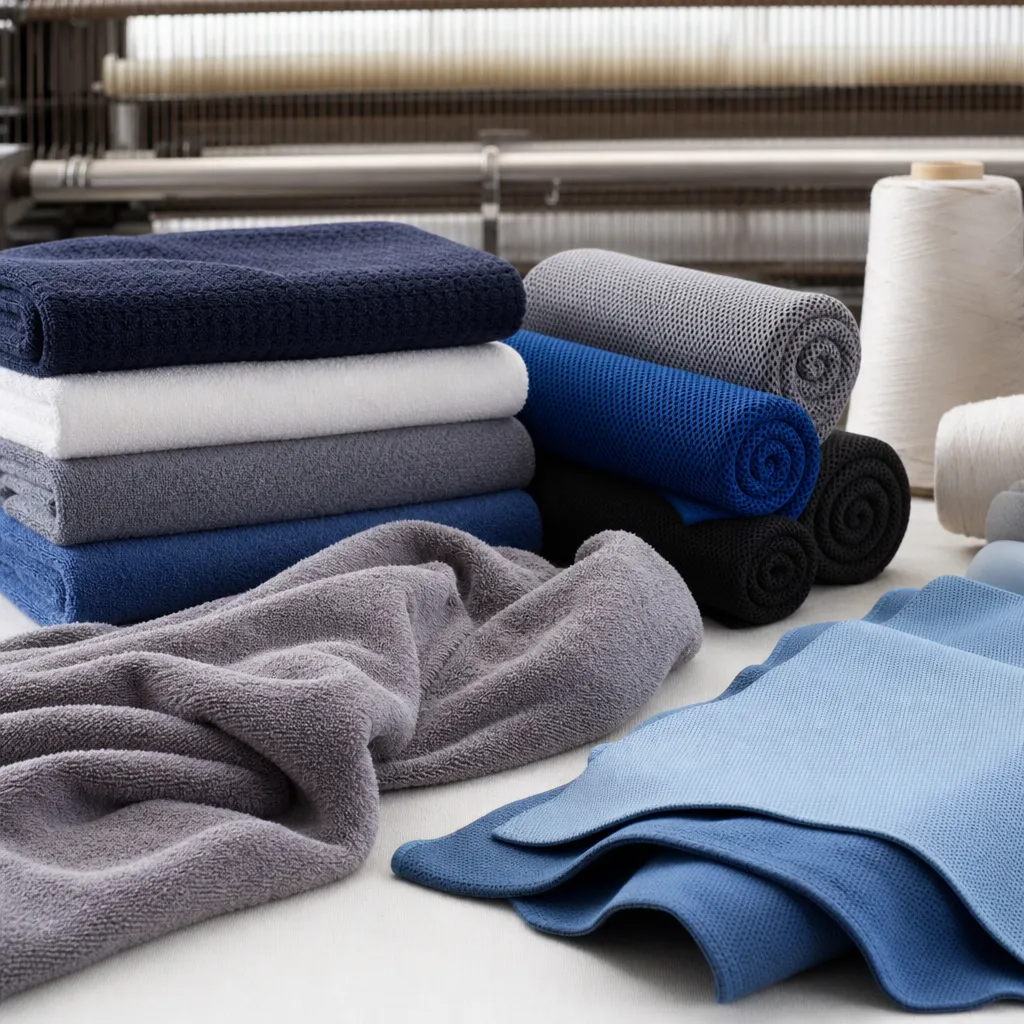
Start with the acceptance plan, not the handfeel
Soft handfeel is easy to fake in a salesman sample. Silicone softener, short test handling, and over-conditioned presentation can hide weak loop anchoring or unstable hems. For bulk acceptance, we set the lot first, then the sample count, then the pass-fail line. For bath towels above 550 GSM, we usually suggest final inspection under ANSI/ASQ Z1.4 single sampling, general inspection level II, with critical defects at AQL 0, major defects at AQL 2.5, and minor defects at AQL 4.0. If the order is for five-star hotel use or a retail program with low return tolerance, we tighten major defects to AQL 1.5.
| Order quantity | Suggested sample size | Major defect reject point | Minor defect reject point |
|---|---|---|---|
| 500-1,200 pcs | 50 pcs | 3 | 5 |
| 1,201-3,200 pcs | 80 pcs | 5 | 7 |
| 3,201-10,000 pcs | 125 pcs | 7 | 10 |
| 10,001-35,000 pcs | 200 pcs | 10 | 14 |
We do not recommend approving on one carton pulled from the top of the stack. Pull from early, middle, and late production if possible. On white or light ivory goods, include cartons from different bleaching batches because whiteness drift shows there first. On dobby-border bath towels, also pull samples from both loom heads if the fabric was woven on paired lines; border skew and broken picks can track to one head only.
- Record lot size, carton count, loom date, dye or bleaching batch, and finishing date before inspection starts.
- Take at least 10 pieces for destructive testing if the order exceeds 3,000 pcs. Those pieces should not be returned to sellable stock.
- Ask the mill to identify whether the towel is ring-spun combed cotton, zero-twist, or low-twist. The failure pattern is different for each.
The wash protocol that actually predicts complaints
If the article is supposed to serve luxury hospitality or high-end retail, a one-cycle home wash tells very little. Our internal comparison protocol for bulk approval is a 10-wash accelerated durability sequence using ISO 6330 domestic laundering principles and measurement checkpoints at cycles 1, 5, and 10. We wash three specimens from bulk and one approved pre-production sample as control.
- Condition specimens for 24 hours in a standard room before first measurement.
- Measure pre-wash size, weight, border width, and skew on 3 towels from bulk.
- Launder at 60 C, normal process, with standard detergent and a ballast load to stabilize drum action.
- Tumble dry to normal dryness, then rest for 4 hours before re-measuring.
- Repeat to 10 total cycles and inspect hems, loop pull, shade drift, and torque after cycles 1, 5, and 10.
| Check after wash | Recommended pass level for luxury bath towels | Common failure mode |
|---|---|---|
| Dimensional change | Within 5% length and 4% width after 10 cycles | Loose construction shrinks unevenly; border ripples |
| Side seam / hem integrity | No open seam over 8 mm | Needle density too low or wrong sewing thread ticket |
| Twist / skew | Below 3% body skew | Uneven loop tension between ground warp and pile warp |
| Appearance | No obvious barriness or yellow cast vs control | Bleaching inconsistency or overdry finishing |
For zero-twist bath towels, we tighten the seam review because the body can still feel soft while the hems fail first. The specific weak point is often the transition from pile body to dobby border, where the fabric bulk changes abruptly and sewing compression becomes uneven. If we see needle cutting or tunneling on that line after five cycles, we would hold shipment even if the towel still looks good on the table.
What to check on the inspection table before any lab test
Table inspection is not glamorous, but it catches a large share of claims before wash testing starts. Open every selected towel fully on a flat board under bright white light. On white bath towels, use side lighting as well; it shows pile lean, reed marks, and patchy shearing much better than overhead light alone.
- Measure GSM from cut specimens, not from carton math. For luxury bath towels, we accept bulk average within plus or minus 4% of approved standard.
- Check size tolerance piece by piece. A practical limit is plus or minus 3 cm on bath towel length and width unless your tech pack states tighter.
- Inspect the dobby border alignment. Border height variation above 5 mm across one towel is visible in stacked retail presentation.
- Count pulled loops and dropped loops on the face. More than 3 obvious loop defects on a first-quality piece should be treated as major.
Two construction defects deserve special attention because buyers miss them in early reviews. First is temple mark shadowing near the selvedge, which appears as a narrow vertical band with slightly flatter pile; it becomes more obvious after the first wash. Second is snapped ground warp compensation, where the loom auto-corrects tension enough to keep weaving, but the local area becomes thinner and less absorbent. Both are production realities, and both should be screened under strong light on opened goods.
Absorbency and whiteness: basic, but they need numbers
In this best luxury bath towels QC inspection guide, absorbency should not be described as "good" or "poor" without a method. For cotton bath towels, we use a simple incoming comparison on top of formal tests: place a controlled water droplet on an unsoftened, conditioned sample and record wetting time. For lab reporting, many buyers ask for absorbency or sink behavior as a comparative benchmark, but the useful plant-side rule is that a finished bath towel for luxury use should wet quickly without surface beading from excess finish.
| Property | Practical bulk benchmark | Why it matters |
|---|---|---|
| Wetting time | Initial wetting within 6 seconds on conditioned fabric | Heavy softener can mask poor water intake |
| Whiteness consistency | No visible batch difference at arm's length under D65 light | Mixed batches create uneven room presentation |
| Odor after conditioning | No sour, sulfur, or oil odor | Poor drying or finish residue can trigger claims |
| Fiber shed in shake test | Light lint only, no visible flurrying cloud | Early lint complaints are common in new openings |
Luxury white towels sold into hotels are often judged more harshly on shade than on sewing. If bulk comes from split bleaching lots, compare at least six towels from each lot side by side under daylight-equivalent light. We reject visible cream-to-blue drift even where lab values are technically close, because housekeeping carts and stacked bathroom shelves amplify small shade differences.
Colorfastness, even for white towels
White does not mean risk-free. Optical brightener chemistry, residual alkali, and embroidery thread if any can all create issues. For dyed luxury bath towels, the lab sequence should include ISO 105-C06 for washing colorfastness and ISO 105-X12 for rubbing. For white programs, we still ask for repeated laundry observation because yellowing, grey cast, and localized brightness loss show up after heat exposure.
- For piece-dyed dark colors, target washing color change grade 4 minimum and staining grade 3-4 minimum.
- For dry rubbing on medium and dark shades, target grade 4; for wet rubbing, grade 3 is usually the practical floor.
- If the towel has a woven border with contrasting yarn, test the border separately. Border yarn sometimes fastness-fails before the pile body.
A common mistake is testing only the face body. On jacquard or dobby-border bath towels, rubbing and wash transfer can differ between border and terry field because yarn count and dye penetration are different. That is why we isolate both zones in approvals. Related reads: pantone color matching on custom towels, how to read an OEKO-TEX certificate, and combed vs zero twist cotton explained.
Seam strength, loop security, and the defects that trigger returns
If your returns are happening after laundry, inspect sewing and loop security more aggressively than the body cloth. Luxury bath towels carry more mass, so the hems take more stress in wash and tumble drying. A towel that weighs around 480-650 g per piece can punish a light sewing setup very quickly.
- Check sewing thread ticket and stitch density against the approved sealed sample.
- Pull the hem gently by hand at four corners and both long sides. Look for seam grin, skipped stitches, or popping sound.
- Run a hook test on visible long loops near the border transition. If loops pull free too easily, the pile anchoring is weak.
- Inspect back side needle penetration. Dense pile can hide skipped stitching from the face.
The three defects that generate the most arguments in high-end bath towel programs are uneven side hem roll, loop snag cascades near the border, and hard edge handle caused by excessive hem compression. Hard edges are not only a comfort issue. They are often the first sign that sewing thread tension and folder setting were wrong, which later leads to puckering after wash.
Carton checks matter because compression can change first impression
Packaging is usually treated as an afterthought, but luxury bath towels lose presentation value fast if packout pressure is too high. Thick pile compressed into undersized cartons opens with flat shoulders and crease memory. We inspect finished cartons for count, barcode, carton drop damage, and compression ratio before seal approval.
| Packout point | Recommended control | Reject condition |
|---|---|---|
| Carton count | 100% verify first 3 cartons per lot | Mixed count or size mix in one carton |
| Compression | Carton top should not bow inward more than 20 mm | Visible pile crush or distorted folded size |
| Inner poly | As specified for retail or moisture protection only | Unapproved poly gauge or missing suffocation warning where required |
| Shipping mark | Match PO, color, size, carton number, gross/net weight | Missing or conflicting information |
For export retail programs, we normally ask the warehouse to leave one master carton unstrapped for final opening review. If the towel is folded with border facing out, confirm that the best-looking side is consistent carton to carton. In hotel replenishment orders, presentation is less decorative, but barcode placement and carton weight consistency matter more because receiving teams process by scan and stack speed.
Price bands and why tighter QC costs a little more
A realistic FOB China band for luxury combed cotton bath towels in 2026 depends on yarn, construction, weight, and finishing. For a 70 x 140 cm bath towel in 600-700 GSM with combed cotton loops, reactive dyed color or optical white finish, and standard export carton packing, we are typically quoting inside the ranges below. Zero-twist or low-twist constructions, double-stitched hems, and tighter lab control move the price upward.
| Volume | Indicative FOB China price per pc | Typical QC scope |
|---|---|---|
| 500-1,499 pcs | USD 4.65-6.10 | Inline checks, final AQL, basic wash trial |
| 1,500-4,999 pcs | USD 4.10-5.55 | Inline + final AQL, 10-cycle wash protocol, shade lot review |
| 5,000-19,999 pcs | USD 3.78-5.05 | Full lot controls, destructive test set, carton audit |
| 20,000+ pcs | USD 3.46-4.72 | Locked spec, routine lab sequence, tighter process stability |
We push back when buyers ask for luxury appearance with entry-level hemming and no wash trial budget. The savings are small relative to claims. On a 3,000-piece order, reducing QC scope might trim only a few hundred dollars, while one failed hotel opening or one retail return batch can cost several times that in replacement freight and write-off.
Lead times for sampling, testing, and bulk release
A disciplined QC path needs calendar space. For a new luxury bath towel program, our usual schedule is 3-5 days for yarn and construction confirmation, 5-7 days for loom-off sample, 7-10 days for dyed or bleached finished sample, and 18-30 days for bulk production after approval depending on volume. Formal wash and colorfastness testing adds 3-6 days if handled in parallel. MOQ remains 500 pcs per design per color, but below 1,500 pcs you should expect less room for color or construction splits.
- New weave structure or new border layout: add 4-6 days.
- Custom retail insert, belly band, or gift box: add 5-8 days.
- Peak season booking before August hotel replenishment: reserve loom and sewing slots at least 3 weeks ahead.
Related reads: hotel towel sourcing guide 2026, hotel towels wholesale supplier guide, and setting up a hotel linen program in 90 days.
The short checklist we would put in the PO
If you want fewer approval arguments, put the acceptance language directly into the purchase order and tech pack. The best luxury bath towels QC inspection guide is useful only if the factory, lab, and inspection team are all working to the same written line.
- State construction, finished size, GSM tolerance, yarn type, border design, and hem spec.
- Name the inspection plan and AQL level.
- Attach the 10-cycle wash protocol with dimensional and seam pass limits.
- Specify colorfastness standards by test method where color is involved.
- List carton count, barcode format, and whether destructive test samples are billable or not.
Need a bath towel QC spec reviewed
We can review your tech pack, wash protocol, and final acceptance limits before sampling. Contact us at [email protected] or WhatsApp +86 13205717266.
Request a review →