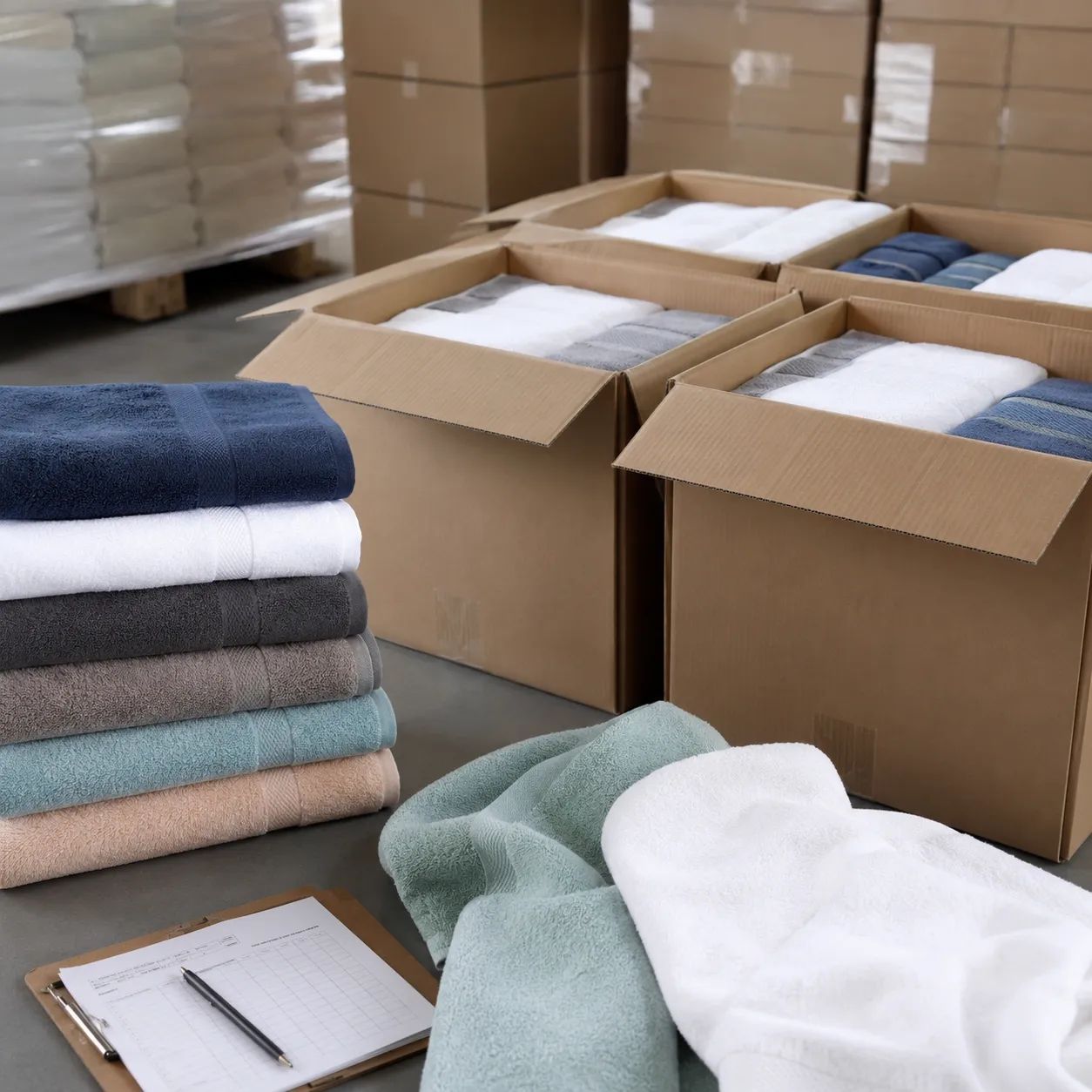
Why Cartons Matter More on Small Export Runs
Low MOQ towel orders behave differently from container-size programs. A 28,000-piece hotel order usually has one or two carton formats, a full pallet plan, and a receiving team expecting volume. A 500 to 1,200-piece reorder may include four colors, two towel sizes, barcode stickers, inner polybags, and mixed carton quantities because the buyer is topping up retail or hotel stock.
That is where export cartons become a control point, not a packaging afterthought. If the carton is too weak, terry towels compress and rebound during sea freight, pushing against seams and tape. If the case pack is inconsistent, the buyer's warehouse sees shortages even when the production count was correct. If the outer mark is vague, cartons sit in exception lanes while demurrage or 3PL handling fees keep running.
At our mill, MOQ starts at 500 pcs per design per color. For export orders below 2,000 pcs, we lock carton specs during pre-production, not after folding. That gives merchandising, packing, QC, and freight forwarder teams the same dimensions, gross weight targets, SKU marks, and barcode layout before towels reach the finishing line.
| Order type | Typical towel count | Carton risk we watch first | Factory control point |
|---|---|---|---|
| Trial hotel order | 500-800 pcs | Too many SKUs packed into similar cartons | Color-coded carton marks plus SKU-level packing list |
| Beach club reorder | 600-1,500 pcs | Bulky towels exceeding courier size limits | Carton dimension check before final folding approval |
| Gym towel program | 1,000-3,000 pcs | High carton count from small towel sizes | Case pack optimization to reduce local handling charges |
| Retail private label | 500-2,000 pcs | Barcode mismatch between inner pack and master carton | Scan test against buyer SKU sheet before sealing |
The Low MOQ Towels Export Carton Checklist
This is the low moq towels export carton checklist we ask buyers to confirm before bulk packing. It is practical rather than decorative: carton strength, quantity, label, moisture control, and receiving logic. A good carton should protect the towels and make the receiving clerk's job boring.
- Confirm towel SKU, color, size, GSM, and decoration method against the approved purchase order.
- Set the case pack by towel weight and receiving preference, not by a round number guessed at the end.
- Approve carton board grade, dimensions, tape method, and maximum gross weight before bulk folding starts.
- Freeze outer carton marks: PO number, SKU, color, size, quantity, country of origin, carton number, and gross/net weight.
- Check inner packaging direction so barcodes, care labels, and hangtags face consistently when cartons are opened.
- Run one sealed-carton inspection for compression, tape adhesion, scan readability, and actual measured weight.
- Match the final packing list to sealed carton numbers before the goods leave our loading area.
For small export orders, we normally recommend keeping master cartons under 18 kg gross weight unless the buyer's 3PL gives another limit. Courier and parcel networks may accept heavier cases, but warehouse staff often flag 20 kg-plus cartons as two-person lifts. That sounds minor until a 52-carton order receives a handling surcharge.
Carton Board, Burst Strength, and Drop Risk
Towels are soft, but towel cartons are not easy cargo. Cotton has memory: after compression, it tries to recover loft. During a 30-day sea route with vibration, humidity shifts, and stacking pressure, that rebound can deform a weak box. For this reason, we rarely use thin domestic cartons for export even on low MOQ orders.
Our normal export option is a 5-ply corrugated carton, often K=A or K=K depending on towel weight and destination. For heavy bath towels or compressed beach towels, we specify a bursting strength around 200-250 lb/in² or equivalent edge crush performance. For small microfiber or gym towels, a lighter 5-ply may be enough if the carton height stays controlled.
A useful factory test is simple: seal one bulk carton with the final tape pattern, weigh it, then perform an ISTA 1A-style sequence for cartons under 68 kg. We use practical drops on corners, edges, and faces from a height matched to gross weight. The point is not to pretend a small order needs a full laboratory transit simulation. The point is to catch split seams, crushed corners, and towel packs that shift inside the carton.
| Towel category | Common GSM range | Recommended carton board | Typical gross weight target |
|---|---|---|---|
| Hotel bath towels | 500-700 GSM | 5-ply K=A or K=K | 14-18 kg |
| Pool or beach towels | 360-520 GSM | 5-ply K=A, reinforced if oversized | 12-17 kg |
| Gym sweat towels | 320-450 GSM | 5-ply B=C or K=A | 11-16 kg |
| Microfiber towels | 220-350 GSM | 5-ply with tight height control | 10-15 kg |
- Watch for carton belly: side panels bow outward after sealing, usually because the case pack is too tight or the fold is too bulky.
- Reject soft corner collapse: cartons that dent under hand pressure before palletizing will not improve during freight.
- Check tape lift after 20 minutes: terry pressure can peel weak tape after the carton has been sealed and moved.
- Avoid empty headspace above folded towels: it allows the stack to bounce and crush during truck loading.
Case Pack Math: Count, Weight, and Receiving
Buyers sometimes ask us to pack every carton at 50 pcs because it looks tidy on a spreadsheet. That can work for 30 x 30 cm gym towels, but it is wrong for heavy bath sheets. We calculate case pack from unit weight, fold size, carton dimensions, and the buyer's unloading method.
For example, a 76 x 152 cm beach towel at 430 GSM has a fabric-area weight around 497 g before finishing tolerance, borders, and moisture regain. After hemming and normal production variance, the packed unit may sit near 520-560 g. A 24-piece carton then reaches about 13.5 kg net towel weight before polybags and board. That is manageable. The same 24-piece case for a 700 GSM bath sheet can pass 21 kg gross and create both carton and labor problems.
We also consider how the cartons will be received. A hotel purchasing team may prefer one SKU per carton even if it creates more cases. A DTC brand may accept 2-color mixed cartons for an urgent launch, but then each carton needs a clear internal divider and a packing list note. For Amazon-style receiving or strict 3PL inbound rules, mixed cartons should be avoided unless the buyer's routing guide allows them.
| Product | Better case pack | Why it works | When to reduce |
|---|---|---|---|
| 30 x 50 cm gym towel, 380 GSM | 80-120 pcs/carton | Small fold, low unit weight, efficient handling | If inner polybags add bulk or cartons exceed 16 kg |
| 50 x 100 cm hand towel, 450 GSM | 40-60 pcs/carton | Keeps carton shape stable without over-compression | If embroidery backing makes stacks uneven |
| 70 x 140 cm bath towel, 600 GSM | 18-24 pcs/carton | Balances weight, loft recovery, and carton strength | If buyer requires parcel delivery |
| 90 x 170 cm beach towel, 420 GSM | 16-20 pcs/carton | Oversized fold needs more room to prevent corner crush | If jacquard borders create thick edge stacks |
Outer Marks, Barcodes, and Carton Numbers
A towel carton mark should answer three questions without opening the box: what is inside, where it belongs, and whether it is the carton listed on the packing document. On low MOQ towels export carton checklist reviews, this is where we catch the most buyer-side ambiguity. The artwork is approved, the towels are correct, but the carton label says only "TOWELS" and a PO number.
For export, our standard carton mark includes buyer name or code, PO number, item/SKU, product description, color, size, quantity, gross weight, net weight, carton dimensions, country of origin, and carton sequence such as 1/46. If the order has multiple colors, we prefer color names that match the buyer's system, not only our dye-house name. "Stone Blue" and "Blue Grey" may be different SKUs in retail even if the lab dip looked close.
For barcode cartons, we check print contrast and scanning angle before mass labeling. Where buyers require barcode verification, ISO/IEC 15416 is the common print quality reference for linear barcodes. We do not promise formal grading unless it is written into the order, but we do scan each label format using the same data file that will appear on the final packing list.
- Use one carton number sequence per shipment, not separate sequences by color unless the forwarder approves it.
- Place labels on the same carton face so warehouse teams do not rotate every case during receiving.
- Keep barcode stickers away from carton seams and tape edges where scanners read poorly.
- Print country of origin as Made in China when required by the destination or retailer routing guide.
- For mixed cartons, add a visible mixed-SKU warning and list the internal split on the packing list.
Moisture Control for Cotton and Microfiber
Export cartons fail quietly when moisture is ignored. Cotton towels can leave the finishing area dry enough, then absorb humidity during storage, trucking, or container loading. Microfiber has less cotton-like moisture regain, but polybags can trap condensation if packed warm after drying.
We check towel moisture with handheld meters as a production control, then keep packed cartons in a dry staging area. For cotton terry, we usually want finished goods around 6-8% moisture content before sealing, depending on season and fiber blend. Cartons stored directly on damp floors are rejected; we use pallets or raised staging even for small orders.
Container routes add another layer. For sea freight during humid months, desiccant strips or container desiccants may be worth the small cost. On a 900-piece spa towel order, adding USD 28-45 of container desiccant can prevent musty odor claims that cost hundreds in inspection, repacking, or discounting. For air freight, the risk is lower, but sealed polybags still need towels cooled and conditioned before packing.
| Moisture control item | Typical factory action | Cost impact | Risk reduced |
|---|---|---|---|
| Raised carton storage | Keep sealed cartons off floor before loading | Included in handling | Wet bottom cartons and mildew odor |
| Carton liner polybag | Add master poly liner for sensitive routes | USD 0.06-0.14/carton | Rain splash during transfer |
| Silica or clay desiccant | Use by carton or container plan | USD 0.03-0.10/carton equivalent | Condensation and musty smell |
| Pre-load container check | Inspect floor, roof, door gasket, odor | Included when we arrange loading | Water ingress and contaminated cargo |
Pricing Impact: Carton Choices Are Small Costs
Export carton upgrades feel annoying because they are visible line items, but they are usually small compared with freight, replacement goods, or chargebacks. For low MOQ programs, the trick is to upgrade where failure is likely and avoid over-specifying every box like industrial equipment.
As a practical range, basic export cartons for towel orders often add USD 0.18-0.42 per towel depending on towel size and case pack. Private-label inner packaging, printed carton marks, and barcode labels can move that to USD 0.30-0.75 per towel on small runs. When volume increases, the cost per towel drops because label setup, carton ordering, and packing labor spread across more units.
| Volume per design/color | Typical FOB towel price band | Export carton and label add-on | Notes |
|---|---|---|---|
| 500-799 pcs | USD 2.85-8.90/pc | USD 0.30-0.75/pc | Most sensitive to carton MOQ and manual labeling |
| 800-1,999 pcs | USD 2.55-8.20/pc | USD 0.22-0.56/pc | Better carton utilization and faster packing rhythm |
| 2,000-4,999 pcs | USD 2.25-7.60/pc | USD 0.16-0.38/pc | Custom printed cartons become easier to justify |
| 5,000+ pcs | USD 1.95-6.95/pc | USD 0.10-0.28/pc | Pallet plan and carton print can be standardized |
A cheaper carton can look like savings until it creates rework. One recent small replenishment program used 720 embroidered hand towels packed 60 pcs per carton. Switching from a domestic 3-ply carton to a 5-ply export carton added about USD 64 to the order. Replacing only three crushed cartons at destination, including local handling and repack labor, would have cost the buyer more than USD 110. That is the cost-per-use logic we prefer: compare the carton cost against the failure it prevents.
Inspection Documents Buyers Should Ask For
The best time to catch packing errors is before cartons are sealed. The second-best time is before they leave the factory gate. For small export towel orders, we keep the document set lean but complete enough for a buyer, forwarder, or 3PL to trace the shipment.
- Packing list by carton number showing SKU, color, size, quantity, gross weight, and dimensions.
- Carton photo set with front mark, side mark, open carton view, inner pack view, and sealed tape pattern.
- AQL inspection report using ISO 2859-1 sampling when third-party inspection is requested.
- Certificate file for OEKO-TEX Standard 100 Class I, BSCI audit status, and ISO 9001 quality management when relevant to the buyer.
- Loading photos showing container condition, pallet or floor-loading pattern, carton count, and seal number.
OEKO-TEX Standard 100 Class I matters when towels touch skin, especially baby, spa, and hospitality programs. BSCI is not a packing standard, but many brand buyers request it as part of social compliance. ISO 9001 supports process control, including how packing instructions, inspection records, and nonconforming cartons are handled. We keep these documents available because carton control is part of the total sourcing file, not an isolated warehouse task.
Production Timing and Export Handover
Packing deadlines need to be built into the production calendar. A low MOQ order still needs yarn preparation, dyeing, weaving or knitting, decoration, washing, finishing, inspection, packing, and export handover. Rushing the last two days creates the carton mistakes buyers remember.
For repeat towel programs using existing yarn, color, and packaging, production is usually 18-28 days after deposit and final artwork approval. New color development, jacquard weaving, embroidery sampling, or retail packaging can move that to 30-45 days. If the order needs third-party inspection, we reserve one extra day for inspection and one day for corrective action before pickup.
- Day 1-3: confirm PO, carton mark template, case pack, certification file, and shipping route.
- Day 4-12: yarn, dyeing, weaving, and decoration preparation depending on towel type.
- Day 13-24: finishing, washing, trimming, folding trial, and pre-pack inspection.
- Day 25-28: bulk packing, carton weighing, label scan check, final packing list, and forwarder handover.
- Day 29-45: extended window for new jacquard, custom packaging, complex embroidery, or peak-season capacity.
For shipping, cartons can move by courier, air freight, LCL sea freight, or full container. We help buyers choose based on carton dimensions and urgency, but the routing guide must come from the buyer when a retailer or hotel group has strict inbound rules. More detail on freight tradeoffs is covered in container vs air freight towel orders, and carton data should match the freight plan before booking.
Common Carton Mistakes We Push Back On
Some buyer requests look efficient on paper but create receiving problems. We will usually push back gently, with numbers, because a carton that fails at destination makes both sides look careless.
- Packing oversized bath towels at 30 pcs per carton when gross weight will exceed 22 kg.
- Using identical blank cartons for six colors without large color marks or SKU labels.
- Requesting mixed cartons for a 3PL that requires one SKU per master carton.
- Approving retail polybags before checking whether the added thickness changes the master carton count.
- Asking for ultra-thin cartons to save USD 0.05 per towel on a sea shipment that will be stacked for several weeks.
The fix is usually not expensive. Reduce the case pack, improve the label, strengthen the carton, or separate SKUs. The discipline is to decide before the first bulk carton is sealed. For buyers building the full product spec, build a towel tech pack that mills can quote is a useful companion to this packing checklist. For towel weight decisions that affect carton count, see towel GSM decision framework and towel sizes dimensions complete guide.
Related reads: hotel buyers may want hotel towel sourcing guide 2026 and setting up hotel linen program 90 day roadmap. Brand teams comparing decoration and packing bulk should also review embroidery vs sublimation vs jacquard before approving carton dimensions.
Related reads for compliance and small-run planning: how to read OEKO-TEX certificate, negotiate towel MOQ without killing margin, and private label vs white label towel programs. These decisions connect directly to carton labels, inner packs, and export documents.
What to Send Us Before We Quote
A complete export carton brief does not need to be long. We need enough detail to price the towel, protect it in transit, and make the receiving process match your warehouse. If you are not sure about case pack or carton board, send the destination, delivery method, and any 3PL routing guide; we can propose the starting point.
- Towel size, GSM target, material, color count, and decoration method.
- Order quantity by design and color, with MOQ starting at 500 pcs per design per color.
- Preferred case pack or maximum carton gross weight from your warehouse.
- Required carton marks, barcode format, SKU naming, and country-of-origin wording.
- Shipping method: courier, air, LCL sea freight, full container, or nominated forwarder pickup.
- Certification requirements such as OEKO-TEX Standard 100 Class I, BSCI, and ISO 9001 documentation.
LUMA & CO. TEXTILE has produced towels since 2007 with a 220-person team, about 2.4 million towels per year, and clients in 47 countries. For export packing, our job is straightforward: make the towel your buyer approved, pack it so it arrives in that condition, and document the cartons clearly enough that receiving does not become a guessing exercise.
Send Your Carton Checklist
Share your towel spec, quantity, destination, and warehouse rules. We will return a carton plan with case pack, label fields, timing, and export packing cost.
Request Carton Review →