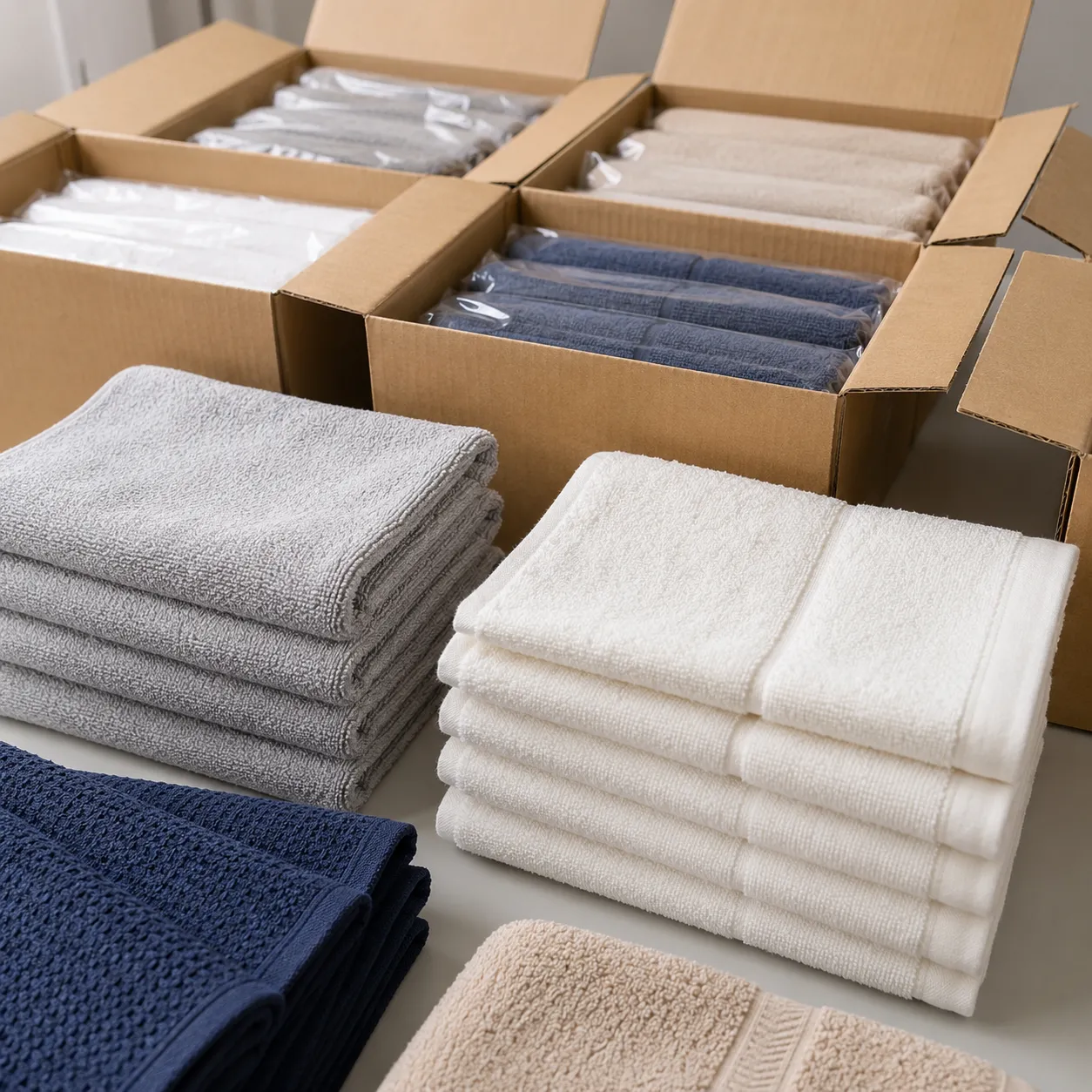
Why the carton spec changes by fabric
Microfiber and cotton towels do not travel the same way. Microfiber is light, slick, and usually packed at higher piece counts per carton. Cotton is heavier, bulkier, and more sensitive to trapped humidity. If one carton drawing is used for both, the freight math may look simple, but the risk moves into crushed cartons, mildew claims, barcode scanning delays, and uneven shelf presentation at destination.
In our export packing room, the carton decision starts after final inspection, not at the quoting desk. We weigh the finished towel, confirm folded size, check moisture reading, and then select carton board grade. For repeat orders we still re-check because a 500 GSM cotton hand towel and a 500 GSM microfiber beach towel behave differently once compressed. Cotton rebounds and pushes the carton outward. Microfiber stacks flat but can slide inside the master carton if the inner bag is too loose.
Our baseline MOQ is 500 pcs per design per color. At that quantity, carton design still matters because small cartons with mixed SKUs create more handling points. For 3,000 pcs and above, carton cube affects container utilization enough to change landed cost by several cents per towel. That is why we ask buyers to approve carton markings, carton dimensions, and pack count together with the towel spec, not after production is finished.
| Fabric type | Common export towel GSM | Typical carton issue | Factory control point |
|---|---|---|---|
| Microfiber suede or terry | 180-320 GSM | Carton feels underfilled; towels slide during truck transfer | Tighter polybag sizing and anti-slip carton stack pattern |
| Microfiber waffle or twist pile | 300-420 GSM | Edges can snag against rough corrugated liner | Smooth inner bag and no exposed staple points |
| Cotton hand or gym towel | 360-520 GSM | Carton bulges after compression release | Lower pack count and higher burst-strength board |
| Cotton bath or beach towel | 500-750 GSM | Corner crush and moisture retention | Double-wall carton, moisture check, and silica gel when routed by sea |
Microfiber vs Cotton Towel Export Carton Checklist
A practical microfiber vs cotton towel export carton checklist should be short enough for the merchandiser to use, but specific enough for the warehouse team to follow. We use it at three points: pre-production carton planning, pilot packing before bulk folding, and final AQL inspection before sealing cartons.
- Confirm finished towel weight after washing or heat setting, not only theoretical GSM from the quote sheet.
- Set carton pack count by real packed height, leaving 12-18 mm headspace for carton closure without force.
- Choose single-wall or double-wall corrugated board based on gross weight, route, and pallet stacking height.
- Approve inner packing: individual polybag, bundle bag, paper band, or naked folded pack depending on retail and laundry use.
- Check moisture before packing cotton goods; do not seal cartons if bale-area humidity is above the approved range.
- Run a pilot carton drop and compression review before the first 30 cartons are packed.
- Match carton marks to the commercial invoice, packing list, and destination warehouse routing labels.
For microfiber programs, the checklist often focuses on movement control. For cotton programs, it focuses on weight and moisture. If the same order includes both materials, we prefer separate carton codes even when the towel size looks similar. One mixed carton spec may save 20 minutes in artwork setup and cost the buyer several hours in receiving exceptions.
Carton dimensions and pack counts that work
Export carton dimensions are not chosen only by towel size. We also look at labor efficiency, maximum carton gross weight, pallet footprint, and whether the buyer unloads by hand or by forklift. For hand-loaded LCL shipments, we try to keep gross weight below 18 kg. For palletized FCL orders going to a distribution center, 20-23 kg may be acceptable if the carton board and stacking plan are specified.
Cotton towels usually hit the weight limit before they hit the volume limit. Microfiber towels often hit the carton-size limit first because buyers want clean retail folds and a high piece count. We avoid overlong cartons for microfiber because they bend at the middle during manual handling. For cotton bath towels, we avoid cartons that are too tall because lower cartons on the pallet take compression from every layer above.
| Towel program | Example finished spec | Recommended carton pack | Approx. gross weight | Carton style |
|---|---|---|---|---|
| Microfiber gym towel | 40 x 80 cm, 260 GSM | 100 pcs/carton | 10.5-12.0 kg | Single-wall K=A, 5-ply not required |
| Microfiber beach towel | 80 x 160 cm, 280 GSM | 40 pcs/carton | 15.0-17.5 kg | Single-wall reinforced, tight bundle bags |
| Cotton gym towel | 40 x 80 cm, 450 GSM | 60 pcs/carton | 18.0-20.0 kg | Double-wall preferred for sea freight |
| Cotton bath towel | 70 x 140 cm, 620 GSM | 24 pcs/carton | 21.5-23.5 kg | Double-wall BC flute, corner protection if palletized |
| Cotton pool towel | 76 x 152 cm, 560 GSM | 20 pcs/carton | 20.0-22.0 kg | Double-wall with moisture barrier liner if needed |
These are working ranges, not fixed rules. A yarn-dyed jacquard cotton towel packs differently from a plain dobby towel of the same GSM because the raised pattern adds thickness. A microfiber waffle towel can trap more air than a flat suede towel, so the carton count may need to drop even when the finished weight is low. For towel sizing decisions before carton planning, we usually point buyers to our towel sizes and dimensions guide and the GSM decision framework.
Moisture control before sea freight
Cotton is cellulose fiber, so it absorbs and releases moisture during processing. A towel can pass appearance inspection but still carry enough residual humidity to create a mildew odor after four weeks in a closed container. Microfiber does not absorb water the same way, but its carton can still suffer condensation if goods are packed warm, moved into a cool warehouse, and loaded into a container without acclimation.
Our cotton towel packing standard is to measure random pieces with a textile moisture meter after tumble drying or relaxation. We also check carton-room relative humidity. If a cotton batch reads high, we hold packing and return it to controlled drying. Sealing damp cotton in a polybag is a defect, not a shortcut. For microfiber, we focus more on temperature stabilization and avoiding trapped steam after heat transfer printing or sublimation curing.
- For cotton bath and beach towels, we target finished-goods moisture generally below 8.5 percent before carton sealing.
- For microfiber towels after heat setting, we allow cooling time so packed cartons do not sweat inside the liner.
- For long sea routes above 25 days, we may add 5-10 g silica gel per inner bag or 30-50 g per master carton depending on carton volume.
- For humid-season shipments from South China ports, we recommend container desiccants when the buyer books FCL sea freight.
- For naked-pack hotel towels, we avoid direct contact between towel and raw kraft carton by using a clear PE liner or bundle bag.
We have rejected cartons in our own warehouse when the tape looked perfect but the inner cotton stack felt cool and heavy. That decision delays shipment by a day, but it prevents destination claims that are much more expensive. For hotel and resort buyers, this is especially important because towels often go straight into storage before first wash. Our hotel towel sourcing guide covers laundry-side checks that should align with export packing.
Corrugated board, tape, and drop tests
Carton board grade is one of the easiest places to under-spec. Buyers sometimes request the lowest carton cost because the carton is discarded. We push back when the carton must survive factory handling, port trucking, container loading, ocean vibration, destination unloading, and warehouse sorting. A USD 0.42 cheaper master carton can damage 24 bath towels worth far more than the savings.
For lighter microfiber programs under 12 kg gross weight, a good single-wall carton can be enough. For cotton bath, pool, and hotel towels above 18 kg, we usually move to double-wall BC flute. We check edge crush, board stiffness, glue line, and closure strength. Tape should not be a random commodity item; low-tack tape lifts in humid routes and creates carton-open findings during warehouse receiving.
Our packing validation references ISO 2233 for conditioning atmosphere before package testing and uses an ISTA 1A-style drop sequence for non-palletized cartons. We perform corner, edge, and face drops at practical heights based on carton weight. We also run a manual compression stack review by leaving pilot cartons under simulated pallet load overnight. This is not a replacement for a certified lab report when a retailer requires one, but it catches weak cartons before bulk shipment.
| Carton gross weight | Suggested board | Drop review height | Main risk checked |
|---|---|---|---|
| Under 10 kg | Single-wall B flute or K=A | 76 cm | Open seam, corner dent, internal sliding |
| 10-18 kg | Single-wall reinforced or light double-wall | 61 cm | Tape lift, edge compression, bundle shift |
| 18-24 kg | Double-wall BC flute | 46 cm | Bottom sag, corner crush, towel deformation |
| 24 kg and above | Avoid if possible; split carton count | Case by case | Manual handling injury and pallet collapse risk |
A carton that passes empty compression but fails after packing towels is common. Towels are soft goods, so they do not support the carton walls like rigid products do. Heavy cotton towels slump toward the lower corners. Microfiber bundles can slide and hit one end wall. We therefore test with real packed goods, not dummy filler.
Inner packing: polybag, bundle, or retail-ready
The inner packing decision should match the selling channel. A resort laundry does not need each towel in a retail polybag. A DTC brand may need individual bags with suffocation warnings, barcode labels, and size stickers. A tournament golf towel program may want 10 pcs per inner bag for easy event distribution. The wrong inner pack creates labor cost at destination even if the carton arrives intact.
Microfiber towels are more likely to need individual or small-bundle packing because printed surfaces can pick up lint and dust. Cotton towels for hotels can often ship in bundle bags or paper-banded stacks, but dyed cotton should be protected from carton rub. White cotton towels are especially sensitive to kraft dust if packed naked.
- Individual polybag: best for retail, DTC, club shops, and mixed-SKU cartons; adds material cost and packing time.
- Bundle bag: practical for hotel, gym, spa, and beach club replenishment; usually 5, 10, or 12 pcs per bundle.
- Paper band: lower plastic use and clean presentation, but weak in humid routes unless paired with a master PE liner.
- Naked folded pack: lowest cost for institutional laundry, but only safe when carton liner and moisture control are specified.
- Retail carton insert: useful for shelf programs, but it reduces towel count per carton and increases cube.
For buyers comparing decoration methods, inner packing also protects the logo. Embroidery can press against neighboring towel piles if the fold puts the stitched area at the carton edge. Sublimated microfiber should be cooled and stacked print-to-print only when transfer stability has been checked. We explain those decoration trade-offs in embroidery vs sublimation vs jacquard and in our guide to custom microfiber towels wholesale.
Carton marks and export documents
Carton marks are part of the product specification. A clear towel export packing list must connect item number, color, size, GSM, piece count, carton number range, net weight, gross weight, and carton measurement. If carton marks are changed after goods are packed, the warehouse team may need to relabel hundreds of cartons by hand. That creates delay and scanning errors.
We ask buyers to confirm whether destination warehouses require GS1-128 labels, Amazon FBA-style labels, retailer routing labels, or simple SKU stickers. Some hotel groups only need PO number and carton count. Some retail programs require scannable carton IDs and mixed-carton warnings. For mixed microfiber and cotton shipments, carton labels should state fabric type because inspection and storage teams may treat them differently.
- Approve carton mark artwork before bulk packing starts, including brand name, PO number, item code, color, size, quantity, and country of origin.
- Confirm whether the buyer wants net weight and gross weight printed or only shown on the packing list.
- Separate carton number ranges by SKU; do not restart numbering for every pallet unless the warehouse requests it.
- Match HS code and material description on commercial documents to the actual towel composition.
- Keep one retained carton photo set per SKU: open carton, inner pack, side mark, top mark, and sealed carton.
We see avoidable problems when the commercial invoice says cotton towel, the carton mark says microfiber towel, and the inner label says polyester polyamide cleaning cloth. Customs brokers may treat those as different products. The factory can correct paperwork before shipment, but after vessel departure the cost becomes courier fees, amendment fees, and sometimes destination storage.
Pricing bands with carton and packing included
Packing is not free; it is just often hidden inside the FOB towel price. The cost changes with carton grade, inner bag type, label quantity, and inspection requirement. For a realistic quote, we separate the towel cost from the export packing assumptions. This helps buyers compare offers properly instead of choosing a cheaper quote that uses a weak carton.
| Order volume | Microfiber towel FOB range | Cotton towel FOB range | Export packing allowance |
|---|---|---|---|
| 500-999 pcs | USD 1.05-3.85/pc | USD 1.45-6.90/pc | USD 0.10-0.28/pc depending on inner pack |
| 1,000-2,999 pcs | USD 0.88-3.40/pc | USD 1.28-6.20/pc | USD 0.08-0.22/pc with standard carton marks |
| 3,000-9,999 pcs | USD 0.72-3.05/pc | USD 1.12-5.65/pc | USD 0.06-0.18/pc if carton specs are standardized |
| 10,000 pcs and above | USD 0.64-2.78/pc | USD 0.98-5.25/pc | USD 0.05-0.15/pc on repeat packout programs |
These ranges depend on size, GSM, yarn, decoration, and packing. A 250 GSM microfiber gym towel with bundle packing sits near the low end. A 700 GSM cotton bath towel with embroidery, individual polybag, barcode label, and double-wall carton sits much higher. OEKO-TEX Standard 100 Class I materials, BSCI audit documentation, and ISO 9001 production controls are already part of our factory system, but special retailer lab tests or certified package testing are quoted separately.
Cost-per-use is where carton savings should be judged. Suppose a cotton pool towel program ships 4,800 pcs at USD 4.35 each. Upgrading from single-wall to double-wall cartons and adding PE liners may add around USD 0.14 per towel, or USD 672 total. If weak cartons cause only 3 percent of towels to arrive with dirty edges or mildew odor, the replacement value is about USD 626 before air freight, labor, and guest-service cost. In that case the stronger packing is not an upgrade; it is the cheaper risk position.
Production timing and inspection windows
Export carton planning should be locked before yarn dyeing or fabric finishing ends. If carton dimensions are still open during final folding, the packing room has to wait or improvise. We prefer to receive the buyer's routing guide with the tech pack so our merchandising, QC, and warehouse teams work from the same version.
For standard OEM towel orders, sample development usually takes 7-10 days for plain dyed cotton, 10-14 days for jacquard, and 12-16 days for printed microfiber with color calibration. Bulk production normally runs 25-35 days after deposit, artwork approval, and lab dip approval. Packing and final inspection take 2-4 days for small orders and 5-8 days for multi-SKU container loads. Sea freight booking should be started while production is running, not after cartons are sealed.
- 500-1,000 pcs: confirm carton spec at sample approval; packing can usually finish in 1-2 working days after final QC.
- 1,000-5,000 pcs: approve pilot carton before bulk folding; allow 3-5 days for packing, carton weighing, and photo records.
- 5,000-20,000 pcs: freeze routing labels before production week three; allow 5-8 days for staged packing and pallet plan checks.
- Mixed microfiber and cotton container: schedule separate QC release lots so light cartons are not buried under heavy cotton cartons.
Related reads: buyers building the product file should start with build a towel tech pack that mills can quote, then review container vs air freight towel orders before choosing carton size. If MOQ or SKU count is the constraint, negotiate towel MOQ without killing margin explains where factories have flexibility.
Factory checks before the container closes
The final warehouse check is simple but non-negotiable. We compare packed cartons against the approved packing instruction, commercial invoice, and booking plan. Random cartons are opened for piece count. Gross weights are checked against the packing list. Carton photos are stored by SKU and PO. For palletized shipments, we confirm stack height, stretch film tension, pallet label placement, and whether heavy cotton cartons are on the bottom.
A microfiber vs cotton towel export carton checklist also needs a loading rule. Microfiber cartons can deform if squeezed between heavy cotton towel cartons and container walls. Cotton cartons can absorb condensation if placed directly against a wet container floor. We inspect the empty container for odor, holes, rust flakes, water stains, and door gasket condition before loading. If the container fails, we request a replacement rather than treating packaging as the last defense.
- Check carton seal: no tape lift, no open corners, no crushed top panels.
- Check count: carton piece count matches the packing list and side mark.
- Check weight: random gross weight tolerance normally within plus or minus 0.5 kg for the same SKU.
- Check label scan: barcodes readable after carton sealing and stretch wrapping.
- Check loading order: double-wall cotton cartons below lighter microfiber cartons unless the pallet plan states otherwise.
Related reads: for microfiber performance differences, see microfiber vs cotton towel comparison. For quality failures after repeated laundering, why gym towels fail after 50 washes is useful for fitness buyers. For certification paperwork before shipment, use how to read an OEKO-TEX certificate.
We manufacture OEM towels in Gaoyang, Zhejiang with 220 employees, approximately 2.4 million towels per year, and export experience across 47 countries. Our standard compliance base includes OEKO-TEX Standard 100 Class I, BSCI, and ISO 9001. For a carton review, send the towel size, GSM, fabric, decoration method, order quantity, destination country, and warehouse routing guide. We can respond with a packout proposal, carton dimensions, estimated CBM, and FOB price band.
Need a carton-safe towel quote?
Send your towel spec and destination routing guide. We will check fabric weight, carton pack count, inner packing, MOQ, timing, and export documentation before quoting.
Request carton review: [email protected] | WhatsApp +86 13205717266 →