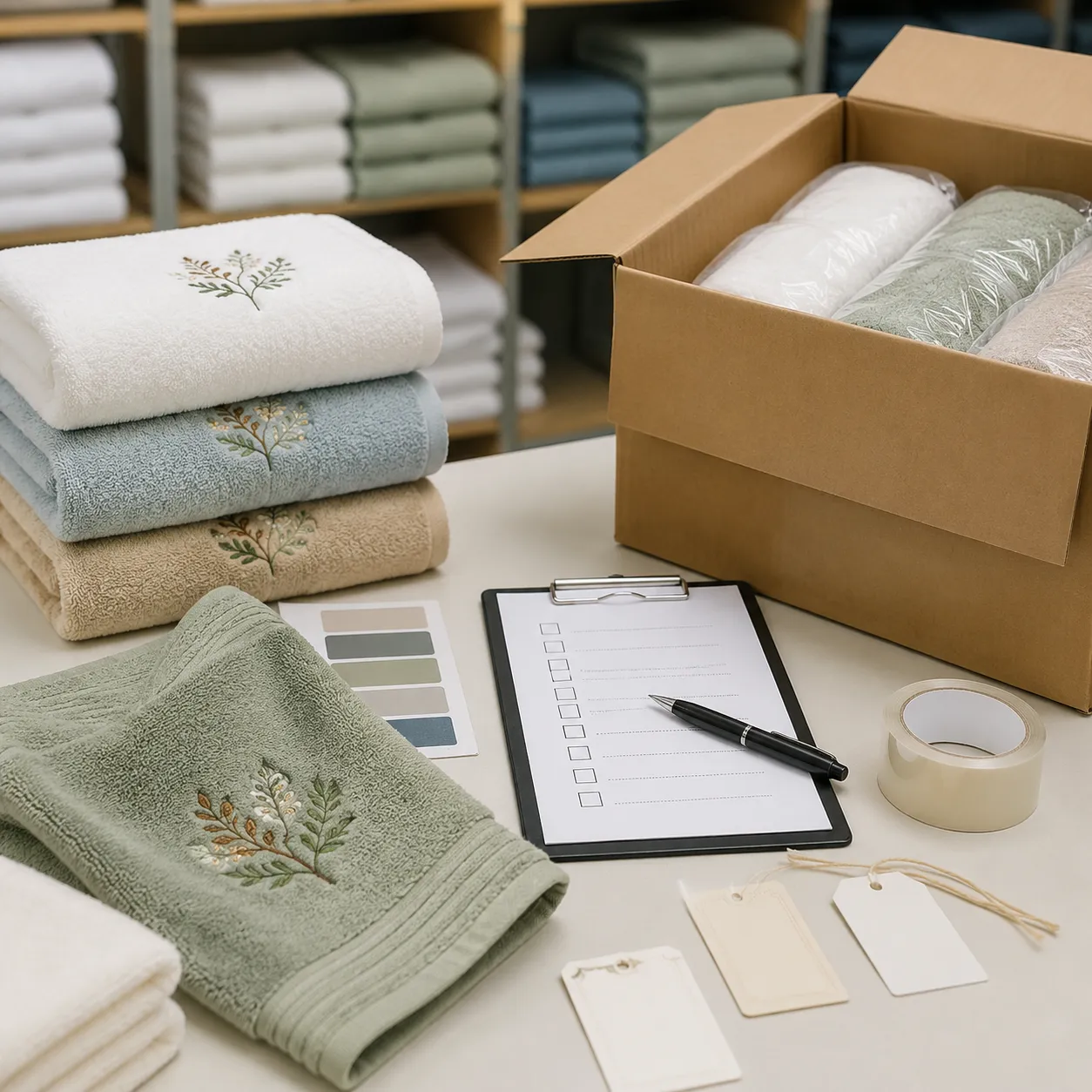
Why the Carton Matters More on Embroidered Hand Towels
Embroidery changes the way a hand towel behaves in the carton. The stitched area is thicker, less compressible, and more sensitive to abrasion than a plain terry towel. If the embroidery is placed against a rough carton wall or a plastic zipper from another item, thread fuzzing can show up before the buyer ever washes the towel.
For hotel, spa, and retail programs, we treat packing as part of the finished specification, not as a warehouse afterthought. Our normal MOQ is 500 pcs per design / per color, but even a 500-piece order can create two to six export cartons depending on GSM, size, folding method, and whether each towel needs a belly band, hangtag, or individual polybag.
Most embroidered hand towel programs we make sit between 420 and 650 GSM. Common sizes are 30×50 cm, 35×75 cm, and 40×70 cm. At these weights, carton compression is not the only issue. Moisture content, stitch protection, carton markings, and pallet stack height all decide whether the shipment reaches the buyer in sellable condition.
| Hand towel spec | Typical packing risk | Factory control point |
|---|---|---|
| 30×50 cm, 420-480 GSM, small logo | Overpacking makes cartons too dense for inspection and receiving counts | Limit to 80-120 pcs per master carton depending on fold |
| 35×75 cm, 500-580 GSM, crest embroidery | Raised embroidery can rub against adjacent folds | Face embroidery inward and use tissue or PE layer for retail packs |
| 40×70 cm, 600-650 GSM, dense monogram | Carton bulging after compression and humid transit | Reduce pack count and use 5-ply export carton |
| Gift or amenity hand towel with band | Paper band dents pile if carton is overfilled | Use looser packing ratio and check band position after vibration |
Embroidered Hand Towel Export Carton Checklist
The core embroidered hand towel export carton checklist has eight checkpoints in our packing line. We apply it after final towel inspection and before sealing, because once the carton is taped and strapped, defects become harder to detect without damaging retail presentation.
- Confirm the approved bulk towel: size, GSM, yarn, color, embroidery thread color, logo position, and stitch density match the signed sample.
- Check towel moisture content before packing. We target below 8.5% on cotton hand towels in normal export conditions.
- Confirm embroidery protection: logo facing inward, no metal clips touching thread, no hangtag pin passing through the stitched area.
- Verify unit pack: loose bulk, set pack, individual polybag, belly band, kraft wrap, or barcode sleeve.
- Count pieces per inner pack and per master carton using a written pack ratio, not an operator estimate.
- Inspect carton board grade, dimensions, edge crush feel, and seam glue before loading towels.
- Apply export marks, SKU labels, PO number, gross weight, net weight, carton number, and destination data.
- Seal, weigh, photograph, and sample-check cartons before palletizing or loose container loading.
For buyers building a tech pack, packing should have its own line. A drawing of the logo is not enough. The PO should state pieces per carton, inner packing, carton dimensions tolerance, barcode rule, and whether the hotel or retailer requires carton sequence numbers. We explain the broader PO data structure in build a towel tech pack that mills can quote.
Carton Strength, Board Grade, and Drop Risk
Hand towels look light, but cartons become heavy quickly when the fabric is 550 GSM cotton and packed tightly. A carton filled with 100 pcs of 35×75 cm hand towels can reach 18-22 kg gross weight depending on embroidery, polybag, and carton board. Above that range, manual handling damage increases. Corners crush, tape splits, and warehouse teams start dragging cartons instead of lifting them.
For export carton testing, buyers often ask for a generic drop test. We prefer to define the test. For non-fragile textile cartons, we use a practical version based on ISTA 1A handling logic: drops on one corner, three edges, and six faces from a height matched to carton weight. A 19 kg towel carton should not be treated like a 6 kg carton. We record seam opening, carton wall rupture, and whether the embroidered surface has shifted or creased inside.
| Carton gross weight | Recommended carton type | Practical limit | Inspection note |
|---|---|---|---|
| Under 12 kg | 3-ply export carton acceptable for non-retail bulk | Good for small hand towel packs | Still check corner crush after stacking |
| 12-18 kg | 5-ply export carton preferred | Best range for hotel replenishment orders | Use H-tape sealing on top and bottom |
| 18-23 kg | 5-ply stronger board, reduced carton height | Accept only when receiver allows heavier cartons | Perform drop and compression observation |
| Above 23 kg | Avoid unless buyer specifically approves | High labor and claim risk | Split pack count or change carton size |
One construction quirk we watch closely is the carton flap gap. If the top flaps do not meet cleanly because towels are over-compressed, tape carries the load instead of the board. During container vibration, the tape can lift and expose towels to dust. A carton that looks acceptable at the packing table may fail after three weeks in ocean transit if the flap gap is ignored.
Pack Ratio: The Number That Controls Cost and Claims
Pack ratio affects unit freight cost, warehouse labor, and damage risk. Buyers sometimes ask us to fit as many towels as possible into each carton to reduce CBM. That can lower freight on paper, but it can also increase chargebacks if retail cartons arrive rounded, damp, or difficult to count.
For a 35×75 cm embroidered cotton hand towel at about 540 GSM, the towel body weighs roughly 142 g before embroidery and packaging. With a dense 6,000-stitch logo, individual PE bag, and carton allowance, a 100-piece carton may approach 17 kg gross. If we push the same item to 130 pcs per carton, the carton may save about 0.035 CBM per 1,000 pcs, but it becomes harder to pass compression checks and slower for hotel receiving.
| Order volume | Loose bulk pack FOB China | Individual polybag FOB China | Retail band or barcode sleeve FOB China |
|---|---|---|---|
| 500-999 pcs | USD 1.18-1.72 per pc | USD 1.25-1.84 per pc | USD 1.34-1.98 per pc |
| 1,000-2,999 pcs | USD 0.96-1.48 per pc | USD 1.03-1.59 per pc | USD 1.12-1.73 per pc |
| 3,000-7,999 pcs | USD 0.82-1.31 per pc | USD 0.89-1.42 per pc | USD 0.97-1.56 per pc |
| 8,000 pcs and above | USD 0.74-1.18 per pc | USD 0.81-1.29 per pc | USD 0.90-1.43 per pc |
These bands assume cotton terry hand towels from 420-620 GSM with standard embroidery, OEKO-TEX compliant materials, and normal export cartons. Very high stitch counts, metallic thread, gift boxing, recycled paper bands, or FSC-certified printed cartons can move the price outside this range. We do not recommend cutting carton board grade to reduce a few cents when the shipment will move through multiple truck transfers.
Moisture Control Before Closing the Carton
Moisture problems on towels usually start before the container, not inside it. Cotton terry can feel dry by hand while still holding too much residual moisture after finishing or steaming. Embroidered areas dry more slowly because thread and backing add layers. If packed too early, the carton becomes a closed microclimate.
Our packing team checks moisture with a calibrated textile moisture meter at random positions: body pile, hem, and near the embroidered zone. For dark dyed towels, we also watch for condensation risk after carton sealing. If the order ships during humid weeks, we may hold finished towels 12-24 hours longer before final packing or add desiccant according to carton volume.
- Cotton hand towels: target below 8.5% moisture before carton closing.
- Bamboo-cotton blends: allow slower conditioning because the handfeel can mask dampness.
- Individually polybagged towels: confirm towels are fully conditioned before bag sealing, not only before carton sealing.
- Retail paper bands: avoid packing immediately after steam shaping because paper absorbs moisture first.
- Container loading: reject cartons with soft corners, damp smell, or visible waviness on outer board.
For color and wash reliability, we connect packing checks with lab control. Embroidery thread must not bleed onto the towel during humid storage. We normally test dyed cotton and embroidery thread using ISO 105-C06 for domestic and commercial laundering simulation, and ISO 105-X12 for rubbing where dark thread sits on light terry. Certification paperwork should be checked against the actual material lot, not copied from a previous order. Buyers can cross-check document details with how to read an OEKO-TEX certificate.
Labels, Carton Marks, and Receiving Scans
A clean carton label saves time at the buyer's warehouse. It also prevents mixed-SKU claims that are expensive to investigate after delivery. For embroidered hand towels, different logos can look similar from a distance. A spa crest, guest initials, and housekeeping mark may all be stitched in the same thread color, so carton identification must be precise.
- PO number and style number: printed exactly as the buyer's system uses them.
- Color name and Pantone reference: helpful when ivory, cream, and natural are in the same shipment.
- Logo version: include department, property, team, or monogram code if more than one embroidery file exists.
- Carton sequence: mark as 1/24, 2/24, and continue without gaps.
- Gross weight, net weight, and measurements: needed for freight audit and receiving.
- Barcode or QR label: place on a flat carton face, not across the seam or tape line.
A common defect mode is label curl on cartons stored near the loading door in humid weather. We use stronger adhesive labels or a printed carton mark when cartons may sit for several days before vessel cutoff. If a retailer requires GS1-128 or a specific carton barcode, that should be tested during sample or pilot packing, not discovered on the final shipping day.
Color naming also matters. If the embroidery thread is Pantone matched but the carton only says 'white towel,' the receiving team may not know whether champagne thread and silver thread are separate SKUs. For deeper color control, see Pantone color matching custom towels. For decoration method choices before packing, embroidery vs sublimation vs jacquard explains which logo methods create different packing sensitivities.
Inner Packing Choices: Bulk, Polybag, Band, or Set Pack
Inner packing should match the channel. Hotel housekeeping may prefer loose bulk because staff opens cartons and sends towels directly to laundry. A DTC brand may need each hand towel in a printed sleeve with barcode. A spa amenity program may want sets of two tied with a paper band. Each option changes packing speed, material cost, carton size, and inspection method.
| Inner packing type | Best use | Added cost range | Main risk |
|---|---|---|---|
| Loose bulk in master carton | Hotel and gym back-of-house replenishment | USD 0.00-0.02 per pc | Embroidery rubbing if fold direction is wrong |
| 10 pcs per inner PE bag | Distributor stock and mixed-property shipments | USD 0.025-0.055 per pc | Moisture trapped if packed too early |
| Individual recyclable PE bag | Retail, e-commerce, or gift orders | USD 0.045-0.095 per pc | Barcode mismatch or bag seam pressing pile |
| Paper belly band | Spa and boutique hotel presentation | USD 0.06-0.14 per pc | Band denting towel if over-compressed |
| Two-piece set pack | Guest amenity or promotional kit | USD 0.08-0.18 per pc | Set count errors when colors are similar |
We push back when buyers request individual polybags only because it looks more organized in photos. For a hotel order of 4,800 pcs that goes directly to central laundry, individual bags may add USD 240-430 in material and labor, plus unpacking waste at destination. If the receiving site needs scan control, a 10-piece inner bag with one barcode can be a better cost-per-handling solution.
Related reads: for towel dimension planning before carton sizing, see towel sizes and dimensions complete guide. For monogram placement and stitch behavior, monogrammed bath towels luxury brand guide is useful even when the item is a hand towel.
Pre-Shipment Inspection: What We Open and Record
Final inspection should not only measure towels. It must open cartons and prove the packing system works. Our standard outgoing inspection follows ISO 9001 process control and uses AQL-style sampling for finished goods, with stricter attention to embroidery defects because a single broken logo thread is visible to the end user.
We inspect carton count, carton condition, actual pack ratio, label accuracy, gross weight, and moisture. Then we pull towels from the top, middle, and bottom of sampled cartons. This matters because compression damage often appears in the middle layer, while dust or carton abrasion appears on edge towels.
- Embroidery surface: no loose thread tails longer than 3 mm, no puckering around dense stitches, no backing visible from the face.
- Fold alignment: logo not placed on the outer pressure corner unless the buyer approved that presentation.
- Carton interior: no loose staples, sharp glue lumps, crushed dividers, or exposed recycled paper dust.
- Weight variance: sampled cartons should stay within the agreed tolerance, usually ±3% for the same SKU pack.
- Photo record: sealed carton, open carton, label close-up, weighing scale, and pallet layout.
For export customers, we can align inspection with buyer checklists or third-party agencies. Our mill holds OEKO-TEX Standard 100 Class I, BSCI, and ISO 9001 certifications. Certifications do not replace carton inspection, but they reduce upstream risk around restricted substances, social compliance, and repeatable process control.
Lead Time, MOQ, and Shipment Planning
Carton planning starts before bulk weaving. If the buyer approves the towel but changes from loose bulk to individual retail sleeve after production, we may need new carton dimensions, extra barcode artwork approval, and a revised CBM calculation. That can add 4-8 days even when towels are finished.
For embroidered hand towels, our typical timeline is 5-7 days for yarn, lab dip, or thread confirmation when needed; 7-10 days for sample making and embroidery approval; 18-28 days for bulk weaving, dyeing, finishing, and embroidery; 3-5 days for final QC and packing; and 2-4 days for booking coordination before vessel handoff. Larger multi-property orders can run 35-50 production days if there are many logo files or color splits.
- MOQ: 500 pcs per design / per color for OEM production.
- Normal bulk lead time: 28-42 days after sample, deposit, and packaging artwork approval.
- Rush risk: embroidery queues and carton label changes are usually the bottleneck, not towel weaving alone.
- Sea freight planning: confirm CBM early if cartons will be palletized.
- Air freight planning: reduce carton gross weight; couriers punish oversized cartons even when weight is modest.
Ocean freight normally suits replenishment programs. Air freight is only sensible for launches, replacement stock, or small VIP orders because towels are bulky. For a 2,000-piece hand towel order, changing carton size by only 4 cm in height can alter chargeable volume enough to affect landed cost. More detail is in container vs air freight towel orders.
A Practical Buyer Sign-Off Before We Seal
The final sign-off should be short but specific. We ask buyers to approve one photographed carton setup before full packing when the order has retail labels, property-specific logos, or mixed colors. That photo set becomes the packing standard for the production line.
- Approve towel fold direction with embroidery visible or protected according to the channel.
- Approve inner pack: loose, bundle, individual bag, paper band, or set pack.
- Approve carton label content and barcode scan result.
- Approve pieces per carton and expected gross weight range.
- Approve master carton dimensions and whether cartons ship loose or palletized.
- Approve any desiccant, warning label, recycling mark, or destination compliance mark.
This is also the point to confirm whether the order will be delivered to one warehouse or split by property. A 6,000-piece order for three hotel locations may need three carton mark formats and three packing lists. If the split is given after packing, the warehouse must relabel or reopen cartons, which increases error risk.
Related reads: if the hand towel is part of a hotel program, hotel towels wholesale supplier guide covers sourcing structure. If the buyer is still comparing logo methods, custom logo towels OEM decoration guide gives a broader decoration view.
Send Us Your Packing Requirement
For embroidered hand towel orders, we can quote towel cost, carton dimensions, pack ratio, CBM, and export labeling from one spec sheet. MOQ is 500 pcs per design / per color. Contact us by WhatsApp at +86 13205717266 or email [email protected].
Request packing review →