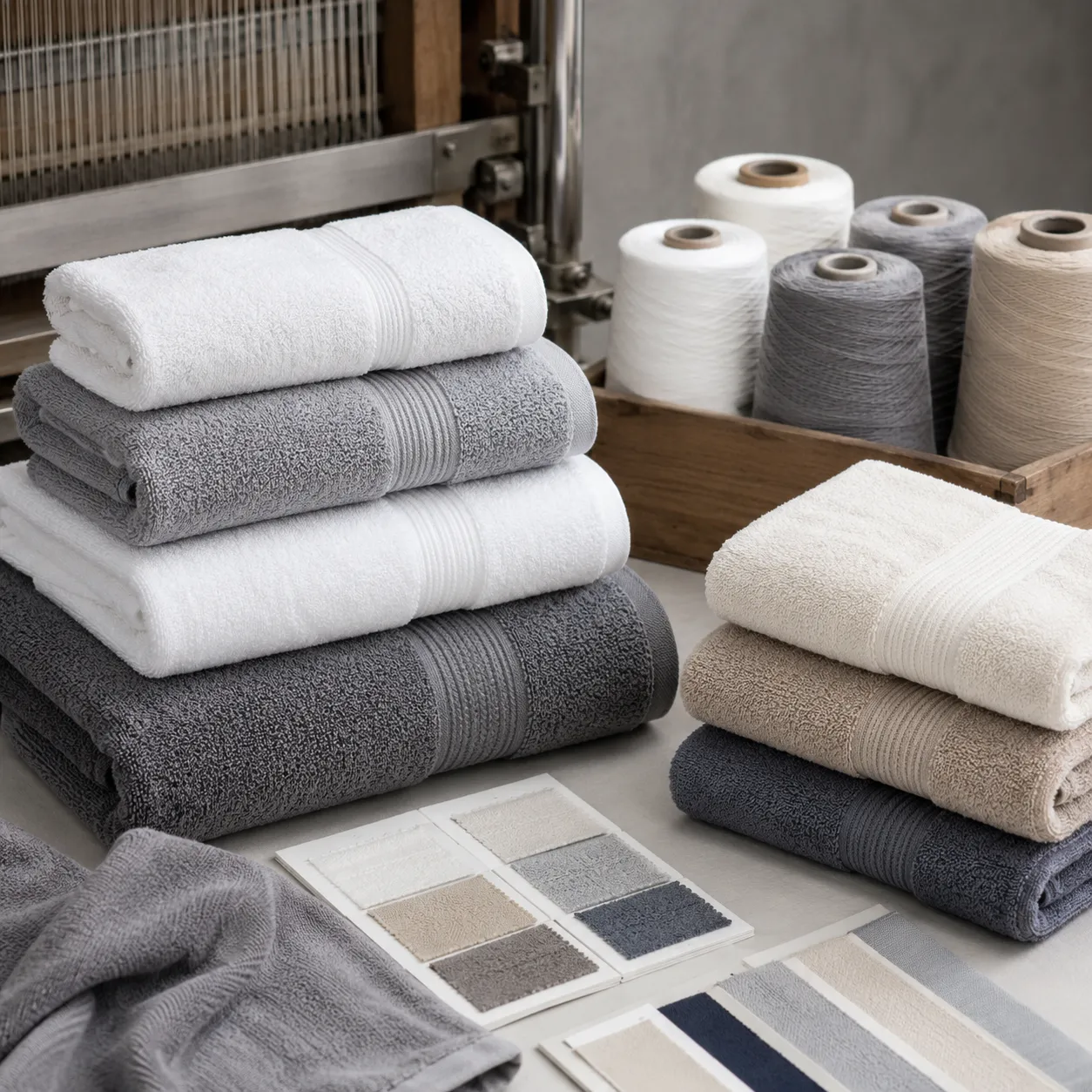
What low MOQ means in hotel towel buying
For hotel towels, low MOQ should not mean random leftovers from a wholesaler. It means the mill accepts a controlled production run while still using normal yarn, dyeing, sewing, inspection, and export packing processes. At LUMA & CO. TEXTILE, our MOQ is 500 pcs per design / per color. For a hotel program, that usually works when the buyer separates the purchase into bath towels, hand towels, washcloths, bath mats, or pool towels instead of forcing all items into one mixed carton count.
We operate a 220-person mill in Gaoyang, Zhejiang, China, producing about 2.4M towels per year for 80+ brand clients in 47 countries. Small hotel orders can run through the same inspection gates as larger hospitality contracts, but only if the spec is clear. The cost risk is not the towel itself; it is rework, shade mismatch, late artwork approval, or a wash failure found after goods arrive at the property.
| Hotel item | Practical low-MOQ start | Common size range | Usual GSM range | Best use case |
|---|---|---|---|---|
| Bath towel | 500-1,000 pcs | 70×140 cm to 76×152 cm | 500-650 GSM | Guest rooms, suites, spa showers |
| Hand towel | 500-1,500 pcs | 35×70 cm to 40×76 cm | 450-600 GSM | Bathrooms, public restrooms, vanity setups |
| Washcloth | 500-2,000 pcs | 30×30 cm to 33×33 cm | 400-550 GSM | Face use, amenity tray, housekeeping replacement |
| Bath mat | 500-800 pcs | 50×75 cm to 56×86 cm | 700-900 GSM | Wet floor control outside tubs and showers |
| Pool towel | 500-1,200 pcs | 80×160 cm to 90×170 cm | 380-520 GSM | Pool deck, beach, spa wet areas |
The low moq towels hotel procurement checklist we use internally starts with four controls: fiber, size, weight, and wash target. Decoration, labeling, and carton packing come later. A buyer who approves a logo embroidery before confirming shrinkage has the sequence backward.
Low MOQ Towels Hotel Procurement Checklist
Below is the checklist we recommend before issuing a purchase order. It is written for hotels, serviced apartments, boutique resorts, and management groups that are buying below container scale but still need predictable laundry performance.
- Define the room count, occupancy assumption, and par level before asking for price. A 60-room property running 3.2 par needs a different launch quantity than a 20-room villa group washing in-house twice per week.
- Separate bath, hand, washcloth, mat, and pool items into individual lines. Do not request one blended towel price.
- Confirm the fabric construction: ring-spun cotton, combed cotton, zero-twist, bamboo blend, or microfiber. For most hotel rooms, we quote 16s or 21s cotton terry yarn depending on handfeel and durability target.
- Choose GSM by laundry system, not by showroom feel. Tunnel washers and high-temperature tumble drying punish loose pile more than a guest does.
- Request one pre-production sample after lab dip approval, not only a loose hand sample. The sample should use the final yarn count, border width, label, and hem stitching.
- Ask for test standards in writing: ISO 6330 for domestic wash dimensional change, AATCC 61 for accelerated laundering colorfastness where relevant, and GB/T 22799 towel absorbency checks if the program requires a local China test report.
- Confirm certification documents before deposit. We can provide OEKO-TEX Standard 100 Class I, BSCI, and ISO 9001 documentation for qualified production programs.
- Lock carton quantity, polybag method, and barcode label fields before bulk sewing starts. Repacking hotel towels after final inspection is slow and expensive.
This is also where a hotel linen procurement team should decide how strict the shade tolerance needs to be. White towels look simple, but optical brightener level changes the visual tone under warm bathroom lighting. For dyed pool towels, we normally work to a practical Delta E target agreed by lab dip, then check bulk shade under D65 and TL84 light sources to catch metamerism.
Build the order from par level, not guesswork
A low MOQ order fails when it is treated like a one-time retail purchase. Hotels consume towels every day through guest use, housekeeping carts, laundry loss, stains, theft, and retirement. The first calculation should be par level. Most properties we supply use 3.0 to 4.0 par for guest room bath towels. A property with outsourced laundry, weekend occupancy spikes, or long transport time may need 4.5 par for the first six months.
| Property type | Room count example | Suggested launch par | Bath towel launch qty | Hand towel launch qty | Washcloth launch qty |
|---|---|---|---|---|---|
| Boutique city hotel | 36 rooms | 3.2 par | 240-260 pcs | 240-260 pcs | 260-320 pcs |
| Resort with pool | 58 rooms | 3.6 par | 420-460 pcs | 420-460 pcs | 500-650 pcs |
| Serviced apartments | 85 units | 3.0 par | 520-570 pcs | 520-570 pcs | 600-750 pcs |
| Spa hotel | 44 rooms + treatment rooms | 4.0 par | 360-400 pcs | 360-430 pcs | 700-900 pcs |
The table shows why MOQ planning matters. A 36-room hotel may not reach 500 pcs for every item on the first buy if it uses a strict room-only calculation. In that case, we usually suggest one of three options: combine properties under one group PO, order 500 pcs for the fastest-moving item only, or use a stock white base with custom woven label instead of a fully custom dyed towel.
- If the hotel has in-house laundry, choose slightly stronger hems and avoid very long loose pile that traps lint.
- If laundry is outsourced, request carton and bale packing that protects towels during transport to the laundry provider.
- If the property has high sunscreen exposure, avoid dark pool towel colors unless crocking and chlorine resistance have been tested.
- If rooms use open shelving, keep size and fold height consistent so housekeeping presentation stays uniform.
Related reads: we cover room-count planning in more depth in setting up a hotel linen program, and we explain spec decisions for larger hospitality buys in our hotel towel sourcing guide. For size planning, use the complete towel dimensions guide before confirming the PO.
Spec choices that decide laundry life
For hotel towels, the factory spec must survive more than the receiving inspection. We normally design around 80-120 commercial wash cycles for midscale hotel programs and 120-160 cycles for stronger resort or luxury specifications. The life depends on water hardness, detergent alkalinity, dryer temperature, and how aggressively stained towels are treated.
A common mistake is choosing a 680 GSM bath towel for a small hotel because it feels substantial in a sample room. If the towel is 76×152 cm at 680 GSM, the finished piece is around 785 grams before moisture and finishing variation. That weight increases laundry drying time and can push cost per use above a better-balanced 600 GSM towel. For a 54-room hotel washing 1,100 bath towels per week, even 7 extra minutes per dryer cycle becomes a monthly labor and energy issue.
| Spec variable | Safer hotel range | Factory note | Failure if ignored |
|---|---|---|---|
| Bath towel GSM | 520-620 GSM | Good balance for guest feel and drying time | Heavy towel stays damp and develops sour odor |
| Hand towel GSM | 450-560 GSM | Avoid overly bulky hems for vanity folding | Hem ridge becomes hard after repeated drying |
| Washcloth GSM | 400-500 GSM | Lower pile helps facial cleanser rinse out | Makeup stains bind deep in pile |
| Bath mat GSM | 750-850 GSM | Tighter ground weave improves floor stability | Loose mats distort and curl at corners |
| Pile yarn | 16s/1 or 21s/2 cotton options | Combed cotton reduces short-fiber lint | High linting during first 10 washes |
| Hem stitch | 2-needle lockstitch or reinforced chain | Use 9-11 stitches per inch on most hotel goods | Open hems and side seam fray |
One construction quirk we check on hotel bath towels is the border-to-terry transition. If the dobby border is too wide or too tight compared with the pile field, the towel can bow after tumble drying. On a 70×140 cm towel, a 5-7 cm border is usually safer than a decorative 10 cm border unless the weave tension is adjusted. This detail rarely appears on a quotation sheet, but it shows up after the fifth wash.
For cotton choices, see combed vs zero-twist cotton. Zero-twist can feel soft, but we do not recommend it blindly for hotels that bleach, over-dry, or use outside laundries without controlled chemistry.
Wash tests we ask buyers to approve before bulk
A small hotel order still deserves a wash protocol. At low MOQ, we do not advise running every possible lab test because the testing cost can become disproportionate. Instead, we define a practical test set that catches the common hotel failures: shrinkage, lint, color loss, seam opening, and slow absorbency.
- Dimensional change: ISO 6330 wash and tumble dry, measured after 3 cycles and sometimes 10 cycles for resort programs.
- Colorfastness to laundering: AATCC 61 2A or equivalent, especially for beige, grey, navy, forest green, or pool towel colors.
- Absorbency: drop test or sinking time check after prewash, because silicone softener can make a towel feel soft but repel water.
- Lint shedding: dark fabric rub check and dryer filter observation after pilot wash.
- Seam strength: manual pull plus visual inspection at side hem, label attachment, and hanger loop if used.
We often run a pilot wash on pre-production samples using neutral detergent and 60°C water, then compare weight loss, handfeel, and edge shape. If the towel is destined for a hotel laundry using peroxide or chlorine spot treatment, the buyer should tell us before yarn dye or vat dye approval. Reactive dyed cotton is workable for many hotel shades, but repeated chlorine exposure will not be kind to deep color.
Another factory detail: towels can pass a first absorbency drop test and still perform poorly if they carry too much finishing oil. We control this by adjusting the scouring and softening process, then checking that the pile opens after the first wash. A towel that feels waxy at approval stage is not a luxury towel; it is a risk in disguise.
If your team is new to certificate review, read how to read an OEKO-TEX certificate. Certifications do not replace wash testing, but they do help verify that restricted substances and production controls are not being treated casually.
Pricing bands for 500 to 3,000 pcs
Low MOQ pricing is sensitive to yarn price, towel weight, dye color, carton packing, and decoration. The figures below are realistic FOB China ranges for standard cotton hotel towels in 2026, assuming normal export cartons, no unusual gift box, and no air freight. They are not a substitute for a formal quote because a 90×170 cm pool towel and a 70×140 cm bath towel do not consume the same yarn.
| Item and spec | 500-799 pcs | 800-1,499 pcs | 1,500-3,000 pcs | Main cost driver |
|---|---|---|---|---|
| White bath towel, 70×140 cm, 560 GSM | USD 3.85-4.65 | USD 3.55-4.25 | USD 3.25-3.95 | Cotton weight and hem sewing |
| White hand towel, 40×70 cm, 500 GSM | USD 1.05-1.38 | USD 0.96-1.25 | USD 0.88-1.15 | Cutting efficiency and carton count |
| White washcloth, 32×32 cm, 450 GSM | USD 0.34-0.52 | USD 0.30-0.46 | USD 0.27-0.40 | Labor share is high at small size |
| Dyed pool towel, 80×160 cm, 430 GSM | USD 4.10-5.20 | USD 3.80-4.85 | USD 3.45-4.45 | Dyeing lot and shade control |
| Bath mat, 50×80 cm, 800 GSM | USD 2.35-3.05 | USD 2.15-2.78 | USD 1.98-2.55 | Dense ground and slower weaving |
A cheap quote can still be expensive. For example, one buyer compared a 500 GSM bath towel at USD 3.18 with a 590 GSM combed cotton towel at USD 4.06. On paper, the first saved USD 0.88. After 65 laundry cycles, the lower-cost towel had higher edge fray and was retired early; the stronger towel reached 118 cycles in their test batch. The first towel cost about USD 0.049 per completed use, while the second landed near USD 0.034. That is the kind of cost-per-use math procurement should bring to ownership.
For broader supplier comparison, our hotel towels wholesale supplier guide explains how to compare quotes without mixing FOB, CIF, DDP, and domestic warehouse pricing.
Decoration, labeling, and packing for hotel operations
For low MOQ custom hotel towels, decoration should support operations, not only branding. Embroidery is common for suites, spa, and boutique properties, but every stitch adds cost and can reduce softness at the logo area. Jacquard borders are cleaner for larger programs, but they are less flexible at 500 pcs because loom setup and yarn planning matter. Woven labels, heat-transfer care labels, or color-coded laundry tags are often more useful than a large visible logo.
- Embroidery: best for small logos under 8,000 stitches. Keep placement away from the main face-wiping zone on hand towels.
- Woven label: practical for low MOQ because it identifies property, size, and batch without changing the towel body.
- Jacquard border: suitable when the design is repeated across bath and hand towels, but it needs a clear pattern file and loom planning.
- Color-coded thread: useful for separating room floors, spa stock, pool towels, or housekeeping reserve goods.
- Carton label: should show item name, size, color, quantity, gross weight, net weight, PO number, and carton number.
We ask hotel buyers to approve packing early because housekeeping teams often care about carton handling more than headquarters expects. A carton of 24 heavy bath towels may exceed 20 kg gross weight depending on GSM and moisture. For easier receiving, some hotels choose 12 pcs per inner bundle and 24 pcs per export carton. Others prefer no individual polybag to reduce waste, using only a master liner bag for moisture protection.
Decoration decisions can be benchmarked against embroidery vs sublimation vs jacquard. For properties using personalized suite towels or VIP gifts, monogrammed bath towels covers stitch density and placement more specifically.
Certifications and factory checks before deposit
For hotel procurement, certificates should be current, relevant, and tied to the production site or product category. We maintain OEKO-TEX Standard 100 Class I, BSCI, and ISO 9001 systems. Buyers should still ask for document validity dates, scope, and name consistency with the exporting entity. A certificate screenshot is not enough for a procurement file.
BSCI is useful for social compliance review. ISO 9001 is useful because it shows documented quality management, but it does not automatically prove a towel will survive your laundry. OEKO-TEX Standard 100 Class I is stricter than adult-skin categories and is appropriate when towels may touch infants or sensitive skin. For hotel groups, that level is often easier to standardize across guest rooms, spa, and family areas.
- Ask whether the mill controls weaving, dyeing coordination, cutting, sewing, inspection, and packing, or only trades finished goods.
- Request photos of the bulk yarn, loom setup, sewing line, inspection table, and packed cartons for the PO.
- Confirm AQL inspection level. For hotel towel programs, we commonly use general inspection Level II with AQL 2.5 for major defects and 4.0 for minor visual defects, adjusted if the buyer has its own standard.
- Define unacceptable defects: oil marks, missing label, open hem, broken pile stripe, severe shade panel, wrong size after tolerance, and carton shortage.
- Keep one sealed approval sample at the factory and one with the buyer, both signed or referenced by date.
One specific defect we watch in white hotel towels is needle contamination after sewing dark labels or colored products on the same line. Our line supervisors clear thread, clean the needle plate, and check first-off pieces after style change. It is a small step, but black lint trapped in a white hem creates unnecessary rejection at final inspection.
Production timeline and reorder planning
A low MOQ hotel order still needs calendar discipline. The fastest path is not skipping steps; it is approving each step without drifting. For a standard white cotton hotel towel with woven label, a realistic production timeline is 28-38 days after deposit and final sample approval. Dyed towels, jacquard borders, or embroidery can add 5-12 days depending on the season and lab dip cycle.
- Day 1-3: confirm tech pack, quotation, payment term, and certification requirements.
- Day 4-8: lab dip or white sample preparation; buyer reviews handfeel, size, border, label, and packing concept.
- Day 9-13: pre-production sample making and internal measurement check.
- Day 14-24: weaving, dyeing or finishing, cutting, and sewing.
- Day 25-30: washing or conditioning where required, trimming, inspection, needle check, and carton packing.
- Day 31-38: final inspection, export documents, vessel booking, and loading preparation.
Sea freight timing depends on port and destination. A small LCL shipment to the US West Coast may take around 18-26 days on water plus consolidation and customs time. Europe often runs 32-45 days door planning depending on routing. Air freight can solve a launch emergency, but towels are heavy and bulky; freight can exceed the product cost on bath towels if the volume is not controlled.
For logistics planning, compare container vs air freight for towel orders. If your first PO is only the opening stock, place the reorder trigger when inventory reaches roughly 1.6 par, not when shelves look empty. That gives enough time for production, sailing, customs clearance, and local delivery.
How to send us a quote-ready file
The cleanest quote request is a one-page specification plus any brand requirements. If you send only “hotel towel, good quality, low MOQ,” we have to make assumptions, and those assumptions can move the price by 20-35%. A quote-ready file protects both sides.
- Hotel type, country, room count, expected launch date, and laundry method.
- Item list with size, GSM target, color, quantity, and par-level goal.
- Material preference: ring-spun cotton, combed cotton, zero-twist cotton, bamboo blend, or microfiber.
- Decoration files in AI, PDF, or high-resolution PNG, with Pantone references if color is required.
- Packing requirements: no polybag, master liner only, inner bundle count, carton label fields, barcode, or hotel receiving marks.
- Testing and compliance needs: OEKO-TEX Standard 100 Class I, BSCI, ISO 9001, ISO 6330, AATCC 61, or buyer-specific wash protocol.
- Target Incoterm: FOB Ningbo/Shanghai, CIF destination port, or DDP if your team needs landed-cost comparison.
Related reads: before sending an RFQ, review how to build a towel tech pack that mills can quote and how to negotiate towel MOQ without killing margin. If your property also operates a beach or pool program, our beach club resort towel program covers a different set of sunscreen, chlorine, and pool-deck controls.
For a low moq towels hotel procurement checklist, the key is not to make the order look large. It is to remove uncertainty before the mill buys yarn, books dyeing, and cuts fabric. We can support hotel towel MOQ planning from 500 pcs per design / per color, with practical specs, realistic FOB pricing, and production timing in writing. Contact our merchandising team by WhatsApp at +86 13205717266 or email [email protected] with your room count and towel list.
Send a hotel towel RFQ
Share your item list, target GSM, quantity, laundry method, and packing needs. We will check MOQ, pricing, lead time, and test options before sampling.
Request a quote →