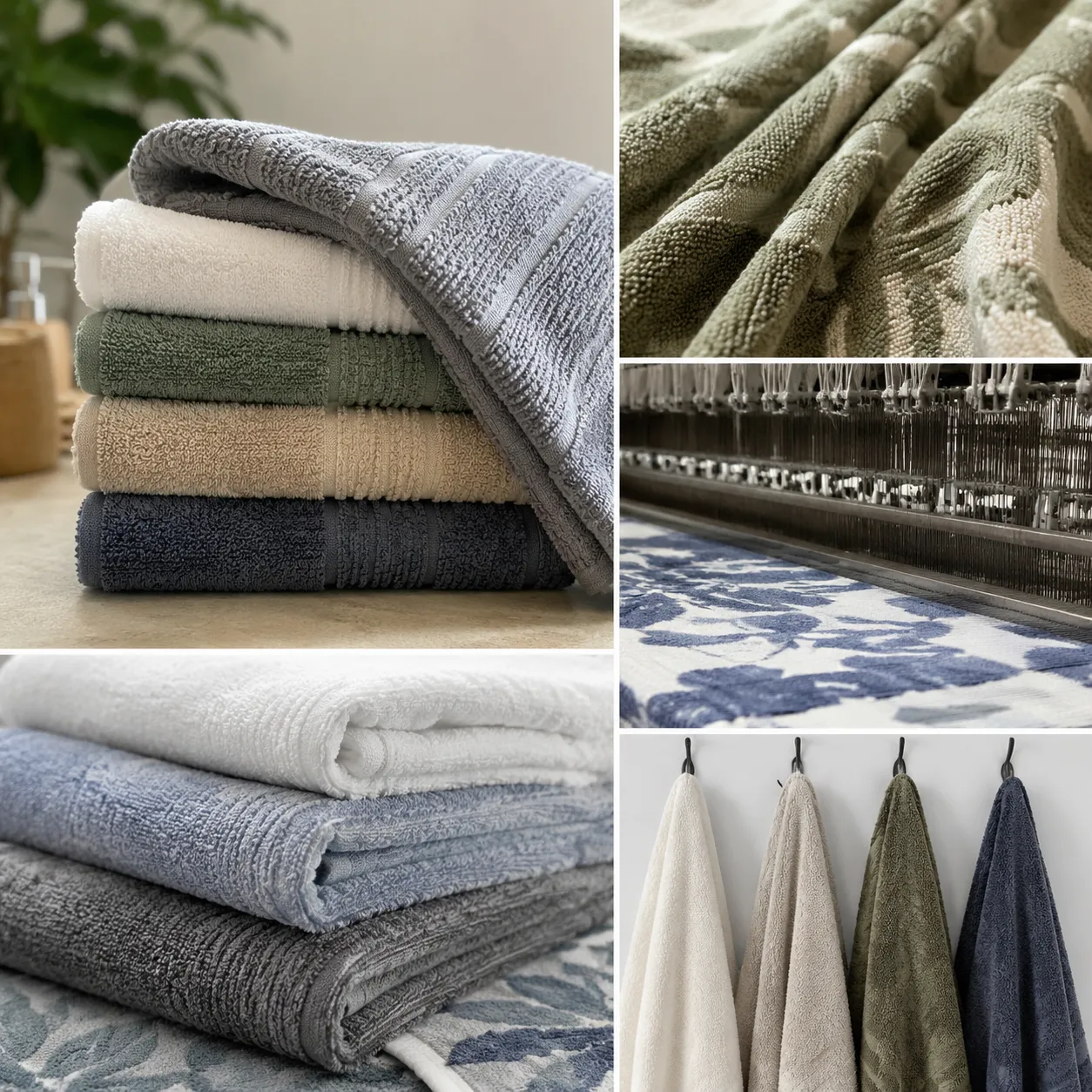
What actually fails after washing a jacquard towel
The first thing we check is not the artwork file but the weave behavior. In a jacquard towel, the design is built into the fabric structure, so the common failures are structural: a border that waves after washing, a motif that becomes blurred because the pile height changes unevenly, or a loop that catches and turns into a pull. That is why a proper jacquard towel design wash test standard has to measure the fabric, not just inspect the image.
We have seen buyers approve a beautiful sample and then reject the bulk lot because the pattern lost definition after the first hot wash. Usually the cause is one of three things: pile tension was too loose during weaving, the terry ground and jacquard figure were dyed in slightly different liquor ratios, or the cloth was finished too hard and then relaxed too much in laundering. None of those problems show up in a photo.
| Failure mode | What it looks like after wash | Root cause we usually see | How we test it |
|---|---|---|---|
| Loop distortion | Motif edges look soft or uneven | Unequal pile tension, over-bleaching | Flat visual comparison after ISO 6330 cycles |
| Snagging / pulling | Single yarn stands out from the design field | Long floats, weak twist, poor selvedge control | Manual snag inspection and 180° pull check |
| Dimensional change | Border width or towel length shifts | Relaxation shrinkage, over-drying | Before/after measurement in cm |
| Shade shift | Figure and ground no longer match | Dye recipe or washing chemistry mismatch | Grey scale comparison after laundering |
The wash protocol we use on jacquard samples
For wash approval, we do not rely on a home-laundry style rinse. We run a repeatable sequence based on ISO 6330 for domestic washing and AATCC 61 as a faster comparative screen when a buyer needs early feedback. For export programs, we usually test a sample set at 3 cycles, 5 cycles, and 10 cycles, because most jacquard towel complaints show up between the second and fifth wash, not on the first one.
- Condition the sample for 24 hours at standard room conditions before measurement.
- Record length, width, GSM, and visual pattern alignment at the center and borders.
- Run the wash cycle at the buyer-agreed temperature, detergent dose, and spin setting.
- Line-dry or tumble-dry using the same method the end user will likely use.
- Repeat measurement and compare against the pre-wash baseline.
| Test point | Typical setting we use | Why it matters |
|---|---|---|
| ISO 6330 wash cycle | 40°C, standard detergent, controlled load | Shows ordinary consumer laundering behavior |
| AATCC 61 screening | Accelerated wash equivalence | Useful for early go/no-go decisions |
| Drying method | Line dry or low tumble as specified | Jacquard borders behave differently under heat |
| Measurement | GSM, shrinkage, motif registration | Confirms the fabric is still within spec |
One detail that matters with jacquard is border balance. If the design has a dense logo panel on one end and an open terry field on the other, the ends can relax differently during washing. We therefore measure the towel at three points across width and two points along length, then average the results rather than trust a single center reading.
Jacquard towel design wash test standard for buyers: the pass-fail numbers
There is no single global law that says every jacquard towel must shrink the same amount. The correct limit depends on product type, yarn, and finish. Still, for a typical cotton jacquard towel program, we use practical commercial limits that a mill can actually hold in bulk production.
| Metric | Acceptable target | Reject condition |
|---|---|---|
| Length shrinkage after 5 washes | Within 4% | Beyond 6% |
| Width shrinkage after 5 washes | Within 4% | Beyond 6% |
| Pattern edge distortion | No visible skew from 1 m viewing distance | Motif wavy or twisted |
| Color change | Grey scale 4 or better | Grey scale 3 or below |
| Snag or pull count | No single pull that crosses the design field | Any pull affecting readability |
For hospitality buyers, we sometimes tighten the dimensional limit to 3% because repeated hot laundering in house linen rooms tends to exaggerate edge curl. For beach or promotional programs, the visual standard is more important than a hard-press finish, so a slightly softer hand is acceptable if the design still reads cleanly after washing.
If you want a useful benchmark, look at the combination of GSM and yarn construction rather than GSM alone. A 450 to 520 GSM jacquard towel in ring-spun cotton can hold pattern detail well without becoming boardy. Go too heavy and the towel may look rich but dry slowly; go too light and the motif can lose definition when the pile is cut or raised unevenly.
Why jacquard needs different acceptance rules than printed towels
A printed towel can hide some surface irregularities because the image sits on top of the fabric. Jacquard cannot hide anything. The design is built by loop height, weave density, and yarn movement. That means washing exposes structural problems in a way printing never will. A motif that looks crisp on a dry sample may blur once the yarn relaxes and the pile stands up differently.
- The figure and ground can shrink at slightly different rates if the weave density is uneven.
- Longer floats in the design area can catch in laundering and create a small pull that spreads.
- A heavily sheared face can lose contrast after washing because the shorter pile reflects light differently.
- If the finishing is too aggressive, the towel may pass one wash and fail on the second because recovery is not stable.
That is why the wash test has to include a visual distance rule. We inspect at standard tabletop distance, then again from about 1 m away. If the logo panel disappears at normal viewing distance after laundering, the design is not robust enough for bulk approval, even if the exact loop counts are still inside spec.
Construction details we insist on before test approval
Most failed wash programs can be traced back to a tech pack that specified the look but not the weave logic. For jacquard towels, we need the drawdown, the face/back mapping, border repeat width, and the exact position of the motif relative to the hem. When those are missing, the sample room makes judgment calls, and judgment calls become wash failures later.
- Define whether the motif is woven as a raised terry figure or a cut-pile highlight.
- Confirm the border repeat so the design lands symmetrically after hemming.
- State the yarn count and twist direction for both ground and pattern areas.
- Clarify whether the towel will be piece-dyed, yarn-dyed, or left in natural white before decoration.
Two technical issues show up often in our lab. First, loop grind-through: the raised face gets abraded on the back side during finishing, which weakens the motif edges and leads to fuzzing after wash. Second, selvedge torque: one side pulls more than the other, so the towel twists diagonally after laundering. Both are detectable before bulk if the sample is measured under the same wash cycle every time.
| Construction detail | Risk in wash | What we check in sampling |
|---|---|---|
| Pile contrast ratio | Motif loses readability | Visual contrast before and after 3 cycles |
| Yarn twist consistency | Fuzzing, weak loops | Yarn twist records and hand-rub check |
| Border density | Edge curling | Width measurement after wash |
| Hemming spec | Wavy hem or seam puckering | Thread tension and seam length |
Where the test sits in our approval flow
We do not wait until the bulk lot is packed to discover that the jacquard design is unstable. Our approval sequence starts with the weave sample, then the lab wash, then the buyer hand feel. If the design passes all three, we release the production shade and loom setting. If it fails at any point, we adjust structure first, not just finishing.
- Prototype loom sample: confirm pattern clarity and border symmetry.
- Lab wash sample: run the agreed wash cycles and record shrinkage, twist, and shade.
- Buyer approval sample: review hand feel, motif visibility, and end-use fit.
- Bulk pilot lot: inspect the first production panels before full run release.
That order matters because finishing can mask a weak weave, but it cannot fix it. A softener can make the towel feel better on day one while weakening wash recovery later. We prefer to approve a slightly firmer sample that stabilizes after laundering rather than a slippery hand that collapses after repeated wash cycles.
Typical pricing, MOQ, and timing for jacquard programs
For sourcing teams, the commercial side is tied to construction complexity. Jacquard towels require more loom setup time than plain terry, and the design mapping can reduce efficiency if the repeat is dense. At our mill, MOQ is 500 pcs per design per color, and lead time depends on yarn availability, loom allocation, and finishing route.
| Order band | Indicative FOB price per pc | Typical lead time |
|---|---|---|
| 500-1,999 pcs | USD 2.40-4.10 | 20-28 days |
| 2,000-4,999 pcs | USD 1.95-3.35 | 18-24 days |
| 5,000 pcs and up | USD 1.70-2.95 | 16-22 days |
Those numbers move with cotton count, border complexity, and whether the towel is reactive-dyed, yarn-dyed, or left undyed. A dense jacquard beach towel with a wide decorative panel will price differently from a lighter hotel hand towel with a simple woven logo. We always quote against the exact construction, because a vague spec creates a vague price and usually a bad one.
For certified programs, we work under OEKO-TEX 100 Class I, BSCI, and ISO 9001 controls. That does not make a towel washable by itself; it simply means the material input, factory system, and process records are managed to a standard buyers can audit. If your customer requires traceability by lot, we can keep the dye lot and loom batch records tied to the approved sample set.
How we interpret results when a sample is borderline
Borderline samples are common with jacquard because small structural changes have visible effects. If the towel shrinks 4.5% but the motif remains crisp, we may still call it acceptable for a promotional or beach use case. If shrinkage is only 2% but the design drifts and the hem waves, we reject it. In other words, the wash test is not a single-score exercise; it is a function of appearance, fit, and stability.
- Accept if all key measurements stay inside tolerance and the motif remains readable.
- Hold if the fabric is sound but finishing can plausibly correct the issue without new tooling.
- Reject if the design loses registration, the loops pull, or the pattern field blurs after the agreed cycles.
- Retest only after a process change, not after a cosmetic change.
A jacquard towel that looks good only before washing is not a finished product. It is a prototype with a sales photo.
When buyers push for the lowest unit cost, we usually suggest comparing cost per wash, not just purchase price. A towel that survives 30 wash cycles with stable design clarity may cost more upfront than a cheaper version that starts fraying at cycle 8, but the true replacement cost is lower. We calculate that based on the buyer's actual laundry frequency, not a generic retail assumption.
Related reads
If you are comparing structure options, embroidery vs sublimation vs jacquard is the fastest way to understand where woven decoration makes sense and where it does not. For fabric behavior, towel GSM decision framework helps match weight to use case. And if you need to build the spec before sampling, build towel tech pack that mills can quote is the piece we ask buyers to read first.
For broader sourcing context, how to read OEKO-TEX certificate, combed vs zero-twist cotton explained, designing for jacquard pattern brief, and pantone color matching custom towels are all useful before you lock the final approval set.
What to send us before we run the wash test
A clean technical file shortens the loop between sample and approval. We need the final towel size, intended wash temperature, end-use category, target hand feel, and whether the design priority is pattern clarity or softness. If the towel will be sold as a spa piece, a club amenity, or a retail gift, say so up front because the acceptance lens changes.
- Final size in cm, not just nominal label size.
- Front and back image or sketch of the jacquard layout.
- Planned wash temperature and drying method.
- Target MOQ and first-order volume.
- Any required third-party standard or retailer testing reference.
If your team wants to compare a sample quickly, send the artwork plus one physical reference towel. We can then advise whether the design needs tighter border density, a different yarn twist, or a lighter GSM to survive laundering without losing definition. For sourcing teams that need a quote or a test plan, contact us on WhatsApp at <strong>+86 13205717266</strong> or by email at <strong>[email protected]</strong>.
Request a jacquard wash test review
Send your tech pack, target wash cycles, and order volume. We will reply with a workable spec, pricing band, and sample plan.
Get a Quote →