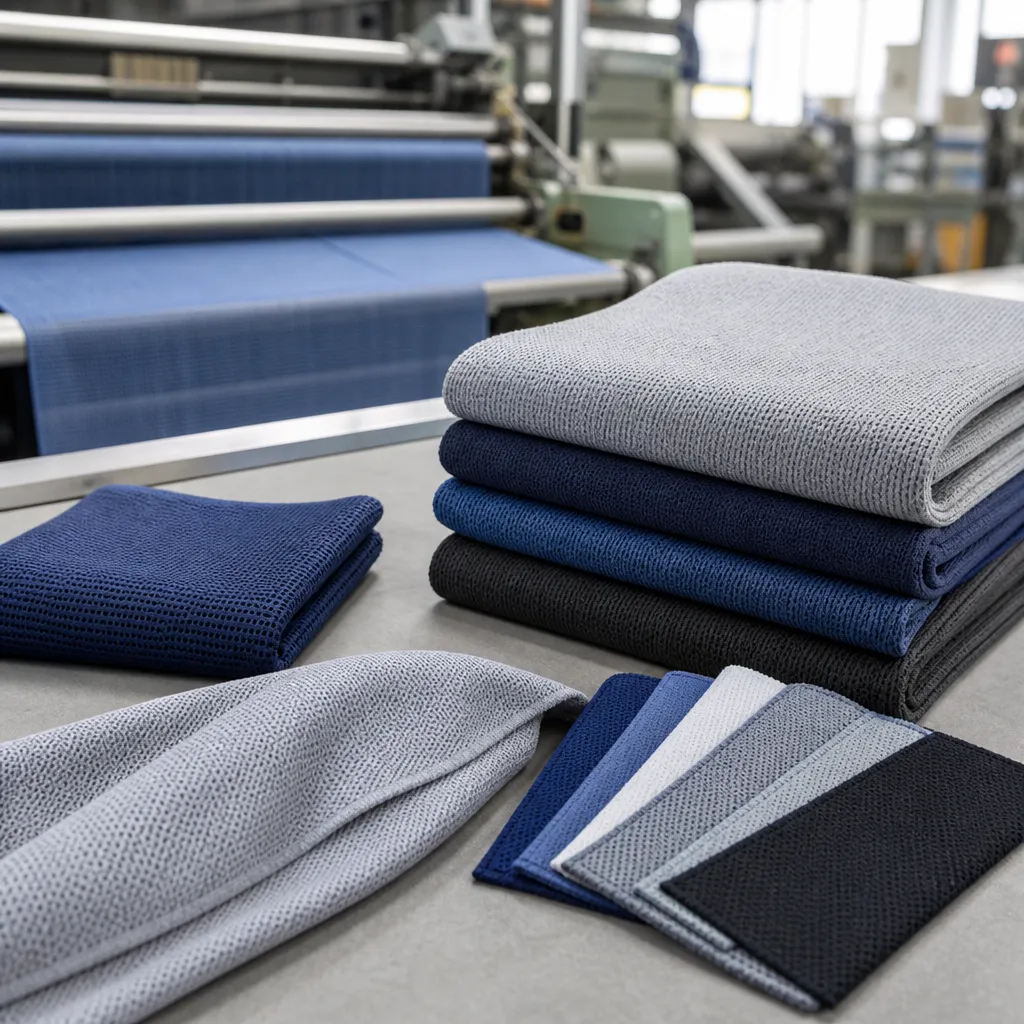
Start with the base towel, because embroidery amplifies weak construction
For monogram work, the towel itself is doing half the job. Embroidery adds local tension, extra needle penetration, and heat during finishing. A base that feels acceptable as a blank bath towel can fail once initials are stitched into the dobby border or body panel. We usually steer hotel and retail buyers toward ring-spun or combed cotton terry between 520 and 680 GSM for this category, depending on the sales channel and laundry expectation.
The main operational issue is ground stability. If the pile is very loose, or the border fabric is too open, the monogram area can tunnel or ripple after washing. Buyers sometimes hear terms like cover factor and assume it is abstract mill jargon. In plain terms, it is how tightly the yarns occupy the woven ground. On a border panel with low cover, the needle holes stay visible and the satin stitches sit unevenly. On a denser border, the monogram edge stays cleaner and the backing holds better.
| Base towel option | Typical use | Working spec range | Why we use it for monograms |
|---|---|---|---|
| 16s ring-spun cotton terry | Hotel room bath towel | 560-620 GSM | Stable pile, good absorbency, lower risk of puckering on 2-3 letter initials |
| 21/2 combed cotton terry | Retail gift and premium hospitality | 620-680 GSM | Cleaner surface and stronger border presentation for denser satin stitches |
| Zero-twist blend construction | Soft retail handfeel programs | 540-600 GSM | Use only with conservative stitch density; soft hand is good but border distortion risk is higher |
- For a 70 x 140 cm bath towel, we normally reserve a monogram area either in the dobby border or 80-110 mm above the hem to avoid bulky folded seam zones.
- If the towel has a decorative border under 35 mm high, monogram placement becomes cramped and thread buildup can distort the border line.
- For body embroidery on plush terry, we often add water-soluble topping during sampling so buyers can see whether small serif letters will sink into the pile.
Where buyers lose approvals: the monogram file is fine, but the stitch plan is wrong
The artwork for initials is rarely the problem. The trouble comes from digitizing choices that ignore towel behavior. A monogram that works on shirting or caps will often fail on terry because the pile swallows detail and the backing has to resist repeated wet processing. In this monogram bath towels 2026 buyer guide, the most practical checkpoint is not "Do you have the logo file" but "Was the file digitized for terry with the target letter height and border placement".
We normally review four technical points before we approve an embroidery run card: stitch type, stitch density, underlay, and backing. For example, a 38 mm satin-stitch monogram may run clean on a sheared border, but the same artwork on full terry may need a tatami fill with edge run to prevent thread from dropping into the loops. This is also where hoop burn matters. Buyers who have not seen it before should know it is the compression mark left when the embroidery hoop presses pile yarns too hard, especially on soft white towels. If the towel is over-hooped, the ring mark can remain visible after pressing and washing.
- A typical 2-letter or 3-letter hotel monogram at 45-65 mm height usually lands around 7,000-12,500 stitches depending on font and fill method.
- We prefer soft cutaway backing for bath towels over tear-away in most export programs because repeated laundering pulls at the stitch field.
- For very pale grounds, we sample white backing behind white towels and avoid dark temporary materials that can show through thin border zones.
- Needle size and machine speed matter: on denser terry we often reduce speed to around 650-700 rpm during approval runs to check edge definition and thread drag.
Placement decisions should match the selling channel, not just the artwork
Hotels, resorts, and retail gift brands do not place monograms the same way, even when they buy the same towel size. A resort may want understated initials in the lower border so housekeeping fold presentation stays neat. A retail brand may want a larger center-body monogram because the product is sold flat in gift boxes and the embroidery needs to read from shelf distance.
| Channel | Common placement | Letter height | Operational note |
|---|---|---|---|
| Hotel room use | Lower dobby border | 30-45 mm | Best for repeated laundering and folded shelf presentation |
| Spa or villa gifting | Body panel lower quadrant | 45-70 mm | Needs topping and tighter QC because pile interference is higher |
| Retail boxed set | Border center or visible fold line | 40-60 mm | Placement must align with packaging window or folded presentation |
| Boutique private label | Custom location by design brief | 35-80 mm | Approve folded mockup before bulk, not only flat towel photos |
We ask buyers for one simple photo during sampling: how the towel will actually be folded in use or in pack-out. That avoids a common mistake where the initials disappear under the fold after boxing. For support on fold planning and spec setup, buyers often pair this with build-towel-tech-pack-that-mills-can-quote.html and towel-sizes-dimensions-complete-guide.html.
The wash trial should be designed around the monogram, not the towel alone
Some approval packs still pass with only base-fabric absorbency and shade checks. That is not enough here. The stitch field changes shrink behavior and surface appearance, so the wash trial has to test the embroidered zone specifically. We usually run a pre-production wash sequence on finished samples before bulk signoff, then compare before/after measurements on both overall towel size and the stitched area.
For cotton bath towels, the scope needs to be explicit. A statement like "shrinkage within tolerance" is too loose to be useful. We usually define it as after 3 home-laundry cycles at 40 C with tumble dry low, overall dimensional change not exceeding 4.5% lengthwise and 4.0% widthwise, while local distortion around the monogram must not create visible edge tunneling beyond the approved sample standard. If a hotel buyer expects commercial laundry chemistry or higher heat, we note that the sample test only indicates home-laundry performance unless a separate institutional wash trial is booked.
- We photograph the monogram area before wash, after wash, and after light pressing so the buyer can separate temporary pile crush from true distortion.
- Colorfastness checks should cover both the towel and the embroidery thread. We typically request testing to ISO 105-C06 for domestic washing and ISO 105-X12 for rubbing when dark thread sits on white ground.
- If the monogram uses metallic or rayon thread for retail gifting, we flag a different risk profile from standard polyester embroidery thread.
What a realistic quote looks like in 2026
Buyers asked the editor for actual numbers, so here is the practical range we are quoting this year for standard bath sizes with embroidery included. These are FOB China guide numbers for 70 x 140 cm bath towels in white or light solid shades, packed in export cartons, based on our current cotton and thread inputs. They are not a universal market price. Final cost still moves with yarn count, towel weight, monogram stitch count, border construction, and packaging.
| Order volume | Base towel spec | Monogram setup | FOB unit price |
|---|---|---|---|
| 500-999 pcs | 580 GSM ring-spun cotton, 70 x 140 cm | Single-position 2-3 letter monogram, up to 9,000 stitches | USD 5.10-5.85 |
| 1,000-2,999 pcs | 600 GSM ring-spun or combed cotton, 70 x 140 cm | Single-position monogram, 9,000-12,000 stitches | USD 4.62-5.38 |
| 3,000-7,999 pcs | 620 GSM combed cotton, 70 x 140 cm | Single-position monogram, standard backing and thread colors | USD 4.28-4.96 |
| 8,000+ pcs | 560-650 GSM depending on program brief | Stable repeat monogram program with shared packaging format | USD 3.98-4.72 |
Typical add-ons also need scope qualifiers. We do not quote them as fixed rules because they move by construction and carton format. As a working range, custom gift box packing may add USD 0.42-0.88 per set depending on board grade and insert structure. Individual polybag with barcode sticker is usually around USD 0.06-0.12 per piece. A monogram larger than the approved stitch bracket can add USD 0.10-0.34 per piece if it pushes machine time up materially. New digitizing for one monogram style is commonly USD 35-80 per file. Those figures are for planning only and should always be tied to artwork size and pack-out assumptions.
Lead time usually breaks at two points: digitizing approval and finishing queue
Embroidery programs do not move on the same clock as blank towel replenishment. The towel weaving and dyeing may be straightforward, but embroidery introduces a second production gate. In most cases, the buyer delay is not in weaving. It is waiting three days to approve a digitized sew-out, then discovering the initials should have been 8 mm smaller to sit inside the border.
| Stage | Typical days | What can extend it |
|---|---|---|
| Artwork review and quote confirmation | 1-3 days | Missing placement size, unclear font ownership, no folded reference photo |
| Digitizing and first sew-out | 3-5 days | Complex serif initials, metallic thread request, border too narrow for artwork |
| Lab dip or shade approval if dyed ground | 4-7 days | Pantone gap, low stock yarn shade, multiple white base comparisons |
| Bulk weaving, dyeing, cutting, embroidery, packing | 22-32 days | Peak-season capacity, mixed colorways, custom gift box packing |
| Export booking and documents | 5-9 days | Late carton mark approval, destination-specific labeling changes |
For urgent launches, air freight can solve timing but rarely solves approval drift. Buyers weighing split shipments should compare container-vs-air-freight-towel-orders.html before booking. If the monogrammed bath towels are going into a new hotel linen rollout, setting-up-hotel-linen-program-90-day-roadmap.html helps align opening-stock timing.
Three failure modes we see repeatedly in bulk orders
- Border waviness after wash. Usually caused by high stitch density on a light border construction or by ignoring shrink interaction between towel ground and embroidery zone. We fix it through lower density, better underlay, or a denser border specification before bulk.
- Thread halo on dark initials. Fine lint from the white pile catches around navy or black monograms after finishing. This is often manageable with trimming, air cleaning, and a realistic visual standard, but buyers should approve a lint-tolerance sample instead of expecting photo-retouched cleanliness.
- Inconsistent monogram position across cartons. The towel may be within size tolerance, yet the embroidery looks off because the fold reference changed between lines. We use placement templates and first-piece checks every shift, especially on border embroidery where a 5-7 mm drift is visible immediately.
These are not theoretical defects. They are the reasons we insist on a signed pre-production sample with placement measurement, stitch count bracket, backing note, and wash comments. Buyers comparing methods should also review embroidery-vs-sublimation-vs-jacquard.html, although for bath towels with personalized initials, embroidery remains the most practical route in most programs.
Certifications and compliance: what actually needs checking
The towel base and the decorated final good both matter. Our mill operates with OEKO-TEX STANDARD 100 Class I, BSCI, and ISO 9001 controls, but buyers should still verify whether the certificate scope matches the product category and whether the embroidery thread and backing are controlled inputs inside the approved material set. If a buyer only checks the cotton towel certificate and ignores decoration materials, they have not finished the compliance review.
- Ask for the current OEKO-TEX certificate and read the product class and validity period. how-to-read-oeko-tex-certificate.html is useful for procurement teams that do not review certificates every week.
- If you require infant-safe or highly sensitive-skin positioning, make sure the thread supplier declaration and accessory list are included in the compliance file.
- BSCI and ISO 9001 do not replace product testing. They tell you about social compliance and process control, not whether your specific monogram sample will survive your laundry conditions.
A short buying checklist for the PO
If you want fewer email loops and fewer approval resets, the purchase order should carry more than size and quantity. Our cleaner monogram programs usually arrive with exact embroidery fields already locked.
- Base towel: size, finished GSM range, cotton type, white standard or shade reference, border height
- Embroidery: artwork file version, placement from hem or side seam, letter height, target stitch count bracket, thread color code, backing type
- Testing scope: wash method, number of cycles, dimensional tolerance basis, visual approval standard for pile crush and lint
- Packing: fold method, barcode position, carton assortment, inner pack count, destination labeling
- Commercial terms: MOQ 500 pcs per design per color, FOB port, sample charge treatment, bulk lead time from final approval
Related reads: monogrammed-bath-towels-luxury-brand-guide.html, pantone-color-matching-custom-towels.html, and negotiate-towel-moq-without-killing-margin.html.
Bottom line for a 2026 order
The safest monogram programs are not the ones with the fanciest artwork. They are the ones where the buyer locks the towel construction, border geometry, stitch method, and wash scope before bulk starts. If your target is hotel use, we would rather see a slightly smaller monogram on a stable 580-620 GSM base than a larger decorative mark that distorts after laundry. If your target is retail gifting, spend the extra approval time on placement and folded presentation because that is where returns usually begin.
For quoting, send us the towel size, target GSM, artwork, expected stitch count or letter height, placement photo, packaging format, and ship window. We can then give a price band tied to the actual spec instead of a generic number. Contact us at [email protected] or WhatsApp +86 13205717266.
Request a monogram towel quotation
Send artwork, towel size, GSM target, placement, and pack-out details for a usable FOB quote and sampling plan.
Get a Quote →