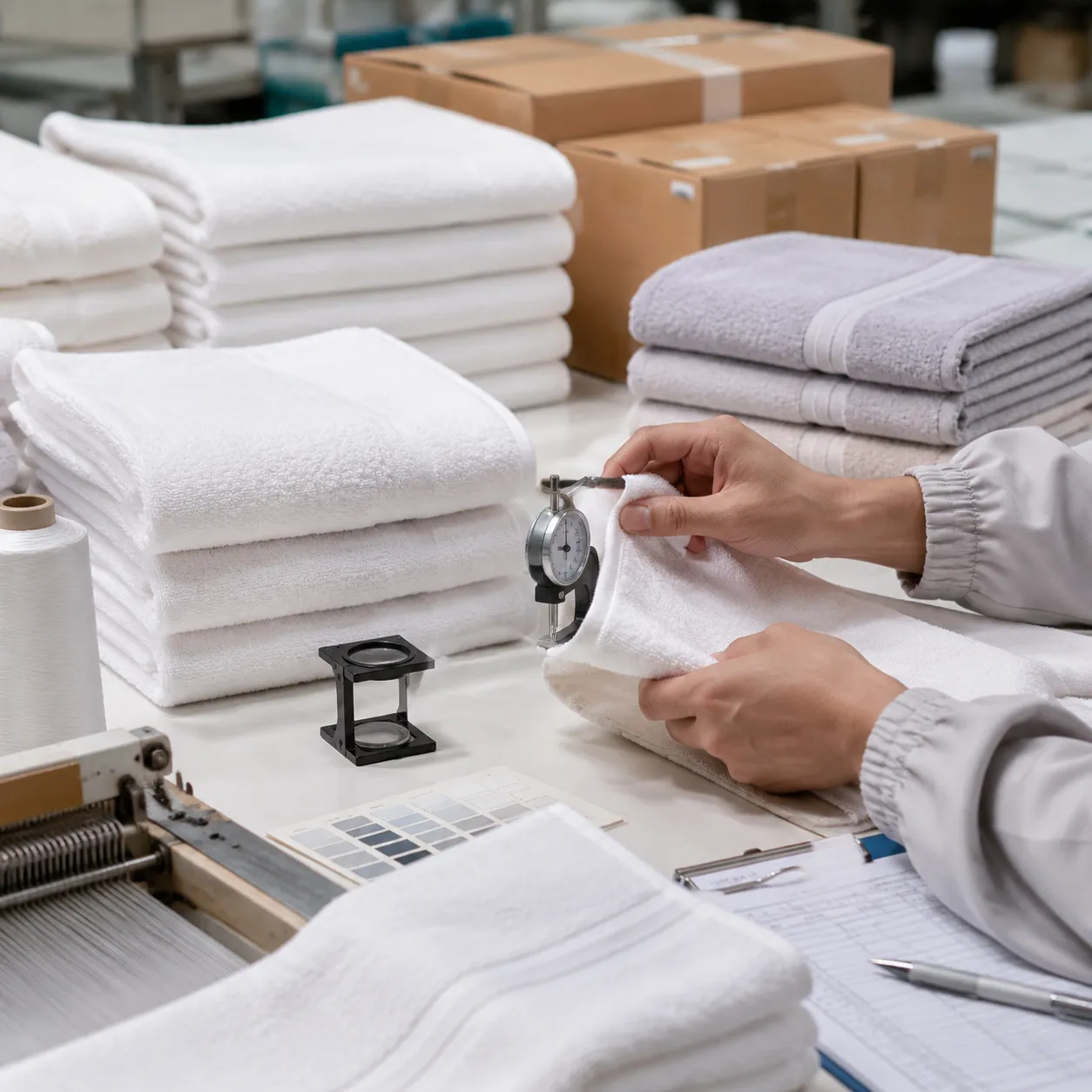
Why hotel bath towel qc inspection before shipment is a gate, not paperwork
For hotel towels, final inspection is not only about finding dirty pieces or loose threads. It is the last point where the mill, the buyer, and the freight plan still have options: hold one shade lot, re-pack cartons, replace short-weight pieces, or correct labeling before the goods leave China.
At LUMA & CO. TEXTILE, we run this inspection after bulk production, finishing, needle detection if required, folding, polybag or paper band packing, and export carton sealing. We normally inspect when 100% of goods are finished and at least 80% are packed. If a buyer wants an independent third-party inspection, we schedule it in the same window so the goods are not opened twice.
Our factory in Gaoyang, Zhejiang has 220 employees and has supplied OEM towel programs since 2007. We work with OEKO-TEX Standard 100 Class I documentation, BSCI social audit requirements, and ISO 9001 process controls. Those certificates do not replace inspection. They make the inspection traceable: which yarn lot, which dye lot, which finishing batch, which carton range, and which corrective action.
| Inspection item | Factory control point | Typical tolerance for hotel bath towels | Why hotels care |
|---|---|---|---|
| Piece size | Measure after finishing and relaxation | ±3% length/width unless buyer spec is stricter | Towels must fit shelving, carts, and guest-room presentation |
| Finished weight | Weigh 10-20 pcs across cartons | ±5% against approved sample or TDS | Short weight reduces absorbency and guest perception |
| GSM | Calculate from finished size and weight | Usually 450-700 GSM for hotel bath towels | Controls hand feel, laundry drying time, and cost |
| Shade lot | Compare against approved lab dip/bulk standard | Grade 4 minimum on grey scale for lot-to-lot visual match | Mixed-room towels look inconsistent under bathroom lighting |
| Hem and selvedge | Visual and pull check | No broken stitch lines, skipped lockstitch, or open hem | Laundry tunnels expose weak sewing quickly |
| Carton packout | Count, barcode, carton mark, gross weight | Must match PO packing instruction | Receiving teams reject unclear carton ranges |
The inspection window we recommend on hotel orders
A clean final QC window starts before cutting production is complete. For hotel programs, we ask buyers to approve the production sample, care label text, carton mark, and packing method before bulk weaving reaches 30%. Waiting until goods are packed to change a label or carton sequence creates rework, not better quality.
For a standard OEM hotel bath towel order of 3,000-12,000 pcs per color, our production lead time is usually 25-40 days after deposit, yarn confirmation, and sample approval. Decoration, special dyed yarn, or boxed private-label packing can add 5-12 days. Final inspection normally takes 1-2 working days for our internal team, or 2-4 days if a third-party inspector needs booking and re-inspection hold time.
- Day 0-3: PO confirmation, deposit, artwork or woven label file, and technical data sheet freeze.
- Day 4-10: yarn purchasing, lab dip or strike-off approval, and weaving setup.
- Day 11-26: weaving, dyeing if piece-dyed, washing, drying, raising or shearing as specified.
- Day 27-33: hemming, label attachment, folding, packing, metal or needle control if required.
- Day 34-36: hotel bath towel qc inspection before shipment, carton sealing audit, and loading plan.
- Day 37-42: rework buffer, booking confirmation, customs documents, and factory loading.
The rework buffer is not wasted time. If an inspection finds carton short count, mixed sizes, or a borderline colorfastness issue, three days can prevent a container from moving with a known defect. For new hotel openings, we prefer to split critical-path goods into a first release and replenishment release rather than compress QC into the last afternoon.
AQL sampling: how many towels we actually open
Most hotel buyers ask for AQL but do not specify the inspection level. For woven terry towels, we usually apply ANSI/ASQ Z1.4 or ISO 2859-1 single sampling, General Inspection Level II, unless the contract says otherwise. Critical defects are not accepted. Major and minor defect limits depend on buyer risk tolerance.
For a repeat hotel chain program with stable history, AQL 2.5 for major defects and 4.0 for minor defects is common. For a first order, white bath towels above 600 GSM, or any order with embroidery, we often recommend AQL 1.5 major and 4.0 minor. The stricter level costs more time, but it catches shade mixing, pulled loops, and decoration placement errors before cartons are loaded.
| Lot size | Common sample size at Level II | Typical major AQL | Typical minor AQL | Factory note |
|---|---|---|---|---|
| 501-1,200 pcs | 80 pcs | 1.5-2.5 | 4.0 | Suitable for MOQ hotel color trials |
| 1,201-3,200 pcs | 125 pcs | 1.5-2.5 | 4.0 | Common for boutique hotel replenishment |
| 3,201-10,000 pcs | 200 pcs | 1.5-2.5 | 4.0 | Most chain hotel PO ranges we see |
| 10,001-35,000 pcs | 315 pcs | 1.5-2.5 | 4.0 | Needs carton-range control by shade lot |
| 35,001+ pcs | 500 pcs | 1.5-2.5 | 4.0 | Often split by production batch for better traceability |
AQL is a decision rule, not a guarantee that every towel is perfect. That is why we combine random sampling with process controls: inline hem checks, weight monitoring after drying, shade segregation, and final carton audit. If the same defect appears repeatedly during final inspection, we do not treat it as random; we trace the batch and expand the check.
Defects we classify as critical, major, and minor
A hotel bath towel has a simple shape, but the defect list is not simple. Terry fabric hides issues inside loops, borders, and hems. Some defects look small in a showroom but fail after 20 industrial washes at 60-75°C with alkaline detergent.
- Critical defects: blood or unknown contamination, sharp metal, needle fragment, mold odor, wrong fiber content claim, missing mandatory care label, or carton mix that could create customs or safety risk.
- Major defects: open hem, broken border, hole, severe pulled loop cluster, wrong size, short weight outside tolerance, obvious shade mismatch, crooked logo over buyer tolerance, or poor absorbency caused by finishing residue.
- Minor defects: single loose thread that can be trimmed, slight fold mark, small lint mark, label sewn 5-8 mm off center when not visible in guest use, or acceptable terry loop variation within the approved standard.
Two towel-specific defects deserve attention. The first is loop snag propagation. A single pulled loop is not always major, but if the ground weave is loose, one snag can open a ladder after tumble drying. We check whether trimming the loop stops the problem or whether the base structure continues to release yarn.
The second is border cupping. This happens when the dobby border, body terry, and hem shrink at different rates. It may pass a flat table inspection before wash, then curl after the first laundry cycle. For hotel bath towel qc inspection before shipment, we compare current bulk pieces with the washed approved sample rather than only the unwashed showroom sample.
Measurements: size, GSM, weight, and shrinkage evidence
Hotels often specify bath towels by size first, but the real commercial control is finished weight. GSM is calculated from the towel area and weight; it is not something a factory can honestly confirm by appearance. A 76 x 152 cm bath towel at 520 GSM should finish around 601 g before normal tolerance. If we inspect pieces averaging 565 g, we do not call that a small variation; it changes absorbency and cost-per-use.
We measure after the towel has relaxed, not while it is stretched from folding. Our QC team lays the towel flat, smooths without pulling, measures length and width at two points, and records the average. For weight, we use calibrated digital scales and sample across the first, middle, and last packed carton ranges.
| Hotel use case | Common size range | Practical GSM range | What we check before shipment |
|---|---|---|---|
| Standard guest-room bath towel | 70 x 140 cm to 76 x 152 cm | 480-600 GSM | Weight consistency, hem strength, white shade stability |
| Five-star or suite towel | 76 x 152 cm to 80 x 160 cm | 600-720 GSM | Drying-time risk, pile density, carton weight limits |
| Pool or spa crossover towel | 80 x 160 cm to 90 x 180 cm | 450-600 GSM | Chlorine colorfastness, linting, deck handling |
| Economy hotel towel | 68 x 137 cm to 70 x 140 cm | 420-500 GSM | Shrinkage allowance, cost-per-wash, edge durability |
Shrinkage cannot be fully proven during final inspection unless a wash test is included in the contract. For hotel programs, we recommend a production wash verification using ISO 6330 domestic washing as a baseline or a buyer-specific industrial laundry simulation if the hotel has a known formula. A practical target is total dimensional change within 5-7% after 3-5 wash/dry cycles, but some heavy terry constructions need a different agreed limit.
If a buyer is still building the spec, our towel GSM decision framework and towel sizes and dimensions guide help translate guest feel into measurable tolerances. For new procurement teams, we also suggest preparing a TDS using the fields in build a towel tech pack that mills can quote.
Color, absorbency, and wash checks that matter for hotels
White towels are not risk-free. Different optical brightener levels can make one carton look blue-white and another look cream under LED bathroom light. Dyed towels carry a different risk: crocking, chlorine shift, or shade banding across lots. We keep dye lots separated during packing and mark carton ranges so a hotel can allocate rooms consistently.
For colorfastness, common references include ISO 105-C06 for washing, ISO 105-X12 for rubbing, and ISO 105-E03 for chlorinated water when pool or spa use is involved. For white towels, we may record whiteness or compare under a D65 light source with a grey scale. For absorbency, a simple drop test can identify hydrophobic finishing residue, but for disputes we prefer a timed sink or vertical wicking method agreed in the buyer specification.
- Ask the mill to keep an approved bulk standard: not only the lab dip, but an actual production towel after finishing.
- Do not approve shade from a phone photo. Request light box photos under D65 and TL84, then confirm with the physical sample.
- For dark spa or pool towels, specify whether ISO 105-E03 chlorinated water testing is required.
- For white hotel towels, agree whether optical brightener is allowed and whether all replenishment orders must match the same whiteness range.
- For embroidered towels, check thread colorfastness separately from terry fabric because polyester thread and cotton pile behave differently.
Absorbency problems usually come from softener overuse, silicone finishing, or insufficient scouring. A towel can feel smooth at the factory and still repel water for the first guest. We would rather reduce softener and keep absorbency than create a slippery hand feel that fails in laundry. This is one place where we push back on buyers who ask for a showroom-soft sample but also want fast water uptake and low lint from the first wash.
Decoration and label checks before cartons close
Hotel bath towels may be plain white, but many programs include woven labels, jacquard borders, embroidery, or monogramming for suites. Decoration defects are often found late because they happen after towel finishing. The inspection must verify placement, stitch density, backing removal, thread tails, and whether the decoration distorts the towel body.
For embroidery, we measure the logo from the hem or border reference point, not from the soft folded edge. A common tolerance is ±5 mm for placement and ±2 mm for small monogram alignment, but each program should define it. Dense embroidery on a 500 GSM towel can create puckering after washing if the stabilizer is too stiff or the stitch count is too high. For a 90 x 50 mm hotel crest, we often keep fill areas open and use satin borders to reduce stiffness.
For jacquard, the risk is different. The logo is built into the weave, so the final QC checks float length, border straightness, and pile height contrast. A logo that looks sharp in CAD can blur if the minimum line width is too thin for the yarn count. Our decoration team usually asks for 8-10 mm minimum letter height on terry jacquard and thicker strokes for small serif fonts.
Related reads: for decoration trade-offs, compare embroidery vs sublimation vs jacquard. If the hotel program uses initials or crest work, the monogrammed bath towels guide gives placement and thread considerations. For shade-critical artwork, see Pantone color matching custom towels.
Carton audit: the part buyers notice at receiving
A towel can pass piece inspection and still create receiving problems if cartons are wrong. Hotel receiving teams usually check PO number, style, size, color, quantity, and carton sequence before they open pieces. If cartons are mixed or overweight, the problem moves from factory QC to hotel operations.
Our export carton audit covers inner packing, carton burst strength, gross and net weight, carton dimensions, shipping marks, barcode scanability when required, and pack count. For heavy bath towels, carton weight matters. A carton loaded with 24 pcs of 650 GSM oversized bath towels may exceed safe manual handling limits, so we often reduce to 12 or 16 pcs per carton even if freight cube increases slightly.
| Packout decision | Lower-cost option | Safer hotel receiving option | Factory recommendation |
|---|---|---|---|
| Pieces per carton | 20-24 pcs for mid-weight towels | 10-16 pcs for heavy or oversized towels | Keep gross weight usually under 18-22 kg |
| Inner packing | Bulk packed without band | Paper band or recyclable polybag by set | Use banding when linen room sorting is manual |
| Carton marking | Generic item code only | PO, style, size, color, carton range | Use hotel property code for multi-site rollouts |
| Palletization | Loose cartons to save volume | Pallets for DC receiving | Choose by warehouse rules, not only freight cost |
Carton compression is another towel-specific issue. Terry goods can settle during sea freight. If cartons are under-filled, they crush. If over-compressed, towels arrive with hard fold lines and slow loft recovery. We test carton closure after a settling period and avoid forcing the top flap down with excessive tape tension.
Pricing impact: what inspection and rework really cost
Final QC is not a separate luxury service in our normal FOB pricing; basic internal inspection is part of production. Costs increase when the buyer requires third-party inspection, extra lab tests, individual polybagging, barcode labeling, palletization, or re-inspection after a failed lot.
For OEM hotel bath towels, MOQ is 500 pcs per design per color. At that MOQ, the unit price is sensitive to yarn purchase, dyeing minimums, label setup, and inspection handling. At 5,000 pcs and above, fabric efficiency and carton planning improve, so the unit price drops. The ranges below are realistic FOB China bands for cotton hotel bath towels without highly complex decoration.
| Order volume per design/color | Typical GSM and size basis | FOB China price band | Inspection note |
|---|---|---|---|
| 500-999 pcs | 70 x 140 cm, 480-550 GSM | USD 3.45-5.20/pc | Higher handling cost; inspect cartons broadly |
| 1,000-2,999 pcs | 70 x 140 cm to 76 x 152 cm, 500-600 GSM | USD 3.05-4.70/pc | Good level for boutique hotel launch |
| 3,000-9,999 pcs | 76 x 152 cm, 520-650 GSM | USD 2.72-4.35/pc | AQL sampling is efficient; shade lot control important |
| 10,000+ pcs | chain hotel bath towel programs | USD 2.48-4.05/pc | Split inspection by batch if production spans multiple dye lots |
A cheap towel can look attractive if only the first PO price is compared. For example, a 430 GSM towel at USD 2.36 may survive 45-55 industrial washes before edge fraying becomes visible. A 560 GSM combed cotton towel at USD 3.18 may run 95-120 washes under the same laundry. Even before guest complaints are counted, the lower-priced towel can cost around USD 0.047 per wash while the stronger towel lands near USD 0.030-0.033 per wash. Those numbers change by laundry chemistry, but the direction is consistent.
Third-party inspection in China commonly costs USD 180-320 per man-day depending on location, report scope, and booking urgency. Lab colorfastness or shrinkage tests may add USD 45-160 per test item. These costs are small compared with air-freighting replacement towels for a hotel opening.
Documents we release with shipment approval
A proper hotel bath towel qc inspection before shipment ends with records, not a verbal “passed.” We keep the inspection report, carton count, defect photos if any, weight and measurement log, and corrective action note where needed. For export, commercial invoice, packing list, and certificate documents must match the goods exactly.
- Final inspection report with sample size, AQL level, defect classification, and pass/fail result.
- Measurement and weight sheet covering at least several carton ranges and shade lots.
- Packing list showing PO, SKU, carton quantity, pieces per carton, gross weight, net weight, and CBM.
- OEKO-TEX Standard 100 Class I certificate reference when the buyer requires baby/skin-contact documentation.
- BSCI and ISO 9001 records when requested for vendor compliance files.
- Photos of carton marks, inner packing, folded towel, label, and any decoration close-up.
For buyers who audit supplier documents internally, our article on how to read an OEKO-TEX certificate explains certificate scope and validity. If you are still choosing vendors, hotel towels wholesale supplier guide and evaluating hotel towel manufacturers cover factory capability questions before deposit.
Our practical sign-off checklist for buyers
The best inspections happen when the buyer’s expectations are written before production. If the PO only says “white hotel bath towel, good quality,” the factory must guess. A one-page checklist is enough to remove most ambiguity.
- Confirm size, GSM, finished weight, yarn type, color standard, and allowed tolerance in the TDS.
- State the AQL standard, inspection level, and major/minor defect limits on the PO.
- Approve one sealed production sample and one washed reference sample before bulk packing.
- Define carton marks, inner packing, pieces per carton, barcode rules, and pallet rules if any.
- Require shade lot separation and carton range recording for dyed or optical-white programs.
- Book third-party inspection at least 5-7 days before ex-factory date if your company requires it.
- Keep 2-4 days of buffer after inspection for rework, carton replacement, or document correction.
We produce custom hotel towels with a normal MOQ of 500 pcs per design per color, and we are comfortable with buyer-side inspection teams. Our internal QC is built around measurable tolerances, not a beauty contest at the packing table. If a shipment does not meet the agreed spec, we would rather fix it in the mill than discuss it after the towels arrive at a hotel laundry.
For timing around new hotel openings, the 90-day hotel linen program roadmap is a useful planning reference. For freight trade-offs after inspection release, read container vs air freight towel orders.
Need a pre-shipment QC plan for hotel towels?
Send your towel TDS, target GSM, size, quantity, packing rules, and inspection standard. We will review risk points, quote realistic FOB bands, and map the QC window before shipment. WhatsApp: +86 13205717266. Email: [email protected].
Request QC and pricing review →