Where Luxury Bath Towels Fail First
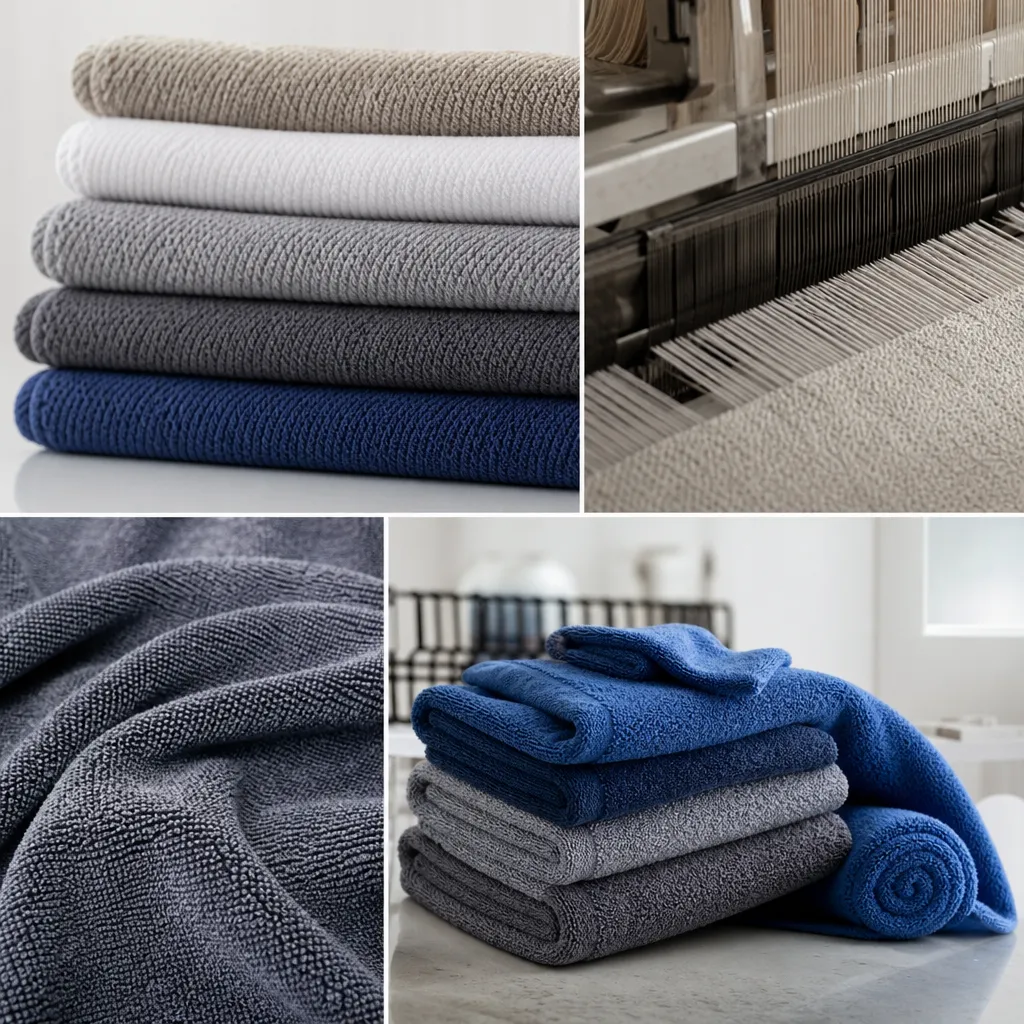
Luxury towels usually fail in three places before they fail on weight: pile recovery, edge stability, and shade consistency. A 680 GSM bath towel can still look cheap if the loops collapse after drying, the long hem waves by 12 mm, or the white shade drifts from one carton to the next. In our mill, the inspection table for hotel-grade bath towels starts with visible performance zones, then moves to measurements and lab records.
For most luxury hotel and retail programs, we build cotton terry bath towels between 620 and 760 GSM. Resort pool-bath hybrids may sit lower, around 560-640 GSM, because drying speed matters. Retail gift towels with embroidery often land at 650-720 GSM so the fabric supports stitches without becoming too slow in home laundry. A towel above 780 GSM can feel impressive in a showroom, but the laundry cost and drying time usually push back hard.
- Pile face: loop height must be even across the center panel, with no low bands from yarn tension changes.
- Borders: dobby or cam border must stay flat after washing, not cup inward or ripple at the side seams.
- Edges: long hems and short hems need balanced stitching density, usually 9-12 stitches per inch for heavy hotel goods.
- Shade: carton-to-carton whiteness or color must stay inside the approved lab dip range, especially for ivory, stone, charcoal, and spa green.
- Handfeel after wash: softener cannot hide weak yarn. We inspect again after controlled wash and tumble dry.
Best Luxury Bath Towels QC Inspection Guide: Acceptance Gates
The best luxury bath towels QC inspection guide should split acceptance into gates, not one final look at packed cartons. We use four gates: incoming yarn and greige terry review, dyeing or bleaching approval, sewing and finishing inspection, then final AQL carton sampling. If a buyer only inspects finished cartons, the expensive problems are already sewn, folded, and packed.
| QC gate | What we check | Typical rejection trigger |
|---|---|---|
| Greige terry review | Loop density, ground weave stability, broken ends, pile height uniformity | Visible reed marks, thin bands wider than 20 mm, unstable selvage |
| Wet processing approval | Bleach shade, reactive dye fixation, absorbency after washing | Whiteness drift beyond approved standard, patchy dye face, hydrophobic handfeel |
| Sewing and finishing | Hem straightness, corner bulk, loose threads, size after tumble | Hem wave over 8 mm on bath towels, open seam, folded corner lump |
| Final carton inspection | AQL sampling, weight, barcode, packing ratio, metal detection record | Mixed shades, wrong carton count, failed needle control, moisture risk |
We normally inspect to ANSI/ASQ Z1.4 sampling plans, using AQL 2.5 for major defects and AQL 4.0 for minor defects unless the buyer's standard is stricter. For luxury hotel opening orders, some groups ask for AQL 1.5 major on the first PO. That is workable, but it adds inspection time and can increase sorting loss by 1.2-2.8% if the tolerance sheet is vague.
The Defects We Separate as Major and Minor
A useful hotel towel inspection checklist must define what blocks shipment. Not every loose fiber is a claim, but a pulled loop across the center panel of a white guest-facing towel is not acceptable. We mark defects by use zone: center face, border area, hem, label area, and packaging.
| Defect | Major or minor | Factory note |
|---|---|---|
| Pulled loop over 15 mm in center face | Major | Usually caused by rough handling after shearing or by snagging on sewing tables |
| Open hem seam over 10 mm | Major | Will expand quickly in commercial laundry |
| Oil stain larger than 3 mm | Major | Especially visible on white and ivory towels; cannot be packed as first quality |
| Pile height band across towel width | Major | Often from terry loom tension variation; sorting alone does not solve it |
| Loose thread under 12 mm at hem | Minor | Trim if isolated and no seam opening is present |
| Slight carton corner dent | Minor | Acceptable if inner poly and product are clean and dry |
Two defects are easy to miss during a rushed inspection. The first is border torque: the decorative border twists after hot tumble drying because the ground and pile shrink differently. The second is hard-edge handfeel at the hem, caused by too much folding bulk or high sewing tension. Guests notice both even when the towel meets the weight spec.
Measurement Tolerances That Actually Protect the Buyer
For bath towels, we recommend tolerances that match production reality but still protect the buyer. A spec that says 70 x 140 cm with zero tolerance is not a quality standard; it is a dispute waiting to happen. Cotton terry changes through scouring, dyeing, drying, sewing, and final conditioning.
| Spec line | Recommended tolerance | Inspection method |
|---|---|---|
| Finished size | -2% / +3% after conditioning | Measure flat without stretching after 4 hours at room humidity |
| GSM | -5% / +6% against approved bulk standard | Cut-weight or full towel area-weight calculation |
| Piece weight | -6% / +7% by size and GSM | Weigh 10 pcs per sampled color and compare average |
| Skew or bow | Max 2.5% across body | Measure edge alignment against square table grid |
| Hem width | +/- 3 mm | Check both long sides and both short ends |
| Moisture before packing | Usually below 8.5% | Moisture meter check before carton sealing |
As a working example, an 80 x 160 cm towel at 700 GSM has a theoretical fabric mass of about 896 g before allowance for border structure, sewing thread, and process variation. If the bulk average comes out at 815 g, the issue is not a small tolerance argument. Either the GSM, finished size, or pile construction changed. We would stop shipment review and trace loom records before packing more cartons.
For buyers writing a new technical data sheet, our article on building a towel tech pack that mills can quote is the right companion to this section. Size and GSM also need to be checked against guest use, so the towel sizes and dimensions complete guide is worth reading before the PO is frozen.
Wash Testing Before Final Carton Approval
A towel that passes only fresh inspection is not ready for a luxury program. We run wash checks before final carton approval because pile bloom, shrinkage, lint release, and shade movement show themselves after laundering. For hotel towels, we usually test 3, 5, and 10 cycles depending on order value and launch risk.
- Condition the pre-wash sample for at least 4 hours, then record size, piece weight, visual shade, and handfeel.
- Wash under an agreed method, commonly ISO 6330 for dimensional change or an aligned commercial laundry cycle for hotel buyers.
- Tumble dry at controlled temperature. Overheating can create false shrinkage data, so cycle notes matter.
- Measure shrinkage under ISO 5077 and compare against the signed bulk tolerance.
- Check colorfastness using ISO 105-C06 for washing and ISO 105-X12 for rubbing when dyed colors are involved.
- Record lint in the dryer filter and review pile face under inspection light. High lint after 5 cycles means the yarn or finishing process needs review.
For white hotel bath towels, we also watch absorbency carefully. A towel can feel soft because of finishing agents and still repel water during first use. We target water drop absorption under 5 seconds after pre-wash for most cotton luxury bath programs. For spa towels that use heavier softener, we ask the buyer to choose: a slicker handfeel on arrival or faster absorbency after unpacking. Both cannot be maximized at the same time.
If the towel is sold as luxury but cannot survive a controlled wash trial without border twist, pile collapse, or heavy lint, the inspection standard is too weak.
GSM, Yarn, and Construction Checks
Luxury bath towel quality control depends on the relationship between yarn count, pile height, twist, and ground stability. We use combed cotton for most upper-tier hotel towels because short fibers create more lint and a rougher face after repeated wash. Zero-twist yarn gives a plush touch, but it needs tighter process control and is less forgiving in aggressive laundries. Low-twist or softly twisted combed yarn is often the better hotel compromise.
| Construction choice | Common range | QC concern |
|---|---|---|
| Combed cotton terry | 620-720 GSM | Good balance of absorbency, pile recovery, and lint control |
| Zero-twist cotton | 650-760 GSM | Very soft, but loop snagging and dryer flattening need stricter wash checks |
| Cotton-bamboo blend | 580-700 GSM | Smooth handfeel, but shade and shrinkage must be watched closely |
| Ring-spun cotton | 560-680 GSM | Cost-efficient for four-star programs, less plush than combed luxury specs |
| Dobby border towel | 620-740 GSM | Border torque and puckering are the main risks |
We do not advise chasing the highest GSM just to win a showroom touch test. A 760 GSM towel may cost USD 6.90-8.40 FOB China at 3,000 pcs depending on size, yarn, and packaging, while a 680 GSM combed cotton towel may sit at USD 5.35-6.55. If the heavier towel takes 18% longer to dry and the hotel laundry charges by energy and machine time, the cost-per-use can move the wrong way within one season.
For buyers comparing cotton options, combed vs zero twist cotton explained gives more detail on yarn behavior. If the decision is still open between microfiber and cotton for specific facilities, see microfiber vs cotton towel comparison before approving samples.
Price Bands and MOQ Reality for QC-Safe Orders
Our MOQ is 500 pcs per design per color, but luxury bath towels become more stable when the order allows proper shade control, cutting efficiency, and replacement sorting. Below 800 pcs per color, the cost of lab dips, machine setup, trims, and inspection is spread across too few pieces. That does not make small runs impossible; it means the buyer should not expect the same FOB price as a 12,000 pc replenishment order.
| Order volume per color | Typical FOB China range | Best use case |
|---|---|---|
| 500-799 pcs | USD 7.80-10.60 per bath towel | Pilot hotel floor, retail photography, VIP suite launch |
| 800-2,999 pcs | USD 6.40-8.90 per bath towel | Boutique hotel opening, spa resort reorder |
| 3,000-7,999 pcs | USD 5.10-7.35 per bath towel | Multi-property hotel group or retail first season |
| 8,000-20,000 pcs | USD 4.55-6.60 per bath towel | Program order with stable colors and repeat packaging |
| 20,000+ pcs | USD 4.20-5.95 per bath towel | Annual contract with planned greige stock and forecast releases |
These bands assume cotton terry bath towels in roughly 650-730 GSM, standard woven label, carton packing, and no heavy embroidery. Monogramming, belly bands, rigid gift boxes, RFID labels, or individual cotton bags change both price and inspection time. A luxury towel with a 9,000-stitch embroidery can add USD 0.38-0.95 per piece depending on thread count, placement, and trimming standard.
The practical point is simple: a cheap towel that fails at 28 washes can cost more than a stronger towel that reaches 75 washes. If a 640 GSM towel costs USD 4.85 and survives 35 guest-laundry cycles, the towel cost is about USD 0.139 per use. If a better combed 700 GSM towel costs USD 6.25 and reaches 82 cycles, the towel cost is about USD 0.076 per use before laundry overhead. Procurement should compare cost per accepted use, not carton price alone.
Certification and Compliance Records to Request
For luxury bath towels, documentation should match the actual lot, not just the factory brochure. LUMA & CO. TEXTILE works under OEKO-TEX Standard 100 Class I, BSCI, and ISO 9001 systems, but buyers still need to connect the certificate scope, product type, dyehouse, and shipment records. A certificate that covers a different material or expired facility does not protect the order.
- OEKO-TEX Standard 100 Class I: request certificate number, validity date, product scope, and appendix if applicable.
- BSCI audit: check the audit date, facility name, and whether corrective actions are closed.
- ISO 9001: useful for process control, but it does not replace product testing.
- Colorfastness reports: request ISO 105-C06 washing and ISO 105-X12 rubbing for dyed towels.
- Dimensional change: ask for ISO 6330 wash method and ISO 5077 result format, not only a one-line pass statement.
For first-time buyers, how to read an OEKO-TEX certificate is a useful check before deposit. Certification review is also part of supplier selection, so our hotel towels wholesale supplier guide can help when comparing OEM mills, distributors, and hotel supply catalog options.
Timeline for Samples, Bulk, Inspection, and Shipment
A realistic QC calendar prevents rushed approvals. For a new luxury bath towel program, we normally need 5-8 days for yarn and construction review if greige stock is available, 7-12 days for lab dip or strike-off approval, and 10-16 days for sample weaving, dyeing, sewing, and wash testing. Bulk production usually takes 28-40 days after deposit and signed sample, then 2-5 days for final inspection and carton correction if needed.
- Day 1-3: confirm tech pack, size, GSM, yarn, border, label, packing, and inspection standard.
- Day 4-15: lab dip, sample towel, wash record, and buyer comments.
- Day 16-22: revise sample if shade, handfeel, or embroidery placement changes.
- Day 23-58: bulk weaving, wet processing, sewing, finishing, and inline QC.
- Day 59-64: final AQL inspection, moisture check, carton marking audit, and loading plan.
Air freight can rescue a missed opening date, but luxury bath towels are heavy. A 6-carton sample shipment is reasonable by air; a 4,000 pc bath towel order is usually not. For freight planning, container vs air freight towel orders explains the cost and timing trade-offs in more detail.
Buyer Checklist Before Releasing Balance Payment
The final inspection report should be specific enough that a buyer can approve balance payment without guessing. We include carton photos, sampled piece photos, defect tables, measurement sheets, weight records, packing checks, and any lab or wash-test references agreed in the PO. For the best luxury bath towels QC inspection guide to work in practice, those records need to be tied to the PO number, color name, lot quantity, and carton range.
- Confirm AQL level, sample size, accepted defect count, and actual defect count.
- Check average finished size and piece weight against the signed tolerance sheet.
- Review wash-test shrinkage, lint, absorbency, and colorfastness results before shipment release.
- Match carton marks, barcode labels, polybag warnings, and packing ratio to the PO.
- Ask for moisture readings and container loading photos, especially during humid months.
- Keep one approved pre-production sample and one sealed bulk shipment sample for later claim comparison.
Related reads: for a broader sourcing path, use the hotel towel sourcing guide 2026. For decoration decisions that can affect QC and wash life, compare embroidery vs sublimation vs jacquard before approving logo placement.
LUMA & CO. TEXTILE is a 220-employee towel mill operating since 2007, with about 2.4 million towels produced annually for 80+ brand clients across 47 countries. For luxury bath towel programs, we can quote from a buyer tech pack or help build one from target GSM, size, yarn, wash standard, and packaging requirements. MOQ is 500 pcs per design per color.
Send Us Your Bath Towel QC Spec
Share your size, GSM, yarn, color, quantity, wash target, and inspection standard. We will return a factory-side quote and QC route. WhatsApp: +86 13205717266. Email: [email protected].
Request a Quote →