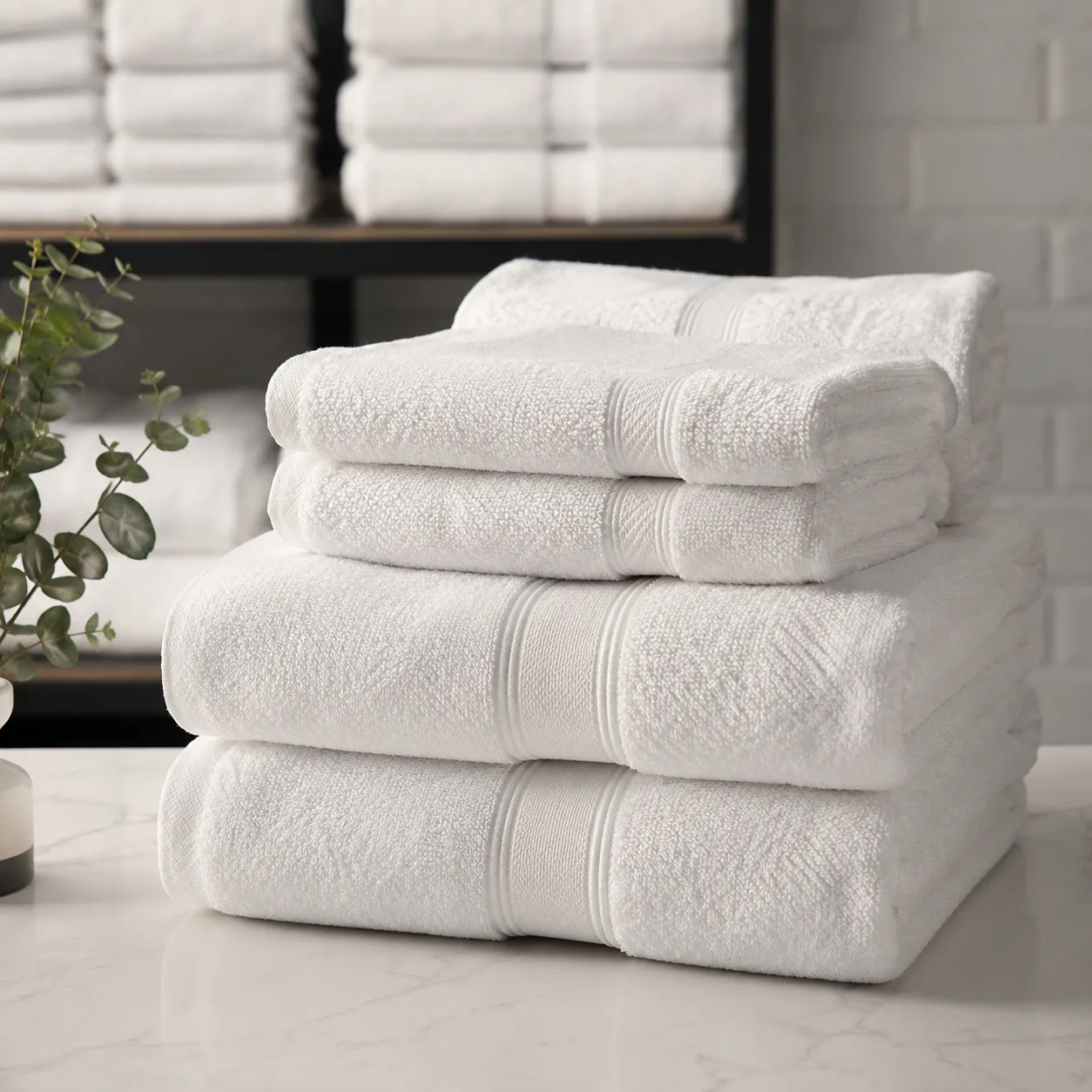
Start with the Laundry Reality
For hospitality buyers, the towel is not judged once. It is judged after repeated tunnel washing, extract pressure, tumble heat, folding, guest use, and housekeeping carts. A bath towel that feels impressive at unpacking can lose 8-12% dimensional stability, develop hard hand feel, or show border puckering if the yarn, weave density, and finishing route are not matched to hotel laundry conditions.
At our mill, we separate retail-style luxury from operational luxury. Retail luxury can tolerate slow drying and decorative borders. Hotel luxury needs absorbency, loft recovery, consistent whiteness, and enough edge strength to survive industrial washing. We usually design hospitality bath towels around 550-720 GSM, depending on the property tier and laundry setup.
- Boutique hotels: 600-680 GSM, softer hand, medium-high pile, clean dobby border.
- Urban business hotels: 520-600 GSM, faster drying, stronger hem priority.
- Resort suites: 650-750 GSM, larger bath sheet options, higher visual loft.
- Serviced apartments: 500-580 GSM, tighter cost-per-use target, quick turnaround laundry.
- Spa-adjacent rooms: 620-700 GSM, low-lint finish and softener control to protect absorbency.
Hotel Style Luxury Bath Towels Specification Map
The phrase hotel style luxury bath towels can mean very different products in buyer briefs. We ask buyers to define the target room category, laundry method, expected replacement cycle, and whether the towel is for in-room bath use, spa use, or retail sale. Those answers change the GSM and yarn choice more than the word “luxury” does.
| Spec Item | Practical Range | Factory Comment |
|---|---|---|
| Bath towel size | 70×140 cm, 76×152 cm, 80×160 cm | 76×152 cm is common for upscale hotel programs needing more wrap coverage. |
| GSM | 550-720 GSM | Above 720 GSM can feel impressive but slows drying and raises laundry cost. |
| Yarn | 21s/2, 16s/1, 32s/2, zero twist blends | Combed ring-spun cotton gives better strength than open-end yarn. |
| Pile construction | Single loop or double-ply terry | Long loops create loft but need tighter ground yarn control to reduce pulls. |
| Hem | 2.0-3.0 cm lockstitch or chain stitch | Wider hems reduce edge curl after repeated tumble drying. |
| Border | Dobby, plain, or low-profile logo jacquard | Heavy decorative borders can shrink differently from terry fields. |
For buyers comparing luxury cotton bath towels, the first mistake is ordering by GSM only. GSM measures mass per square meter, not cotton grade, loop height, twist level, or finishing chemistry. A dense 600 GSM towel can feel firmer than a more open 560 GSM towel if the pile yarn twist is high and the finishing line uses minimal softening.
Yarn Choice Changes the Guest Feel
We produce hotel bath towels mainly in combed cotton, carded cotton, zero twist cotton, and cotton-rich blended constructions. For most hotel groups, combed cotton is the safest starting point because short fibers are removed before spinning, reducing lint and improving pile strength. Carded cotton lowers cost, but it is more likely to shed in the first 5-8 washes.
Zero twist towels create a plush hand because the pile yarn is wrapped during processing and then relaxed, leaving a more open fiber bundle. The tradeoff is lower abrasion resistance and more careful laundry requirements. If a property uses high-alkali detergent, aggressive extraction, or over-drying, zero twist can flatten faster than a well-built combed cotton towel.
| Construction | Best Use | Risk to Watch |
|---|---|---|
| Combed ring-spun cotton, 600-680 GSM | Five star hotel towels and boutique rooms | Slightly higher yarn cost but stable laundry performance. |
| Carded cotton, 500-580 GSM | Budget hotel or serviced apartment programs | More lint and rougher hand after repeated washing. |
| Zero twist cotton, 620-720 GSM | VIP suites, retail hotel shop towels | Needs controlled tumble temperature and gentler detergent. |
| Cotton/poly ground with cotton pile | High-turnover institutional laundries | Less natural hand feel, but good dimensional control. |
One construction quirk matters here: the ground yarn does not touch the guest the way pile yarn does, but it controls the towel’s skeleton. If buyers push us to use a softer but weaker ground yarn to save weight, the towel may show skewing, side seam waviness, or corner distortion after laundering. We prefer to keep ground stability firm and adjust softness through pile yarn and finishing.
Do Not Over-Spec GSM Without Checking Dry Time
A thicker towel is not automatically a better hotel towel. If housekeeping turns rooms quickly, dry time can become a bigger operating cost than the towel purchase price. A 76×152 cm towel at 680 GSM weighs about 786 g before normal finishing tolerance. After washing, the water retained during extraction can increase dryer load significantly if the laundry has older equipment.
For wholesale hotel bath towels, we often run a balance between guest perception and laundry efficiency. A towel in the 600-640 GSM range can still feel full if the pile height is controlled and the finishing process opens the loops properly. Jumping from 620 GSM to 740 GSM may add 18-22% fabric weight, but it rarely gives the same percentage improvement in guest satisfaction.
| Hotel Positioning | Recommended GSM | Typical Size | Why We Use It |
|---|---|---|---|
| Upscale business hotel | 560-620 GSM | 70×140 or 75×150 cm | Good hand feel with manageable dry time. |
| Luxury resort room | 620-700 GSM | 76×152 cm | Fuller appearance on open shelving and guest beds. |
| Spa suite or villa | 680-750 GSM | 80×160 cm | High loft, but laundry cost must be approved first. |
| Long-stay apartment hotel | 500-570 GSM | 70×140 cm | Lower replacement cost and faster wash rotation. |
If a towel cannot return to the room dry, square, and presentable within the laundry cycle, it is not a luxury towel for hotel operations.
Edges, Borders, and the Failure Modes Guests Notice
Guests rarely know GSM, but they notice curled hems, loose threads, gray tone, and thin-feeling centers. In our QC records, the most common early complaints on hospitality bath towels are not dramatic fabric failures. They are hem unraveling, dobby border puckering, pile pulls near the side seam, and uneven whiteness after the first industrial wash.
Dobby borders need special control because the border section and terry field shrink differently. If the border is too dense, the towel can form a shallow wave after drying. If it is too loose, the border looks cheap and can distort during folding. We normally keep border height between 4 and 8 cm for hotel bath towels, with a low-profile weave that does not trap too much moisture.
- Hem unraveling: usually caused by weak sewing thread, low stitch density, or poor back-tacking at corners.
- Pile pulls: often start from long loops snagging on laundry carts, zippers, or rough shelving.
- Border puckering: caused by different shrinkage between the dobby zone and terry body.
- Gray cast: usually from poor optical brightener control, hard water, or mixing towel lots in laundry.
- Hard hand feel: often linked to detergent residue, excessive softener, or over-drying.
For embroidery or woven logo work, we keep decoration away from high-abrasion fold lines when possible. A logo placed too close to the bottom border may look good in a sample photo but become stiff and raised after repeated pressing. For more on decoration selection, buyers can compare embroidery, sublimation, and jacquard or review monogrammed bath towel placement.
Testing Before Bulk Approval
We do not recommend approving plush bath towels from hand feel alone. Before bulk production, we test shrinkage, absorbency, colorfastness if dyed, lint behavior, and seam strength. For white hotel programs, whiteness consistency and optical brightener control are also checked lot by lot, because mixed shades are very visible on open housekeeping shelves.
- Measure dimensional change after washing using ISO 5077 with a defined hotel-laundry wash route.
- Check colorfastness to domestic and commercial laundering under ISO 105-C06 when dyed towels are used.
- Run absorbency by timed water drop or sink test after removing excess finishing softener.
- Inspect hem slippage and corner back-tacking after tumble drying.
- Weigh finished towels against agreed tolerance, normally ±5% unless the buyer requires tighter control.
For larger orders, we also cut random samples from bulk after finishing and run a 10-wash internal check. We look for side seam torque, border wave, pile lint on the dryer screen, and any sour odor from incomplete drying. These are factory-floor checks, not brochure language, but they prevent many claims.
Our certifications include OEKO-TEX Standard 100 Class I, BSCI, and ISO 9001. OEKO-TEX matters when towels touch skin repeatedly; ISO 9001 matters because towel quality is process control, not just final inspection. Buyers who need help reading certificate scope can use our guide on how to read an OEKO-TEX certificate.
Pricing Bands and Cost-Per-Use
Pricing depends on cotton market, size, GSM, yarn, border, packing, and decoration. As a working reference, hotel style luxury bath towels in white combed cotton usually sit between USD 4.10 and USD 8.70 per piece FOB China for OEM orders. Larger sizes, zero twist yarn, woven logo borders, and individual retail bands push the price upward.
| Order Volume | Typical FOB Price | Spec Assumption |
|---|---|---|
| 500-999 pcs | USD 5.90-8.70/pc | 600-700 GSM combed cotton, custom label, standard carton. |
| 1,000-2,999 pcs | USD 5.10-7.60/pc | Better yarn purchasing efficiency and lower setup cost per unit. |
| 3,000-7,999 pcs | USD 4.55-6.80/pc | Stable dyeing or whitening lot, efficient weaving schedule. |
| 8,000+ pcs | USD 4.10-6.25/pc | Best suited for hotel group replenishment or multi-property rollout. |
Here is a realistic cost-per-use view. Suppose a 76×152 cm, 640 GSM combed cotton towel costs USD 5.85 and survives 95 guest-ready laundry cycles before being downgraded to staff or pool use. The textile cost is about USD 0.062 per use. A cheaper 520 GSM carded towel at USD 3.95 may look attractive, but if it is downgraded after 48 cycles, the textile cost is USD 0.082 per use, before counting extra lint handling and guest complaints.
This is why we push back when a buyer asks for a five-star look at a budget towel construction. We can reduce cost by adjusting size, border, packing, or label method, but cutting yarn quality and hem strength usually moves cost from procurement to operations.
MOQ, Sampling, and Production Timing
Our MOQ is 500 pcs per design per color. For plain white hotel towels, buyers often start at 500-1,000 pcs to confirm laundry behavior, then place replenishment orders by property or room count. For dyed towels, MOQ discipline is more important because small dye lots can create shade variation between orders.
- Tech pack review: 1-2 working days if size, GSM, yarn, logo, and packing are clear.
- Sample weaving or closest-stock sample: 5-9 days for plain white, 9-14 days for custom border or yarn changes.
- Lab dip for dyed towels: 4-7 days, with Pantone or physical swatch reference.
- Bulk production: 24-38 days after sample approval and deposit for most hotel programs.
- Final inspection and packing: 2-4 days depending on carton marking and assortment rules.
Ocean freight planning should not be left to the final week. Towels are bulky even when compressed, and bath sheets fill cartons quickly. A 20-foot container can carry far fewer 700 GSM bath sheets than 500 GSM hand towels, so freight cost per piece must be calculated before purchase approval. For freight planning, see container vs air freight for towel orders.
How to Brief the Mill Correctly
A good brief prevents the wrong sample. If a buyer only says “make it like a luxury hotel towel,” the mill has to guess the actual target. We prefer a simple but complete specification that tells us the business use, not only the visual preference.
- Property type: resort, business hotel, serviced apartment, spa suite, or retail hotel shop.
- Target size and weight: finished dimensions, GSM, and acceptable weight tolerance.
- Laundry route: in-house laundry, outsourced industrial laundry, bleach use, dryer temperature, and cycle target.
- Decoration: woven border, embroidery, label, hanger loop, or no visible branding.
- Packing: bulk carton, room-set packing, barcode bag, or retail belly band.
- Compliance: OEKO-TEX, BSCI, ISO 9001 documentation, and any buyer-specific chemical list.
If your team is still building the document, our towel tech pack guide is a useful starting point. For GSM decisions, compare your room tier against the framework in how to choose towel GSM. If the program includes face towels, hand towels, bath towels, and bath mats, the hotel towel sourcing guide gives a broader set-planning view.
What We Recommend for Most Hotels
For most upscale hospitality buyers, we recommend starting with 620-660 GSM combed cotton bath towels, 76×152 cm finished size, 2.5 cm reinforced hems, and a low-profile dobby border. That specification gives a clear luxury signal without creating the laundry burden of very heavy bath sheets. For larger suites, an 80×160 cm bath sheet can be added as a separate line rather than making every room towel oversized.
Hotel style luxury bath towels should be judged by their second month in service, not by the first sample touch. Ask for GSM, yarn, shrinkage data, wash test assumptions, edge construction, and carton weight. Those details decide whether the towel remains guest-ready or becomes an expensive rag too early.
Related reads: compare supplier evaluation points in hotel towels wholesale supplier guide, review cotton behavior in combed vs zero twist cotton, and check full program timing in setting up a hotel linen program.
Build a Hotel Towel Spec That Survives Laundry
Send us your target size, GSM, room tier, laundry process, and annual volume. Our MOQ is 500 pcs per design per color, and we can quote OEM hotel towels with OEKO-TEX 100 Class I, BSCI, and ISO 9001 documentation. WhatsApp: +86 13384590853. Email: [email protected].
Request a hotel towel quote →